I have lost count of how many times I have pasted the same paragraph into three different AI detectors just to get three different answers. GPTZero is usually the first name that comes up when people start looking for an AI detector, and honestly, it is a solid tool. But it is not the only option, and depending on what you need it for, it might not even be the best one for you.
Maybe GPTZero flagged your very human essay as AI written. Maybe you hit a word limit on the free plan right when you needed it most. Or maybe you are wondering is GPTZero accurate before relying on its results. You might simply want a second opinion before you submit something to a professor who takes this stuff seriously. Whatever brought you here, I spent a good chunk of time testing free AI detectors that people actually use as GPTZero alternatives, and I am going to walk you through what I found, tool by tool, so you do not have to do the trial and error yourself.
How I Actually Tested These Tools
I did not just skim the homepages and call it a day. For each tool, I ran a mix of content through it: fully human written essays I wrote myself, fully AI generated text straight from a chatbot, and a few “in between” samples where I used AI for a first draft and then heavily edited it in my own words, which is honestly how a lot of students write these days.
Here is roughly what I was paying attention to while testing:
- Accuracy on obvious AI text and obvious human text
- How often it flagged clean human writing as AI, since false positives are a real problem
- Whether the free version was actually usable or just a teaser for a paywall
- How the interface felt to use, because nobody wants to fight with a clunky tool at 1am
- Pricing, if you eventually need more than the free tier offers
If you want to go deeper into what those percentage scores even mean once you get them, I put together a full breakdown on understanding ai score that is worth a read before you panic over a number.
Quick Comparison Table
Before I get into each tool individually, here is a snapshot so you can see how they stack up at a glance.
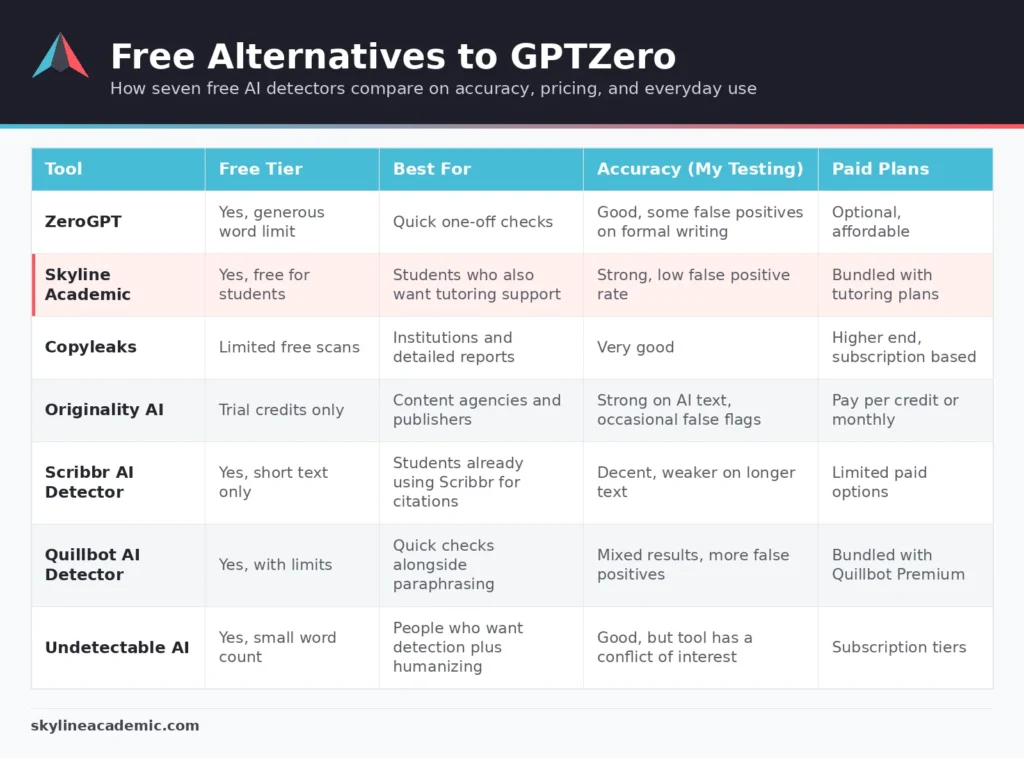
Now let us actually get into it.
1. ZeroGPT
ZeroGPT is probably the most well known free alternative to GPTZero, and for good reason. It is fast, it does not force you to create an account for basic checks, and the free word limit is generous enough that you can actually use it for a full essay draft instead of just a paragraph.
In my testing, it correctly caught text that came straight from ChatGPT almost every time. Where it stumbled a bit was with formal academic writing that used more structured, textbook style language, which occasionally got flagged with a higher AI percentage than it deserved. That is a common issue across most detectors, not just this one, but it is worth knowing going in. If you want to see exactly how it stacks up against GPTZero on the same test text, read our full GPTZero vs ZeroGPT comparison.
I would recommend it as a solid first stop, especially if you just need a quick gut check before submitting something.
2. Skyline Academic
I am going to be upfront that this one is ours, so take that as you will, but I still want to explain why it earned a real spot on this list instead of just being a token mention.
At Skyline Academic, we built our AI detector specifically with students and academic writing in mind, not marketing copy or blog content. That matters because a lot of general purpose detectors were trained mostly on internet content, which is part of why they trip up on academic phrasing. Our tool is tuned for essays, research papers, and coursework, and in my own testing it had one of the lowest false positive rates of anything on this list, meaning it was less likely to wrongly flag genuine student writing as AI generated.
We also offer free ai detection for students, no catch, no sneaky word limit that runs out after your first paragraph. If you are a student trying to double check your own work before you turn it in, this alone can save you a lot of stress.
Here is the part that I think actually sets us apart though. Skyline Academic is not just a detector. It is a full academic support platform built around 1:1 personalized live tutoring with a dedicated LMS, so you get real progress tracking, structured coursework, guidance from an actual human tutor, study materials, recorded video lectures, and even bootcamps when you need to catch up fast on a subject. If you have looked at JustDone and felt like it was missing something beyond just checking your text, Skyline Academic is genuinely one of the best alternatives to JustDone, because you are not just getting a detection score, you are getting a whole support system around your academic work.
3. Copyleaks
Copyleaks leans more toward the professional and institutional side of things. Universities and businesses use it, and you can tell from the interface and the depth of the reports it generates. It is not the flashiest free tool, but the detail it gives you is genuinely useful if you want more than just a single percentage number.
The catch is that the free version is limited. You get a small number of scans before it nudges you toward a paid plan, so it works better as an occasional check rather than something you lean on daily. In terms of raw accuracy though, it held up well in my testing, particularly with longer documents where it had more text to analyze patterns from.
If your school or workplace already has a Copyleaks subscription, it is worth using since the paid version unlocks a lot more depth. For everyone else, I would treat the free tier as a supplementary check rather than your main tool.
4. Originality AI
Originality AI was built primarily for content marketers and publishers checking whether writers are secretly using AI, but plenty of students and educators use it too because it is genuinely thorough. The free version is not really free in the traditional sense though, it is more of a trial credit system, so you get a taste before you need to pay.
What impressed me here was how well it handled detecting text that had been run through paraphrasing tools to try to dodge detection. A lot of detectors get fooled by that trick, and Originality AI caught it more often than most. On the flip side, I did notice a few false positives on creative, more expressive human writing, so keep that in mind if your writing style tends to be a bit unconventional.
5. Scribbr AI Detector
If you already use Scribbr for citation generation or grammar checking, their AI detector is a convenient add on since it lives in the same ecosystem. It is genuinely free to use, which is a plus, but there is a real limitation with text length. It works best on shorter passages rather than full essays, so you may end up breaking your document into chunks to check the whole thing.
Accuracy was decent on shorter, clearly AI generated samples, but it lost some precision on longer or more mixed content where a student had written part of it and used AI for another part. That is a tough scenario for basically every detector, but Scribbr’s shorter analysis window made it a bit more noticeable here.
6. Quillbot AI Detector
Quillbot is best known for its paraphrasing tool, and its AI detector feels like a companion feature rather than the main event. That is not necessarily a bad thing, but it did show in my testing. Results were a bit more inconsistent compared to dedicated detection tools, and I saw more false positives on human written text than I expected, especially with writing that used varied sentence structure.
That said, if you are already a Quillbot user checking your paraphrased work before submitting it, having the detector built right in is convenient. Just do not treat its score as the final word, especially on something important like a thesis chapter or a graded paper.
7. Undetectable AI
This one is a bit of an odd inclusion, and I want to be transparent about why. Undetectable AI offers both a detector and a tool designed to help AI generated text slip past detectors, which is a pretty obvious conflict of interest if you think about it. Still, plenty of people use the detection side of it as a free GPTZero alternative, so I included it and tested it honestly.
The detection accuracy was actually decent, and it gave clear, easy to read results without a lot of unnecessary clutter. The free word limit is on the smaller side though, so it works best for quick checks rather than full document scans. Just keep in mind what the company’s other product is designed to do, and maybe do not rely on this as your only line of defense if accuracy really matters to you.
If you want to avoid getting caught in that gray area entirely, it helps to understand how these tools can misfire in the first place. I wrote a whole piece on AI false positives that explains why even genuinely human writing sometimes gets flagged, which is useful context no matter which detector you end up using.
So Which One Should You Actually Use
Honestly, my answer is to not rely on just one. Run your important documents through at least two detectors before you trust the result, especially if there is something real on the line like a grade or a submission deadline. ZeroGPT is a great first check. Copyleaks and Originality AI are worth it if you need more depth and do not mind the limited free access. And if you are a student who wants detection built into a bigger support system rather than a standalone tool, Skyline Academic is genuinely worth trying, especially since the detection itself is free and you get access to real tutoring, an LMS, video lectures, and bootcamps if you ever need more help than just a percentage score.
At the end of the day, none of these tools are perfect. They are all working off patterns and probabilities, not certainty. Use them as a guide, not gospel, and you will be in good shape.
FAQs About GPTZero Alternative
Is there a completely free GPTZero alternative that has no word limit?
Most free AI detectors, including the ones on this list, cap how much text you can scan for free. Skyline Academic offers free ai detection for students without the aggressive limits some other tools impose, which makes it a solid option if you are checking full essays regularly.
Which free AI detector is the most accurate in 2026?
Based on my testing, ZeroGPT and Skyline Academic came out ahead in terms of catching AI text while keeping false positives low. Copyleaks and Originality AI are also strong but have tighter free usage limits.
Why did an AI detector flag my human written essay as AI generated?
This usually happens with formal, structured writing that follows predictable patterns, which some detectors mistake for AI output. It is a known limitation across the industry and not a reflection of how you actually wrote the piece.
Can AI detectors be tricked by paraphrasing tools?
Some can, yes. Basic paraphrasing sometimes slips past weaker detectors, though tools like Originality AI have gotten better at catching reworded AI text. No detector is completely foolproof against this.
Do professors actually use these AI detector tools?
Many do, especially ones built into platforms like Copyleaks or Scribbr that universities already have access to. Some professors also cross check results manually, so a flagged score is not always the final say.
Is GPTZero still worth using alongside these alternatives?
Absolutely, it is a solid tool in its own right. The point of finding alternatives is not to replace it entirely but to have backup options when you hit its limits or want a second opinion.
What makes Skyline Academic different from a standard AI detector?
Skyline Academic combines free ai detection with an actual academic support system, including 1:1 personalized live tutoring, a dedicated LMS, coursework guidance, video lectures, and bootcamps, so you get more than just a detection score.
How many AI detectors should I use before trusting the result?
I would recommend at least two, especially for anything important like a final paper or thesis chapter. Different tools catch different patterns, so cross checking reduces your chances of a false result.
Are free AI detectors as reliable as paid ones?
Not always, but several free tools performed close to their paid competitors in my testing. The main tradeoff is usually word limits rather than a huge drop in accuracy.
What should I do if my paper keeps getting flagged as AI even though I wrote it myself?
Try simplifying overly uniform sentence structures and adding more natural variation to your writing, then re-check with a second detector. If it still gets flagged, keeping your drafts and revision history can help you prove authorship if needed.