Last updated:
I have tested enough AI detectors to know that they can behave like an overconfident classmate who gives an answer before fully understanding the question. Sometimes they are impressively accurate. Other times, they look at completely human writing and confidently announce, “Yes, a robot definitely wrote this.”
So, is Copyleaks AI Detector accurate?
To find out, I personally tested it with five different samples: two fully AI-generated passages, two fully human-written passages, and one sample containing a mixture of human and AI writing. I also read Reddit discussions and Trustpilot reviews to see whether my results matched other users’ experiences.
My testing produced a mixed but interesting result. Copyleaks correctly identified both AI samples and both human samples. However, it labelled the mixed human and AI sample as 100 percent AI-generated, which was much more confident than the sample’s actual authorship justified.
That does not make Copyleaks useless. It does mean you should understand the accuracy of AI detectors before treating any percentage as proof that a student has used ChatGPT.
Is Copyleaks AI Detector Accurate? My Quick Answer
Mostly, on clear-cut text. It got 4 of my 5 tests right, but scored a mixed human and AI passage as 100% AI. Use it as a screening signal, never as proof.
- Test 1Fully AI-written100% AI
- Test 2Fully AI-written100% AI
- Test 3Mixed AI and human100% AI
- Test 4Fully human-written0% AI
- Test 5Fully human-written0% AI
Five short samples, so this is a practical check, not a benchmark. An independent 2026 study found no false positives from Copyleaks on human essays, but it missed much of the AI text.
Copyleaks was accurate in four of my five broad test cases. It correctly gave both fully AI-generated samples a 100 percent AI score, and it correctly gave both human-written samples a 0 percent AI score.
The problem appeared when I tested mixed authorship. My passage contained both human and AI-written content, yet Copyleaks classified the entire sample as 100 percent AI. That suggests Copyleaks may work well when the difference is clear but can be overly definite when human and AI writing are blended.
Copyleaks advertises 99 percent accuracy and a .03 percent false positive rate on its AI detector features page, and says it can identify AI content even when it is mixed with human writing. Its testing methodology describes internal tests run separately by its data science and quality assurance teams, most recently on model V11 in September 2026. Those are the company’s own results, however, and they should not be confused with my small practical test or with universal accuracy across every writing style.
My verdict is that Copyleaks is useful as a screening tool, but its result should be treated as an estimate, not a final judgement about authorship.
What Is the Copyleaks AI Detector?
Copyleaks is an online content-authenticity platform offering AI detection and plagiarism checking. Its AI detector analyses submitted text and estimates how much of that text may have been generated by an AI model.
According to Copyleaks, the detector supports more than 30 languages and is designed to recognise writing associated with systems such as ChatGPT, Gemini and Claude. The company also offers browser, Google Docs, API and learning management system integrations, making it relevant to individual writers as well as schools and organisations.
| Feature | Details |
|---|---|
| Free use | Scan up to 25,000 characters without logging in; a free account adds more monthly scan credits |
| Languages | More than 30, according to Copyleaks |
| AI models | Copyleaks says it detects ChatGPT, Gemini, Claude, DeepSeek and newer models |
| Sensitivity settings | Three levels: Extra Safe, Balanced (default) and Extra Sensitive |
| AI Logic | Explains why text was flagged; a paid feature |
| Integrations | Canvas, D2L, Moodle, Blackboard, Schoology, Edsby and Sakai; Chrome and Edge extension; Google Docs add-on; API |
| Plagiarism | Offered as a separate plagiarism checker on the same platform |
| Privacy | Copyleaks cites GDPR compliance and SOC 2 and SOC 3 certification |
Checked October 2026 against Copyleaks AI Detector features page and its testing methodology. Limits and plans change, so confirm before you rely on them.
The free web interface is simple. You paste your content into the text box, run the scan, and receive an estimated AI percentage. In my tests, Copyleaks also displayed the number of phrases it believed appeared more frequently in AI writing than in human writing.
Copyleaks explains that its system examines numerous writing patterns. These include phrase-frequency ratios, grammar and syntax, syllable distribution, and other linguistic signals. The company’s newer “AI Logic” feature is intended to provide additional context about why certain content has been flagged.
That sounds sophisticated, but the result still needs careful interpretation. An AI detector does not watch someone write a document. It does not have access to the writer’s thoughts, research process, browser history or document drafts. It evaluates patterns in the final text and compares those patterns with what its model has learned.
This is why understanding the truth behind AI detection scores matters. A score is a model’s classification of the submitted text, not a recording of who typed each sentence.
It is also important not to confuse AI detection with plagiarism detection. AI detection estimates whether writing resembles machine-generated text. Plagiarism detection searches for similarities between the submitted content and existing sources. A student can write original AI-generated content with no plagiarism matches, while a human-written paper can contain copied passages. Students who are checking source overlap rather than AI patterns can use a separate free plagiarism check.
How I Tested the Copyleaks AI Detector
I wanted this Copyleaks AI Detector review to include more than a description of its features, so I conducted five practical tests.
The samples were divided into three categories:
- Two passages were fully AI-generated.
- One passage combined human and AI-written content.
- Two passages were fully human-written.
I submitted each passage through the same public Copyleaks interface and recorded the displayed percentage. I did not repeatedly edit a sample until I obtained the result I wanted. The purpose was to observe how the detector handled straightforward AI writing, human writing and mixed authorship.
This is a small hands-on test, not a scientific benchmark. Five passages cannot represent every academic subject, language background, AI model, editing method or document length. The results show what happened with these specific samples at the time of testing.
They do not prove that Copyleaks has an 80 percent accuracy rate simply because four out of five classifications were broadly reasonable. A proper accuracy study would require a much larger labelled dataset, consistent testing conditions and metrics that separately measure false positives and false negatives.
My Copyleaks AI Detector Test Results
Test 1: Copyleaks Correctly Flagged Fully AI-Generated Content
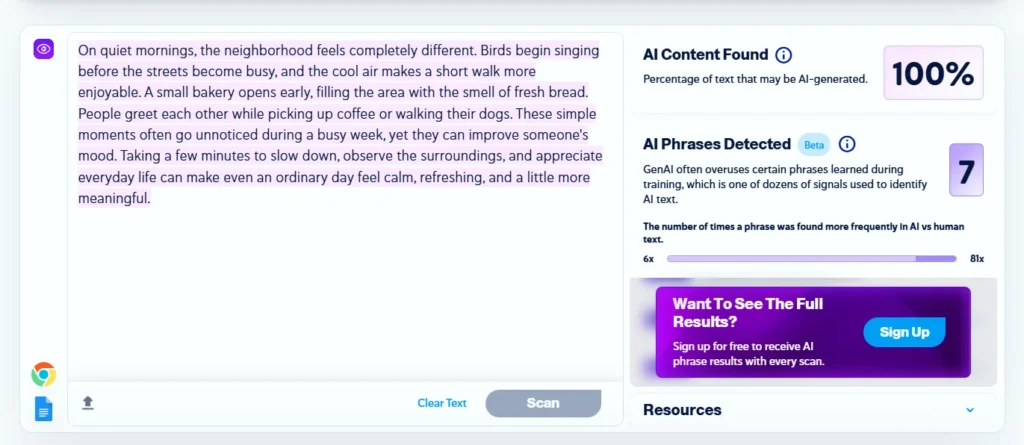
My first sample was fully generated by AI and described an ordinary morning neighbourhood scene. Copyleaks classified it as 100 percent AI-generated and identified seven AI-associated phrases. For this test, the detector reached the expected conclusion without hesitation. The passage did contain polished transitions, evenly structured sentences and a generally smooth rhythm, which may have contributed to the result. Still, one correct detection only shows that Copyleaks recognised this particular sample, not that it will identify every piece of AI-generated writing.
Test 2: A Second AI Sample Also Received a 100 Percent Score
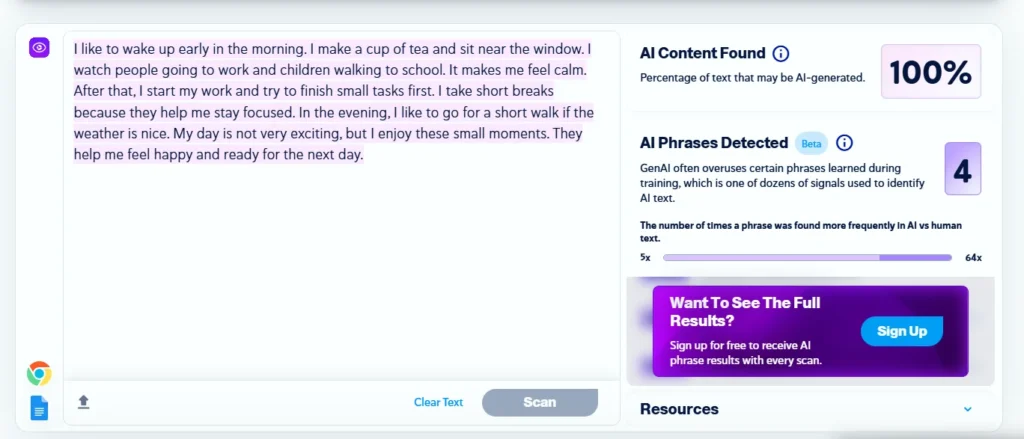
I used another fully AI-generated passage for the second test, this time about a simple morning routine. Copyleaks again returned a 100 percent AI result, although it detected four AI-associated phrases rather than seven. Repeating the correct result across a second sample increased my confidence that the tool could recognise clear, unedited AI writing of this kind. However, both AI passages were relatively short and followed simple narrative structures. More technical, heavily edited or deliberately personalised AI content could produce a different outcome.
Test 3: Copyleaks Labelled Mixed Human and AI Writing as 100 Percent AI
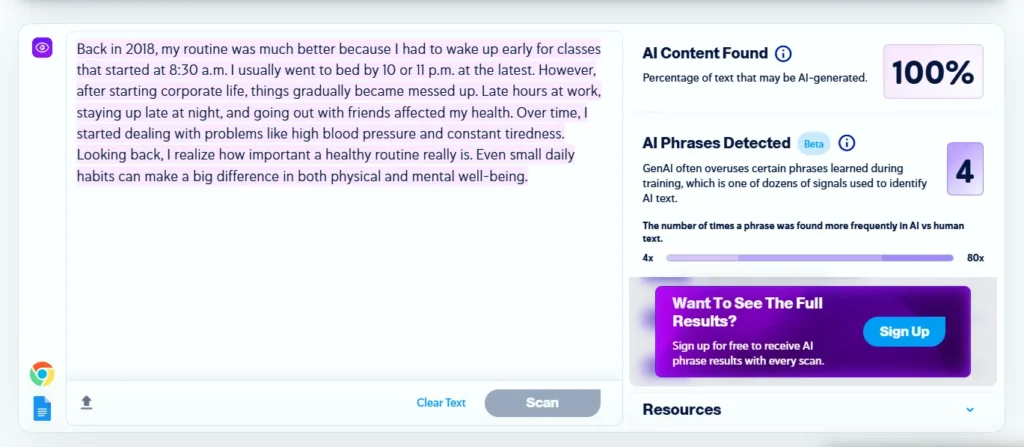
This was the most revealing part of my test. The passage contained a mixture of human and AI-written content, but Copyleaks labelled it 100 percent AI and highlighted four AI-associated phrases. The result was not completely wrong because AI text was present, but the percentage did not communicate the mixed authorship accurately. A reader seeing “100 percent AI” would reasonably assume that the entire passage had been generated by a machine. This shows how a broadly correct warning can still become misleading when the displayed level of certainty is too absolute.
Test 4: Copyleaks Correctly Recognised the First Human-Written Sample
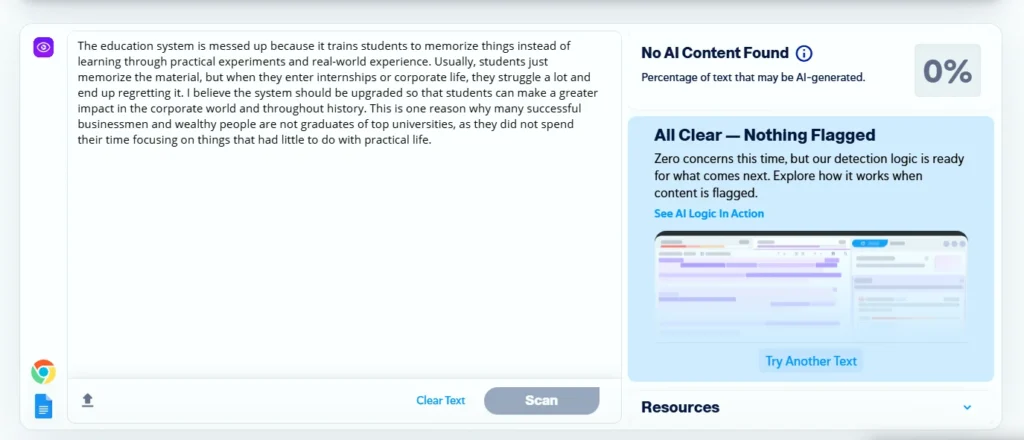
My fourth sample was written entirely by a human and contained an opinion about education, university training and practical experience. Copyleaks returned a 0 percent AI score and displayed “No AI Content Found.” That was the correct classification, even though the sample used fairly formal academic language and several long sentences. This result is reassuring for students worried that every polished paragraph will automatically be flagged. However, the Trustpilot and Reddit screenshots examined later show that other users say they have received very different results on their own original writing.
Test 5: The Second Human Sample Also Passed as Human
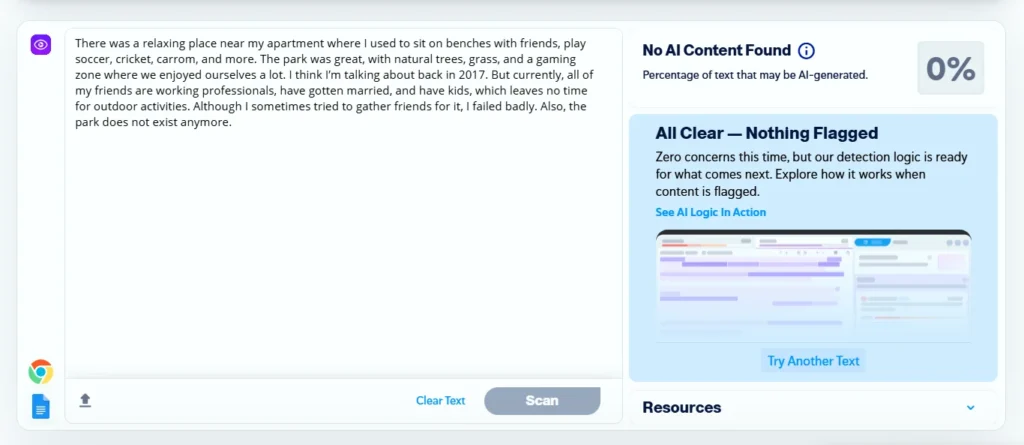
The final sample was a personal reflection about a local park, friendships and changes over time. Copyleaks again gave the text a 0 percent AI score, correctly recognising it as human-written. The personal details and uneven, natural sentence construction may have helped distinguish it from the smoother AI samples. Getting two correct human classifications matters because false positives are the most concerning errors in high-stakes academic situations. Even so, two successful passages cannot establish that Copyleaks will consistently protect every student from being wrongly flagged.
Summary of My Copyleaks Test Results
| Test | Known source | Copyleaks result | Verdict |
|---|---|---|---|
| Test 1 | Fully AI-written | 100% AI (7 AI phrases) | Correct |
| Test 2 | Fully AI-written | 100% AI (4 AI phrases) | Correct |
| Test 3 | Mixed AI and human | 100% AI (4 AI phrases) | Overstated |
| Test 4 | Fully human-written (formal) | 0% AI | Correct |
| Test 5 | Fully human-written (personal) | 0% AI | Correct |
Green: correct. Amber: AI was present, but the score ignored the human part. Five short samples, so this is a practical check, not a benchmark.
What My Five Tests Actually Showed
Copyleaks performed very well on clear-cut content. Both fully AI-generated passages received 100 percent AI scores, while both fully human passages received 0 percent.
The detector struggled to represent the sample sitting between those two extremes. It recognised that AI writing was present in the mixed passage, but it did not communicate that human writing was present too.
This distinction is important. AI detection is not always a simple yes-or-no question anymore. A student may use an AI tool to brainstorm, correct grammar, organise headings or refine a few sentences while writing most of the assignment independently. Another student may paste an entire generated response into a document with almost no personal contribution. Those are very different situations, even if a detector identifies AI-related patterns in both.
Copyleaks states that its percentage represents the amount of submitted text determined to be AI-generated and that it can identify interspersed human and AI text. In my mixed test, the displayed 100 percent result did not reflect that distinction successfully.
The latest independent evidence is also more complicated than a single marketing percentage. A June 2026 study in the International Journal for Educational Integrity compared Copyleaks, Turnitin, GPTZero and Pangram on 160 documents: fully human, fully AI, hybrid and humanised AI. Copyleaks did not falsely flag any of the 40 human-written documents. However, it missed 75 percent of the fully AI-written documents entirely, and reached only 30 percent accuracy on hybrid texts and 22.5 percent on humanised AI. Only Pangram performed consistently on the AI-involved categories. The authors concluded that detectors could provide initial flags but should not be the sole evidence in high-stakes decisions.
My small test produced the opposite kind of mixed-text problem, with Copyleaks overestimating rather than underestimating the AI share. Together, these findings show why real performance depends heavily on the exact material being tested.
How Accurate Is Copyleaks AI Detector in Real Academic Use?
Real academic writing is far messier than a clean laboratory category marked “human” or “AI.”
A university assignment may include quotations, citations, standard definitions, technical terminology and expressions that hundreds of students have used before. Scientific writing often values consistency and precision, while reflective writing encourages personal voice. A detector must interpret all these genres without observing how the document was actually created.
This creates several challenges.
A short passage gives the model fewer language patterns to assess. A long report may contain sections written at different times or edited by multiple people. Group assignments can combine several human writing styles. References, headings and repeated terminology can introduce predictable phrases. Grammar tools may change the rhythm of otherwise human-written sentences.
Research has repeatedly shown that detector performance varies with text type and writing conditions. A February 2026 study of Turnitin and Originality, rather than Copyleaks, found that both tools had considerable difficulty classifying hybrid texts. Their performance also changed with text length and genre, with scientific writing proving more difficult than humanities content.
A separate 2023 study found that several GPT detectors disproportionately misclassified writing by non-native English speakers. That research did not establish that every detector, or Copyleaks specifically, will always show the same bias. It does demonstrate why institutions should test tools carefully before applying their results to multilingual student populations.
Academic writing can also sound “AI-like” for perfectly legitimate reasons. Students are taught to use clear topic sentences, formal transitions and structured conclusions. They may repeat important terminology because replacing a precise technical term with a fancy synonym would reduce accuracy.
This is why a student should never be expected to make good academic writing deliberately awkward merely to satisfy a detector.
Students who want to learn more about AI false positives should understand that a suspicious score is the beginning of an investigation, not the end. The relevant questions include how the assignment was produced, what the university policy permits, whether drafts exist and whether the student can explain the argument.
The same principle applies when asking can Turnitin detect AI. Detector brands differ, but no percentage can reconstruct an entire writing process by itself.
Why Does Copyleaks Say Everything Is AI?
The phrase “Copyleaks says everything is AI” appears frequently in user discussions, but my own test did not support that statement literally. Copyleaks correctly recognised both of my fully human-written samples.
Still, the complaints deserve attention. Several Trustpilot and Reddit users say their original writing received very high AI scores. There are several possible explanations for this, although nobody outside Copyleaks can confirm exactly why an individual passage receives a particular result.
Predictable sentence patterns
AI systems often produce sentences with balanced structures, clear transitions and consistent grammar. Human writers can naturally use the same patterns, especially in formal assignments.
A paragraph may contain phrases such as “This demonstrates that,” “It is important to consider,” or “In conclusion.” These expressions are not owned by AI. They are common academic constructions, but their predictability may contribute to an AI-like statistical profile.
Limited text length
Short passages contain less information for a detector to analyse. One ordinary sentence may resemble thousands of human examples and thousands of AI outputs at the same time.
Copyleaks notes that its detector is intended for essay-style writing and does not support songs and poems. This illustrates an important point: a model’s reliability depends partly on whether the submitted content resembles the material it was designed to evaluate.
Heavily polished language
Grammar tools, professional proofreading and repeated editing can make human writing more regular. Ironically, the student who carefully removes every clumsy sentence may end up with prose that looks more statistically predictable.
This does not mean students should avoid editing. It means educators should avoid treating stylistic regularity as proof of misconduct.
Generic academic introductions
Many students begin assignments by defining the topic, describing its importance and previewing the discussion. AI tools often do the same. A detector may therefore encounter patterns strongly associated with AI even though a human student followed a familiar essay structure independently.
Learning about understanding the difference between human and AI writing can help students and teachers see why the boundary is not always obvious.
Mixed or AI-assisted editing
A student may write a paragraph and then use software to improve grammar or clarity. Depending on how extensively the tool rewrites the passage, the final result may contain AI-associated language even though the ideas and initial draft were human.
Copyleaks itself warns that platforms integrating generative features, including some functions within Grammarly, can result in writing being flagged as possible AI content.
The percentage looks more certain than the evidence feels
A result such as 100 percent appears definitive. Most readers interpret it as “every part of this document was certainly generated by AI.”
In reality, it is the output of a classification system. Even when the model has strong confidence, the percentage should be considered alongside the highlighted passages, document type and writing history.
That gap between mathematical-looking output and real-world uncertainty is one reason people conclude that Copyleaks says everything is AI.
Copyleaks AI Detection False Positives
A false positive occurs when a detector classifies human-written content as AI-generated.
A false negative is the reverse. The detector identifies AI-generated writing as human.
There is also a third category that receives less attention: a partly correct but misleading result. My mixed sample fits here. Copyleaks correctly recognised AI content, so the result was not a complete false positive. However, the 100 percent score did not represent the human contribution.
What Is Copyleaks’ False Positive Rate?
Copyleaks publishes two different figures. Its features page advertises a .03 percent false positive rate, while its September 2026 testing methodology for model V11 reports 0.30 percent at the default Balanced setting, 0.16 percent on Extra Safe and 0.66 percent on Extra Sensitive. Neither page explains the difference, and both figures come from Copyleaks’ own English-language test sets.
Even 0.30 percent matters at scale. A university scanning 10,000 genuinely human essays at that rate could expect about 30 to be wrongly flagged. Independent testing is more encouraging here: the June 2026 study found no false positives from Copyleaks on 40 human-written documents, although it missed much of the AI-written text.
| Source | What it reports | Who measured it |
|---|---|---|
| Copyleaks features page | “99% accuracy” and a “.03% false positive rate” | Copyleaks (marketing claim) |
| Copyleaks methodology, model V11 (Sept 2026) | Default “Balanced” setting: 0.30% false positives, 0.64% false negatives. Extra Safe: 0.16% / 0.88%. Extra Sensitive: 0.66% / 0.49%. | Copyleaks (internal English test sets) |
| Independent study, June 2026 | 0 of 40 human-written documents falsely flagged | University researchers (Van Vlasselaer et al.) |
| Same study, AI documents | Fully AI-written: 75% missed entirely. Hybrid: 30% accuracy. Humanised AI: 22.5% accuracy. | University researchers |
| My 5-sample test | 0 of 2 human samples flagged; mixed sample scored 100% AI | Skyline Academic |
Sources: Copyleaks features page, Copyleaks testing methodology, International Journal for Educational Integrity (2026). Company figures come from Copyleaks’ own test data.
False positives are especially serious in education because the cost is not limited to an incorrect percentage. A student may face stress, delayed grading, a misconduct investigation or damage to their relationship with an instructor.
Independent research has found substantial variation among detectors. A major 2023 evaluation of 14 detection systems concluded that the tools tested were neither consistently accurate nor reliable, and that attempts to modify AI-generated material worsened performance. Detector technology has improved since then, but the study remains a useful warning against assuming that automated classification is infallible.
Turnitin’s own guidance openly states that its assessment may misclassify both human and AI writing and should not be used as the sole basis for adverse action against a student. It also suppresses precise scores below 20 percent because false positives are more likely in that range. That policy applies to Turnitin rather than Copyleaks, but it reflects a sensible principle for AI detection generally.
Students should also understand that an AI score and a Turnitin similarity score measure different things. A high similarity percentage may come from quoted or referenced material, while an AI result estimates writing origin. Neither number should be interpreted without opening the complete report.
If your own writing is flagged, preserve evidence of your process:
- Initial outlines and research questions
- Notes taken from books, lectures and articles
- Document version history
- Earlier drafts
- Source records and citation-manager entries
- Tutor or supervisor feedback
- Timestamps from cloud storage
- Comments showing how the argument developed
These records do not guarantee that an institution will dismiss a concern, but they provide far more meaningful evidence than simply running the document through five more detectors and hoping they agree.
What Trustpilot Reviews Say About Copyleaks
Trustpilot reviews provide useful insight into customer experiences, but they are not controlled accuracy studies. Reviewers choose their own samples, describe events from memory and may leave out relevant information. Positive and negative reviews should therefore be treated as individual experiences rather than scientific proof.
The reviews I examined include both satisfied customers and users reporting serious concerns about detection reliability, subscriptions and customer service.
Copyleaks’ Trustpilot Rating Shows a Divided User Experience
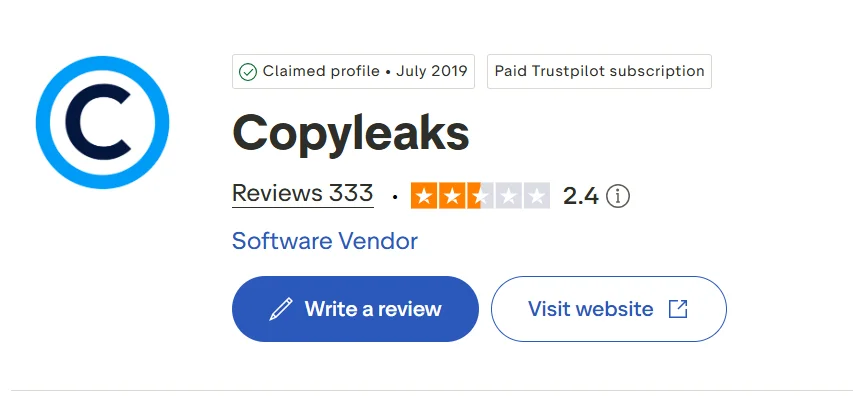
When I checked in July 2026, Copyleaks had 333 Trustpilot reviews and an overall rating of 2.4 out of 5. The score may change as new reviews are added. A rating at this level indicates that a meaningful number of customers reported dissatisfaction, but it does not tell us whether every complaint related specifically to AI accuracy. The individual screenshots show concerns ranging from false detections to billing and support, alongside several users who found the service useful.
Positive Copyleaks Trustpilot Reviews
Some Users Consider Copyleaks Useful for Basic AI Detection
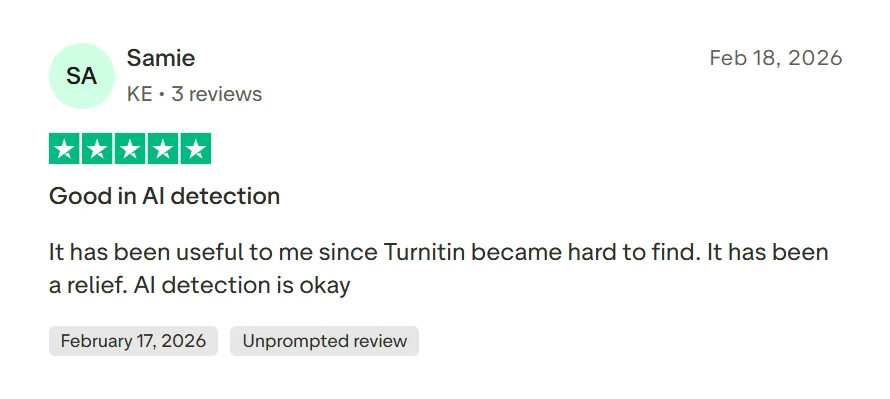
This reviewer described Copyleaks as helpful after Turnitin became difficult for them to access and rated the service five stars. The written feedback was brief, stating that the AI detection was satisfactory rather than providing detailed testing examples. It shows that some users value having an accessible tool that can act as an alternative when institutional software is unavailable. However, the review does not reveal what types of documents were checked or how the reviewer confirmed the accuracy of the results. I would treat it as positive user sentiment, not independent validation.
A Reviewer Praised Copyleaks for Clear AI and Plagiarism Reports
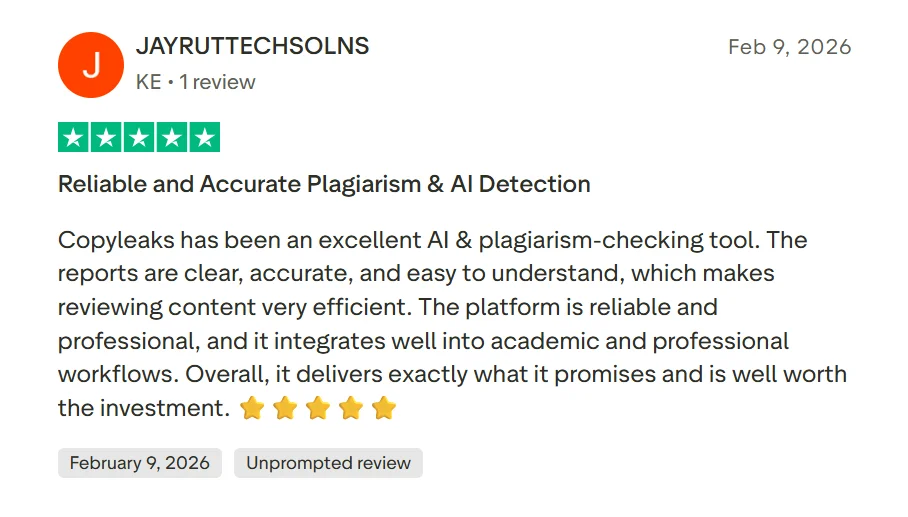
This reviewer gave Copyleaks five stars and praised both its AI and plagiarism-checking functions. They described the reports as clear, understandable and efficient for academic and professional workflows. That is useful feedback because report clarity matters almost as much as the percentage itself. A tool that shows context and highlighted sections can support better human review than one that produces a score with no explanation. Even so, this remains one customer’s favourable experience and does not establish that the detector will perform equally well on all academic content.
One Reviewer Viewed Copyleaks as a Tool for Supporting Honest Work
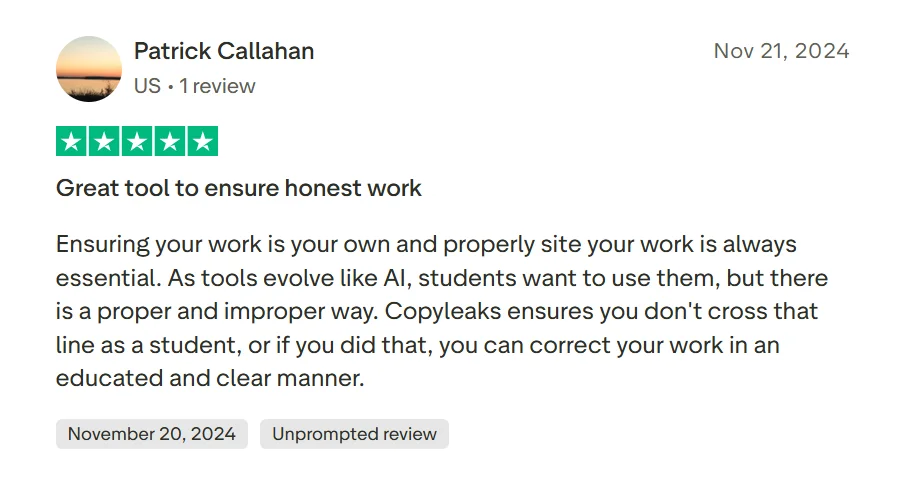
The reviewer presented Copyleaks as a way to help students check whether their work crosses a line between proper and improper AI use. Their comments focus more on academic honesty and responsible writing than on measured detector accuracy. That reflects a constructive use case: a detector may encourage a student to review how much automated assistance has shaped the final submission. However, the result must still be interpreted under the institution’s own policy. A detector can raise a question, but it cannot decide by itself whether a student’s use of technology was permitted.
A User Found Copyleaks Simple for Identifying AI Content
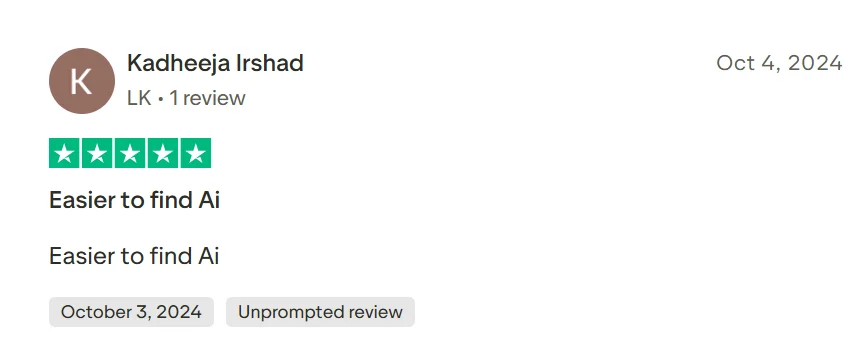
This five-star review simply states that Copyleaks made AI content easier to identify. The comment is positive but extremely short, so there is little information about the reviewer’s testing process or the type of content involved. It may reflect satisfaction with the interface and convenience rather than a carefully measured accuracy rate. Short reviews still contribute to overall sentiment, but they should carry less evidential weight than documented tests with known human and AI samples. It is encouraging feedback, though not enough to answer how reliable Copyleaks is for student essays.
Another Reviewer Said Copyleaks Successfully Detected AI Writing
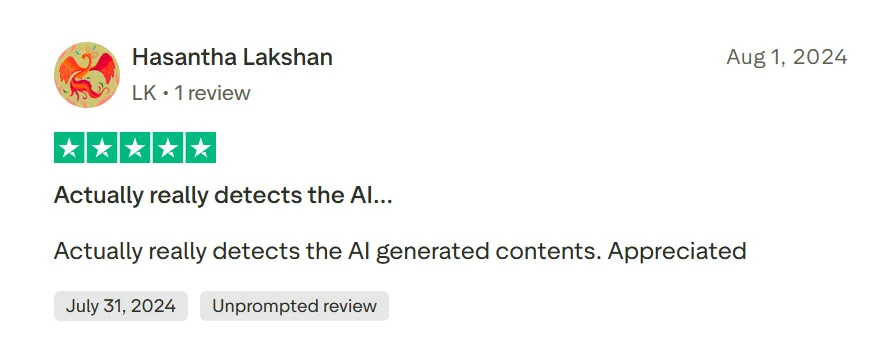
This reviewer appreciated that Copyleaks appeared to detect AI-generated material successfully. Their comment supports what I saw in my first two tests, where unedited AI passages were correctly given 100 percent scores. The limitation is that the review does not explain whether the user also tested human writing, mixed text or edited AI content. Detecting obvious AI output is only one part of detector performance. A reliable academic system must also avoid falsely accusing human writers and communicate uncertainty when content has mixed origins.
Negative Copyleaks Trustpilot Reviews and Common Complaints
A Student Said Five Hours of Original Writing Was Flagged as AI
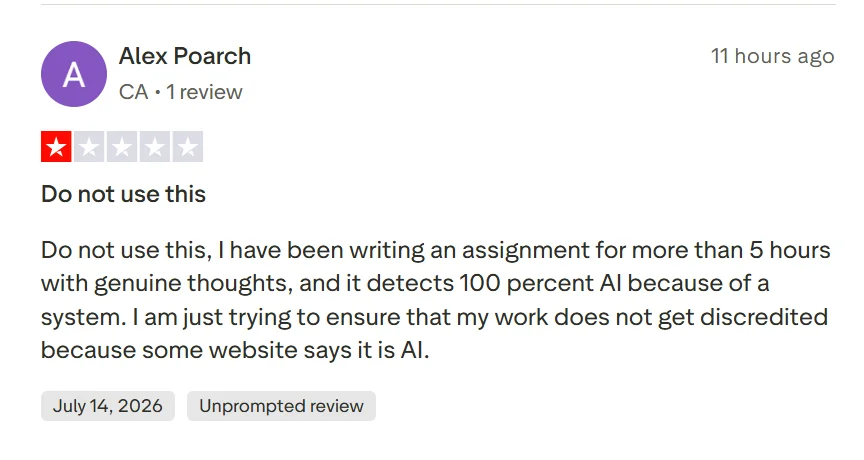
The reviewer claimed that an assignment they had written independently over more than five hours received a 100 percent AI result. Their main concern was not merely the score but the risk that original work could be discredited because an automated service labelled it as machine-generated. There is no way to independently verify the authorship of the document from this screenshot alone. Still, the account captures the emotional and academic cost of a possible false positive. It also shows why students need access to the complete evidence and an opportunity to explain their writing process.
One Reviewer Reported Repeated 100 Percent AI Scores on Original Work
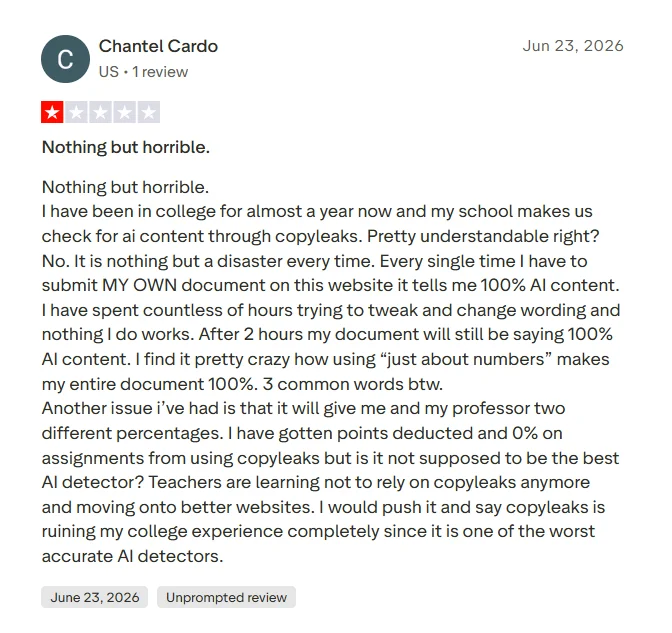
This student described repeatedly submitting original college documents and receiving 100 percent AI classifications. They also claimed that changing only small elements, including numbers, could cause an entire document to receive a different result. The reviewer said instructors at their institution were beginning to question reliance on the tool, although that statement cannot be verified from the screenshot. The experience, as described, suggests inconsistency rather than a single accidental result. It also illustrates the frustration created when students feel forced to change honest writing without understanding what triggered the score.
A Customer Complained About Subscription and Customer-Service Problems
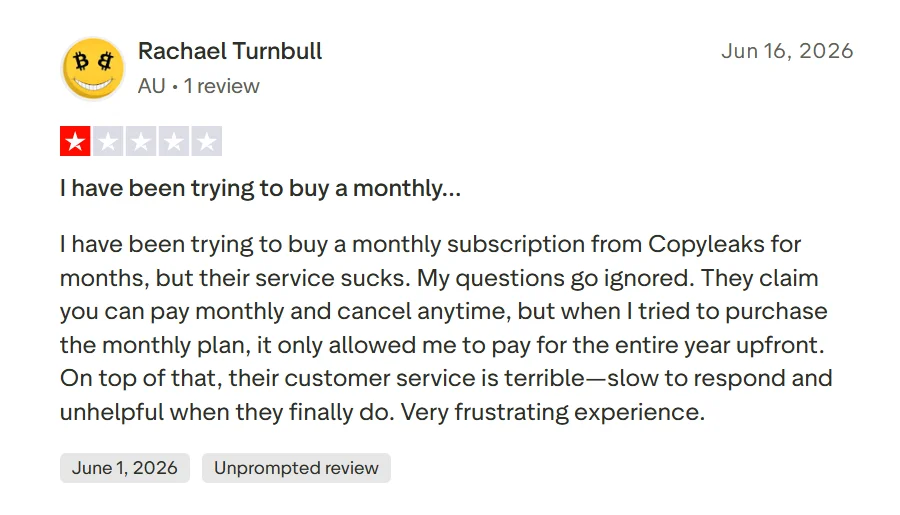
Not every negative Copyleaks review concerns AI detection. This customer described difficulty purchasing the monthly plan and said the checkout process appeared to require a larger upfront payment than expected. They also reported slow or unhelpful responses from customer service. I cannot confirm the account details or whether the pricing page was interpreted correctly, but the review raises a separate usability issue. A technically strong detector can still leave customers dissatisfied if subscription terms are unclear or help is difficult to obtain when something goes wrong.
A Reviewer Questioned How a Newly Written Sentence Could Be Flagged as AI
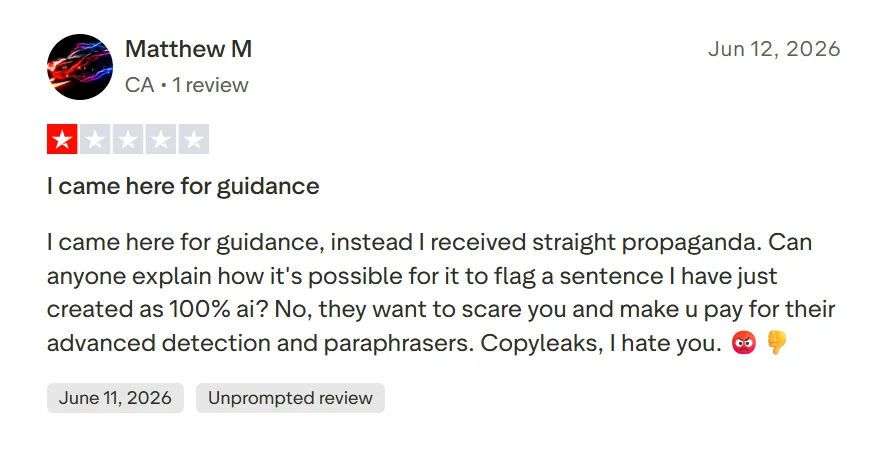
This reviewer said a sentence they had just created was flagged as 100 percent AI and questioned how that result was possible. A single sentence can be particularly difficult to classify because there is very little linguistic evidence available. Many ordinary sentences could plausibly be written by either a person or a language model. The reviewer interpreted the result as pressure to purchase more advanced features, but the screenshot does not provide evidence that the score was deliberately connected to an upgrade attempt. The more defensible conclusion is that highly confident classification of very short text deserves caution.
Another Student Said Copyleaks Made Frequent Detection Mistakes
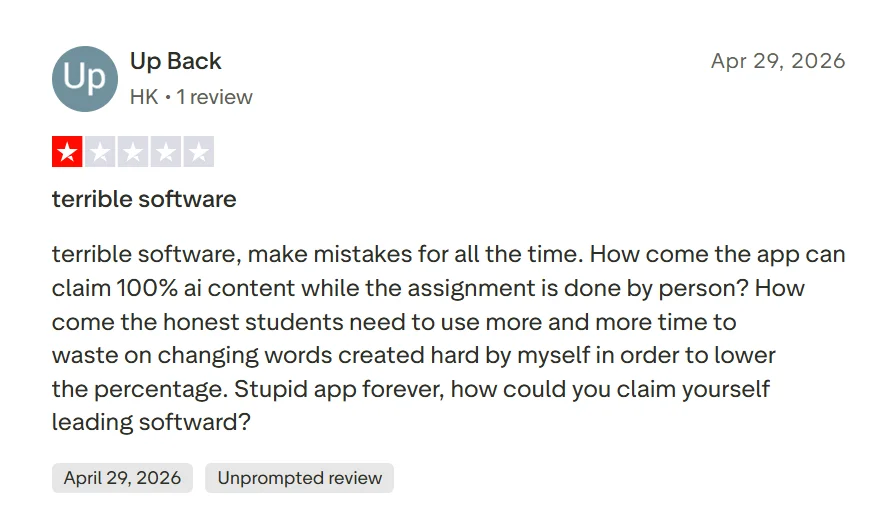
The reviewer claimed that human-written assignments regularly received 100 percent AI scores and said honest students were being pushed to change their wording. Their frustration centres on a basic fairness problem: students may begin optimising their language for a detector rather than writing as clearly and accurately as possible. The screenshot cannot confirm whether every document was fully human-authored, so the allegations should not be treated as established fact. However, the concern is consistent with a broader principle supported by research: detector output must be reviewed alongside other evidence rather than accepted automatically.
Older Human Writing Was Reportedly Classified as AI
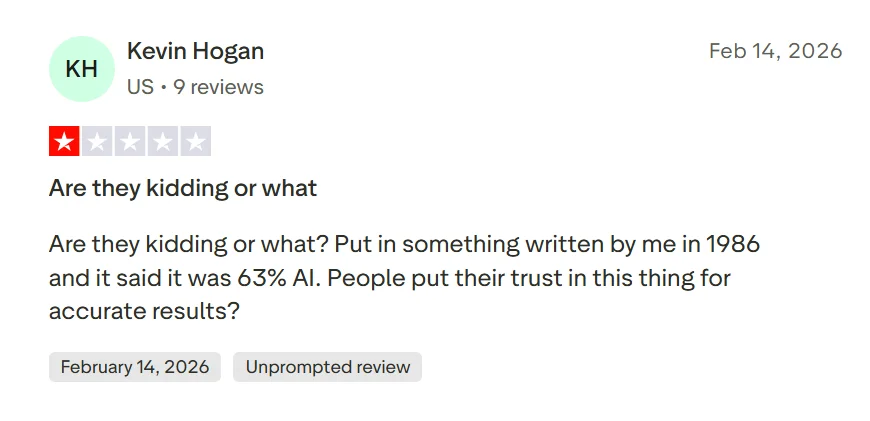
This reviewer claimed that material they wrote in 1986 received a 63 percent AI score. If the document truly remained unchanged since that year, it would be a compelling example of a false positive because modern generative AI was not available to produce it. The screenshot alone cannot verify the document’s date, content or editing history. Still, testing pre-AI writing is a reasonable way to examine false-positive behaviour when provenance is reliable. Results like this also remind users that detectors classify language patterns, not the historical circumstances in which the words were created.
A Reviewer Warned That False Positives Could Affect Students
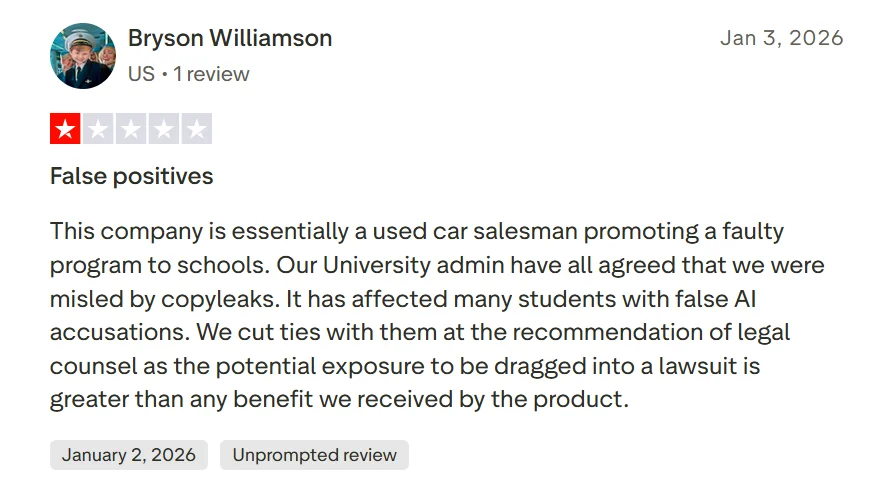
This reviewer alleged that students at their university had faced false AI accusations and used very strong language about the company. Those wider claims cannot be independently confirmed from a customer review, and legal conclusions should not be drawn from the screenshot. The underlying concern, however, is legitimate: a false positive can become much more damaging when an institution treats the detector as decisive evidence. Universities need clear appeals processes, trained reviewers and policies that distinguish an automated warning from proof of misconduct. The review is most useful as an illustration of perceived institutional harm.
One User Said Their Informal Writing Was Mistaken for AI
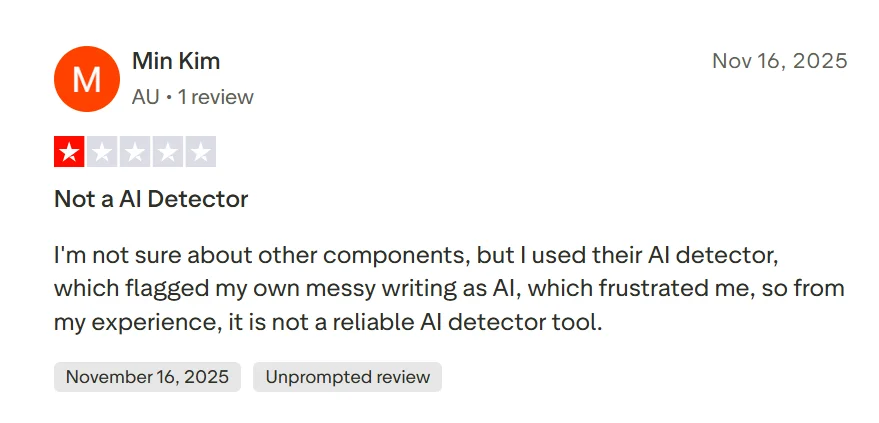
This reviewer said their own informal or messy writing was classified as AI, leading them to consider the detector unreliable. The comment is interesting because AI false-positive discussions often focus on polished, formulaic academic language. If informal writing is also flagged, the cause may involve patterns beyond grammar quality alone. We do not have the original passage or report, so I cannot evaluate whether the classification was reasonable. The review nevertheless reinforces the need to inspect the exact highlighted text instead of assuming that either formal or casual style is automatically safe from detection.
A Reviewer Claimed Copyleaks Had Become More Aggressive Over Time
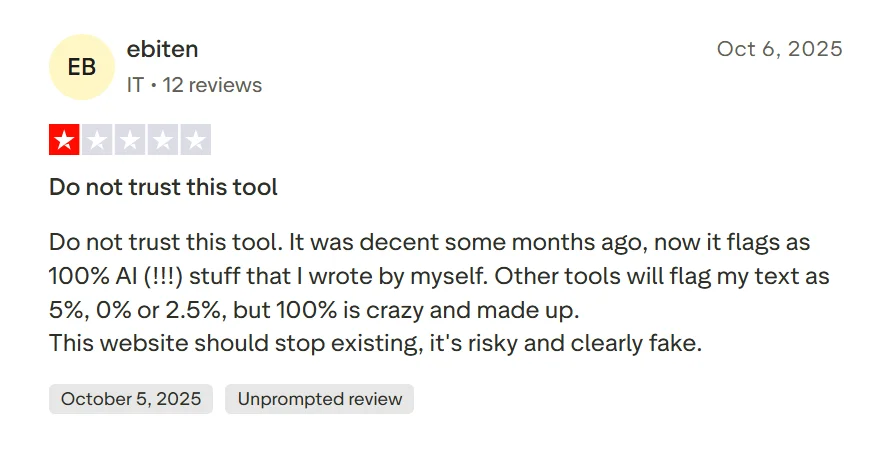
This customer claimed that Copyleaks had previously produced more moderate results but had begun labelling their original writing as 100 percent AI. Detector models are updated over time, and Copyleaks’ methodology page identifies the version and date of its own tests. However, this review does not provide controlled before-and-after samples showing that an update caused the change. It does show why reproducibility matters. If the same writing receives substantially different classifications as models change, institutions should record the detector version and scan date whenever a result is used in an academic process.
One Customer Said Detection Could Be Changed Through Small Edits
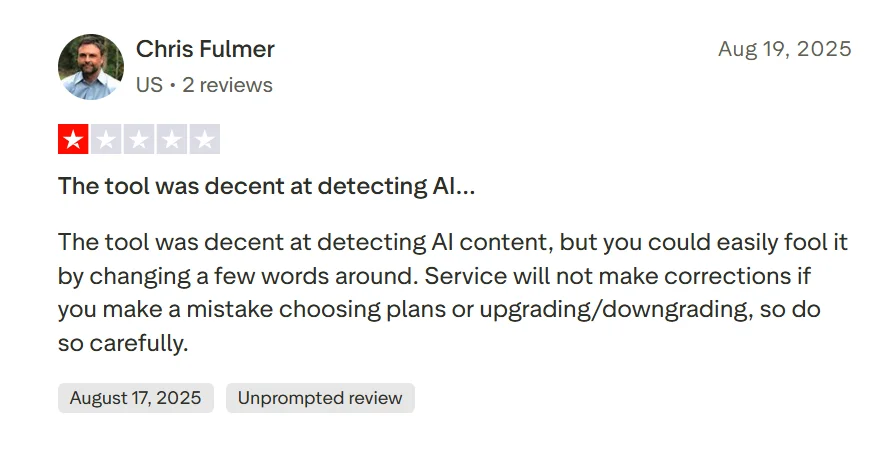
This reviewer initially described the tool as reasonably effective but claimed that changing a few words could alter the detection result. They also reported difficulty correcting subscription choices and moving between plans. Small textual changes can affect machine-learning classifications, especially when a sample is near the model’s decision boundary. That does not necessarily mean the detector can always be defeated with a few edits, but it raises questions about result stability. The service-related complaint is separate and suggests that customers should read plan and cancellation terms carefully before purchasing.
The Main Patterns in the Negative Trustpilot Reviews
The most common complaint in the negative reviews I examined is that human-written material allegedly received high or even 100 percent AI scores. Several reviewers also reported that relatively small edits changed the classification, which made the results feel unstable.
Other complaints concerned subscriptions, plan changes and slow customer support. These issues do not tell us whether the underlying AI model is accurate, but they influence the overall customer experience and help explain the low overall Trustpilot rating.
These reviews should not be treated as a representative sample of every Copyleaks customer. People with negative experiences may be more motivated to post publicly, while satisfied institutional users may never leave consumer reviews. At the same time, it would be unwise to dismiss repeated false-positive concerns merely because they appear on a review platform.
What Reddit Users Say About Copyleaks AI Detection
Reddit can reveal recurring user concerns in much more detail than a star rating. It can also contain exaggeration, missing context and unverifiable claims. I therefore use the following screenshots as anecdotal evidence of what some users report, not as a controlled accuracy test.
A Reddit User Said Their Own Paper Was Labelled 100 Percent AI
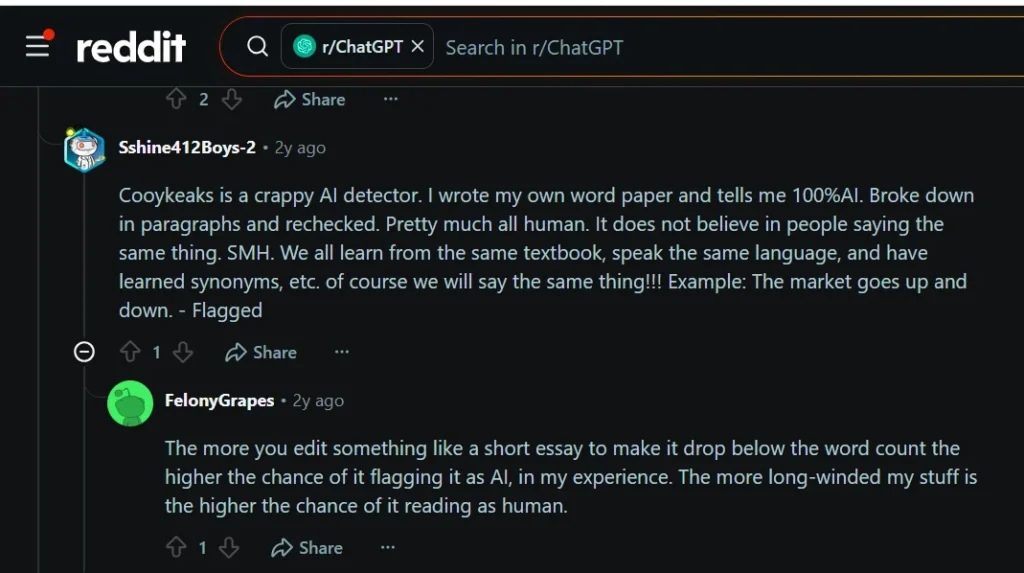
The original commenter said Copyleaks labelled their own paper as 100 percent AI, but that scanning separate paragraphs produced mostly human classifications. They argued that ordinary expressions and shared textbook language could be incorrectly treated as AI-like. Another commenter suggested that shortening or heavily editing an essay sometimes increased the chance of a flag in their experience. These claims were not supported by the original documents or repeatable test data. Even so, the discussion raises useful questions about sample length, paragraph segmentation and whether a whole-document score remains stable when the same text is divided.
One Reddit Comment Strongly Challenged Copyleaks’ Accuracy Claims
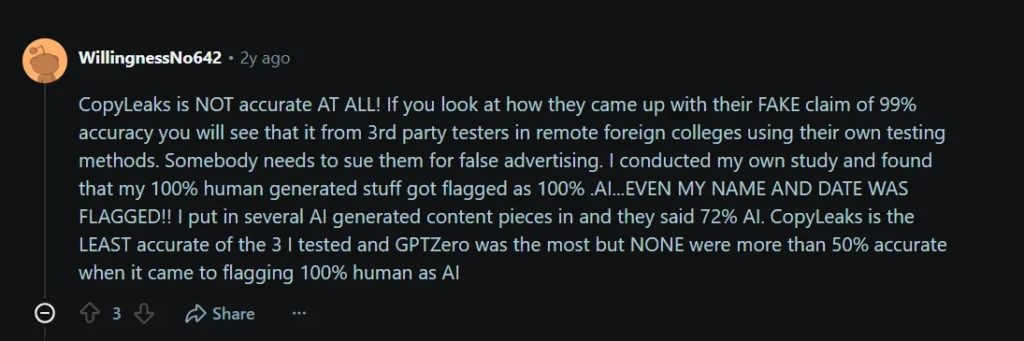
This commenter strongly rejected Copyleaks’ advertised accuracy and claimed that their own informal test produced several contradictory classifications. According to the post, fully human text was flagged as AI, while some AI-generated passages received lower scores. They also claimed that names and dates were highlighted. The language used is emotional, and the testing conditions are not documented, so the percentages cannot be independently assessed. However, the report demonstrates why company accuracy claims need context about datasets, thresholds, text lengths, models and the difference between internal and external evaluation.
A User Reported Different Results After Splitting the Same Paragraph
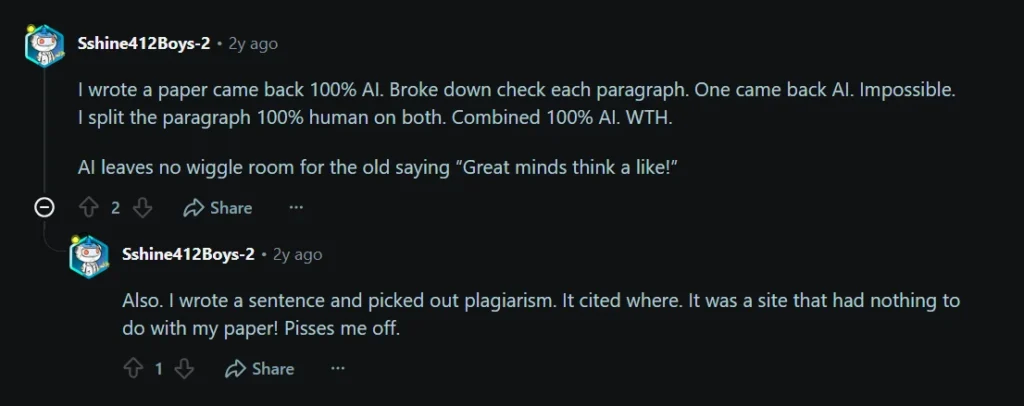
The user said a complete paper received a 100 percent AI result, while splitting the same paragraph into smaller pieces produced human classifications. They also described an unrelated plagiarism match for a sentence they believed was original. We cannot verify whether formatting alone caused the changes because the screenshots do not include the submitted reports. If identical wording does receive sharply different outcomes depending on segmentation, that would make the displayed percentage harder to interpret. It is another reason to use detector results as prompts for closer reading rather than as standalone proof.
Another Student Said Human Work Was Flagged While Partly AI Work Passed
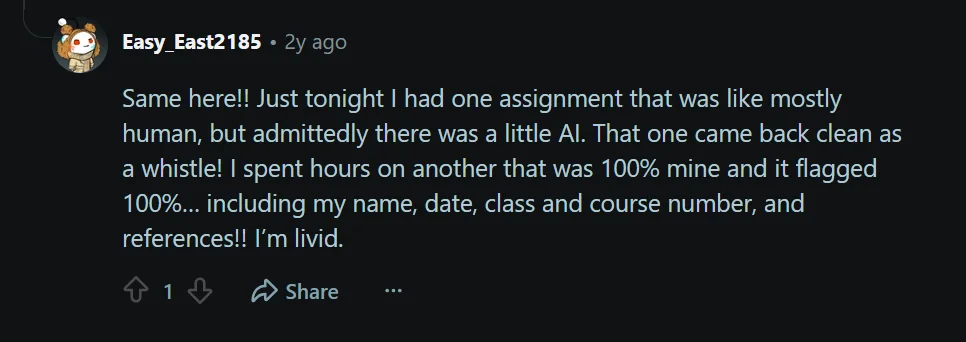
This student described two contrasting assignments. They claimed that a mostly human paper containing some AI material passed without a warning, while another assignment they wrote independently received a 100 percent AI result. The commenter also said names, dates, course details and references were included in the detected material. None of this can be confirmed without the original files, but the claimed pattern represents exactly what students fear: a false negative on AI-assisted work combined with a false positive on authentic writing. A reliable academic process must be prepared for both error types.
How Accurate Is Copyleaks AI Detector According to Reddit?
The Reddit comments I examined are predominantly negative. Users describe human papers receiving 100 percent AI scores, results changing when a document is split into paragraphs, and partly AI-assisted assignments being classified as human.
That does not prove that these experiences are common across all Copyleaks scans. Four comments are not a representative survey, and Reddit users are not required to supply original files or controlled testing procedures.
Still, the consistency of the themes matters. The users are not simply saying, “I dislike the colour of the dashboard.” They are questioning whether the tool distinguishes human, AI and mixed writing reliably enough for academic consequences.
My own mixed-content result gives part of that concern practical support. Copyleaks recognised the presence of AI but represented the sample as entirely AI-generated. Reddit users describe other forms of inconsistency, particularly when the same text is divided or when human and AI content coexist.
For broader explanations, read our guide to how AI detectors work and why they disagree, rather than relying on anonymous discussions alone.
Copyleaks Pros and Cons
- Correctly scored both fully AI samples at 100%
- Correctly scored both human samples at 0%
- Simple paste-and-scan checker, free without logging in
- Shows flagged phrases, with AI Logic on paid plans
- More than 30 languages, plus LMS, Google Docs and API options
- Scored my mixed sample as 100% AI
- A precise-looking percentage can overstate certainty
- Users report false positives and unstable scores
- Accuracy claims come from the company’s own tests
- Trustpilot reviews also cite billing and support problems
The strongest part of Copyleaks in my test was its performance on clear human and AI samples. It produced results quickly and made the overall classification easy to understand.
Its biggest weakness was confidence calibration. A mixed sample should ideally produce an output that helps the reader understand which sections seem AI-generated and which appear human. A 100 percent AI result did not do that effectively in my test.
Is Copyleaks a Good AI Detector for Students?
Copyleaks can be useful for students when it is treated as a second opinion.
For example, a student might scan a draft to see whether highly generic or heavily AI-assisted sections stand out. They can then review whether those sections accurately reflect their own understanding, comply with the assignment policy and include proper citations.
The wrong approach is to assume that every highlighted sentence must be rewritten until the score reaches zero. That can turn legitimate academic editing into a strange game where the detector, rather than the instructor or subject matter, becomes the audience.
Students should also avoid shopping around among detectors until one produces the answer they want. A 0 percent result from one service does not prove authorship, just as a 100 percent result from another does not prove misconduct.
Comparing results can still be informative when done responsibly. Reviews of the QuillBot AI Detector, ZeroGPT, StealthWriter AI and the JustDone AI review show that different tools may interpret the same writing differently.
The most reliable protection is evidence of your actual work: drafts, notes, reading records, feedback and the ability to explain what you wrote.
Is Copyleaks Reliable Enough for Teachers and Universities?
Copyleaks may be useful to educators as an initial screening signal, especially when it is integrated into a broader academic-integrity process. It should not be the entire process.
A teacher reviewing a high AI score should consider:
- Whether the highlighted passages differ noticeably from the student’s previous work
- Whether the student can explain the argument and evidence
- Whether drafts and version history support the student’s account
- Whether generative AI was prohibited, restricted or permitted with disclosure
- Whether grammar or translation software may have altered the language
- Whether quotations, references or standard terminology affected the report
- Whether the detector was tested on comparable assignments and student populations
The June 2026 comparative study offers a useful conclusion. Even though some tools performed better than others and false positives were rare in that particular dataset, the researchers still recommended using detection as part of a wider decision-making strategy rather than as sole evidence.
Universities should also record the date and model version associated with a result. Copyleaks’ own methodology page shows that the service updates its detection model and tests named versions. A score generated under one version may not be directly comparable with a score produced months later.
Human judgement is not automatically perfect either. Teachers can be influenced by assumptions about vocabulary, grammar or a student’s language background. A fair process should combine technology with transparent policies, evidence and an opportunity for the student to respond.
Copyleaks Compared With Other AI Detectors
No comparison table can identify one detector that will be best for every document. Tools differ in access, reporting style, intended users and the way they present uncertainty.
| Tool | Access | How results are shown |
|---|---|---|
| Copyleaks | Free public checker, plus paid and institutional plans | AI percentage with flagged phrases; AI Logic explanations on paid plans |
| Skyline Academic AI Detector | Free, built for students | AI percentage as a second opinion, with tutoring support available |
| QuillBot AI Detector | Free, with extra options for premium users | Sentence-level highlights with human, AI and AI-refined categories |
| ZeroGPT | Free access, with paid features | Document, paragraph and sentence-level analysis |
| Turnitin | Sold to institutions, not to individual students | Scores from 1% to 19% shown as an asterisk; exact score from 20% |
Access and features as described on each tool’s own pages, October 2026. No single detector is best for every document.
Copyleaks says its detector supports more than 30 languages and provides AI Logic information intended to explain flagged content. QuillBot’s official pages describe a free detector with sentence-level highlighting and categories for human, AI and AI-refined writing. ZeroGPT offers document, paragraph and sentence-level analysis, while Turnitin is sold to institutions rather than directly to individual students. We ran a similar five-sample test in our review of whether Scribbr’s AI detector is accurate.
Turnitin also handles low scores differently. Results between 1 and 19 percent are displayed as an asterisk rather than an exact percentage because false positives are considered more likely in that range. This does not make Turnitin automatically more accurate, but it is an example of communicating uncertainty rather than displaying a precise-looking number for every result.
The Best Copyleaks Alternative for Students
Students who cannot access institutional tools or want a second opinion can try the free AI detector for essays from Skyline Academic.
I would not claim that any public detector is universally perfect or that one scan can establish authorship. The practical advantage is accessibility. Students searching for the best alternatives to Copyleaks can review their essays without needing a university-managed account and compare the result with the feedback produced by another detector.
Skyline Academic also goes beyond automated checking. Students who are struggling with a subject, research task or assignment can use 1:1 Personalized Live Tutoring with subject-specific tutors.
The tutoring platform includes a personalised student portal for managing sessions, tutors and learning progress. Its live sessions support document sharing, video communication, annotation and virtual whiteboard collaboration. Students can receive coursework guidance, concept clarification, exam preparation, research support and feedback suited to their academic level.
That human support is important because an AI detector can tell you that a paragraph looks statistically unusual, but it cannot teach you the topic. A tutor can ask how you reached a conclusion, identify gaps in your reasoning and help you improve the work without taking ownership of it.
For students, the best alternative is therefore not merely “another percentage.” It is a combination of a second detection result, responsible academic guidance and evidence of an authentic writing process.
What to Do If Copyleaks Says Your Human Writing Is AI
First, do not panic. A high score is concerning, but it does not erase the work you completed.
Save a screenshot or PDF of the result, including the date and any highlighted passages. Do not immediately rewrite the entire paper because one website produced a surprising percentage.
Next, examine what was flagged. Is it a generic introduction? A definition? A quotation? A technical explanation that cannot be phrased in many different ways? Does the detector appear to include references, headings or names?
Check your university’s actual policy. Some institutions permit AI for brainstorming or grammar support but prohibit generated paragraphs. Others require disclosure. The relevant issue is not simply whether a detector found a pattern; it is whether your writing process complied with the stated rules.
Preserve your evidence. Version histories from Google Docs or Microsoft 365 can show how a document developed. Notes, outlines and source records may demonstrate that the ideas were researched and organised over time.
You can also compare the document with another detector, but treat that result cautiously. Two tools agreeing is more informative than one isolated score, yet it still does not prove authorship.
When speaking to an instructor, stay calm and specific. Explain:
- When you began the assignment
- How you researched it
- How the structure developed
- Which tools you used
- Whether you used grammar, translation or citation software
- What each major argument means
- Where your drafts and notes are stored
Students searching for how to avoid AI detection should approach the issue ethically. The goal should not be to disguise generated assignments or trick a detector. The sensible goal is to write independently, disclose permitted AI assistance, maintain evidence and reduce accidental false positives without damaging the quality of your work.
Do not deliberately insert mistakes, random slang or awkward sentences merely to obtain a lower score. Your assignment should be written for the reader and the assessment criteria, not for a machine classifier.
My Final Verdict: How Reliable Is Copyleaks AI Detector?
So, how good is Copyleaks AI Detector?
Based on my five tests, it was strong at identifying clear examples. Both unedited AI-generated passages received 100 percent AI scores, while both human-written passages received 0 percent. That is a better result than I expected after reading some of the harsh reviews.
The mixed sample exposed the main limitation. Copyleaks correctly detected that AI was present, but it classified the passage as 100 percent AI even though part of it was written by a human. The warning was directionally useful, while the percentage was too absolute.
Positive Trustpilot reviews show that some users value the clear reports, combined plagiarism features and accessibility. The negative reviews and Reddit discussions contain repeated allegations of false positives, unstable scores and human writing being classified as AI. These experiences are anecdotal and cannot establish the tool’s overall error rate, but they should not be ignored.
Current research also supports a cautious interpretation. A June 2026 study found that Copyleaks avoided false positives on human-written documents but missed most of the AI-written ones. Its authors concluded that detector output should not stand alone in high-stakes academic decisions.
My final answer is that Copyleaks is useful, but it is not a lie detector for essays. It can highlight writing that deserves closer examination, and it may perform very well on obvious AI-generated content. It cannot observe the writing process, establish intent or prove misconduct.
Students can use it as a preliminary check. Teachers can use it as one signal among several. Neither group should treat a 100 percent result as the end of the conversation.
FAQs About Copyleaks AI Detector
Is Copyleaks AI detector accurate?
It is accurate on clear-cut text but less reliable on mixed writing. In my five tests it scored both fully AI samples at 100% and both human samples at 0%, but rated a mixed human and AI passage as 100% AI. Treat its score as a screening signal, not proof of authorship.
What is Copyleaks’ false positive rate?
Copyleaks’ September 2026 methodology reports a 0.30% false positive rate at its default Balanced setting, from 0.16% to 0.66% depending on sensitivity. Its features page advertises a lower .03% figure. Both come from the company’s own testing, and an independent 2026 study found no false positives on 40 human-written documents.
Why does Copyleaks say everything is AI?
It does not flag everything, since both of my human samples scored 0%. High scores on human writing usually come from predictable academic phrasing, short passages, heavy grammar-tool editing or generic introductions. Users also report that splitting or combining paragraphs can change the result.
Can Copyleaks be wrong?
Yes. Like every AI detector it can flag human writing as AI and miss AI writing. In an independent 2026 study it caught no false positives but missed 75% of fully AI-written documents, and in my test it overstated a mixed passage as 100% AI.
Is Copyleaks reliable for AI detection?
It is reliable enough for an initial check but not as standalone evidence. Its results should be read alongside the highlighted passages, drafts and version history. Copyleaks also updates its model, so record the scan date when a result matters.
Is Copyleaks more accurate than Turnitin?
There is no single winner, because performance changes with the writing type, AI model and editing. A June 2026 study of Copyleaks, Turnitin, GPTZero and Pangram found all four avoided false positives on human documents, but only Pangram performed consistently on AI-involved documents.
Does Copyleaks check for AI and plagiarism in one scan?
Copyleaks offers an AI detector and a plagiarism checker on the same platform, and its AI detector can flag text that matches content published elsewhere. They are presented as separate tools, so check your plan to see what each scan includes.
Is Copyleaks free to use?
Yes, with limits. Copyleaks lets you scan up to 25,000 characters without logging in, and a free account adds more monthly credits. Features such as AI Logic explanations require a paid plan.
What do Reddit and Trustpilot users say about Copyleaks?
Most of the Reddit comments and many of the Trustpilot reviews I examined are negative, describing human work scored as 100% AI and results that change when text is split. Some Trustpilot users praise its clear reports. These are personal accounts, not measured accuracy.
Should a student be punished based only on a Copyleaks score?
No. A detector score should never be the only basis for an academic penalty. A fair review also looks at drafts, notes, version history, the institution’s AI policy and the student’s ability to explain the work.