
The Scribbr AI Detector may help you spot writing that looks AI-generated, but I would not treat its score as proof of who wrote a document. In my five-sample experiment, the detector results ranged from completely correct to surprisingly far from the known source.
One fully AI-written paragraph received a 100% AI score, while another fully AI-written paragraph received only 21%. The mixed sample received 45%, and the human-written paragraph was correctly marked as 0% AI. That is a rather dramatic range for only five short samples.
There is also an important transparency point. The five supplied testing screenshots display QuillBot v7.1.0 inside the results panel rather than Scribbr branding. Scribbr’s current AI Detector page separately recommends QuillBot for users seeking a more advanced check. Therefore, I have used these screenshots as practical examples of the detector experience supplied for this review, but I am not presenting them as laboratory proof of an independent Scribbr model.
That distinction matters. AI detectors can look very confident, but the large percentage on the screen is still a prediction. It is not a tiny digital detective who watched you write the essay.
Students who want more academic support than a percentage score can also explore Skyline Academic, particularly when they need help understanding why their writing is being flagged.
My Scribbr AI Detector Test Results at a Glance
| Test | Known source of the text | Detector result | My interpretation |
| Test 1 | Fully AI-written | 100% AI | Correct result |
| Test 2 | Fully AI-written | 69% AI | Partly correct, but underestimated |
| Test 3 | Fully AI-written | 21% AI | Major false-negative concern |
| Test 4 | Mixed AI and human writing | 45% AI | Directionally reasonable |
| Test 5 | Fully human-written | 0% AI | Correct result for this sample |
The detector succeeded at both extremes in two tests. It correctly identified one AI sample at 100% and the human sample at 0%. However, the other two fully AI-written samples received noticeably lower scores.
My central conclusion is simple. Scribbr may provide a useful warning signal, but its output should be interpreted alongside writing history, drafts, citations, source notes and human review. A broader guide to the accuracy of ai detectors explains why different tools can reach very different conclusions about the same paragraph.
What Is the Scribbr AI Detector?
The Scribbr AI Detector is an online tool designed to estimate whether a passage contains human-written, AI-generated or AI-refined content. According to Scribbr, its free version permits unlimited checks of up to 1,200 words per submission, does not require registration and provides feedback at paragraph level. Its current page lists support for English, German, French and Spanish.
The interface produces a percentage and highlights sections that appear likely to have been generated or refined with AI. Scribbr says its analysis can distinguish among four categories:
- AI-generated
- AI-generated and AI-refined
- Human-written and AI-refined
- Human-written
That extra classification can be more informative than a simple red or green label. However, the percentage still needs context. Scribbr itself acknowledges that no AI detector can guarantee complete accuracy and recommends checking longer passages rather than isolated sentences.
It is equally important not to confuse AI detection with plagiarism detection. An AI detector looks for linguistic patterns, such as predictable vocabulary, repeated structures and limited variation in sentence length. A plagiarism checker compares wording against databases and existing sources. They investigate different questions.
A student could therefore receive a low AI score but still have copied material without citation. The reverse is also possible: an original human paragraph could appear statistically predictable without containing plagiarism. For copied-source concerns, students need a separate free plagiarism check.
How I Tested the Scribbr AI Detection Tool
I used five short passages covering three different situations:
- Three paragraphs written entirely with AI
- One paragraph containing a mixture of AI and human writing
- One paragraph written entirely by a human
I recorded the percentage produced for every passage and reviewed which sentences the detector highlighted. I also compared those results with Reddit discussions and Scribbr-related Trustpilot reviews.
This was a practical review rather than a controlled scientific benchmark. Five short passages cannot establish a universal accuracy rate. The topics, sentence lengths, vocabulary and writing styles were not identical, and future product updates may change the results.
Short paragraphs are also difficult for detectors because they provide fewer patterns to analyse. Scribbr advises users to submit longer material where possible, which should be remembered when reviewing my results.
Another common mistake is interpreting the percentage too literally. Before relying on any result, it helps to understand the truth behind ai detection scores, especially because a 69% result does not automatically prove that exactly 69% of the sentences came from a chatbot.
Scribbr AI Detector Test Results
Test 1: Scribbr Correctly Flagged One Fully AI-Written Sample at 100%
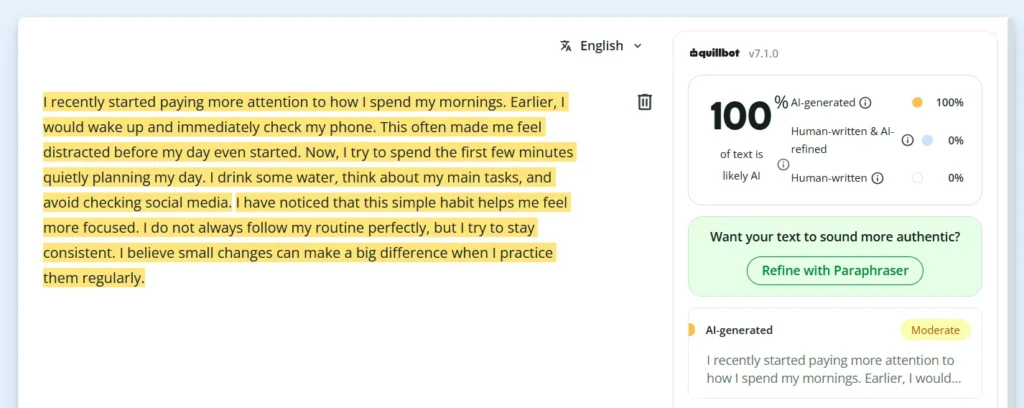
The first passage discussed changing a morning routine, avoiding social media and quietly planning the day. I knew the full paragraph had been generated by AI. The detector marked 100% of it as likely AI and highlighted the entire passage. This was exactly the classification I expected. The sentences were tidy, evenly structured and consistently reflective, which may have made the pattern easier to identify. Still, one correct result cannot show that the tool will recognise every AI passage, as the next two tests demonstrate.
The paragraph contains several characteristics commonly associated with generic AI writing. Every sentence moves smoothly into the next, the vocabulary is safe and the final sentence turns the experience into a neat life lesson. Human writers certainly produce organised paragraphs too, but this example gives the detector many consistent signals.
Test 2: A Fully AI-Written Sample Received a Lower 69% Score
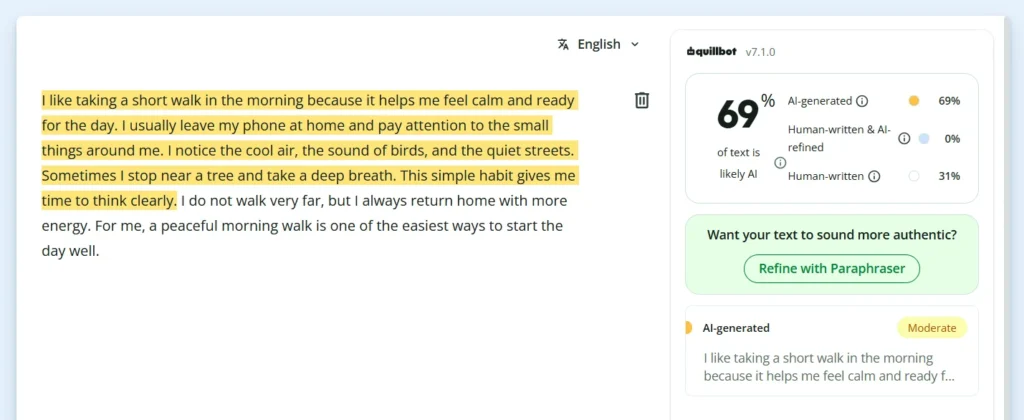
The second AI-written sample described a peaceful morning walk. Although every sentence came from AI, the detector classified only 69% of the passage as AI-generated and treated the remainder as human-written. Most of the opening was highlighted, while the final sentences escaped the AI label. I would describe this as partially successful detection rather than a fully correct result. It recognised that the passage contained strong AI-like patterns, but its percentage underestimated the known level of AI involvement by a considerable margin.
The softer result may have been influenced by the paragraph’s sensory language, including birds, cool air and quiet streets. Those personal details make the writing sound less like a formal generated summary, even though the passage was still produced entirely by AI.
This result also shows why accusations should not be built around one threshold. A teacher using 50% as a cut-off might become suspicious, while someone using 80% might consider the same paragraph acceptable. Neither cut-off establishes authorship. The possibility of inconsistent classifications is part of the wider problem of ai false positives and false negatives.
Test 3: Scribbr Missed Most of This Fully AI-Written Passage
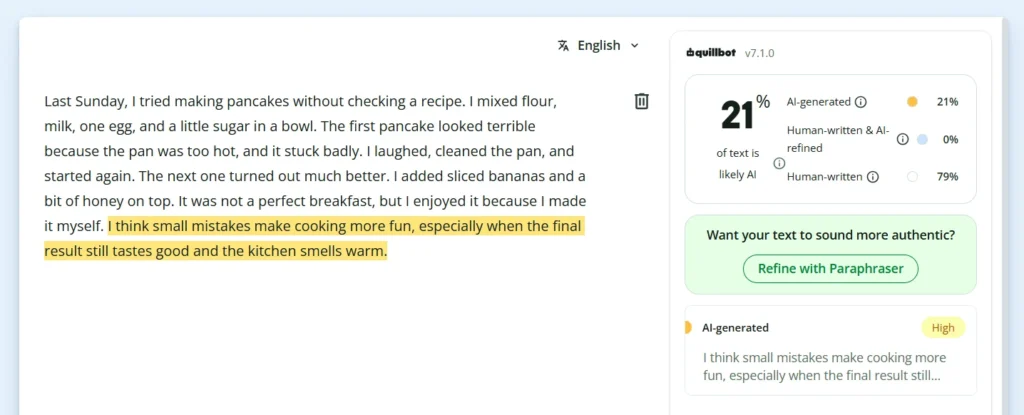
This was the weakest result in my experiment. The passage was entirely AI-written, yet the detector returned only 21% AI and classified 79% as human-written. It highlighted mainly the closing reflection rather than the story itself. A reader relying only on the overall percentage could easily conclude that the paragraph was mostly human. The result therefore represents a clear false-negative concern within this small test, because the detector substantially underestimated the amount of AI-generated writing.
The pancake story includes small mistakes, a failed first attempt and a casual reaction. Those details create the kind of imperfection people often associate with genuine personal experience. The test suggests that adding a narrative sequence and ordinary mishaps may make generated writing harder to classify.
That does not mean every story containing a burnt pancake is secretly a robot masterpiece. It means a detector cannot check whether an event actually happened. It can only analyse the language used to describe it.
Test 4: Mixed AI and Human Writing Produced a 45% AI Score
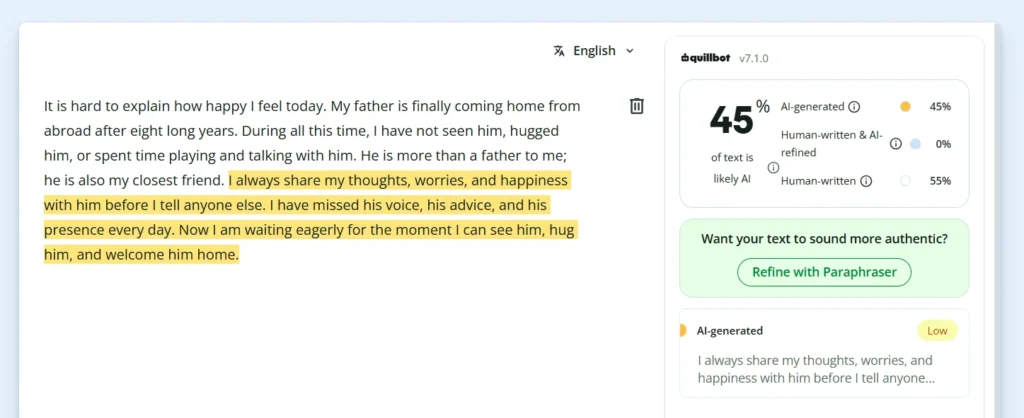
The fourth passage deliberately combined AI-generated and human-written wording. The detector returned 45% AI and marked the closing portion as suspicious. This was broadly consistent with the fact that the passage had mixed authorship, making it one of the more reasonable results in the experiment. However, the score still cannot tell us precisely who wrote each idea or how much editing occurred. A percentage is an algorithmic classification of language patterns, not a verified record of the writing process.
Mixed documents are especially difficult to evaluate because AI assistance is not always all or nothing. A student might write a paragraph personally, use a grammar tool on two sentences and ask a chatbot to simplify another. The final document may contain several layers of authorship and editing.
Anyone reviewing such a score should focus on the student’s reasoning, sources, draft history and ability to explain the work. Learning about understanding the difference between human and ai writing can help, but even visible stylistic clues are not conclusive evidence.
Test 5: Scribbr Correctly Classified This Human-Written Sample as 0% AI
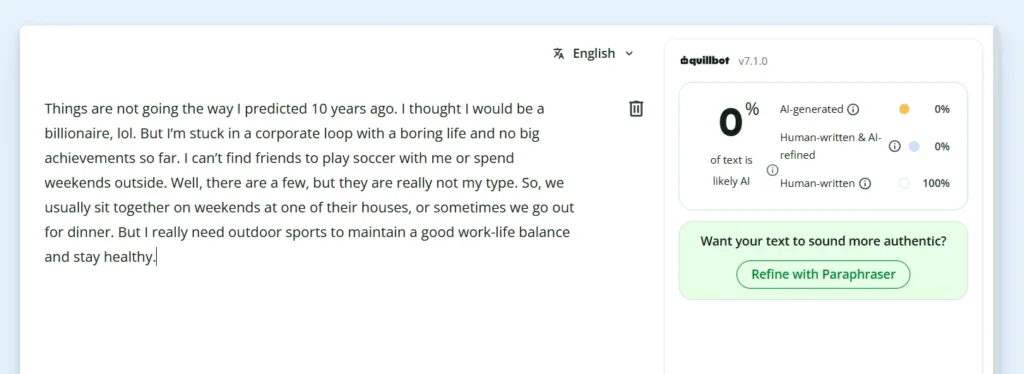
The final passage was written by a human and discussed career disappointment, weekends with friends and the desire to play outdoor sports. The detector classified it as 100% human-written and returned a 0% AI score. This was a correct outcome for the sample. The paragraph included an informal “lol,” uneven sentence lengths and specific personal frustrations, all of which may have made it appear less mechanically polished than the AI-generated passages.
I was pleased to see the detector avoid a false accusation here. However, one successful human test does not prove that it will correctly recognise every human essay. Reddit and Trustpilot screenshots later in this review contain reports from people who say their original writing was flagged.
Complete Test Comparison
| Test | Expected classification | Actual score | Was the result useful? |
| Fully AI sample 1 | Very high AI | 100% AI | Yes |
| Fully AI sample 2 | Very high AI | 69% AI | Partly |
| Fully AI sample 3 | Very high AI | 21% AI | No |
| Mixed sample | Moderate or mixed | 45% AI | Reasonable |
| Fully human sample | Very low AI | 0% AI | Yes |
I did not calculate an overall accuracy percentage because five differently written samples are too few for a meaningful benchmark. Saying the tool was “80% accurate” merely because four results appeared partly reasonable would hide the seriousness of the 21% result.
A detector can technically recognise a small part of an AI passage while still giving the user a misleading overall impression. Accuracy is not only about whether it found one suspicious sentence. It is also about whether the final score correctly represents the document.
Is Scribbr AI Detector Accurate?
My results suggest that the Scribbr AI detection experience can be accurate in clear cases, but it is not consistently reliable across different writing styles.
It correctly handled the fully human sample and one fully AI-generated sample. It also produced a plausible score for mixed writing. However, its performance on the other two AI passages was weaker. The 69% result underestimated the known source, while the 21% result missed most of a completely AI-generated paragraph.
Scribbr openly states that no detector can guarantee 100% accuracy. Its separate guidance also says that no detector can reliably confirm whether a document was written or edited by a human, and that different tools can produce different results for the same text.
Therefore, my answer to “Is Scribbr AI Detector accurate?” is:
It can provide a useful indication, but it is not accurate enough to serve as standalone proof of AI use.
How Accurate Is Scribbr AI Detector for Human Writing?
My human-written sample received 0% AI, which was the correct classification. That result shows that the detector can recognise at least some informal, personally written content without producing a false positive.
The problem is that human writing is enormously diverse. A personal story containing slang and irregular sentences may be easy to classify. A formal academic paragraph may use predictable terminology, cautious language and standard structures. Those features can look algorithmic even when the student wrote every word.
Students who receive a suspicious score should not immediately rewrite their entire paper until it becomes awkward. Instead, they should preserve their document history, outlines, references and earlier drafts. These materials provide stronger evidence of authorship than repeated detector screenshots.
For responsible advice on how to avoid ai detection, the focus should remain on genuine writing, original analysis, proper citation and transparent use of permitted tools, not on tricking a detector.
Can Scribbr Detect ChatGPT-Written Content?
It can detect some ChatGPT-style content, but my results show that performance varies substantially by passage.
The three fully AI-generated samples received:
- 100% AI
- 69% AI
- 21% AI
That range is too wide to assume that every untouched ChatGPT passage will receive a high score. Subject matter, narrative style, sentence length and vocabulary may all affect the output.
Scribbr says its free detector handles GPT-2, GPT-3 and GPT-3.5 with “average accuracy,” while its premium detector is intended to offer higher accuracy and support newer models. It also advises users to analyse longer passages for better results.
The official description is therefore more cautious than many users may realise. “Can detect ChatGPT” does not mean “will correctly detect every ChatGPT response.”
Why Do AI Detection Scores Change So Much?
AI detection tools analyse statistical characteristics rather than checking a hidden authorship record. Scribbr explains that such tools examine features including sentence structure, sentence length, word choice and predictability. They do not compare the writing against a database in the same way as plagiarism software.
Scores may change because of:
- The length of the submitted passage
- Repetitive or varied sentence structures
- Formal versus conversational language
- Personal examples and storytelling
- Editing by a human after generation
- Grammar or paraphrasing tools
- A mixture of AI and human content
- Updates to the detector
Even splitting one document into smaller sections may produce results that do not perfectly match the full-document score.
That is why I recommend reading practical guides about ai rather than treating one detector dashboard as the final authority.
What Does the Scribbr AI Percentage Mean?
Scribbr describes its AI score as a percentage indicating how much of the submitted text contains material that is likely to have been written or refined using AI.
The important word is likely.
A result of 69% should not be interpreted as a verified statement that exactly 69 out of every 100 words were generated by ChatGPT. It is the detector’s classification of patterns within the text.
Similarly:
- 0% does not prove that no AI tool was used.
- 100% does not prove that a human wrote nothing.
- A highlighted sentence is not automatically dishonest.
- A low score does not confirm academic integrity.
- A high score does not establish misconduct.
The percentage should begin a review, not end one.
Scribbr AI Detector False Positives and False Negatives
| Detection problem | Meaning | Example in this review |
| False positive | Human writing is incorrectly marked as AI | Reported by several Reddit and Trustpilot users |
| False negative | AI writing is incorrectly treated as human | My fully AI-written sample received only 21% AI |
| Partial under-detection | AI is noticed, but the amount is underestimated | My fully AI-written sample received 69% |
| Ambiguous mixed result | The score roughly reflects mixed writing but cannot prove authorship | My mixed sample received 45% |
False positives can be especially damaging in education because students may be asked to defend work they genuinely produced. False negatives matter too because they show that a low score cannot certify a document as human-written.
AI detection is also separate from similarity checking. A student trying to understand a university report should review the Turnitin similarity score independently rather than assuming that plagiarism and AI percentages measure the same thing.
What Reddit Users Say About Scribbr AI Detection
Reddit can reveal common frustrations and practical experiences, but it is not controlled research. Posts may be anonymous, incomplete or impossible to verify. I use the following screenshots to illustrate concerns, not to establish Scribbr’s overall accuracy.
A Blogger Says Human-Written Passages Were Flagged as AI
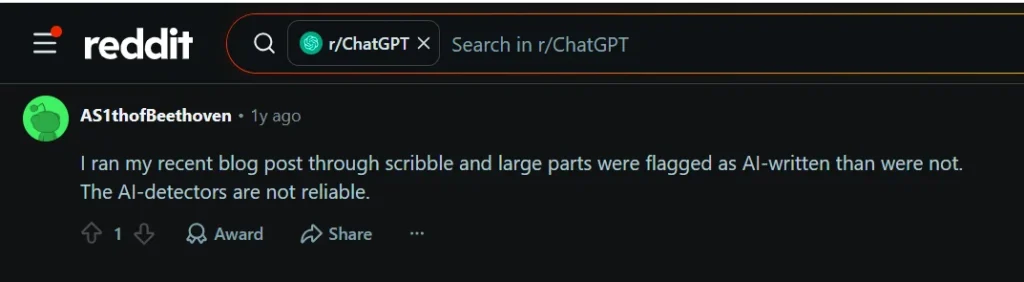
The commenter says large parts of a recent blog post were flagged even though those sections were human-written. Their conclusion is that AI detectors are unreliable. This supports the concern that original writing can occasionally resemble the patterns a detector associates with generated text. However, the screenshot does not include the blog passage, detector result or testing conditions, so the claim cannot be independently checked. It is best understood as one user’s negative experience rather than a measured accuracy study.
One Reddit User Says a Human Paragraph Was Marked 100% AI
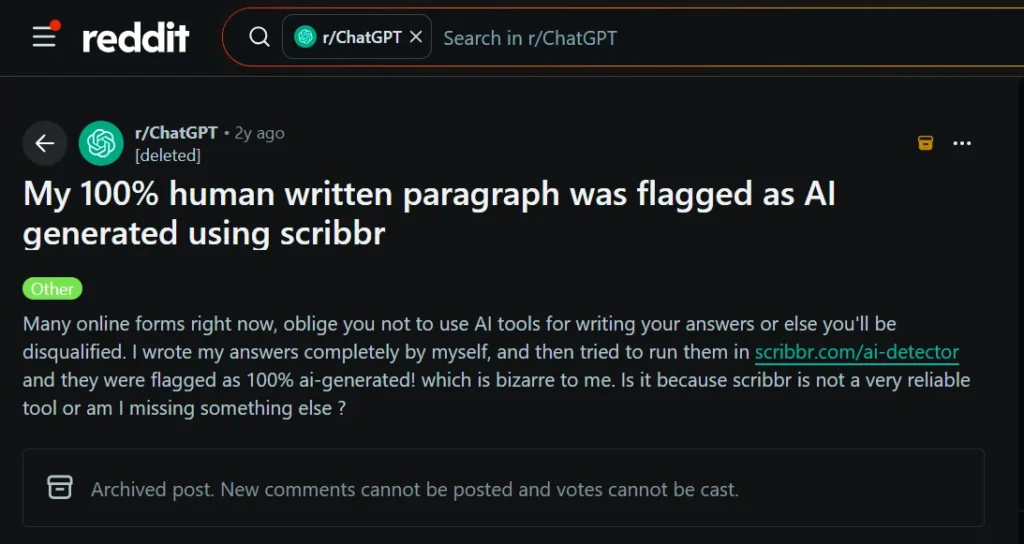
This archived post has a striking title: “My 100% human written paragraph was flagged as AI generated using Scribbr.” The user says they wrote their answers independently but received a 100% AI result. If accurate, this would be a serious false positive. At the same time, the account is shown as deleted, and the original text and writing history are not available in the screenshot. The post demonstrates why students worry about detector scores, but it cannot confirm how the passage was produced.
A Professor Warns That AI Detectors Can Produce Opposite Mistakes
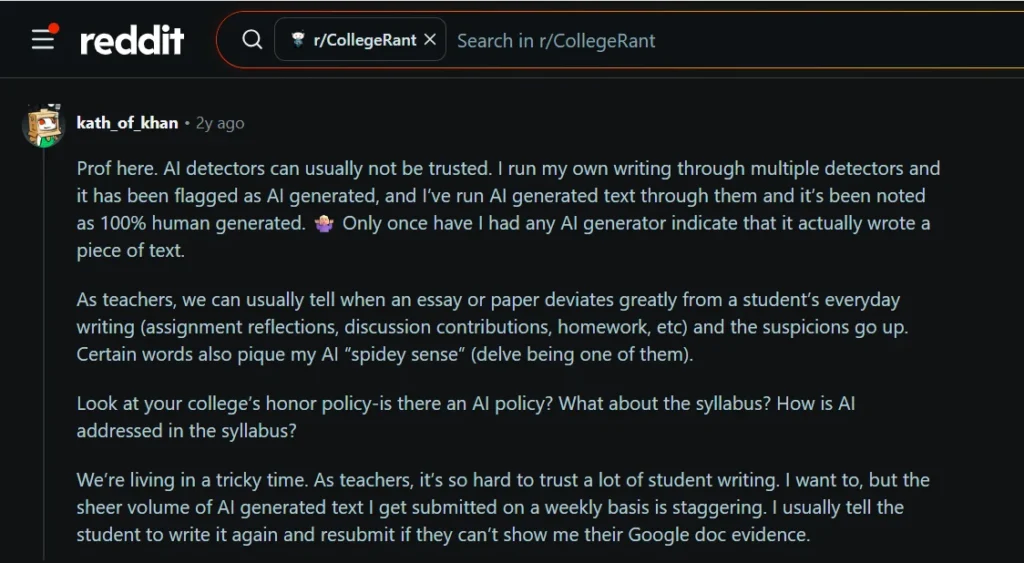
This commenter identifies themselves as a professor and describes testing personal writing and AI-generated content across multiple detectors. They report seeing human work marked as AI and generated work marked as human. The most useful part of the comment is the recommendation to examine whether a student’s style suddenly differs from previous assignments. That approach considers context rather than one automated percentage. The identity and tests are not verified, but the comment presents a more balanced concern than simply declaring every detector useless.
A Student Reports Receiving a Zero After Scribbr Flagged an Essay
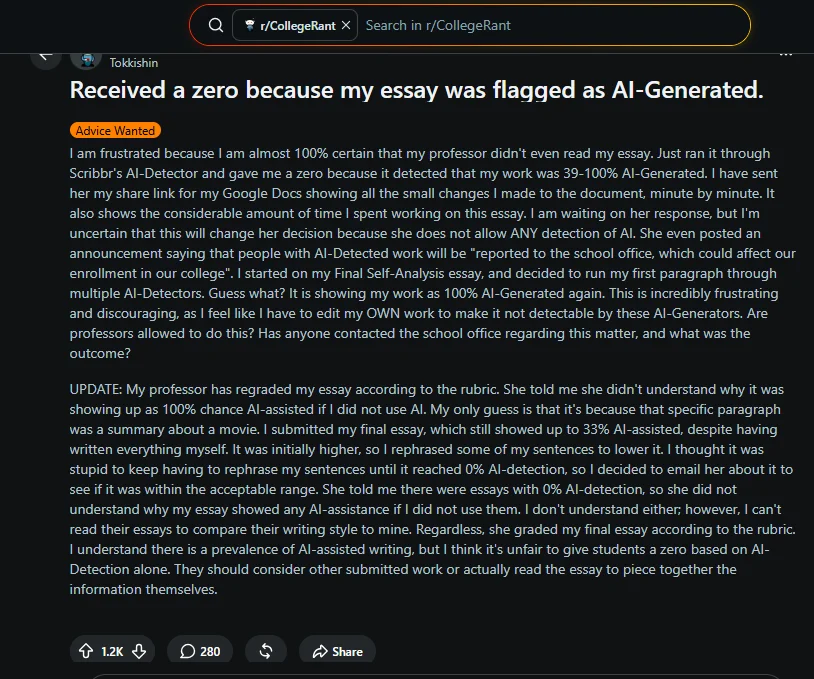
The student says a professor initially assigned a zero after Scribbr reported substantial AI involvement. They also mention having Google Docs records showing the writing process. Importantly, the update says the professor later graded the essay according to the rubric. That outcome strengthens the argument that detector results should be reviewed alongside drafts and the actual quality of the submission. The post is still an unverified personal account, but it shows the emotional and academic consequences of treating detection as automatic proof.
Some Reddit Users Still Consider Scribbr Better Than Basic Free Checkers
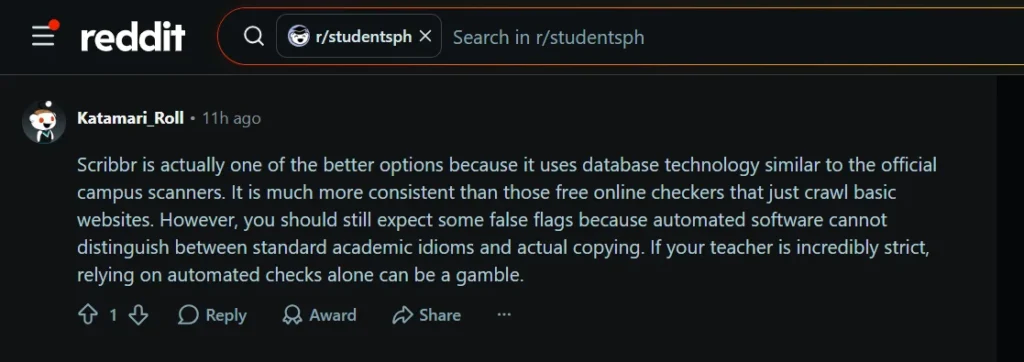
This positive comment describes Scribbr as one of the better options and says it appears more consistent than basic online checkers. The writer still warns users to expect false flags and argues that strict teachers should not rely on automation alone. The statement about Scribbr using technology similar to institutional scanners is the commenter’s claim and should not be treated as verified evidence about the AI detector. Overall, the review is positive about usability but cautious about using the results as a final judgment.
Positive Trustpilot Reviews About Scribbr AI Detector
At the time checked, Scribbr’s Trustpilot profile displayed a rating of 4.3 based on 15,644 reviews. That is a strong overall business rating, but it covers Scribbr’s complete range of services, including citations, proofreading and plagiarism checking. It is not a dedicated rating for the AI Detector.
One Trustpilot User Found Scribbr Easy for AI Checks and Citations
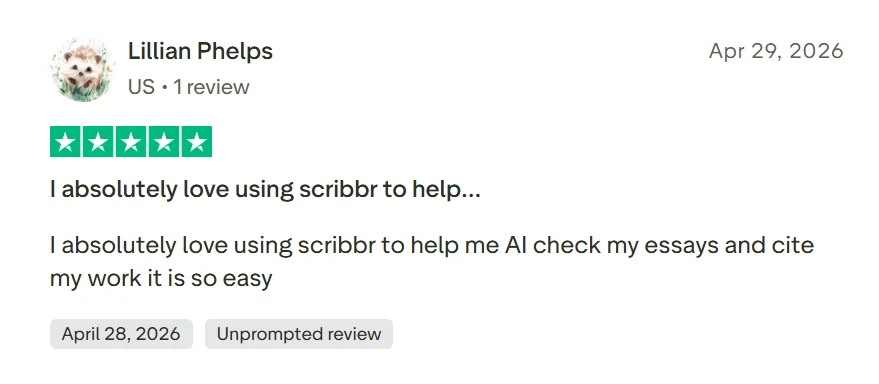
This five-star reviewer says they enjoy using Scribbr to check essays for AI and cite their work. The review supports the tool’s convenience and accessibility rather than proving its detection accuracy. A user can find a service easy and helpful even when its classifications are imperfect. Still, positive experiences matter when evaluating the overall product. The short review suggests that Scribbr’s combination of academic tools is appealing to users who prefer handling citation and AI-related checks in one place.
Negative Trustpilot Reviews About Scribbr AI Detector
A Human-Written Report Reportedly Switched Between 100% and 0% AI
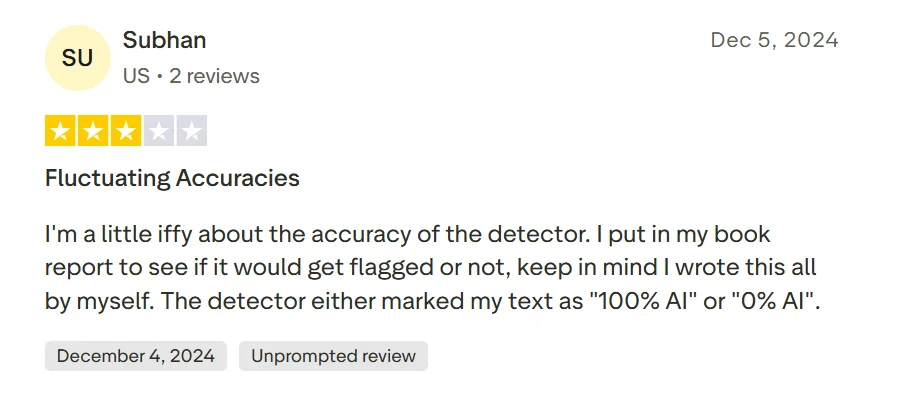
This reviewer says a self-written book report was marked either 100% AI or 0% AI during different checks. If the same unchanged passage produced both results, that would indicate severe inconsistency. However, the screenshot does not show the submitted text, timestamps or whether anything changed between checks. I would therefore treat it as a warning worth investigating, not verified proof. It reflects the uncertainty users experience when a tool displays highly confident but apparently conflicting outcomes.
One Reviewer Says Unedited ChatGPT Text Received a 0% AI Result
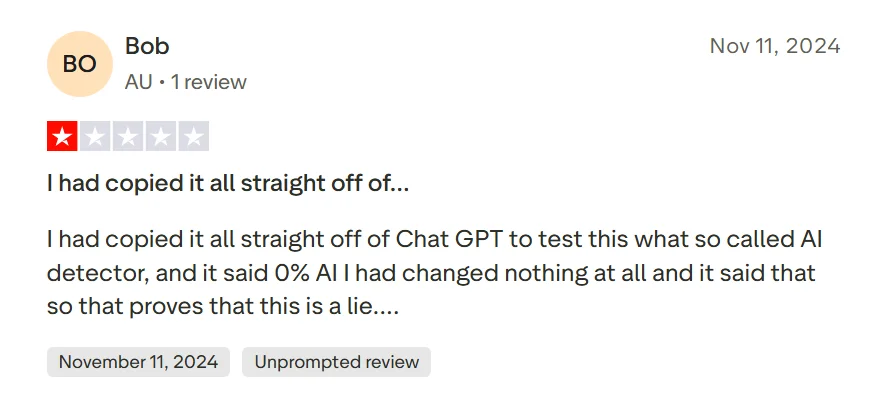
The reviewer claims they copied content directly from ChatGPT, changed nothing and received a 0% AI score. This resembles the false negative seen in my third test, although my result was 21% rather than zero. The review directly challenges the detector’s ability to identify all generated text. Nevertheless, it remains an individual report without the source passage or reproducible testing details. Different models, prompt styles and passage lengths can also affect results, so one failure should not be assumed to occur in every test.
A Reviewer Questions Both Scribbr’s Plagiarism and AI Results
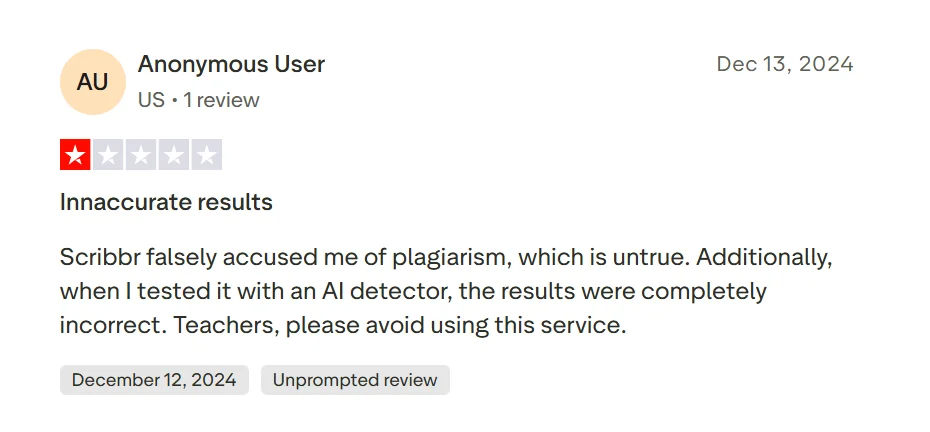
This one-star review disputes both a plagiarism accusation and an AI detection result. It communicates serious dissatisfaction, particularly because incorrect originality claims can affect students and teachers. However, plagiarism detection and AI detection are separate processes, so the two complaints should not automatically be combined into one accuracy judgment. The screenshot also does not include the reports or disputed document. I would treat it as a customer account of inaccurate results, not conclusive evidence that every Scribbr service failed.
A Paid Report Delivery Complaint Raises a Service Concern
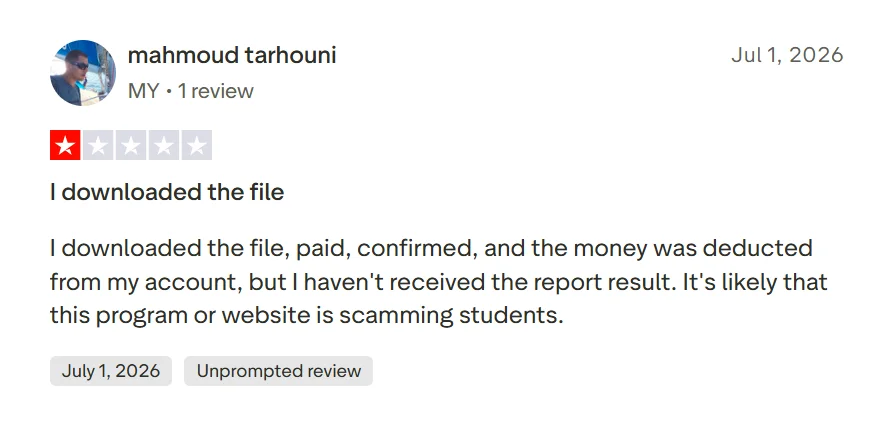
This reviewer says payment was confirmed and deducted, but the expected report was not received. The complaint concerns fulfilment, payment and report delivery rather than whether the AI detector classified writing correctly. It is still relevant to the broader customer experience, particularly for people considering a paid service. However, using this review as evidence that Scribbr’s AI model is inaccurate would be misleading. Product accuracy and customer-service reliability are related to overall satisfaction but remain different questions.
A Reviewer Complains About the Premium Character Limit
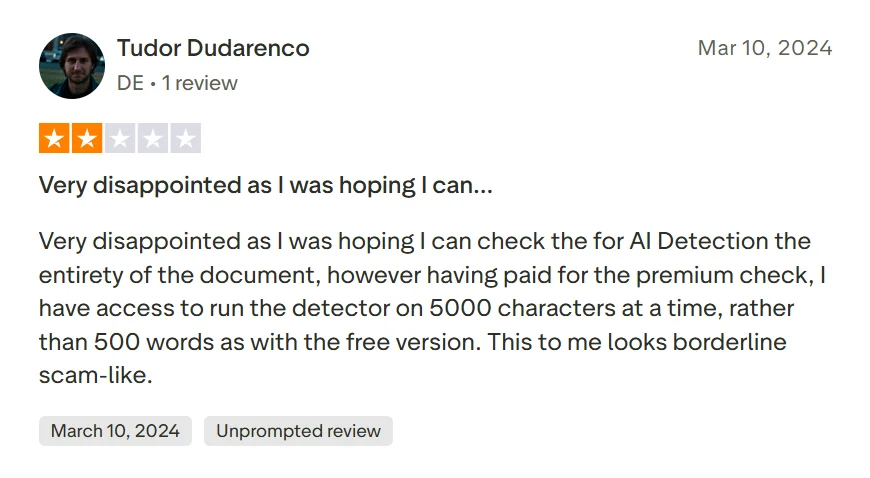
This reviewer expected to scan an entire document but says the premium service allowed only 5,000 characters at a time. The complaint mainly concerns value, expectations and usability. It does not test whether the result was correct. Limits can also change, so readers should check the current product page before purchasing anything. Scribbr’s current free AI Detector page advertises submissions of up to 1,200 words, whereas paid plagiarism or add-on services may follow different rules.
A Browser Reload Problem Prevented One User From Running the Free Detector
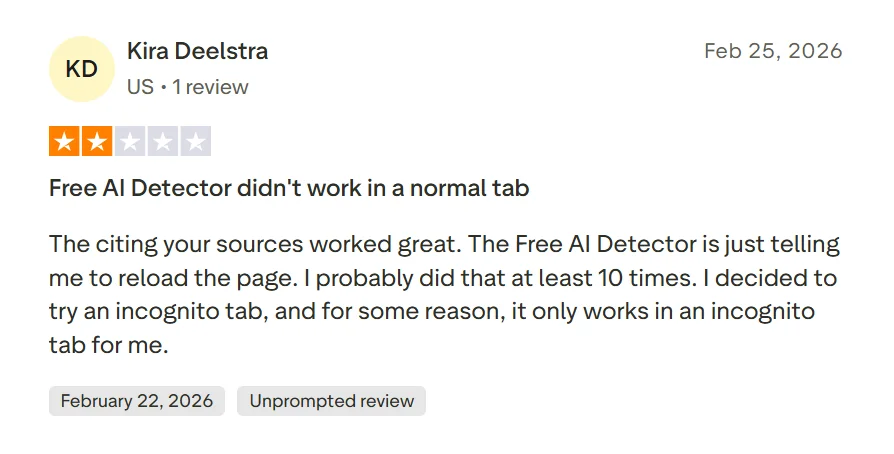
The user says the free AI Detector repeatedly requested a page reload in a normal browser tab but worked in incognito mode. This appears to be a browser, cache, cookie or extension-related problem rather than an accuracy failure. It still matters because a detector is not particularly useful when the user cannot run it. The review also shows why isolated technical problems should be categorised correctly. A loading error provides evidence about accessibility and user experience, not about false positives or false negatives.
Scribbr’s Overall Trustpilot Rating Remains Strong Despite Detector Complaints
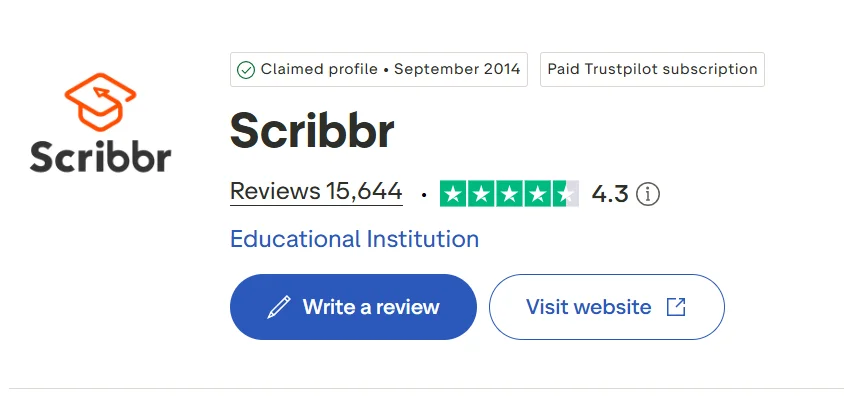
The profile screenshot shows Scribbr with a 4.3 rating and 15,644 reviews at the time it was captured. This suggests that many customers are satisfied with Scribbr as a wider educational service. However, the rating includes feedback about proofreading, citation tools, plagiarism reports and other products. It cannot be used as a direct accuracy rating for the Scribbr AI Detector. The individual detector-related complaints remain relevant, but they form only a small and selectively collected part of the much larger review profile.
Is Scribbr AI Checker Good for Students?
Scribbr is useful when students treat it as a preliminary self-check rather than a final judgment. Its simple interface, free checks and paragraph-level highlights can help identify writing that sounds unusually repetitive or formulaic.
Good uses include:
- Reviewing a draft before submission
- Comparing different sections of the same paper
- Noticing abrupt changes in tone
- Identifying paragraphs that need clearer personal analysis
- Starting a conversation about permitted AI assistance
Poor uses include:
- Treating a high score as proof of cheating
- Rewriting authentic work repeatedly to chase 0%
- Giving a student an automatic penalty
- Assuming a low score proves human authorship
- Ignoring drafts, references and writing history
Students should also check their institution’s AI policy. Some universities permit limited help with brainstorming or grammar, while others require disclosure. The detector cannot interpret those rules for you.
Scribbr AI Detector Pros and Cons
| Pros | Cons |
| Easy to use | Scores can be misinterpreted |
| Free checks are available | Results varied considerably in my samples |
| No sign-up required for the free tool | False positives and false negatives remain possible |
| Paragraph-level highlighting | Short passages may produce weaker results |
| Distinguishes AI-generated, refined and human categories | Cannot prove who wrote the document |
| Correctly classified my human sample | One fully AI sample received only 21% |
Scribbr Compared With Other AI Detectors
Different AI checkers often disagree because they use different models, data and decision thresholds. Running the same essay through several tools may therefore create more confusion rather than a clear answer.
The Quillbot AI detector uses an interface matching the testing screenshots provided here and separates AI-generated, AI-refined and human-written classifications.
Zerogpt is another widely searched option, but a clean score from one platform does not guarantee the same result elsewhere.
My justdone ai review examines another service that combines detection with additional writing features.
The copyleaks ai detector is often discussed in educational contexts, although its output should still be reviewed alongside other evidence.
originality ai is commonly marketed toward publishers and professional content teams rather than only students.
Tools such as Stealthwriter AI approach the issue from the rewriting and humanisation side, which introduces a different set of ethical and reliability concerns.
I would not name a universal winner without running the same controlled dataset through every detector. Even then, performance could change after a model update.
A Practical Scribbr Alternative for Academic Support
The main limitation of any automated checker is that it tells you what the system suspects without necessarily teaching you how to improve your academic reasoning.
Skyline Academic offers a free ai detector that students can use as an initial check. More importantly, students can access academic support beyond the score itself.
Its 1:1 Personalized Live Tutoring includes individual guidance, a dedicated learning management system, progress monitoring, coursework support, learning materials, video lectures and academic bootcamps.
That combination can be more useful for a student who keeps receiving confusing detector results. A tutor can examine whether the paragraph contains enough original analysis, whether sources are integrated correctly and whether the writing genuinely reflects the student’s understanding.
No tutoring service or detector should promise a guaranteed 0% score. The real objective should be well-supported, honestly produced academic work.
Who Should Use Scribbr AI Detector?
Students may use it as a self-review tool, particularly when they understand that the percentage is not a verdict.
Teachers may use it as one limited indicator, but they should compare the submission with previous work, speak to the student and examine writing records before reaching a conclusion.
Bloggers and editors may use it to screen external submissions, although a suspicious score should lead to editorial review rather than automatic rejection.
Researchers and professional writers may find the paragraph highlighting useful, but confidential or sensitive material should always be handled according to the relevant privacy and institutional rules.
My Final Verdict
Is Scribbr AI Detector accurate? Sometimes, yes. Reliably enough to prove authorship? No.
The strongest result in my experiment was the 100% classification of a fully AI-written sample. The detector also correctly returned 0% for the human-written paragraph and produced a plausible 45% result for mixed content.
The major concern was inconsistency. Two other fully AI-written passages received 69% and 21%. The 21% result is particularly important because a user could easily read it as evidence that the paragraph was mostly human-written.
The supplied screenshots were also branded QuillBot v7.1.0, so they should not be presented as proof of an independent Scribbr-only engine. Combined with the varied Reddit and Trustpilot experiences, the responsible conclusion is that Scribbr can be helpful as a screening tool but should never be the sole basis for an academic accusation or penalty.
Frequently Asked Questions
1. Is Scribbr AI Detector accurate?
Scribbr can correctly recognise some AI and human-written passages, but its results are not consistently accurate. In my small test, fully AI-generated samples received scores ranging from 21% to 100%, showing that writing style can significantly affect the result.
2. How accurate is Scribbr AI Detector for student essays?
Accuracy may depend on the essay’s length, tone, structure and level of editing. Formal academic writing can sometimes look predictable even when written by a student, so teachers should consider drafts, sources and previous work alongside the detector score.
3. Can Scribbr AI Detector detect ChatGPT?
It can detect many ChatGPT-style passages, but it may not identify all of them correctly. One of my AI-written samples received 100%, while another received only 21%, despite both being fully generated.
4. Does Scribbr falsely flag human writing as AI?
False positives are possible with Scribbr and other AI detectors. My human sample received the correct 0% result, but several users in the supplied Reddit and Trustpilot screenshots reported that their original writing was flagged.
5. What does a Scribbr AI percentage mean?
The percentage is the detector’s estimate of how much text appears likely to be AI-generated or AI-refined. It is not a verified measurement of authorship and should not be interpreted as definitive proof.
6. Is Scribbr AI Checker good for academic work?
It can be useful for preliminary self-review, particularly when checking whether parts of a paper sound overly formulaic. It should not replace proper citation checks, tutor feedback or a teacher’s evaluation of the student’s actual reasoning.
7. Can teachers rely on Scribbr AI detection results?
Teachers should not rely on Scribbr alone when investigating possible AI use. A fair review should include the student’s drafts, document history, sources, previous writing and ability to explain the submitted work.
8. Why does Scribbr give different scores for similar text?
Small changes in sentence structure, vocabulary, paragraph length and predictability can affect the classification. Editing, paraphrasing and mixing AI with human writing may also cause the score to rise or fall.
9. Is the Scribbr AI Detector free?
Scribbr currently offers a free version for checking limited amounts of text per submission. Product limits and premium features can change, so users should confirm the latest conditions directly before relying on a specific allowance.
10. What is a reliable alternative to Scribbr AI Detector?
There is no perfectly reliable detector. A better approach is to combine an automated check with human academic guidance, original drafts, proper citation and a clear understanding of the institution’s AI-use policy.
Conclusion
My Scribbr AI Detector review produced a mixed verdict. The detector performed well on one fully AI-written passage and correctly recognised my human-written sample. It also gave a reasonable result for the mixed paragraph.
However, another fully AI-generated sample received only 21% AI. That single result is enough to show why a low score cannot certify human authorship. The Reddit and Trustpilot screenshots also contain reports of false flags, missed AI content, technical problems and inconsistent results, although these individual experiences cannot establish the tool’s overall accuracy.
Scribbr is most useful when treated as an indicator. It may draw attention to passages worth reviewing, but it cannot see who typed the words, examine a student’s intentions or verify the complete writing process.
Students should preserve outlines, drafts, references and document histories. Teachers should evaluate those materials before making academic decisions. A detector percentage may contribute to a conversation, but it should never be allowed to become the entire conversation.