If you are searching for a JustDone AI detector review, you are probably trying to answer one very specific question: can I actually trust this thing before submitting my assignment, essay, report, or research paper?
That is a fair question because AI detectors are everywhere now. Some students use them before submitting work. Some writers use them before sending content to clients. Some people use them because their university, professor, or platform has made them nervous about AI scores. And honestly, I get it. Nobody wants to spend hours writing something only for a detector to say, “Congratulations, apparently you are a robot.”
So, I tested the JustDone AI detector with different types of content, including fully AI-generated writing, human-written writing, and mixed content. I also reviewed JustDone AI reviews from Trustpilot and Reddit screenshots to see what real users are saying. Some reviews are positive, some are extremely unhappy, and the test results were more interesting than I expected.
In this review, I will cover whether JustDone AI is legit, how accurate JustDone AI detector is, whether it works for academic writing, what its reviews reveal, and whether students should rely on it before submission. I will also compare it with alternatives such as Skyline Academic, QuillBot, ZeroGPT, StealthWriter AI, and other AI detection tools.
Before we start, one important thing: no AI detector should be treated as a final judge of your academic work. AI detection is useful, but it is not perfect. If you are worried about originality, it is smarter to combine AI detection with a free plagiarism check, proper editing, citation review, and academic guidance.
Quick Verdict: Is JustDone AI Detector Legit?
Yes, JustDone AI appears to be a real AI writing and detection platform. It has an official website, AI detector, plagiarism checker, humanizer, paraphraser, research tools, pricing page, and public reviews. So, in that basic sense, JustDone AI is legit.
But the better question is not just “is JustDone AI legit?” The better question is: is JustDone AI detector accurate enough to trust for academic work?
Based on my tests and the user screenshots I reviewed, my answer is mixed. JustDone AI detector can identify obvious AI-generated content, but it also gave very high AI scores to human-written and partially human-written samples. That is a serious problem for students because a false positive can create unnecessary panic.
Here is the quick verdict:
| Category | Verdict | What It Means for Students |
| Is JustDone AI a real platform? | Yes | It is an actual AI writing and detection tool |
| Does JustDone AI detector work? | Sometimes | It can detect obvious AI text, but results may vary |
| Is JustDone AI detector accurate? | Mixed | My tests showed both correct AI flags and major false positives |
| Is it safe to rely on alone? | No | Students should not treat one AI score as final proof |
| Best use case | Quick first scan | Useful for checking tone, but not enough for academic confidence |
| Main concern | False positives | Human academic writing may still be flagged as AI |
| Better student approach | Use multiple checks | Combine AI detection, plagiarism checking, editing, and tutoring |
If I had to summarize it in one line: JustDone AI detector is legit as a tool, but I would not blindly trust its AI score for academic work.
What Is JustDone AI Detector?
JustDone AI detector is part of the wider JustDone platform. It is designed to check whether a piece of writing may have been generated by AI tools such as ChatGPT, Claude, Gemini, or similar platforms. From what JustDone presents on its website, the detector is not only meant to give a general AI score. It also claims to identify AI-like writing patterns and help users improve or rewrite flagged sections.
The platform also includes tools such as a plagiarism checker, AI humanizer, paraphraser, summarizer, grammar checker, citation generator, fact checker, and research-related tools. That means JustDone is not only an AI detector. It is positioned more like an all-in-one writing and academic assistance platform.
For students, the appeal is obvious. You paste your essay, get a score, and hopefully feel reassured before submission. But that is where things get tricky. A score can feel official, even when it is not. A detector saying “92% AI” does not automatically mean your work was written by AI. It means the tool found patterns that it associates with AI-generated writing.
That distinction matters a lot. Students often write in a formal, structured, polished style because that is what academic writing asks them to do. Unfortunately, that same style can sometimes look “AI-like” to detection tools. This is why understanding the accuracy of ai detectors is important before trusting any result.
How I Tested JustDone AI Detector
For this JustDone AI detector review, I used four main test samples. I wanted to see how the tool reacted to obvious AI text, human-written text, and partially human-style content.
The goal was not to create a scientific laboratory test with hundreds of documents. The goal was to run a practical student-style test. In other words, what happens when a normal person pastes assignment-style content into the tool?
Here are the test samples I used:
| Test Sample | Type of Content | Expected Result | JustDone AI Result | My Observation |
| Test 1 | Fully AI-generated content | High AI score | 88% AI content | It correctly flagged the content as mostly AI |
| Test 2 | Fully AI-generated content | High AI score | 71% AI content | It detected AI, but the score was lower than expected |
| Test 3 | Fully human-written content | Low AI score | 97% AI content | Major false positive concern |
| Test 4 | Partially human-written or mixed-style content | Medium or uncertain score | 92% AI content | It heavily flagged the content as AI |
This is where my eyebrow went up a little. The detector did catch the AI-generated samples, which is good. But it also flagged the human-written sample as 97% AI content. That is not a small mistake. That is the kind of result that can make a student panic, rewrite perfectly fine work, or pay for extra tools they may not need.
JustDone Flags Fully AI-Written Content as 88% AI
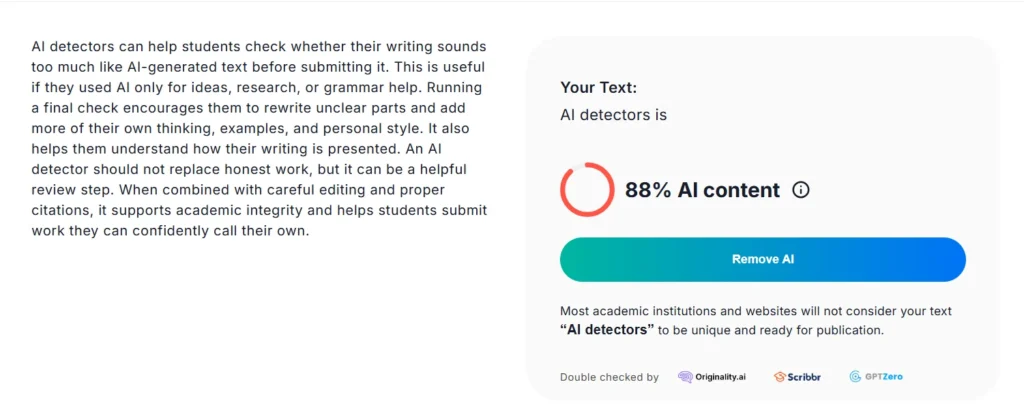
This screenshot shows the first test where fully AI-generated content was pasted into JustDone AI detector. The tool returned an 88% AI content score, which is broadly what I expected because the sample was generated by AI. This result shows that JustDone can identify obvious AI-style writing in some cases. However, the score was not 100%, which is also worth noting because even fully AI-generated content may not always receive a perfect AI score. For students, this means a lower score does not automatically prove a text is fully human.
JustDone Detects AI Content but Gives a Lower 71% Score
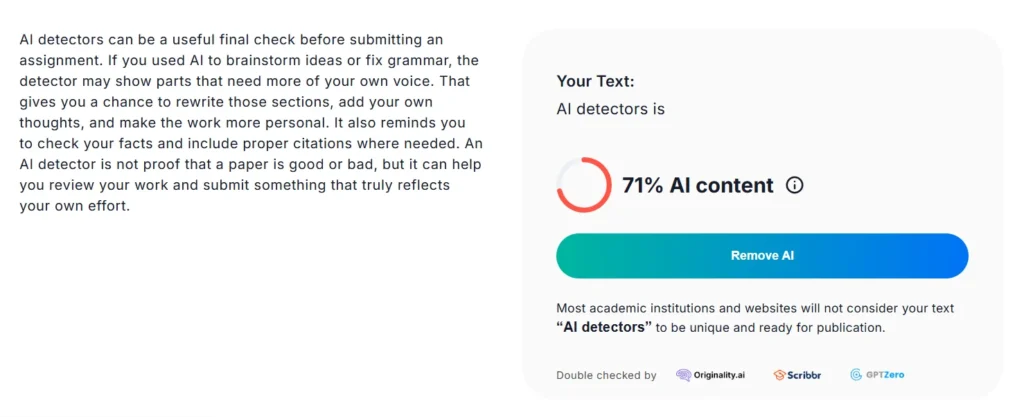
This second test also used fully AI-generated content, but JustDone gave it a 71% AI content score. That still means the tool believed the text was mostly AI-generated, but the result was lower than expected for a fully AI-written sample. This matters because students often assume AI detectors work in a clean yes-or-no way. In reality, AI detection scores are probability-style signals, not absolute proof. A fully AI-written paragraph can sometimes receive a lower score, depending on writing style and wording.
Human-Written Content Gets Flagged as 97% AI
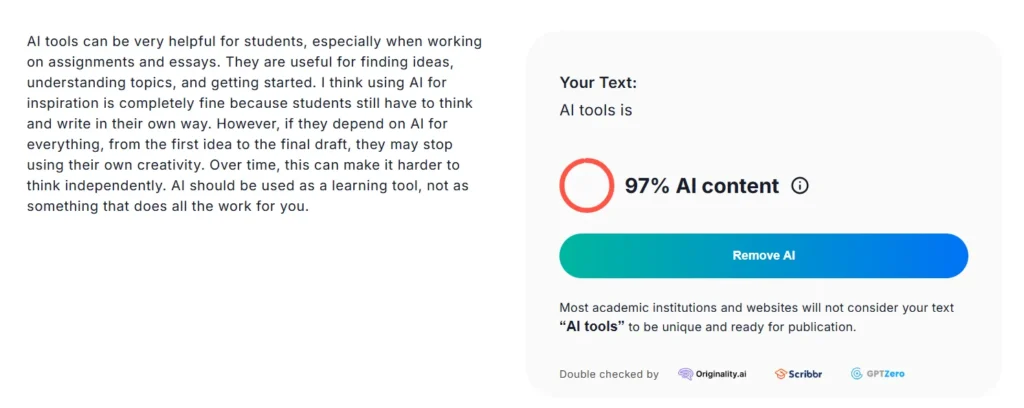
This was the most worrying result in my test. The sample was fully human-written, but JustDone AI detector marked it as 97% AI content. For academic users, this is a serious false positive concern because students often write in a clear, formal, structured way. A detector may mistake polished academic writing for AI writing, especially if the paragraph is generic or well-organized. This screenshot is one of the strongest reasons I would not recommend relying on JustDone AI detector alone.
Partially Human-Written Content Still Gets a High AI Score
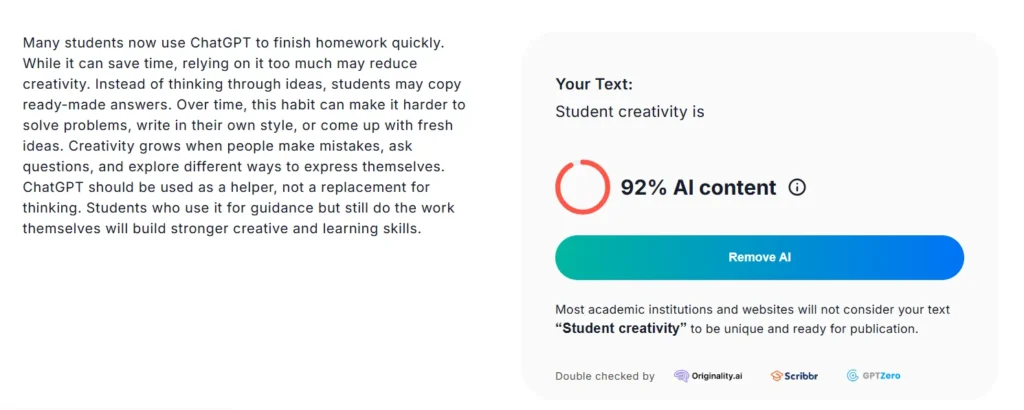
This screenshot shows another high AI score for content that was not simply pasted as raw AI output. JustDone marked the text as 92% AI content, which suggests the detector may be very sensitive to structured or predictable writing patterns. This can be useful when checking obvious AI writing, but it can also create stress for students who write in a simple, organized academic style. The result supports the main theme of this review: JustDone AI detector may work in some cases, but its results need careful interpretation.
JustDone AI Detector Test Results
My test results were mixed. On the positive side, JustDone identified both AI-generated samples as AI. That means the detector is not useless. It can spot obvious AI content, especially when the writing is smooth, predictable, and generic.
But the problem appeared when I tested human-written content. The fully human-written sample received a 97% AI content score. The partially human or mixed-style sample received a 92% AI content score. That is a big issue if the user is a student.
Imagine writing your own essay, pasting it into a detector, and seeing “97% AI.” You would probably think, “Okay, either I write like ChatGPT, or ChatGPT writes like me.” Funny for five seconds, stressful after that.
This is why I always tell students that AI detection scores should be treated as signals, not final evidence. If a detector flags your work, it does not automatically mean you did anything wrong. It may mean your writing is too generic, too polished, too formulaic, or too similar to common AI patterns.
If you want to understand this better, I recommend reading about the truth behind ai detection scores, because a score can look more scientific than it really is.
How Accurate Is JustDone AI Detector?
So, how accurate is JustDone AI detector?
Based on my tests, I would say it is inconsistent. It can detect obvious AI-generated content, but it may also wrongly flag human-written academic content. That makes it risky for students who want a clear yes-or-no answer.
The biggest issue with AI detector accuracy is that the tools are not reading your mind. They do not know whether you wrote the text yourself. They look for patterns such as sentence rhythm, word predictability, structure, repetition, and phrasing. If your writing has those patterns, it may be flagged, even if you wrote every word yourself.
Here is how I would interpret JustDone AI detector accuracy:
| Type of Writing | Likely JustDone Performance | Risk Level | Student Advice |
| Raw AI-generated text | Usually detects it | Medium | Useful as a quick warning |
| Lightly edited AI text | May detect it | Medium to high | Do not rely on score alone |
| Heavily rewritten AI text | May be inconsistent | High | Check originality and writing process |
| Human academic writing | May create false positives | High | Review carefully before panicking |
| Mixed human and AI writing | Hard to judge | High | Rewrite, cite, and follow university rules |
| Simple student writing | May vary | Medium | Use more than one review method |
The short answer is this: JustDone AI detector can be useful, but I would not call it fully reliable for academic decisions.
Is JustDone AI Detector Accurate for Academic Writing?
This is where students need to be extra careful. Academic writing often has features that AI detectors may find suspicious. For example, essays and reports usually have formal tone, balanced structure, topic sentences, transitions, and polished explanations. That is exactly how AI tools also tend to write.
So, when a student asks, “is JustDone AI detector accurate for academic writing?” my answer is: sometimes, but not always.
In my own test, the detector flagged human-written content as 97% AI. That suggests a real risk of ai false positives, especially for students who write in a clean and structured academic style.
This does not mean JustDone is always wrong. It means the result needs context. If you wrote the work yourself, kept your drafts, used proper citations, and can explain your argument, a high AI score should not automatically scare you. But if you copied AI output directly, lightly edited it, and pasted it into your assignment, then yes, a high AI score may be a useful warning.
For academic writing, I would treat JustDone as a first-stage checker, not a final academic integrity tool.
Does JustDone AI Work?
Yes, JustDone AI works in the sense that it gives AI detection results, highlights potential AI-like content, and can identify obvious AI writing. But “does JustDone AI work?” depends on what you expect from it.
If you expect a quick scan that says whether your writing sounds AI-like, then it may be useful.
If you expect a perfect detector that can prove your work is human or AI with 100% certainty, then no, that is not realistic.
JustDone AI can help with:
- Getting a quick AI probability estimate
- Spotting writing that sounds too generic or robotic
- Checking obvious AI-generated drafts
- Reviewing academic paragraphs before submission
- Comparing how different writing styles are scored
But it cannot guarantee:
- Your university will accept your work
- Turnitin will show the same result
- Your writing is fully safe from AI concerns
- A low score means your work is definitely human
- A high score means your work is definitely AI
This is why students should combine AI checks with proper editing, originality review, and academic support. For example, if you struggle with assignments, writing structure, or coursework planning, 1:1 Personalized Live Tutoring can be much more useful than only chasing AI scores.
JustDone AI Reviews: What Are Users Saying?
User reviews are important because AI tools often look great on their own websites. The real test is what users say after trying them, paying for them, or using them under pressure.
The JustDone AI reviews I reviewed from Trustpilot and Reddit were mixed. Some users praised the platform for being helpful, easy to use, and useful for checking plagiarism or AI detection. Others complained about wrong AI detection, false positives, billing concerns, refund issues, and the humanizer not working as expected.
That mixture is important. A tool can have many positive reviews and still have serious problems for specific use cases. For students, the main concern is not whether some people liked it. The main concern is whether the detector is reliable enough for academic work.
Trustpilot Summary Shows a High Rating but Also Needs Context
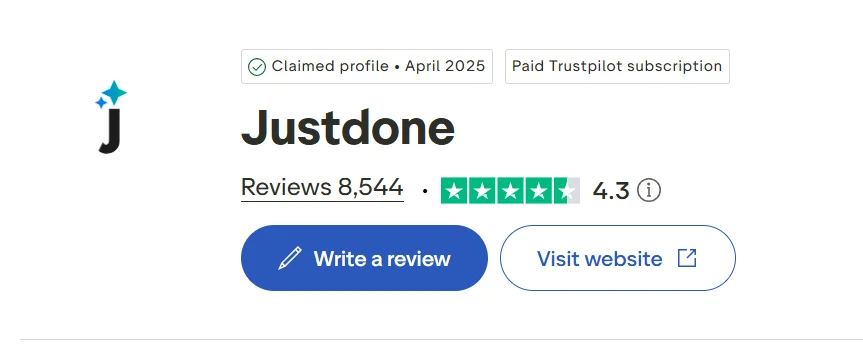
This screenshot shows the Trustpilot overview for JustDone, including a 4.3 rating and thousands of reviews. On the surface, that looks strong and suggests many users have had a positive experience. However, a rating summary does not tell the full story, especially for AI detection accuracy. Students should look beyond the average score and read individual reviews carefully. The detailed screenshots show both satisfied users and users who felt misled by detection results or billing experiences.
JustDone AI Trustpilot Reviews
The Trustpilot screenshots show a mixed picture. Some users say JustDone is easy to use and helpful for academic or writing tasks. Others describe the AI detector as unreliable, especially when their own writing was flagged as AI.
A pattern I noticed in negative reviews is that several users complained about false positives. This matches my own test, where human-written content received a very high AI score.
Review Says JustDone Flags Everything as AI
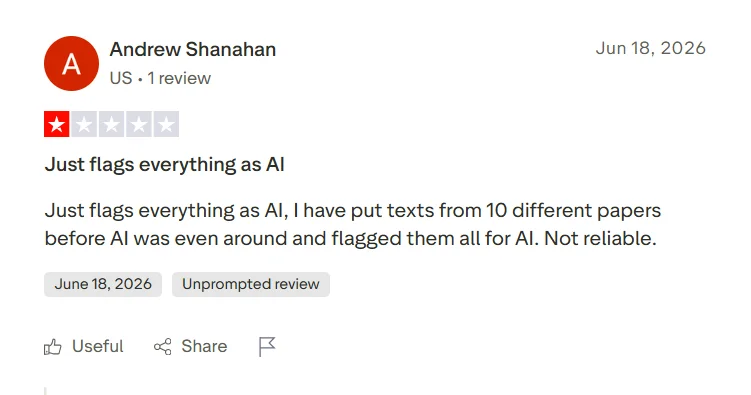
This review complains that JustDone flags everything as AI, including texts from papers written before AI tools became widely used. That is a serious claim because it directly questions the reliability of the detector. If older human-written documents are being marked as AI, the tool may be over-sensitive to formal or academic writing patterns. This kind of review is especially relevant for students because academic writing often follows predictable structures. It supports the concern that JustDone may produce false positives in some cases.
Parent Says a Child’s Original Writing Was Marked 98% AI
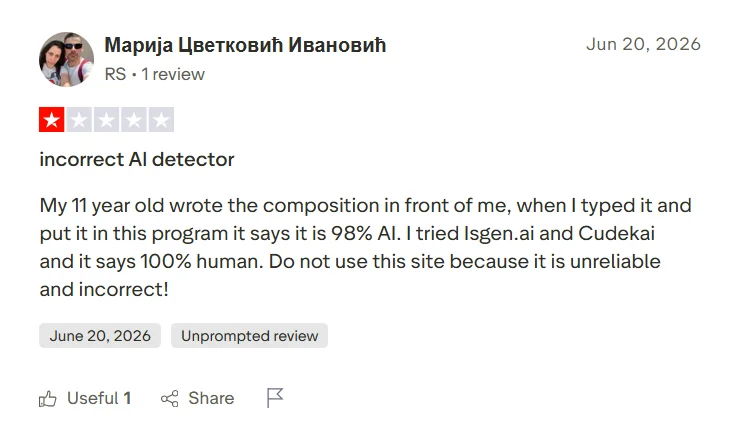
This screenshot shows a reviewer saying their 11-year-old wrote a composition in front of them, but JustDone marked it as 98% AI. The reviewer also mentions trying other AI detectors that reportedly marked the same text as human. This review matters because it shows how stressful AI detector results can be when users believe the writing is clearly original. Whether or not other tools are more accurate, the key lesson is that one detector should not be treated as final proof. A high score needs context, especially for student work.
Their Own Paragraph Was Flagged as 100% AI
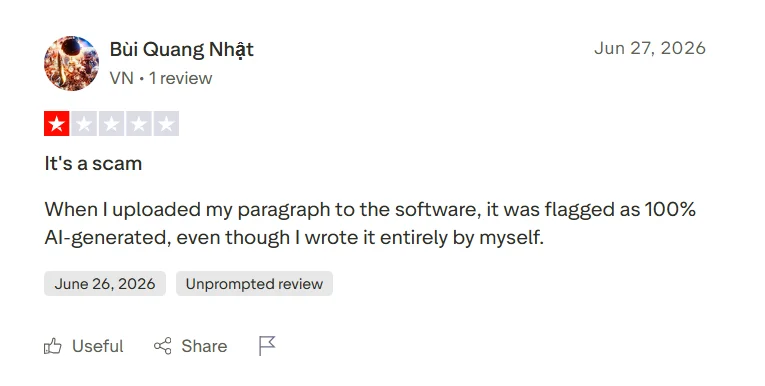
This review says the user uploaded a paragraph they wrote entirely by themselves, but the software flagged it as 100% AI-generated. That is one of the clearest examples of a false positive complaint. For students, this is exactly the kind of issue that can create unnecessary fear before submission. It also matches my own test where human-written content received a 97% AI score. This does not mean every JustDone result is wrong, but it does show why students should not panic based on one scan.
Tool Does Not Work and Humanizer Gives Poor Output
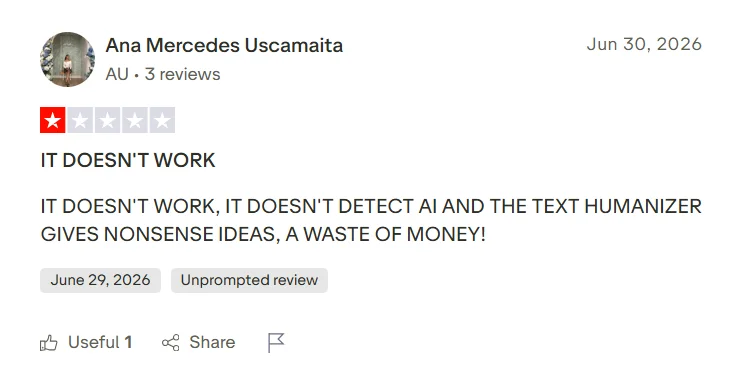
This review criticizes both the AI detector and the text humanizer. The user claims the detector does not properly detect AI and that the humanizer gives poor or nonsensical ideas. This matters because JustDone promotes both detection and rewriting as part of the user journey. If a student gets a high AI score and then uses a humanizer without understanding the content, the writing quality may become worse. For academic work, rewriting should always preserve meaning, citations, and the student’s own understanding.
Complains About a Fraudulent Charge
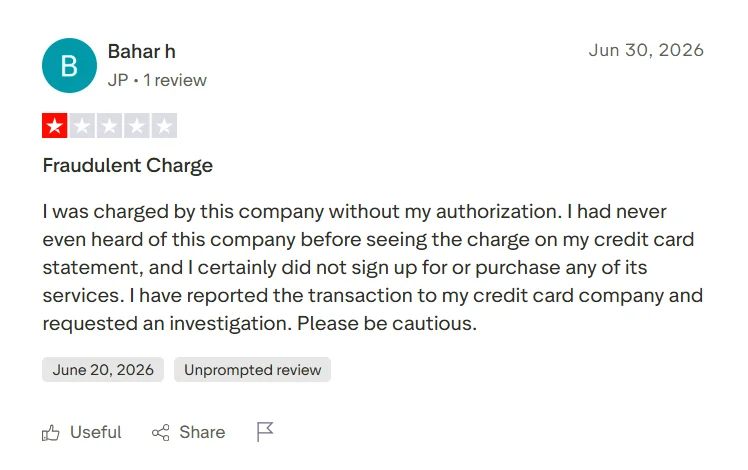
This screenshot is not mainly about detector accuracy. It is about billing trust. The reviewer claims they were charged without authorization and had never signed up for or purchased the service. Billing complaints are important because many students use tools quickly and may not fully understand subscriptions, trials, or payment terms. I cannot verify the individual claim from the screenshot alone, but it is still worth considering. Before entering payment details on any AI tool, students should read the pricing and cancellation terms carefully.
Human Writing Was Marked as 92% AI
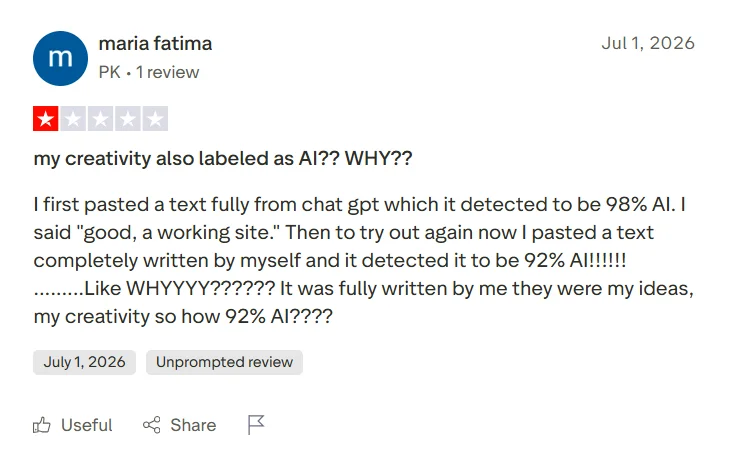
This review is very similar to my own test results. The reviewer says ChatGPT-generated text was detected as 98% AI, which made sense, but then their own fully written text was also marked as 92% AI. That is exactly the problem with over-sensitive detectors. If both AI-generated text and personal writing get high scores, the user cannot easily know what to trust. For students, this makes the tool useful as a warning sign, but not reliable enough as a final answer.
Refund Complaint After Trial or Subscription Charge
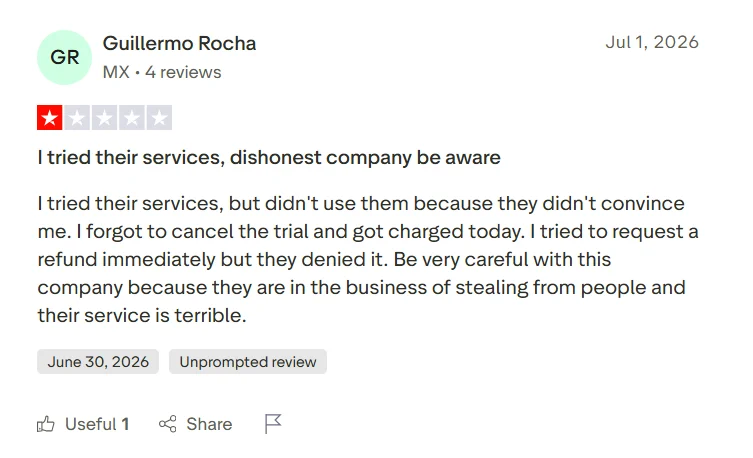
This review focuses on a subscription or trial-related complaint. The reviewer says they tried the service, did not continue using it, forgot to cancel, and later could not get a refund. This is different from AI accuracy, but it still matters in a full JustDone AI review. Students often sign up for tools when they are stressed about deadlines, and that is when subscription details can be missed. The practical advice is simple: before using any paid AI detector, check the renewal terms, cancellation process, and refund policy.
Image Placement: Review Claims Misleading Pricing and Refund Refusal
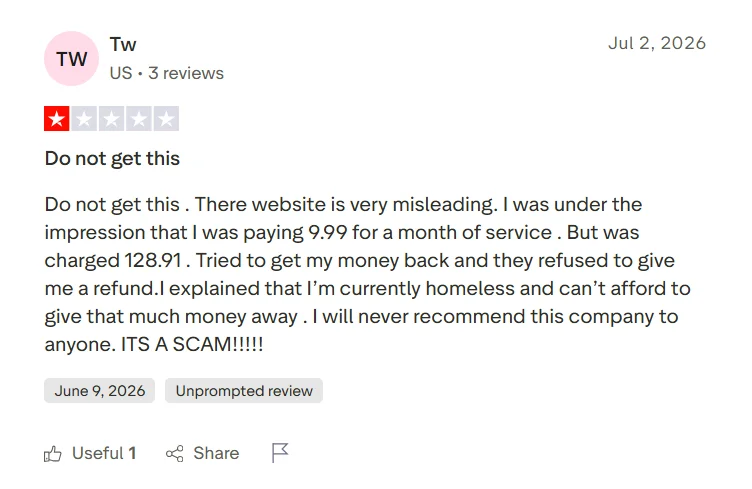
This screenshot shows a user claiming they expected to pay a smaller monthly amount but were charged a much higher amount. The review also says the company refused a refund. Again, this is a billing-focused complaint rather than a detector accuracy complaint. Still, it affects trust because students need tools that are transparent and affordable. If you decide to use JustDone, do not rush through checkout. Confirm the plan, billing cycle, total amount, and cancellation terms before paying.
Student Says Own Writing Was Marked 85% AI
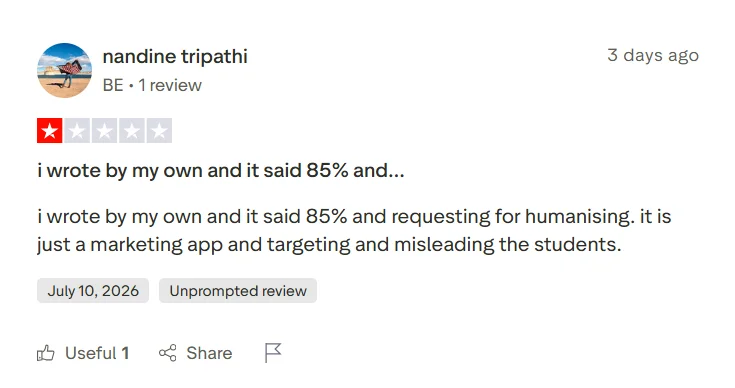
This review says the user wrote the content themselves, but JustDone marked it as 85% AI and then pushed humanizing. The reviewer felt the platform was misleading students. This is a common concern with AI detector and humanizer tools: if a detector gives a scary score and then offers a paid “fix,” users may feel pressured. That does not automatically mean the tool is dishonest, but it does mean students should be careful. A high AI score should lead to thoughtful editing, not panic-buying.
Free Score and Paid Result Appear to Conflict
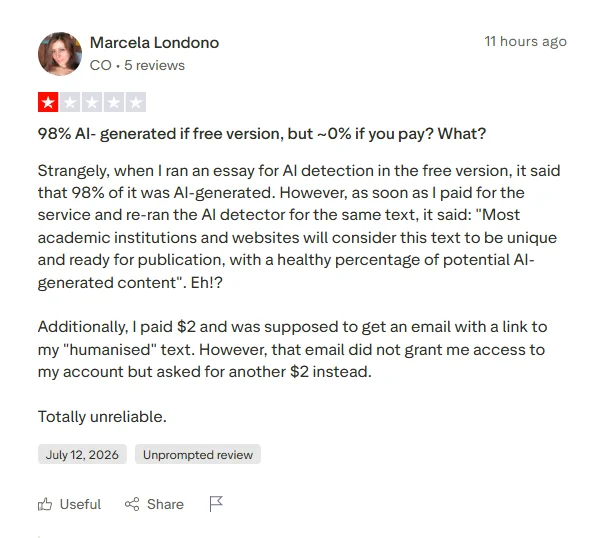
This review claims that the free version showed an essay as 98% AI-generated, but after payment and re-running the same text, the result suggested it was mostly human. The reviewer also complained about paying for a humanized text link and not getting proper access. If accurate, this would raise concerns about consistency and user trust. For students, the main takeaway is that AI detection results can vary between scans, versions, or tool settings. Do not treat a single score as absolute truth.
Positive JustDone AI Reviews on Trustpilot
Not all reviews are negative. Several Trustpilot screenshots show users praising JustDone. Some users say it is easy to use, helpful for checking plagiarism and AI detection, and useful for writing support.
This is why my review is not simply “JustDone is bad.” A more accurate statement is: JustDone may be useful for some users, but students should be cautious when using its AI detector for academic decisions.
User Says JustDone Helped With AI and QuillBot Checks
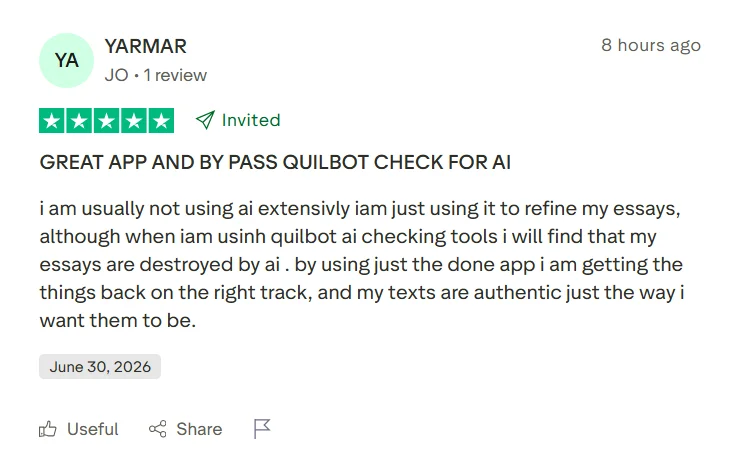
This positive review says JustDone helped the user refine essays and deal with AI detection concerns, including situations where QuillBot flagged their writing. This shows that some users find the platform genuinely useful for improving text and checking AI scores. It also suggests that people often compare multiple detectors because results can differ from tool to tool. That is a smart approach, as long as students remember that no detector is perfect. A positive experience does not remove the need for careful academic judgment.
User Says JustDone Helps Humanize Assignment Thoughts
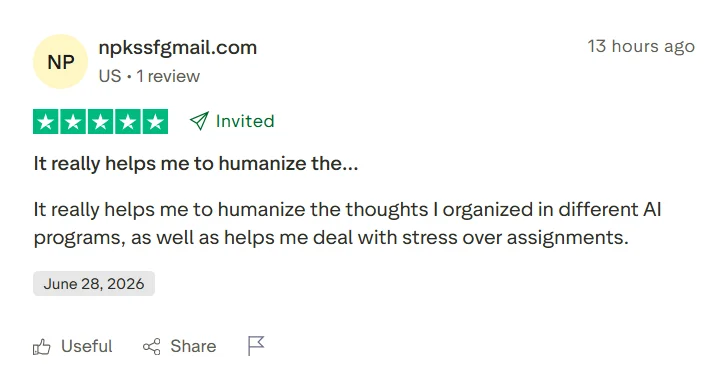
This review says JustDone helped the user humanize thoughts organized in AI programs and deal with assignment stress. That reflects a common student use case: students may use AI tools to brainstorm, then need help making the writing sound more natural. The risk is that “humanizing” should not become a shortcut for submitting work the student does not understand. Used responsibly, rewriting support can help polish ideas. Used carelessly, it can create academic integrity problems.
User Calls JustDone Nice and Easy to Use
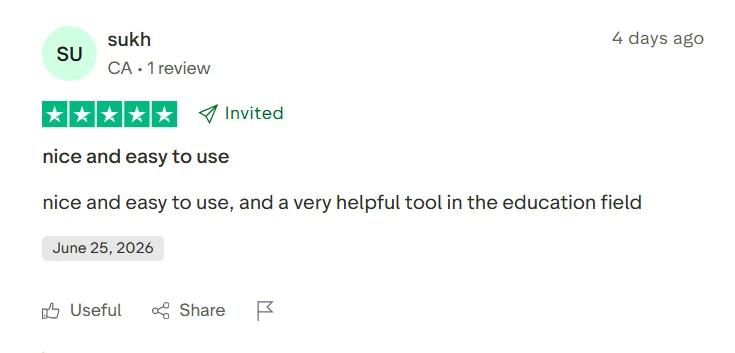
This review praises JustDone as nice, easy to use, and helpful in the education field. Ease of use is one of the platform’s strengths because students often need quick tools that do not require technical knowledge. A simple interface can make AI detection less confusing. However, ease of use does not automatically equal accuracy. A detector can be easy to use and still produce results that need careful interpretation.
User Reports Good Experience With Plagiarism and AI Detection
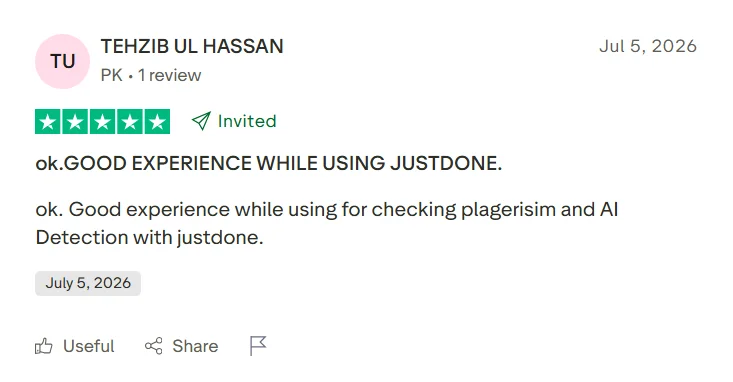
This review says the user had a good experience using JustDone for checking plagiarism and AI detection. This is relevant because many students want both services together. AI detection checks whether text may look machine-generated, while plagiarism checking looks for similarity with existing sources. Those are related but not the same thing. For academic work, students usually need both originality checking and proper citation review.
User Says JustDone Helps Generate Ideas and Sentences
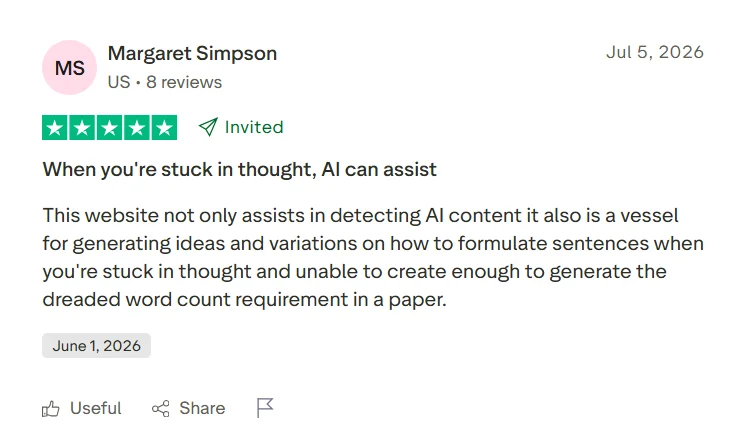
This review focuses more on writing assistance than AI detection. The user says JustDone helps generate ideas and sentence variations when they are stuck. That can be useful for brainstorming, especially when students are dealing with writer’s block. However, students should be careful to turn generated ideas into their own work, with proper understanding and citations. A writing assistant can support learning, but it should not replace original thinking.
JustDone AI Reddit Reviews
Reddit reviews tend to be more direct and less polished than Trustpilot reviews. That can be useful because users often speak casually about what frustrated them.
The Reddit screenshots I reviewed were mostly critical. Several users complained that JustDone marked their own writing or notes as AI-generated. Others criticized the humanizer and described the detector as unreliable.
Again, I cannot verify every Reddit claim independently from screenshots alone. But the pattern is similar to the negative Trustpilot reviews and my own test results: false positives are a recurring concern.
User Says Human Written Were Marked 78% AI
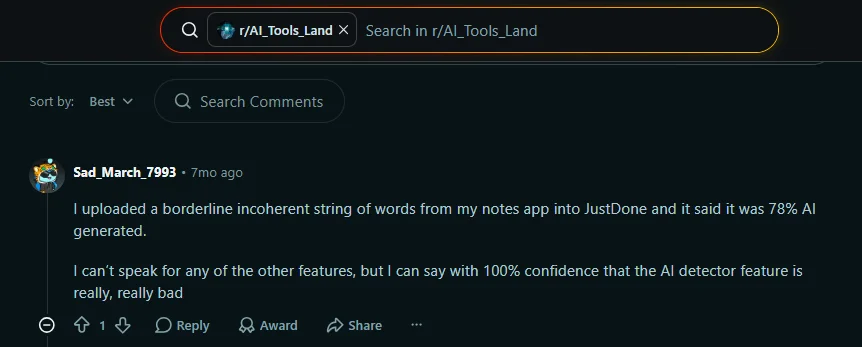
This Reddit screenshot shows a user saying they uploaded a borderline incoherent string of words from their notes and JustDone marked it as 78% AI-generated. The user then says they believe the AI detector feature is bad. This matters because notes are usually messy, personal, and not polished like AI writing. If a detector flags rough personal notes as AI, users may question what signals the tool is actually using. It reinforces the concern that AI scores need context.
User Says Original Material Was Marked 80% AI
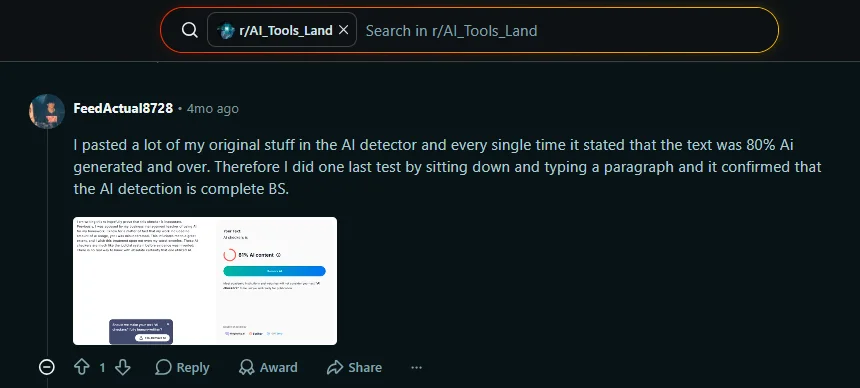
This Reddit review says the user pasted original content into the AI detector and it repeatedly said the text was 80% AI-generated or more. The user also mentions trying a paragraph and saying another tool or system confirmed it as complete. The important point is not the exact comparison but the frustration: users want consistency. If their own writing keeps getting high AI scores, they lose trust in the detector. Students should treat such results as a reason to review style, not as automatic proof of misconduct.
User Says Their Own Text Was Marked 75% AI While Other Platforms Said 0
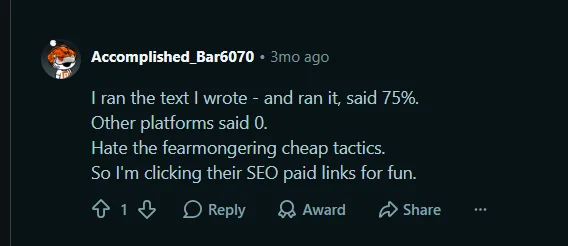
This screenshot shows a user saying they ran text they wrote and JustDone marked it as 75%, while other platforms said 0. This is a classic example of AI detector disagreement. Different tools use different models, thresholds, and detection signals, so they can produce very different results for the same text. That is why I never recommend relying on one AI detector only. If the result affects academic decisions, students should check writing history, drafts, citations, and human explanation, not just one score.
User Criticizes the Humanizer Output
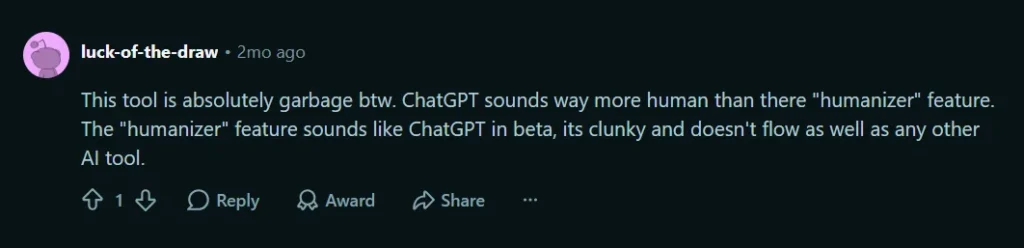
This Reddit screenshot criticizes JustDone’s humanizer, saying ChatGPT sounds more human than the tool’s humanizer feature. The user also says the humanizer produces poor writing that does not make sense. This is important because many AI detector platforms encourage users to “humanize” flagged text. But if the rewrite damages clarity or meaning, it can make academic work weaker. Students should never use a humanizer blindly. The goal should be clear, original, well-supported writing, not just beating a detector.
Strengths of JustDone AI Detector
JustDone AI detector does have some strengths. It is easy to access, simple to use, and gives quick results. For a student who wants a fast first impression of whether their writing sounds AI-like, that can be helpful.
It also appears to be part of a wider writing platform, which means users can access other tools such as plagiarism checking, paraphrasing, summarizing, and humanizing. For some users, having everything in one place is convenient.
The tool also detected both of my fully AI-generated samples as AI. That means it can identify obvious AI text in at least some cases. If you paste raw AI output into the detector, there is a good chance it will flag it.
The strengths are:
| Strength | Why It Helps |
| Simple interface | Students can use it quickly |
| Fast AI score | Useful for first-stage checking |
| Detects obvious AI text | Helpful for raw AI-generated drafts |
| Includes multiple writing tools | Convenient for users who want an all-in-one platform |
| Has plagiarism-related features | Useful when checking originality |
| Supports academic-style use cases | Designed partly for students and academic writing |
But the strengths do not cancel out the limitations. A tool can be useful and still risky if students rely on it too much.
Weaknesses of JustDone AI Detector
The biggest weakness I found is false positives. In my test, fully human-written content received a 97% AI content score. Several Trustpilot and Reddit screenshots show similar complaints from users who say their own writing was marked as AI.
That matters because students do not just use detectors casually. They use them because they are scared of academic penalties, Turnitin AI scores, plagiarism allegations, or being accused unfairly. A wrong AI score can create real stress.
Another weakness is score interpretation. Many users see “92% AI” and assume that means the detector is 92% certain the work was written by AI. But AI detection scores are not always that simple. They are based on patterns and probabilities, not direct evidence of who wrote the text.
JustDone also connects detection with rewriting or humanizing features. That can be useful, but it can also create pressure. If a detector scares a student and then offers a paid solution, the student may feel pushed to rewrite even when the original work was fine.
Main weaknesses include:
| Weakness | Why It Matters |
| False positives | Human writing may be flagged as AI |
| Inconsistent scoring | Similar content types may receive different scores |
| Academic writing risk | Formal writing can look AI-like |
| Humanizer concerns | Rewrites may reduce clarity or meaning |
| Billing complaints in reviews | Students should check payment terms carefully |
| Not a final authority | Cannot replace university review systems |
This is why students need to understand understanding the difference between human and ai writing instead of only chasing a lower detector score.
JustDone AI Detector vs Other AI Detectors
JustDone is not the only AI detector available. Students often compare it with QuillBot, ZeroGPT, StealthWriter AI, Turnitin, and academic-focused support platforms like Skyline Academic.
Each tool has different strengths. Some are better for quick checks. Some are better for understanding writing style. Some include rewriting or humanizing tools. But none of them should be treated as perfect.
| Tool | Best For | Main Limitation | Student Suitability |
| JustDone AI Detector | Quick AI score and writing tools | False positive concerns from tests and reviews | Useful with caution |
| QuillBot AI Detector | Simple AI checking | May also vary by writing style | Good for a second opinion |
| ZeroGPT | Fast AI detection scan | Can be inconsistent depending on text | Useful for quick checks |
| StealthWriter AI | Rewriting and humanizing | Not ideal as academic proof | Use carefully |
| Turnitin | University-level similarity and AI review | Not always available to students before submission | Important but not fully transparent |
| Skyline Academic | Academic AI detection plus student support | Service-based, not just instant software | Strong for students needing guidance |
If you want to compare tools, you can also read the Quillbot AI detector, Zerogpt, and Stealthwriter AI reviews.
The main thing to remember is that different detectors can disagree. One may say 0% AI, another may say 80% AI, and another may say your essay was written by a cybernetic ghost. Okay, maybe not that last one, but you get the point.
Best Alternative to JustDone AI Detector for Students
If you are a student, the best alternative to JustDone AI is not always another basic AI detector. Sometimes, you need academic support that explains why your writing is being flagged and how to improve it responsibly.
This is where Skyline Academic can be a strong alternative. Skyline Academic offers academic-focused AI detection support, plagiarism checking, and personalized student guidance. It is not just about giving you a score and leaving you confused. The aim is to help students understand their work, improve writing quality, check originality, and prepare more confidently.
Students can also use Skyline Academic’s free ai detector for essays if they want a quick AI detection check before submission. The platform also supports students with tutoring, coursework guidance, dedicated LMS access, video lectures, materials, bootcamps, workshops, and progress tracking.
That matters because students often need more than “your essay is 83% AI.” They need to know what to do next. Should they rewrite? Should they cite better? Is the writing too generic? Is the structure weak? Is the problem actually plagiarism, not AI? This is where academic support makes a real difference.
Skyline Academic also offers practical guides about ai that help students understand AI detection, academic integrity, and responsible writing.
JustDone AI Detector for Students: Should You Use It?
Students can use JustDone AI detector, but carefully. I would not tell students to avoid it completely, because it can be useful as a quick scan. But I would also not recommend using it as your only source of truth.
Use it when:
| Situation | Should You Use JustDone? | Why |
| You pasted raw AI text and want to check it | Yes | It may flag obvious AI writing |
| You want a quick first scan | Yes | It gives fast feedback |
| Your essay is fully human-written | Use with caution | False positives are possible |
| You are submitting to university | Do not rely on it alone | University systems may differ |
| You receive a high AI score | Review calmly | Do not panic or pay instantly |
| You need proper academic improvement | Get support | Tutoring and editing may help more |
If you are using AI tools for brainstorming, make sure your final assignment reflects your own understanding. If you want to learn more about responsible writing and editing, you can read this guide on how to avoid ai detection, but the main point should always be ethical writing, not tricking a system.
A better student workflow would look like this:
- Write your draft in your own words.
- Keep earlier drafts or notes as proof of your process.
- Check plagiarism and citations.
- Run an AI detection scan.
- Review flagged sections for generic or robotic wording.
- Rewrite only where the writing genuinely needs improvement.
- Make sure you understand and can explain your own work.
Can JustDone AI Detector Replace Turnitin?
No, JustDone AI detector cannot replace Turnitin.
Turnitin is usually used by universities for similarity checking and sometimes AI writing indicators. JustDone is a third-party tool that students can use independently. These tools may not use the same methods, databases, or thresholds.
It is also important to understand that AI detection and plagiarism detection are different. AI detection looks for machine-generated writing patterns. Plagiarism detection checks whether your work matches existing sources. Similarity checking looks at overlap with published materials, student papers, websites, and databases.
That is why students should understand both can turnitn detect ai and Turnitin similarity score before assuming that one tool gives the whole answer.
Here is the difference:
| Check Type | What It Looks For | Example Tool | Student Risk |
| AI detection | AI-like writing patterns | JustDone, QuillBot, ZeroGPT | False positives and inconsistent scores |
| Plagiarism detection | Matching text from sources | Turnitin, plagiarism checkers | Missing citations or copied text |
| Similarity score | Overlap with existing content | Turnitin | High similarity may need review |
| Human academic review | Logic, citations, originality, understanding | Tutor, editor, instructor | Best for meaningful improvement |
A low JustDone score does not guarantee a low Turnitin AI result. A high JustDone score does not guarantee academic misconduct. They are different systems.
Is JustDone AI Legit or a Scam?
Based on what I reviewed, JustDone AI is a real platform, not a fake website. It offers AI detection and writing tools, has public reviews, and some users clearly report positive experiences.
However, some reviews raise concerns about billing, refunds, trial charges, detector reliability, and humanizer quality. So, I would not call it a scam based only on mixed screenshots, but I would say students should proceed carefully.
Here is my practical advice:
| Question | My Answer |
| Is JustDone AI legit? | Yes, it appears to be a real platform |
| Is every result trustworthy? | No |
| Are there positive reviews? | Yes |
| Are there serious complaints? | Yes |
| Should students pay immediately after a scary AI score? | No |
| Should users read billing terms first? | Absolutely |
If you want to try it, test it with small samples first. Compare results with another detector. Do not upload sensitive work without checking privacy terms. And do not assume the paid version will automatically solve academic writing problems.
Is JustDone AI Detector Worth It?
JustDone AI detector may be worth trying if you want a quick AI score and access to several writing tools in one platform. But for students, I would be cautious about paying for it purely because one scan gave a scary result.
The strongest reason to be careful is the false positive issue. My human-written test received a 97% AI score. Several user reviews also mention self-written work being flagged as AI. If your main concern is academic submission, that inconsistency matters.
It may be worth it for:
- Quick first-stage AI checking
- Basic writing review
- Trying multiple writing tools in one platform
- Checking obvious AI-generated drafts
- Comparing results with other detectors
It may not be worth it if:
- You need a highly reliable academic AI decision
- You are worried about false positives
- You expect Turnitin-style certainty
- You want detailed human academic feedback
- You are not comfortable with subscription-based tools
For students, a better value may come from combining AI detection with academic writing support, plagiarism checking, and proper coursework guidance.
My Final Verdict: Is JustDone AI Detector Legit and Worth Using?
JustDone AI detector is legit in the sense that it is a real tool from a real platform. It can detect obvious AI-generated writing, and some users say it helps with writing, plagiarism checking, AI detection, and idea generation.
But based on my own test results and the review screenshots I analyzed, I would not rely on JustDone AI detector as the final judge of academic writing. The false positive risk is too important to ignore. When human-written content gets marked as 97% AI, students need to be careful.
My final verdict is simple: use JustDone AI detector as a quick first scan, not as final proof. If the result looks strange, compare it with other tools, review your writing style, check plagiarism, keep your drafts, and get academic support if needed.
For students, the goal should not be to chase a perfect AI score. The goal should be to write clearly, understand your work, cite properly, and submit something you can confidently explain.
FAQs About JustDone AI Detector
Is JustDone AI legit?
Yes, JustDone AI appears to be a real AI writing and detection platform. It offers tools such as AI detection, plagiarism checking, humanizing, paraphrasing, and writing support.
Is JustDone AI Detector accurate?
JustDone AI detector can detect obvious AI-generated content, but it may not always be accurate. My test showed that it also flagged human-written content as highly AI-generated.
How accurate is JustDone AI Detector?
The accuracy seems mixed. It detected fully AI-generated samples, but it also produced high AI scores for human-written and partially human-written content.
Does JustDone AI work for student essays?
It can work as a quick first scan, but students should not rely on it alone. Academic writing can sometimes look AI-like because it is formal, structured, and polished.
Can JustDone AI Detector detect ChatGPT?
Yes, JustDone AI detector is designed to detect AI-generated writing, including content that may come from tools like ChatGPT. However, detection results can still vary.
Can JustDone AI give false positives?
Yes, false positives are possible. In my test, a fully human-written sample was marked as 97% AI content, which is a major concern for students.
Is JustDone AI better than QuillBot AI Detector?
It depends on the text and use case. Some users may prefer JustDone, while others may find QuillBot simpler. The best approach is to compare results and not trust one detector only.
Is JustDone AI safe for academic work?
It may be safe for quick checking, but students should be careful with sensitive documents, payment terms, and over-reliance on AI scores. Always follow your institution’s academic rules.
What is the best alternative to JustDone AI Detector?
For students, a strong alternative is an academic-focused support service that combines AI detection, plagiarism checking, and writing guidance rather than only giving a score.
Should students rely on JustDone AI before submitting assignments?
Students can use it before submission, but only as one part of the review process. They should also check plagiarism, citations, drafts, writing quality, and university guidelines.