
Plagiarism isn’t just “copy-paste cheating.” It’s any situation where your work gives the impression that words, ideas, structure, data, or creative output are yours when they actually came from somewhere else. And because universities now rely on a mix of detection software, academic integrity policies, and human review, even small mistakes can turn into a big problem.
If you’re trying to stay safe, the smartest first step is to check your writing before you submit it. A free plagiarism checker for students can help you spot obvious overlaps, missing quotation marks, or citation gaps while you still have time to fix them.
Plagiarism is also more common than many students think. For example, the International Center for Academic Integrity summarizes survey findings where a large share of students admitted to plagiarism (alongside other forms of cheating). That doesn’t mean you should panic. It means you should learn what counts as plagiarism, what it looks like in real assignments, and how to avoid it confidently.
In this pillar guide, you’ll learn the 9 major types of plagiarism that can get you in trouble, along with practical examples, why students get flagged, and the habits that keep your work clean.
Why “Types of Plagiarism” matter more than a similarity score
Many universities use tools like Turnitin, but it’s important to understand what those tools do and don’t do. A similarity report highlights matching text and shows where it appears, but it doesn’t automatically prove plagiarism. Whether something is plagiarism depends on context: quotation marks, citations, how you used the source, and whether the assignment allows certain reuse. (Turnitin Guides)
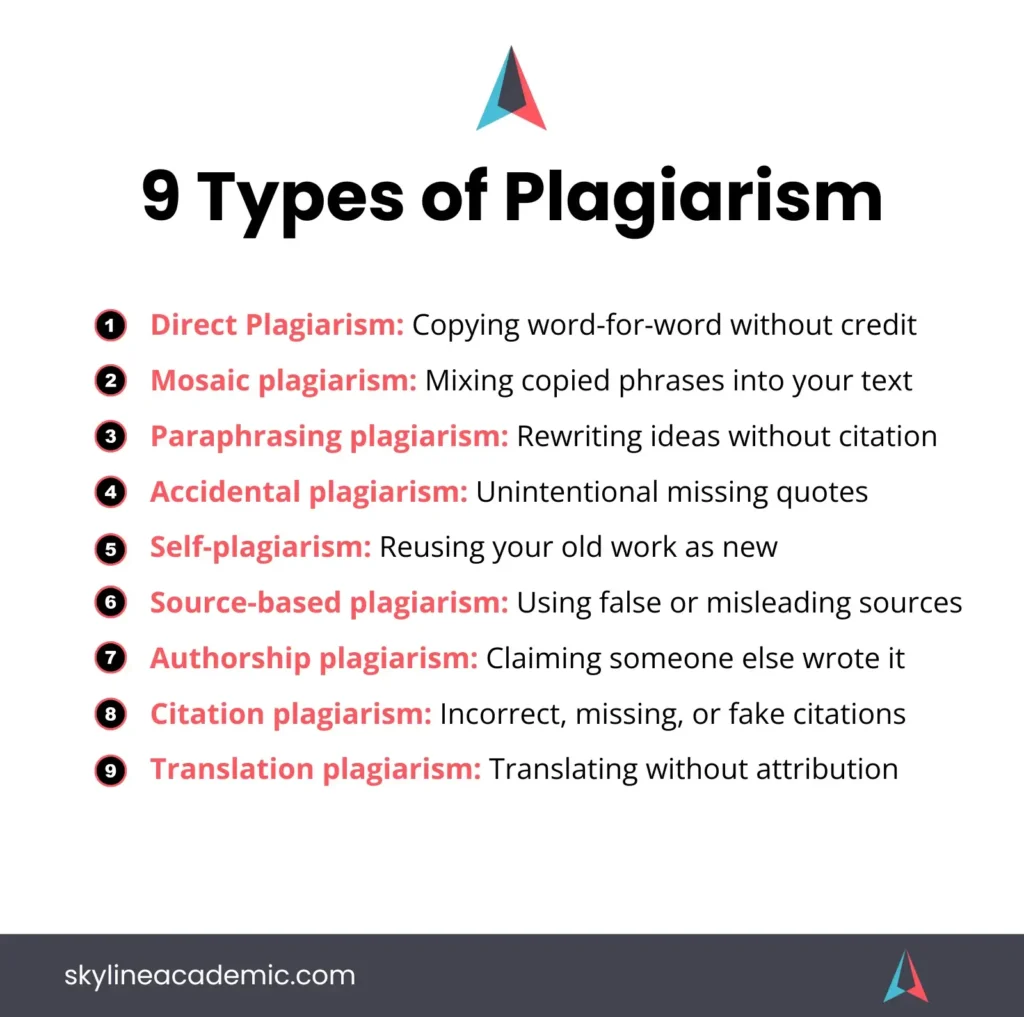
That’s why knowing the different Types of Plagiarism matters. Some are obvious (like copying a paragraph). Others are sneaky and accidental (like patchworking sentences from multiple sources or citing the wrong page). The safer you want to be, the more you need to recognize each type.
1) Direct plagiarism (word-for-word copying)
If you want a deeper breakdown of this, see this guide on direct plagiarism.
Definition
Direct plagiarism is copying someone else’s words exactly (or almost exactly) and presenting them as your own, without quotation marks and proper citation.
Realistic academic example
You find a journal article and copy a full paragraph into your literature review. You change one or two words, but most of the sentence structure stays identical. You don’t use quotation marks and you either don’t cite the source or cite it in a vague way.
Why students get flagged
This is the easiest type for detection tools and markers to spot because the text matches a source very closely. Even if you cite the source, copying word-for-word without quotation marks can still be considered plagiarism in many institutions.
How to avoid it
Write from understanding, not from the source text. If you truly need a direct quote, keep it short, use quotation marks, and cite it correctly. Otherwise, close the source and explain the idea in your own words, then cite the source as the origin of the idea.
2) Mosaic plagiarism (patchwriting)
Explore examples and fixes in this guide to mosaic plagiarism.
Definition
Mosaic plagiarism (also called patchwriting) is when you borrow phrases, sentence structures, or “chunks” from a source and stitch them into your writing, often mixing them with your own words.
Realistic academic example
You’re writing an introduction about climate-resilient infrastructure. You copy a sentence from one article, swap a few words with synonyms, then copy half a sentence from another source, and merge them into a single paragraph.
Why students get flagged
Even if each individual borrowed phrase seems small, the overall paragraph can look unnatural and “source-shaped.” Similarity tools may flag multiple small matches, and human markers often recognize the patchwork style quickly.
How to avoid it
Use a two-step method:
- Read the source and take brief notes in your own words.
- Write your paragraph from your notes without looking at the original wording.
Then add citations to the sources that informed your ideas.
3) Paraphrasing plagiarism (bad paraphrasing)
For a detailed guide, read paraphrasing plagiarism.
Definition
Paraphrasing plagiarism happens when you rewrite a source but stay too close to the original structure, phrasing, or progression of ideas, or you fail to cite the source even though the ideas came from it.
Realistic academic example
Original idea: “X policy reduced emissions by targeting high-impact sectors through a combination of regulation and financial incentives.”
Your version: “The policy lowered emissions by focusing on high-impact sectors using regulations and financial incentives.”
It’s basically the same sentence, just rearranged.
Why students get flagged
Markers look for paraphrases that mirror the original too closely, especially when key phrases repeat. Similarity tools may also catch overlap if distinctive wording remains.
How to avoid it
A real paraphrase changes:
- wording
- sentence structure
- and often the order of information
Then you cite the source because the idea is still borrowed, even if the words are yours.
4) Accidental plagiarism (unintentional mistakes)
If you’re worried about honest errors, read more about accidental plagiarism.
Definition
Accidental plagiarism is plagiarism that happens due to poor note-taking, rushed writing, confusion about citation rules, or misunderstanding what needs a reference.
Realistic academic example
You take notes from multiple sources while researching. Later, you paste your notes into your draft and forget which sentences were copied and which were your own. You submit with missing citations or missing quotation marks.
Why students get flagged
Universities judge submitted work, not intentions. Even if you didn’t mean to plagiarize, the outcome can still breach academic integrity rules.
How to avoid it
Build a simple safety system:
- Keep copied quotes in a different color and always label them as “direct quote.”
- Record full reference details while researching, not at the end.
- Use a final pre-submission scan with a free plagiarism checker for students and a citation check (do all borrowed ideas have a reference?).
5) Self-plagiarism (reusing your own work)
For clear examples, see self-plagiarism.
Definition
Self-plagiarism is submitting your own previously submitted work (or large parts of it) as if it’s new, without permission or disclosure.
Realistic academic example
You submitted a research methods section last semester. This term, you reuse the same methods section in a new assignment because “it’s your own writing,” and you don’t tell your instructor.
Why students get flagged
Many institutions compare new submissions against past submissions, including your own. Even when it’s your work, the assignment expects original effort and assessment.
How to avoid it
Check your module rules. If reuse is allowed, disclose it and cite yourself or reference the previous work as required. If reuse isn’t allowed, rewrite and expand with new sources and updated analysis.
6) Source-based plagiarism (misrepresenting sources)
Learn the patterns that trigger problems in this detailed guide source-based plagiarism.
Definition
Source-based plagiarism is when you misuse sources in a way that misleads the reader, such as citing a source you didn’t read, citing something that doesn’t support your claim, or copying a reference list from another paper.
Realistic academic example
You see a strong statistic in a blog post that cites a journal article. Instead of reading the journal article, you cite the journal article directly in your essay as if you verified it.
Why students get flagged
Markers often check high-impact claims. If your cited source doesn’t contain what you claim, it looks like fabrication or careless scholarship. This can be treated seriously, especially at postgraduate level.
How to avoid it
Only cite what you personally accessed and verified. If you’re relying on a source you found through another source, either:
- track down the original and read it, or
- cite it transparently as a secondary citation (if your style guide allows it).
7) Authorship plagiarism (someone else did the work)
For policy-aligned explanations, see authorship plagiarism.
Definition
Authorship plagiarism is submitting work that wasn’t written by you: contract cheating, buying assignments, using a friend’s work, or having someone “rewrite” your essay in a way that becomes their writing.
Realistic academic example
You pay a writer online to produce a full essay. Or a friend gives you their previous coursework and you submit a lightly edited version.
Why students get flagged
Universities investigate authorship through:
- sudden style shifts compared to your past work
- inconsistent knowledge in viva-style questioning
- unusual references you can’t explain
- draft and process checks (notes, outlines, version history)
How to avoid it
Use support ethically. Feedback, proofreading, tutoring, and guidance are usually fine when they don’t replace your authorship. If you need legitimate help, start at Skyline Academic for student-focused support options that prioritize academic integrity.
8) Citation plagiarism (incorrect, missing, or misleading citations)
For common mistakes, see citation plagiarism.
Definition
Citation plagiarism includes missing citations, incorrect citations, citing the wrong author/year, or using citations in a way that hides where information came from.
Realistic academic example
You paraphrase a researcher’s argument, but you only cite them once at the end of a long paragraph that includes ideas from three different sources. Or you cite an author but the page number is wrong, making your claim impossible to verify.
Why students get flagged
Markers expect traceability. Poor citation quality can look like you’re trying to mask borrowing or inflate your research.
How to avoid it
Treat citations like a map:
- Any borrowed idea gets a citation.
- Any data point gets a citation.
- Any distinctive phrasing gets a quote + citation.
Also check your referencing style (UWE Harvard, APA, MLA, etc.) and be consistent.
9) Translation plagiarism (copying across languages)
For examples that universities recognize, read translation plagiarism.
Definition
Translation plagiarism happens when you translate text from another language and submit it as your own without acknowledging the original source.
Realistic academic example
You find a strong explanation in a non-English article. You translate it into English and include it in your essay with no citation because “it’s not the same words anymore.”
Why students get flagged
Translation can preserve structure and unique phrasing patterns, and the underlying ideas are still borrowed. Academic integrity rules generally treat translation without citation as plagiarism.
How to avoid it
Cite the original source even if you translated it. If you used a translation tool, make sure your final writing is accurate and still reflects your understanding, not just a machine-translated paragraph.
Quick comparison: which Types of Plagiarism are most common?
A lot of students focus only on “copying,” but in real cases, trouble often comes from the messy middle: patchwriting, bad paraphrasing, missing citations, and rushed referencing. That’s why it helps to do a final workflow check before submitting:
- Did I quote anything word-for-word and add quotation marks?
- Did I paraphrase properly and still cite the source?
- Can I justify every citation and every claim?
- Does my reference list match my in-text citations?
- Did I run a scan with a free plagiarism checker to catch accidental overlap?
This is how you avoid most plagiarism issues without overthinking every sentence.
How universities typically handle plagiarism cases
Policies vary, but the process usually looks like this:
- A marker notices overlap or inconsistencies (often via similarity reports). (Turnitin Guides)
- The department reviews the evidence (matched sources, formatting, citation accuracy, writing style).
- You may be asked to explain your process, provide drafts, or discuss your sources.
- Outcomes range from a warning and resubmission to a capped grade, module failure, or formal misconduct procedures.
The best defense is prevention: write with good source habits, keep drafts, and cite as you go.
FAQs about Types of Plagiarism
1) What are the most common Types of Plagiarism among students?
The most common Types of Plagiarism are bad paraphrasing, missing citations, and patchwriting (mosaic plagiarism). They often happen when students rush or don’t understand how much they need to reference.
2) Can I get in trouble for accidental Types of Plagiarism?
Yes. Accidental Types of Plagiarism can still breach academic rules because institutions assess the submitted work, not your intention. The fix is better note-taking, citation habits, and a final plagiarism scan.
3) Are all Types of Plagiarism detected by software?
Not always. Similarity tools highlight matching text, but some Types of Plagiarism (like source misrepresentation or authorship issues) are often identified through human review and academic questioning.
4) Is paraphrasing without citing still one of the Types of Plagiarism?
Yes. Even if you use your own words, the idea still belongs to the original author. Paraphrasing without a citation is one of the clearest Types of Plagiarism in academic writing.
5) Is self-plagiarism really counted in the Types of Plagiarism?
In many universities, yes. Reusing your own past submission without permission can be treated as self-plagiarism because the assignment expects original work created for that assessment.
6) How do I avoid Types of Plagiarism when using sources heavily?
Plan your structure first, take notes in your own words, and cite every borrowed idea. Before submission, run a check using a plagiarism tool and confirm quotations and references are formatted correctly.
7) What should I do if I think my draft has Types of Plagiarism?
Don’t submit yet. Identify the matched parts, rewrite from understanding, add citations, and use a checker to confirm improvements. Keeping drafts and source notes also helps if your work is questioned later.