
If you’ve ever thought, “It’s my own work, so I can reuse it,” you’re not alone. Many students recycle parts of an old assignment, a lab report, or even a literature review because it feels efficient and harmless. The problem is that universities often treat this as Self Plagiarism, and it can still trigger academic integrity concerns.
Before you submit anything, it helps to check what your text matches against, especially if you’re reusing sections from past coursework. Running your draft through an accurate plagiarism checker for students can help you spot repeated wording early and decide what needs rewriting, quoting, or citing.
What is Self Plagiarism?
Self Plagiarism is when you reuse your own previously submitted or published work without permission or proper acknowledgment, and present it as if it’s new. It’s not “stealing from someone else,” but it can still be considered misleading because you’re getting credit twice for the same work.
Different institutions describe it in different ways, but the core issue is the same: assessment is meant to measure fresh learning and original effort for that specific task.
To understand how strict academic integrity can be, it’s worth noting that academic misconduct is common enough that integrity bodies track it closely. For example, the International Center for Academic Integrity cites survey results showing substantial levels of student-reported cheating and plagiarism. (Academic Integrity)
Why universities care about Self Plagiarism
Most university plagiarism rules are built around fairness and transparency. When you resubmit old work, you may be:
- Getting credit again for effort you already used to earn marks
- Skipping the learning outcomes of a new assessment
- Making it difficult for markers to judge your current ability
- Violating module rules that require original, tailored work
This is why Self Plagiarism can be treated as academic misconduct even when the writing is 100% yours.
If you’re learning the broader landscape, it helps to read through the main different types of plagiarism so you can see how self reuse fits alongside other forms of academic integrity issues.
Common Self Plagiarism examples (that students actually do)
Self Plagiarism isn’t always obvious. Here are some realistic scenarios where students get into trouble.
1) Submitting the same assignment for two modules
You submit a strong essay in one module, then upload it again (or with minor edits) for a different module. Even if the topics overlap, this is usually not allowed unless you have written permission.
2) Copying chunks from your previous coursework
You paste your old introduction, methodology, or conclusion into a new assignment. This is especially common in reports and dissertations where you’ve written similar background sections before.
3) Reusing your published work without citing it
If you’ve published a paper, conference poster, blog, or preprint, and reuse paragraphs without referencing the earlier version, that can count as Self Plagiarism in research contexts.
4) Recycling paraphrased sections that are still “too close”
Students sometimes think paraphrasing their own old writing is automatically safe. But if the structure, ideas, and phrasing stay nearly identical, it may still be flagged. (This overlaps with paraphrasing plagiarism concerns, where “rewriting” doesn’t always equal “original.”)
5) “Patchworking” old sections into a new paper
Mixing paragraphs from multiple past assignments can create a stitched-together draft that looks recycled. This can resemble mosaic plagiarism in the way it reuses patterns and chunks, even if the source is your own work.
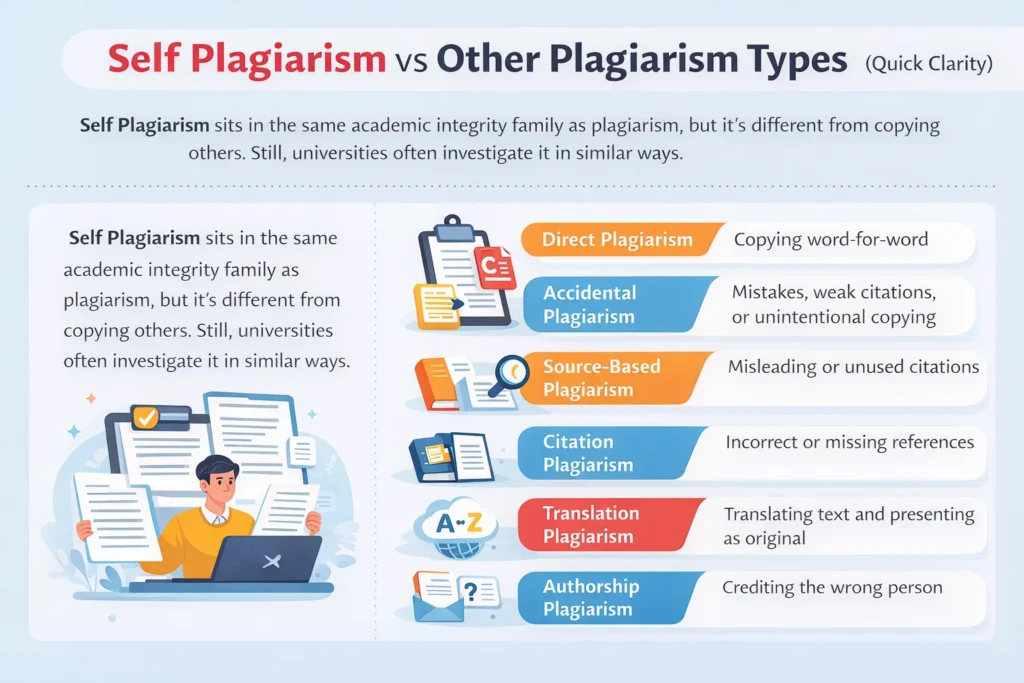
Self Plagiarism sits in the same academic integrity family as plagiarism, but it’s different from copying others. Still, universities often investigate it in similar ways.
- Direct plagiarism is copying someone else word-for-word.
- Accidental plagiarism happens when mistakes, poor note-taking, or weak citation habits create unintentional copying.
- Source-based plagiarism includes misleading citation practices, like citing sources you didn’t actually read.
- Citation plagiarism often involves incorrect, missing, or misleading references.
- Translation plagiarism is translating text from another language and presenting it as original.
- Authorship plagiarism relates to crediting the wrong person or misrepresenting who created the work.
If you want the simplest mental model, think of it like this: plagiarism is about honesty of origin. Self Plagiarism is about honesty of originality and submission.
What do academic rules usually say?
Most universities include Self Plagiarism under “reusing work,” “recycling,” or “multiple submission.” Even when policies vary, two rules show up again and again:
- Don’t resubmit assessed work (unless permission is explicitly given).
- If you reuse any part of your earlier work, disclose it and cite it properly.
The consequences depend on severity and intent. It can range from a warning and resubmission to mark penalties, failing the assessment, or a formal misconduct record.
How Self Plagiarism is detected
Self Plagiarism is often caught through similarity checks and marker familiarity. Even if you’re not copying other people, your work can still match:
- Your earlier submissions stored in institutional databases
- Previously uploaded drafts or resits
- Published documents online
- Shared versions in group folders or class communities
This is also why using a tool like Skyline Academic’s free plagiarism checker can help you find repeated text before your lecturer does.
How to avoid Self Plagiarism (without overthinking it)
You don’t need to panic. In most cases, avoiding Self Plagiarism comes down to being upfront and doing a bit of rewriting.
- Ask for permission if you want to reuse a previous assignment or large section. A quick email can save you a misconduct case.
- Cite your previous work if you reuse ideas, sections, figures, or wording (especially in research writing).
- Rewrite with a new purpose: don’t just swap words. Rebuild the section around the new question, new sources, and new argument.
- Use your old work as notes, not copy-paste. Treat it like a starting point for planning, not a paragraph bank.
- If you’re unsure about what’s acceptable at your institution, check guidance on Skyline Academic and your module handbook, then confirm with your tutor.
FAQs about Self Plagiarism
1) What is Self Plagiarism in university assignments?
Self Plagiarism is reusing your own previously submitted work without permission or acknowledgment. Universities may treat it as academic misconduct because you’re presenting old work as new.
2) Can Self Plagiarism get you in trouble even if it’s your own work?
Yes. Self Plagiarism can lead to penalties because most university plagiarism rules prohibit resubmitting assessed work or recycling large sections without approval.
3) Is reusing a few sentences considered Self Plagiarism?
It can be. Small overlaps may be tolerated in some contexts, but repeated phrasing, reused structure, or copied sections can still count as Self Plagiarism, especially if it’s assessed work.
4) How do lecturers detect Self Plagiarism?
Similarity tools may match your submission to earlier coursework databases, and markers may notice familiar sections. Self Plagiarism is often flagged when large chunks repeat from a prior submission.
5) How can I avoid Self Plagiarism safely?
To avoid Self Plagiarism, don’t copy-paste old sections. Rewrite for the new task, cite your prior work if reused, and ask for permission if you want to submit overlapping content.
6) Is it Self Plagiarism to reuse my dissertation proposal in my dissertation?
Sometimes. If you reuse text, it may still be Self Plagiarism depending on your university rules. Many departments allow limited reuse, but you should confirm expectations and reference earlier versions where required.
7) What should I do if I already submitted Self Plagiarism by mistake?
Act fast. Email your tutor or module leader and explain honestly. Many universities treat Self Plagiarism differently when you disclose it early versus when it’s discovered during misconduct review.