
Mosaic plagiarism (also called patchwork plagiarism) happens when you build a paragraph by stitching together phrases, sentence patterns, or ideas from one or more sources, then making small edits so it looks “new.” It’s often unintentional, but it can still be treated as plagiarism because the writing is too close to the original sources.
Plagiarism is more common than many students realize: one frequently cited set of survey findings summarized by the International Center for Academic Integrity reports that 58% of students admitted to plagiarism. (Source: ICAI facts & statistics). If you want a quick safety check before submitting, run your draft through a free plagiarism checker for students and then fix any highlighted areas the right way (not just by swapping a few words).
What Is Mosaic Plagiarism?
Mosaic plagiarism is a form of plagiarism where a writer:
- pulls wording or sentence structures from sources,
- rearranges them,
- swaps in synonyms or minor edits,
- and blends everything into “original-looking” text without proper quoting and/or adequate paraphrasing.
It often happens during research-heavy assignments, especially when you’re working quickly or juggling multiple PDFs and tabs.
Why it happens (common student behaviors and misconceptions)
Most cases come from normal (but risky) habits, such as:
- Copying notes word-for-word “just for later,” then forgetting what was copied.
- Paraphrasing by editing (synonyms + same structure) instead of rewriting ideas in your own voice.
- Over-trusting citations: thinking that adding a reference automatically fixes close wording.
- Mixing sources inside one sentence without clear attribution.
- Confusing mosaic plagiarism with other forms listed in this types of plagiarism hub.
Mosaic plagiarism can overlap with source-based plagiarism (misusing sources) and citation plagiarism (referencing errors or missing citations), but it has a distinctive “stitched” writing pattern.
Mosaic Plagiarism vs Paraphrasing
Paraphrasing is when you fully restate a source idea in your own words and structure, and still cite the source. Patchwork plagiarism (or patchwriting) is when you keep too much of the source’s wording or sentence design and only “decorate” it with changes.
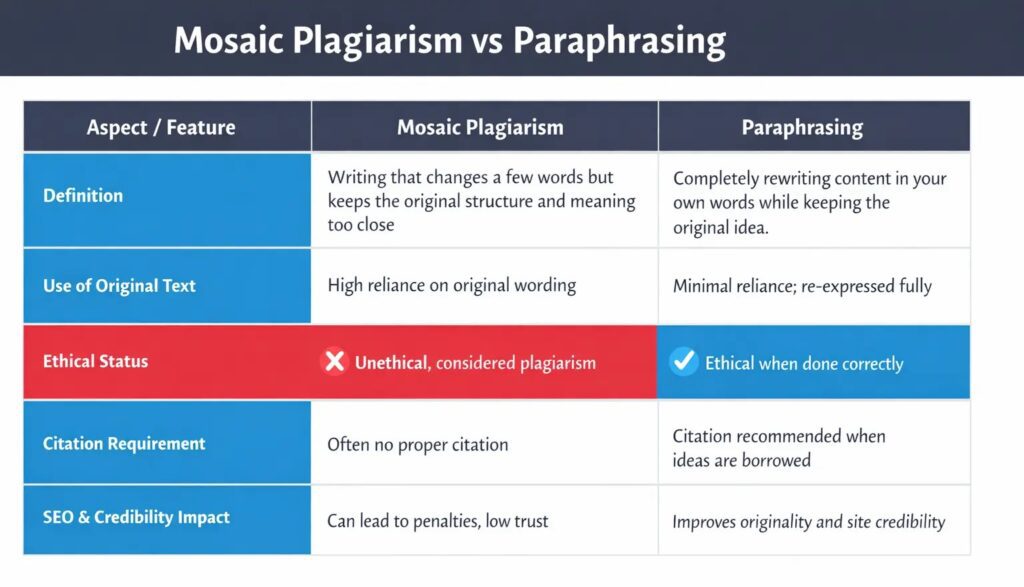
A practical way to think about it:
- Good paraphrase: same idea, new wording, new structure, clear citation.
- Mosaic/patchwork: same idea, similar wording, same structure, citation may or may not be present.
Patchwriting often appears in early drafts, especially for students writing in a second language or trying to sound “academic.” But if that draft gets submitted as-is, it can become accidental plagiarism – still risky, even without bad intent.
When paraphrasing becomes patchwriting
Paraphrasing turns into mosaic plagiarism when:
- you keep distinctive phrases from the source,
- you mirror the source sentence order,
- you change words but not meaning or structure,
- you combine multiple sources in one paragraph without clearly separating them.
Quick rule of thumb: If you can place the source text next to your sentence and see obvious “matching footprints” (same structure, same key phrases), it’s not safe yet. For a deeper breakdown, see our guide to paraphrasing plagiarism.
Mosaic Plagiarism Examples (Realistic, Student-Friendly)
Below are three short, realistic mosaic plagiarism examples with “problem” and “better” versions. (These are illustrative, not pulled from a single published source.)
Example 1: Patchworked sentence made from multiple sources
Problem version (what the student wrote):
“Urban heat islands raise city temperatures because dark surfaces absorb more solar radiation, and this leads to higher energy use and worse air quality.”
Why it’s mosaic plagiarism (1–2 sentences):
This sentence uses common source phrasing (“dark surfaces absorb solar radiation,” “higher energy use,” “worse air quality”) and blends typical wording from multiple readings without making the language and structure truly your own.
Better version (properly paraphrased and cited):
“Cities often become warmer than surrounding areas because built materials store and re-radiate heat; this extra warming can increase cooling demand and contribute to pollution problems (Author, Year; Author, Year).”
Example 2: Synonym swapping that keeps the original structure
Problem version (what the student wrote):
“Construction delays are frequently caused by poor planning, limited resources, and ineffective communication among stakeholders.”
Why it’s mosaic plagiarism (1–2 sentences):
Even if synonyms are added elsewhere, the sentence follows a very standard source template (“X are caused by A, B, and C”) and may closely match a textbook or article line if the wording is too similar.
Better version (properly paraphrased and cited):
“When projects fall behind schedule, the root issues often relate to how work is coordinated—especially scheduling decisions, capacity constraints, and how information is shared across the project team (Author, Year).”
Example 3: Mixing copied phrases with minor edits
Problem version (what the student wrote):
“Plagiarism undermines academic integrity and damages the trust between students and institutions, so universities use policies and software tools to identify misconduct.”
Why it’s mosaic plagiarism (1–2 sentences):
The sentence contains “signature” phrases often lifted from policy pages (“undermines academic integrity,” “damages trust,” “identify misconduct”). Even if the idea is true, the phrasing is too generic-source-like unless rewritten more originally.
Better version (properly paraphrased and cited):
“Because original work is central to fair assessment, institutions set integrity rules and review submissions for signs that a student’s writing relies too heavily on existing texts (Author, Year).”
If you’re unsure whether your draft is “too close,” a similarity review can help—but avoid the trap of simply editing highlighted text word-by-word. That’s how patchwork plagiarism happens.
Why Mosaic Plagiarism Is Risky
Mosaic plagiarism is risky because it can look like you deliberately copied, even when your intention was to learn from sources.
Typical academic consequences can include:
- grade penalties or a resubmission requirement,
- a formal academic misconduct record,
- failing an assessment or module,
- escalation for repeated offenses.
Instructors and integrity reviewers often notice mosaic plagiarism when your writing shows patterns like:
- sudden shifts in tone or vocabulary,
- paragraphs that read like “assembled” notes,
- inconsistent citation quality,
- sentences that closely mirror source structure.
Software can highlight matches, but decisions usually involve academic judgment too. If you want to understand the bigger picture of intentional copying, compare this with direct plagiarism and, if relevant, self-plagiarism (reusing your own previous work without permission).
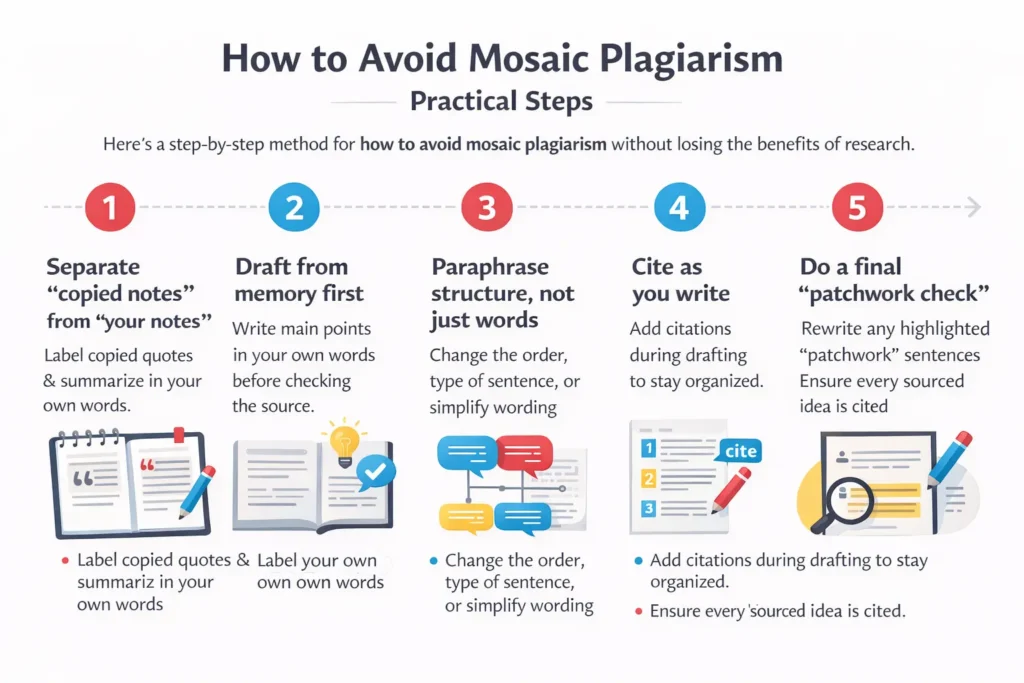
How to Avoid Mosaic Plagiarism (Practical Steps)
Here’s a step-by-step method for how to avoid mosaic plagiarism without losing the benefit of research.
Step 1: Separate “copied notes” from “your notes”
When you take notes, label them clearly:
- Copied quote (exact words) with quotation marks and page numbers
- Your summary in plain language
- Your comment (what you think it means for your argument)
This single habit prevents most patchwork plagiarism.
Step 2: Draft from memory first
After reading a source, close it and write the point in your own words from memory. Then reopen the source to verify accuracy. This reduces the chance you’ll mimic the source sentence structure.
Step 3: Paraphrase by changing structure, not just words
Ask yourself:
- Can I explain this idea in a different order?
- Can I use a different sentence type (cause-effect, contrast, example)?
- Can I simplify the wording while staying accurate?
Step 4: Cite as you write
Don’t leave citations for the end. Add them during drafting so you never lose track of what came from where. This also helps you avoid citation-related mistakes that turn into citation plagiarism.
Step 5: Do a final “patchwork check”
Before submitting:
- read each paragraph and highlight any sentence that sounds like a source,
- rewrite those sentences fully (not with small edits),
- ensure every sourced idea is cited.
If your assignment involves translated material, be careful: translating a source and lightly editing it can still count as plagiarism. See translation plagiarism for how to handle that correctly.
For an extra safeguard, you can run a last scan using Skyline Academic’s free plagiarism checker and focus your edits on rewriting and proper referencing, not cosmetic word swaps.
Quick Checklist Before Submitting
Use this checklist to catch patchwork issues fast:
- I can identify which sentences came from which sources.
- Any exact wording from a source is in quotation marks and cited.
- My paraphrases use a different structure, not just different synonyms.
- Each paragraph has a clear “my point” sentence, not only sourced statements.
- Citations appear right after the sourced idea (not only at the end of the paragraph).
- My references list matches my in-text citations.
- I re-read for tone shifts that suggest stitched-together writing.
- I checked that collaboration or shared notes didn’t become unauthorized copying (this can overlap with authorship plagiarism).
Takeaway: How to stay safe with sources
Mosaic plagiarism is usually a workflow problem, not a character flaw. If you separate notes properly, draft in your own voice, and cite consistently, you’ll avoid patchwork plagiarism while still using strong academic evidence. If you’d like more support with study and writing habits, explore resources on the Skyline Academic.
FAQs About Mosaic Plagiarism
What is Mosaic Plagiarism in simple terms?
Mosaic Plagiarism is when you build your writing by patching together bits of sources, then making small edits so it looks original. Even if you change some words, the structure and phrasing can stay too close.
Is Mosaic Plagiarism always intentional?
No. Mosaic Plagiarism is often accidental, especially when students copy notes first and paraphrase later. But intent doesn’t always remove academic consequences.
Can Mosaic Plagiarism happen even if I cite the source?
Yes. Mosaic Plagiarism can still happen when you cite but keep too much of the original wording or sentence structure. Citation doesn’t replace paraphrasing or quoting.
How many words can I copy before it becomes Mosaic Plagiarism?
There isn’t a universal “safe number.” Mosaic Plagiarism is about recognizable copying of phrasing and structure, not only word count. If wording is distinctive, quote it properly or rewrite it fully.
Are Mosaic Plagiarism and patchwork plagiarism the same thing?
In most academic policies, Mosaic Plagiarism and patchwork plagiarism refer to the same behavior: stitching together source language with small edits. Some instructors may also call it “patchwriting.”
What are the most common Mosaic Plagiarism examples in student essays?
Common Mosaic Plagiarism examples include synonym swapping, copying a sentence template from a source, and mixing small copied phrases into “paraphrased” lines. These usually appear in literature reviews and background sections.
What is the fastest way to fix Mosaic Plagiarism in a draft?
The fastest fix is to rewrite flagged sentences from scratch (not word-by-word edits), then add accurate citations. If a phrase must stay exact, use quotation marks and reference it properly.