
Source-based plagiarism is one of the most common plagiarism problems students run into because it does not always look like plagiarism. You can do the reading, take notes, add a reference list, and still get flagged. That is because the issue is not always “copy and paste.” Often, it is how sources are represented: what you cited, how you cited it, and whether your citation accurately matches what the source actually says.
If you want a quick safety check before you submit, use our free plagiarism checker for students early, not just the night before the deadline. It helps you spot high-risk areas like missing quotation marks, patchy paraphrasing, and inconsistent referencing that can trigger questions.
This topic matters because plagiarism is not rare. The International Center for Academic Integrity reports that in survey research, many students admit to plagiarism at least once, which shows how easily academic integrity can go wrong without strong citation habits. (academicintegrity.org)
What is source-based plagiarism?
Source-based plagiarism happens when your writing uses sources in a misleading, incorrect, or dishonest way, even if you include citations. In simple terms, it is plagiarism rooted in the way you handle your references.
It can include things like:
- Citing a source you did not read
- Citing the wrong source for a claim
- Using a citation to make a source look like it supports your point when it does not
- Paraphrasing so closely that it becomes patchwriting, even with a citation
This is different from “classic” plagiarism, where the main problem is copying text. With source-based plagiarism, the problem is often accuracy and transparency.
Why students get flagged unintentionally
Most students do not set out to mislead. Source-based plagiarism often comes from rushed writing, messy notes, and confusion about what counts as “enough” paraphrasing.
A useful insight here is that even when students try to cite, mistakes still happen. Research summaries often highlight how frequently students struggle with quoting, paraphrasing, and integrating sources correctly, leading to accidental misconduct. (academicintegrity.barefield.ua.edu)
Common scenarios include:
- You copied a sentence into your notes and later forgot it was a direct quote
- You paraphrased but kept the original structure and key phrases
- You cited a secondary source but made it look like you read the original
- You grabbed “supporting evidence” from a source that only vaguely relates to your claim
This is why many universities talk about academic integrity as both a skills issue and a conduct issue, especially for referencing. (sussex.ac.uk)
Other types of plagiarism
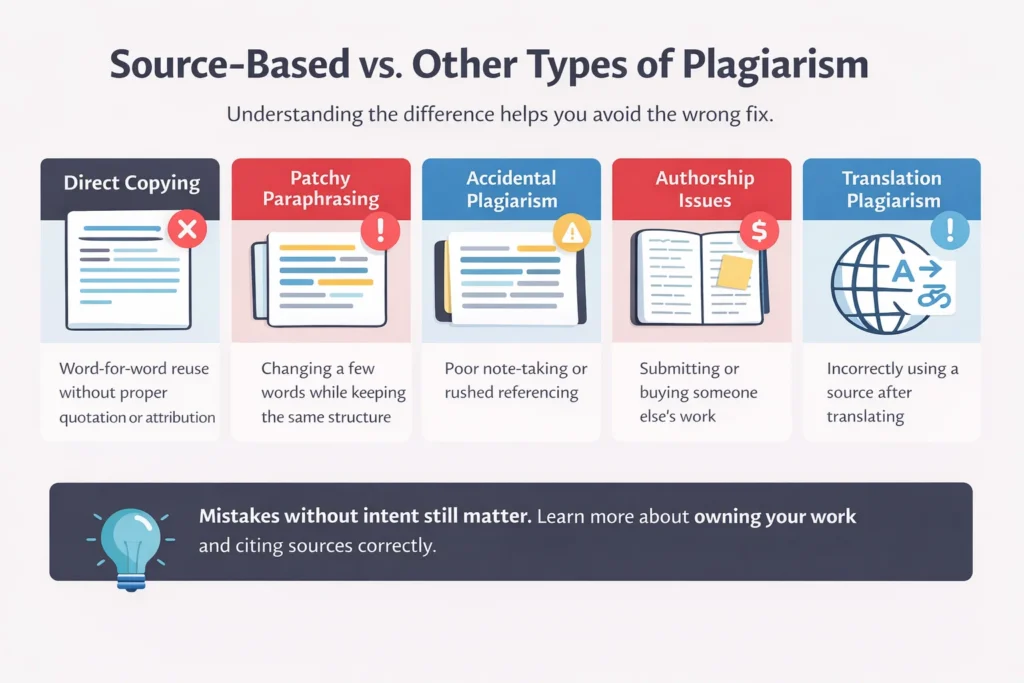
- Direct copying is usually about word-for-word reuse without proper quotation and attribution. See examples of direct plagiarism when text is lifted as-is.
- Patchy paraphrasing happens when you change a few words but keep the same structure and phrasing. That sits closely beside paraphrasing plagiarism and can overlap with mosaic plagiarism.
- Mistakes without intent still matter. Many students fall into accidental plagiarism through poor note-taking or rushed referencing.
- Ownership issues are different again, such as submitting someone else’s work or buying assignments. That falls under authorship plagiarism.
- Language switching can create unique citation risks if the source is used incorrectly after translation. Learn more about translation plagiarism.
If you want a clear overview, start with our pillar guide on different types of plagiarism to see how these categories connect.
Common citation and referencing mistakes that cause source-based plagiarism
Here are the most frequent problems instructors see, including cases where students honestly believe they cited correctly.
1) Citing a source you did not actually use
Example: You read an article that quotes a study, but you cite the study as if you read it.
Better approach: Cite what you actually read, and only cite the original if you accessed it yourself. If your referencing style allows secondary citations, use them properly.
2) Wrong source attached to the right sentence
Example: You have multiple tabs open and accidentally cite Source A for a statistic that came from Source B.
This is a big deal because it looks like careless scholarship at best and deliberate misrepresentation at worst.
3) “Citation laundering” (using citations to disguise copied structure)
Example: You rewrite a paragraph by swapping synonyms but keep the same sentence order and logic, then add a citation at the end.
This is why citation plagiarism is a real category: the citation is present, but the writing still borrows too closely or misleads about originality.
4) Misquoting or quoting out of context
Example: You quote one sentence from a paper that sounds supportive, but the surrounding paragraph actually argues the opposite.
Even if the quotation is accurate, using it to support a claim the author does not make is source misuse.
5) Incomplete references that block verification
Example: Missing page numbers for direct quotes, broken links for online sources, or a reference list that does not match in-text citations.
This is not always plagiarism by itself, but it raises red flags because the reader cannot check your evidence.
6) Making a source sound more certain than it is
Example: A source says “may suggest” but you write “proves.”
That small shift changes the meaning. Instructors treat this as sloppy scholarship, and sometimes as academic misconduct if it looks intentional.
Realistic academic examples of source-based plagiarism
- Essay example (secondary source misuse): You cite a classic theory book because a blog post referenced it, but you never opened the book. A lecturer asks for the page number, and you cannot provide it.
- Report example (wrong attribution): You cite a World Health Organization report for a statistic, but the number is actually from a national health survey cited inside the WHO report.
- Literature review example (patchwriting): You paraphrase a journal article but keep key phrases and the same structure. You cite it, but Turnitin still highlights heavy similarity because the paraphrase is too close.
A similarity report can surface these issues, but it does not “prove plagiarism” by itself. Similarity tools highlight matches for review, and instructors interpret them in context. (Turnitin Guides)
How universities and instructors view citation errors
Most universities separate two questions:
- Did the student misrepresent sources or borrow improperly?
- Was it intentional, repeated, or severe?
A first-time student who made referencing mistakes may be handled differently than a student who repeatedly cites sources they did not use. Universities also look for patterns: inconsistent citations, missing drafts, mismatched writing style, and inability to explain sources when asked.
In other words, citation errors are not automatically treated as misconduct, but they do trigger scrutiny when they affect trust.
Practical tips to avoid source-based plagiarism
You do not need perfect memory. You need a system.
- Separate quotes from paraphrases in your notes. Use clear labels like “DIRECT QUOTE” plus the page number.
- Cite while you write, not after. Adding citations at the end increases wrong-source errors.
- Paraphrase from memory, then verify. Read the source, close it, write your paraphrase, then reopen to confirm accuracy.
- Match every in-text citation to your reference list. Do a quick scan before submission.
- Keep evidence. Save PDFs, screenshots of webpages, and your research notes, especially for online sources.
- Run a check early. Use the free plagiarism checker after your first draft so you have time to fix issues calmly.
If you need more help with academic writing standards, you can explore resources and services on Skyline Academic.
FAQs: Source-Based Plagiarism
1) What is Source-Based Plagiarism in simple terms?
Source-Based Plagiarism is when your citations or references are misleading, incorrect, or don’t match what you actually used. You might have a reference list, but the source handling still breaks academic integrity rules.
2) Can I get in trouble for Source-Based Plagiarism if I cited everything?
Yes. Source-Based Plagiarism can happen even with citations if your paraphrase is too close, your citation is attached to the wrong claim, or the source does not support what you wrote.
3) Is Source-Based Plagiarism the same as citation plagiarism?
They are related. Citation plagiarism is often a subset of Source-Based Plagiarism where the core issue is incorrect, missing, or deceptive citation practices rather than copying text.
4) What are common Source-Based Plagiarism citation errors?
Typical errors include citing sources you did not read, using the wrong source for a point, missing quotation marks, and misrepresenting what an author actually concluded.
5) How do instructors detect Source-Based Plagiarism?
They look for mismatched claims and citations, unusual or inconsistent referencing, and weak source explanations. Similarity reports can help highlight risks, but staff usually confirm issues by checking the sources.
6) Is Source-Based Plagiarism always intentional?
No. Many Source-Based Plagiarism cases are accidental, caused by rushed work, messy notes, or misunderstanding referencing rules. But it still needs fixing because it affects credibility.
7) How can I avoid Source-Based Plagiarism quickly before submitting?
Do a final pass to confirm each citation matches the sentence it supports, add quotation marks and page numbers for direct quotes, and run a check with a plagiarism tool to catch high-risk overlaps and citation gaps.