
Direct plagiarism is one of those academic integrity issues that sounds obvious until you are in a rush, copying notes from a website, and telling yourself you will fix it later. The problem is that “later” often never comes, and direct plagiarism is one of the easiest forms for lecturers and plagiarism software to spot.
If you want to check your work before you submit, run it through a tool like the best plagiarism checker for students and clean up anything that looks too close to the source. It takes minutes and can save you from a stressful academic misconduct meeting.
Plagiarism is also more common than many students think. In surveys linked by the International Center for Academic Integrity, a large share of students have admitted to plagiarism at some point, which tells us this is not a “bad student” issue. It is often a pressure, time, or skills issue that can be fixed with the right habits and support. (ICAI)
What is direct plagiarism?
Direct plagiarism means copying someone else’s words exactly (or almost exactly) and presenting them as your own, without quotation marks and without proper citation.
Think of it as copy and paste plagiarism. It can happen in essays, reports, dissertations, lab write ups, presentations, and even discussion posts. If the wording is taken from a source and you do not clearly show it is a quote and credit the author, it is direct plagiarism.
Direct plagiarism is different from making a citation mistake or forgetting one reference. It is a clear case of using text that belongs to someone else and submitting it as if you wrote it.
Clear examples of direct plagiarism
Here are realistic examples students run into all the time:
Example 1: Copying a paragraph from a website
You copy a paragraph from an online article into your assignment because it explains the topic well. You do not add quotation marks, and you do not cite the page. That is direct plagiarism.
Example 2: Copying from a journal article
You paste two sentences from an academic paper into your literature review. You plan to cite later but forget. Still direct plagiarism.
Example 3: Copying from a friend’s assignment
Even if your friend gave you permission, the work is still not yours. Submitting the copied section is direct plagiarism and may also count as collusion (depending on your university rules).
Example 4: Copying from your own previous work without permission
This one surprises students. Reusing your old assignment text for a new module can be treated as self plagiarism. If you want to understand that risk, see: detailed guide on self plagiarism.
Direct plagiarism vs other types of plagiarism
Direct plagiarism is the most straightforward type, but it sits inside a bigger “family” of plagiarism behaviors. If you want the full overview, your pillar guide is here: Types of Plagiarism.
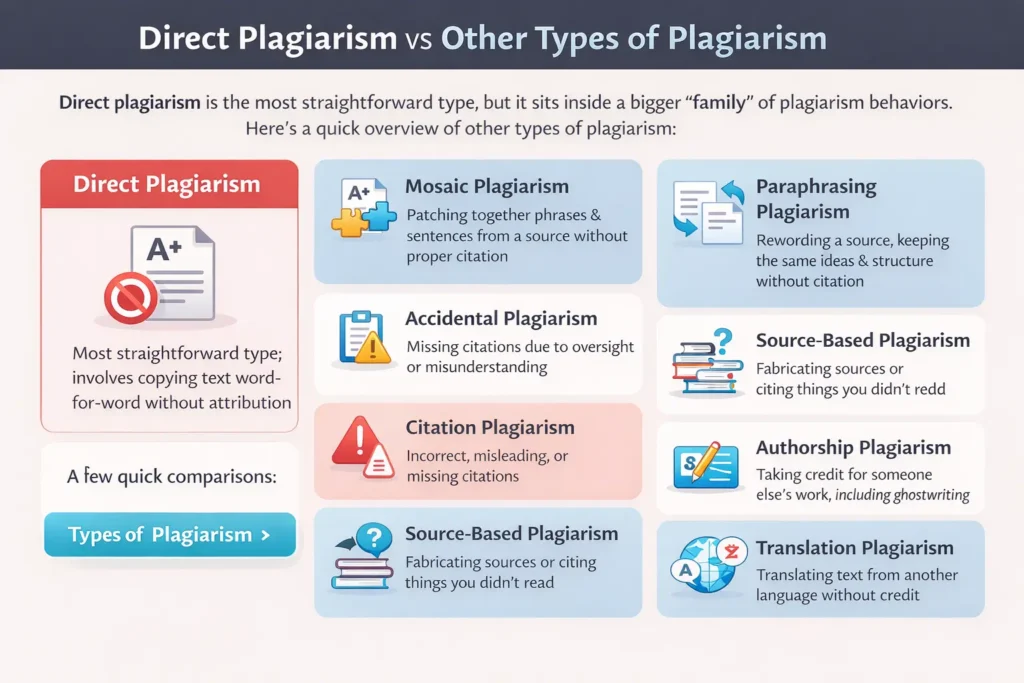
A few quick comparisons:
Mosaic Plagiarism
happens when you patch together phrases and sentence structures from a source, mixing them with your own words. It is not fully copy and paste, but it is still too close to the original.
Paraphrasing Plagiarism
Is when you reword a source but keep the same idea and structure, and you still do not cite it.
Accidental Plagiarism
Is common with poor note taking, missing citations, or misunderstanding what needs a reference. It still carries consequences in many institutions.
Citation Plagiarism
Includes incorrect, misleading, or missing citations, even if you did not copy large chunks of text.
Source Based Plagiarism
Includes fabricating sources, citing things you did not read, or using secondary citations incorrectly.
Authorship plagiarism
Involves claiming credit for work you did not create, including ghostwriting.
Translation Plagiarism
Is translating text from another language and presenting it as original without credit.
Academic consequences of direct plagiarism
Universities treat direct plagiarism seriously because it undermines assessment fairness. The exact penalties depend on your institution, your level of study, and whether it is a first offence.
Common academic consequences include:
- A warning and mandatory academic integrity training
- A reduced grade or a zero for the assignment
- A fail for the module
- A formal misconduct record
- Suspension or expulsion in severe or repeated cases
Even when the outcome is “just” a resubmission, the process can be stressful. You may have to attend a meeting, explain your writing process, and provide drafts or notes to show what happened.
Legal and professional consequences
Students often hear about academic penalties but forget there can be real world consequences too.
1) Copyright issues
In many countries, copying protected text without permission can violate copyright law, especially in published or commercial contexts. A university essay is unlikely to trigger a lawsuit, but the same behavior in a blog, report for work, or published research can cause serious problems.
2) Reputation damage
If you are caught plagiarising in a workplace role, it can damage trust fast. That matters in careers where credibility is everything: education, journalism, marketing, research, law, and healthcare.
3) Career and licensing risks
Some professional bodies have ethics requirements. Proven plagiarism in research or professional writing can lead to disciplinary action, retracted publications, and long term reputational harm.
How to avoid direct plagiarism (practical guide)
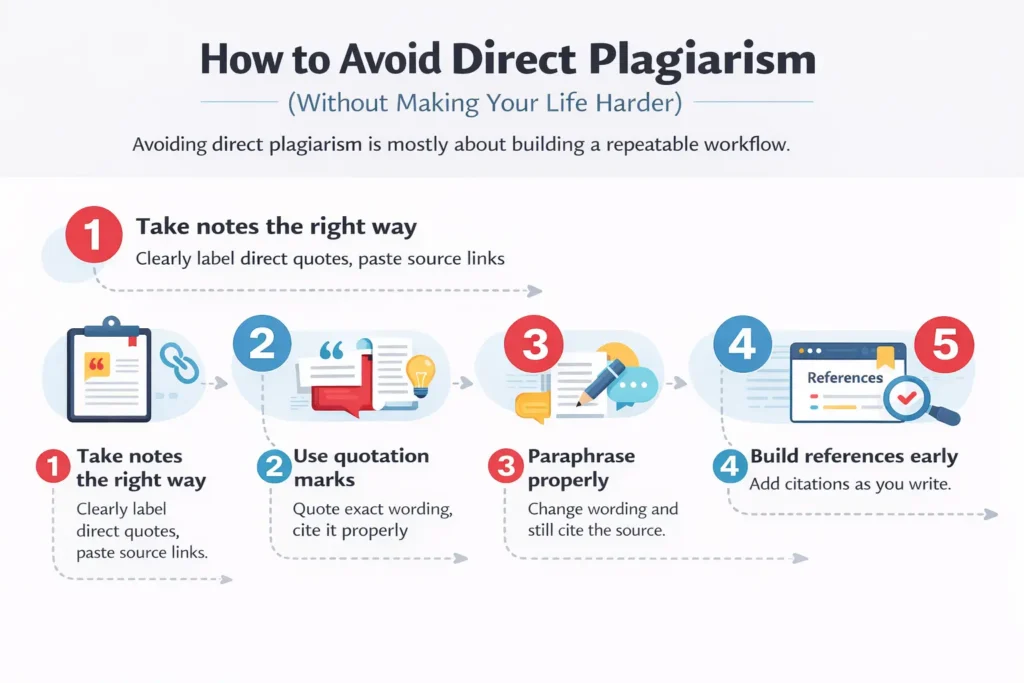
1) Take notes the right way
When you copy text into notes, label it clearly as a direct quote and paste the source link immediately. Most direct plagiarism happens because students forget what came from where.
2) Use quotation marks for exact wording
If you truly need to use the author’s exact sentence, quote it and cite it properly. Do not try to hide it. Quoting is allowed in academic writing when used carefully.
3) Paraphrase properly and still cite
A real paraphrase changes the wording and structure, but the idea still belongs to the source, so you must cite it. If paraphrasing trips you up, review: Paraphrasing Guide.
4) Build your references as you write
Do not leave citations to the last hour. Add them as soon as you use a source.
5) Check your draft before submission
Use a plagiarism checker to catch accidental copy and paste, missing quotation marks, or sections that are too close to a source. Start here: Free Plagiarism Checker.
If you want broader support with academic skills and integrity safe writing, explore Skyline Academic.
FAQs about Direct Plagiarism
What is Direct Plagiarism in simple words?
Direct Plagiarism is when you copy someone’s exact words and submit them as your own without quotation marks and a citation.
Is Direct Plagiarism only copy and paste?
Mostly yes. Direct Plagiarism usually involves copying text word for word, but even very tiny edits can still count if the wording clearly matches the source.
Can Direct Plagiarism happen by accident?
Yes. Direct Plagiarism often happens when students paste text into a draft and forget to rewrite it or add quotation marks and references.
How do universities detect Direct Plagiarism?
They use similarity checking tools plus human review. If a section matches a source closely, it is easy to flag and verify.
What are the consequences of Direct Plagiarism for a first offence?
It depends on policy, but common outcomes include a warning, grade reduction, a zero for the assessment, or required academic integrity training.
Is Direct Plagiarism worse than paraphrasing plagiarism?
Direct Plagiarism is usually treated more seriously because the copying is exact and easier to prove. Paraphrasing plagiarism is still misconduct but can be harder to spot.
How can I quickly reduce Direct Plagiarism risk before submission?
Check your work with a plagiarism tool, fix any copied passages, add citations, and use quotation marks for any exact wording you keep.