
Translation plagiarism happens when someone takes content written in one language, translates it into another language, and submits it as their own without proper credit. Many students assume it is “safer” than copy-pasting because the words look different. But universities still treat it as plagiarism, and many academic integrity policies explicitly include it as misconduct. (Sheffield Hallam University)
Before you submit any assignment, it helps to run a quick self-check using a plagiarism checker for academics, especially if you used translated notes, bilingual sources, or non-English articles during research.
Plagiarism is also far more common than most people think. Surveys summarized by the International Center for Academic Integrity report that large numbers of students admit to plagiarism, which is why institutions take detection and prevention so seriously. (Academic Integrity)
Translation plagiarism meaning in simple words
Translation plagiarism is when the ideas, structure, evidence, or wording from a source are taken and translated, but the original author is not credited. It can happen with:
- Journal articles translated from another language
- Websites and blogs translated into English for assignments
- Books translated chapter-by-chapter using Google Translate or similar tools
- Notes translated from a friend’s work in a different language
A helpful way to remember it: changing the language does not change ownership. The original author still created the work, so you must cite it.
Why translation plagiarism is risky for students
Students often do it for understandable reasons: language barriers, limited time, or a belief that translated material won’t match plagiarism databases. But the risk is real.
- Policies cover it. Many academic conduct rules define plagiarism as using someone else’s work (including ideas and findings) without acknowledgement, even if the text is altered.
- Detection is improving. Similarity tools don’t “judge plagiarism,” but they do highlight matched patterns and sources for staff to review. (Turnitin Guides)
- Markers notice style mismatch. If your writing suddenly becomes more formal, technical, or unusually structured, it can trigger extra checks.
If you want a broader overview of how this fits into academic misconduct, it’s worth reading the Skyline Academic pillar guide on different types of plagiarism so you can spot problems early.
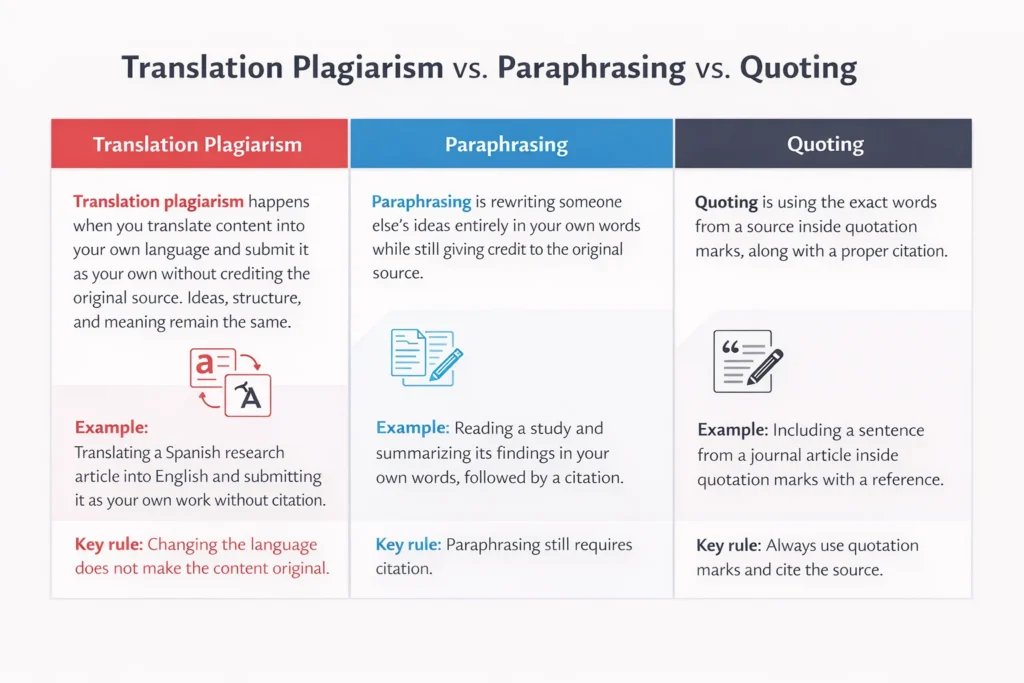
Translation plagiarism is often confused with other forms of copying. Here’s how to separate them:
- Direct copying is taking exact text without quotation marks and citation (see direct plagiarism).
- Paraphrasing is rewriting in your own words, but you still must cite the source (see paraphrasing plagiarism).
- Translation is similar to paraphrasing in one sense: you’re changing the language. But if you don’t cite, it’s still plagiarism because the ideas and structure are borrowed.
In practice, translation plagiarism often overlaps with citation plagiarism (missing or incorrect referencing) and source-based plagiarism (misusing sources, cherry-picking, or disguising the origin of information).
Clear examples of translation plagiarism
Example 1: Translating a paragraph and submitting it as “your writing”
You find a Spanish article explaining a theory. You translate one paragraph into English, tidy the grammar, and paste it into your essay without any citation.
Why it’s plagiarism: The ideas and explanation came from the Spanish author. Translation is not original authorship.
Example 2: Translating multiple sources into one “new” paragraph
You translate two French sources and merge them into one section. You do not cite either source because “the English is mine.”
Why it’s plagiarism: This can become a blended form of copying similar to mosaic plagiarism, where borrowed material is stitched together while hiding the original sources.
Example 3: Translating a friend’s work from another language
Your friend wrote a report in Urdu last year. You translate it into English and change the title page.
Why it’s plagiarism (and more): This can be treated as authorship plagiarism (misrepresenting who created the work). Many universities may also view it as collusion.
Example 4: Reusing your own translated content
Last semester you wrote an essay in Arabic. This semester you translate your own essay into English and submit it for a different module without permission.
Why it’s plagiarism: This is usually self-plagiarism (recycling prior work without disclosure), even though you are the original author.
Example 5: “Accidental” translation plagiarism
You translate notes from a source into English during research. Later, you forget which ideas came from the source and which came from you, and the translated lines end up in the final submission with no reference.
Why it matters: Universities often still treat this as misconduct, even if it was unintentional, which is why accidental plagiarism is so common among busy students.
How to avoid translation plagiarism (without overcomplicating it)
You don’t need perfect referencing skills to stay safe. You just need a consistent process.
1. Cite the original source, even if you read it in another language
If you translate content from a non-English source, cite that source in your reference list. Your reader needs to know where the information came from.
Tip: If you translated a quote, you can signal it clearly in the sentence (for example, “translated from…”). Different universities have different style expectations, so follow your department guidance.
2. Use translated material as understanding, not as ready-made text
A safe approach is:
- read the source in its original language
- write your own explanation from scratch (in your own structure)
- then cite the source that informed your explanation
This prevents your paragraph from mirroring the original structure too closely.
3. Keep a “translation log” while researching
Create a simple note like:
- Source title + link
- Page/paragraph you used
- Your translated notes (clearly labelled as “translated notes”)
This protects you later if a marker asks for your research process.
4. Don’t rely on tools to “hide” the source
Using translators, rewriters, or heavy paraphrasing tools to disguise where ideas came from can still be flagged through investigation, and it can also create referencing problems. If you’re unsure how close your wording is, use Skyline Academic’s free plagiarism checker before submission and fix citations early.
5. When in doubt, ask or disclose
If you used a translated source heavily, it’s usually better to be transparent than to guess. Many integrity cases become serious because students appear to hide their process.
For more guidance and student-safe academic support resources, you can also explore Skyline Academic.
FAQs about Translation Plagiarism
1) What is Translation Plagiarism in academic writing?
Translation Plagiarism is using a source written in another language, translating it, and submitting it without citing the original author. Changing language does not make the work “yours.”
2) Is Translation Plagiarism still plagiarism if I used Google Translate?
Yes. Translation Plagiarism depends on using someone else’s ideas or wording without credit, not on which tool you used to translate.
3) Can universities detect Translation Plagiarism?
Often, yes. Translation Plagiarism can be detected through similarity checks, instructor judgment, and integrity investigations, especially when structure and ideas closely match a known source.
4) How do I cite a source to avoid Translation Plagiarism?
To avoid Translation Plagiarism, cite the original source you translated from in your chosen referencing style. If you translated a quotation, signal that it’s translated in your writing.
5) Is Translation Plagiarism the same as paraphrasing?
Not exactly. Translation Plagiarism is translation without credit, while paraphrasing is rewriting in your own words. Both still require proper citation of the original source.
6) Is it Translation Plagiarism if I translate my friend’s assignment?
Yes. That’s Translation Plagiarism, and it may also be treated as authorship misconduct or collusion, depending on your university’s policy.
7) What’s the safest way to avoid Translation Plagiarism in essays?
Use translated sources to understand concepts, then write your explanation from scratch and cite the original. Running a check with a plagiarism tool before submitting also helps catch missed citations.