
Citation plagiarism is one of those academic problems that often happens quietly. You might not copy-and-paste an entire paragraph, but if you use someone’s ideas, data, or wording without giving clear credit, your work can still be treated as plagiarism. And because universities take academic integrity seriously, even “small” referencing mistakes can lead to stressful consequences, from resubmissions to formal misconduct investigations.
If you want a quick way to spot issues before submitting, run your draft through a free plagiarism checker for academics early in your editing process. It won’t replace good referencing, but it can help you catch accidental overlap and missing attribution while you still have time to fix it.
Plagiarism isn’t rare, either. Surveys compiled by the International Center for Academic Integrity (ICAI) report that a substantial share of students admit to plagiarism in some form. For example, ICAI highlights findings where 58% of surveyed students admitted to plagiarism in a large study set.
What is citation plagiarism?
Citation plagiarism happens when you use someone else’s work (ideas, evidence, structure, data, or wording) but your referencing is missing, unclear, or misleading.
In simple terms, it’s not just “Did you cite something?” It’s also:
- Did you cite the right source?
- Did you cite it clearly enough for the reader to trace?
- Did you represent the source honestly?
- Did you use quotation marks when needed?
Citation plagiarism can occur even when you include a reference list, because the problem is often in how sources are used in the body of your writing.
Why citation plagiarism happens
Citation plagiarism can be intentional or accidental, and universities typically evaluate context, patterns, and the seriousness of the breach.
Intentional citation plagiarism
This is when someone knowingly tries to appear properly referenced while still hiding the true origin of the work. Common motivations include time pressure, fear of low grades, or trying to make an argument look more “academic” without doing the full reading.
Accidental citation plagiarism
This is far more common than students expect. It can happen when you:
- Forget where a key idea came from
- Take notes without marking exact quotes
- Paraphrase too closely
- Cite in the bibliography but not in-text
- Mix multiple sources and lose track
If you want to understand how unintentional referencing mistakes happen, this guide on accidental plagiarism is worth reading alongside this one.
Citation plagiarism vs other types of plagiarism
Citation plagiarism overlaps with other forms, but the difference is what exactly went wrong.
- Direct plagiarism is copying text word-for-word without quotation marks and citation.
- Paraphrasing plagiarism is rewriting someone’s ideas too closely (or without citing) even if the wording changes.
- Mosaic plagiarism is patchwork writing: mixing phrases and sentence structures from sources while making small edits.
- Source-based plagiarism includes misleading citations (wrong author, wrong page, citing a source you didn’t use).
- Self-plagiarism is reusing your own previous work without permission or disclosure.
- Authorship plagiarism involves misrepresenting who created the work (for example, buying an assignment or submitting someone else’s work).
- Translation plagiarism is translating content from another language and presenting it as original without attribution.
If you want the big picture, read different types of plagiarism pillar guide that breaks down each category and how universities typically interpret them.
Common examples of citation plagiarism
Here are realistic situations students and researchers run into all the time.
Example 1: “I cited it in the references, so I’m safe”
You include a full reference list at the end, but you don’t cite sources inside the text where you use their ideas or evidence. Most marking rubrics require in-text citations (or footnotes, depending on style) for this reason.
Example 2: Quoting without quotation marks
You copy a sentence exactly but add a citation at the end. That’s still plagiarism because readers will assume the sentence is your wording unless it’s clearly marked as a direct quote.
Example 3: Paraphrasing too close to the original
You swap a few words and reorder a phrase, but the structure and meaning track the source too closely. Even with a citation, that can be considered weak academic practice, and without a citation it becomes citation plagiarism or paraphrasing plagiarism.
Example 4: Citing the wrong source (or the wrong author)
You saw a claim in a paper that cited another study, and you cite the original study without reading it. That can become a source-based plagiarism issue because you’re implying you consulted a source you didn’t.
Example 5: “Citation dumping”
You add a long list of citations at the end of a paragraph, but it’s unclear which idea comes from which source. In some cases, this is treated as misleading referencing because the attribution isn’t traceable.
How to fix citation plagiarism in your draft
If you think your work may contain citation plagiarism, don’t panic. Most issues are fixable with careful editing.
Step 1: Identify where your ideas came from
Go paragraph by paragraph and ask:
- Is this claim based on a source?
- Is the wording mine, or does it match my notes too closely?
- Would a reader be able to trace this back to the original author?
If you used a similarity tool, remember: similarity is not automatically plagiarism. Even Turnitin explains that similarity reports highlight matches for review, not a final “plagiarism verdict.”
Step 2: Add in-text citations where they’re needed
A reference list alone is not enough. Add citations:
- After any statistic, finding, definition, or theory drawn from a source
- When you summarise an author’s argument
- When you use a distinctive concept or framework
Step 3: Quote properly when you use exact wording
If you keep exact phrases:
- Put them in quotation marks
- Add the correct citation and page number (if your style requires it)
- Keep quotes selective and purposeful
Step 4: Strengthen your paraphrasing
A strong paraphrase uses:
- Your own sentence structure
- Your own academic voice
- Clear attribution to the source
If your paraphrase still “sounds like” the original, rewrite it again after stepping away from the source text.
Step 5: Check the accuracy of your citations
Make sure each citation matches:
- The correct author
- The correct year
- The correct page or section (where required)
- The correct source (don’t cite something you didn’t read)
Step 6: Clean up your reference list
Ensure your references are complete and consistent with your required style (APA, Harvard, MLA, Chicago, IEEE). Missing details can create the impression of careless or misleading sourcing.
Best practices to avoid citation plagiarism (before it starts)
Citation plagiarism is easiest to prevent when you build good habits early:
- Take “clean notes”: clearly label direct quotes vs paraphrases vs your own ideas.
- Cite as you write: add the citation immediately instead of “fixing it later.”
- Use a reference manager: Zotero, Mendeley, or EndNote can reduce formatting errors.
- Keep source PDFs organised: name files clearly so you can verify claims fast.
- Do a final integrity pass: run a similarity scan and then manually review the flagged sections.
If you need support tools or services, you can also explore resources at Skyline Academic, including writing support and checking utilities.
FAQs about Citation Plagiarism
1) What is Citation Plagiarism in academic writing?
Citation Plagiarism is when you use someone else’s ideas, evidence, or words but fail to cite them correctly or clearly. It can happen even if you include a reference list.
2) Can Citation Plagiarism happen if I cite the source in the bibliography?
Yes. Citation Plagiarism can still occur if you don’t include in-text citations where the source is used. A bibliography alone usually isn’t enough.
3) Is Citation Plagiarism always intentional?
No. Citation Plagiarism is often accidental, especially when students paraphrase from notes, forget where ideas came from, or don’t understand citation rules.
4) What are common examples of Citation Plagiarism?
Common examples include missing in-text citations, quoting without quotation marks, paraphrasing too closely, and citing the wrong source or author.
5) How do I fix Citation Plagiarism in my draft?
Add missing in-text citations, correct inaccurate references, use quotation marks for exact wording, and rewrite overly close paraphrases in your own structure and voice.
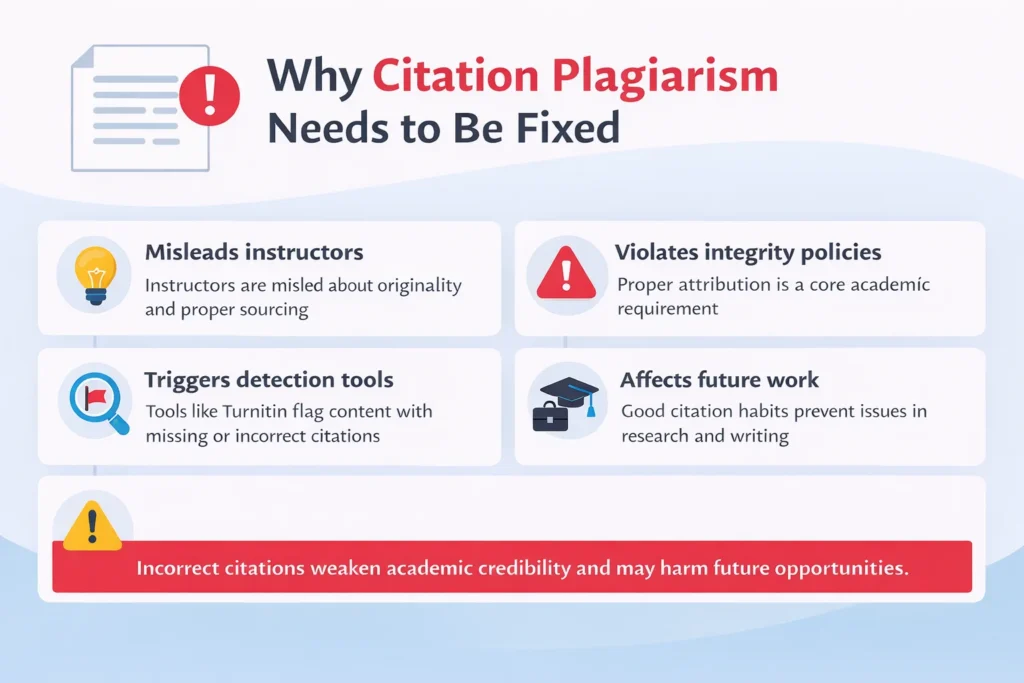
6) Can Citation Plagiarism trigger a Turnitin flag?
It can. Similarity tools may highlight matched text, which can lead reviewers to check whether citations and quotation practices are correct.
7) How can I avoid Citation Plagiarism in future assignments?
Cite as you write, keep clear notes, use a reference manager, and do a final review of citations and paraphrasing before submission.