
Accidental plagiarism happens when you use someone else’s words, ideas, structure, or evidence in your academic work without proper credit, even though you did not mean to cheat. It is one of the most common integrity issues because students are often juggling tight deadlines, complex sources, unfamiliar citation rules, and pressure to “sound academic” while still learning how scholarly writing works.
And yes, it is common. The International Center for Academic Integrity summarizes large survey findings where many students admitted to plagiarism as part of broader academic misconduct patterns, which shows why universities take referencing seriously, even when mistakes are unintentional. Academic Integrity
If you want a practical safety net while you write, using the best plagiarism checker for academics early (not just at the end) can help you catch risky passages before submission.
What counts as accidental plagiarism?
Accidental plagiarism is still plagiarism. The difference is intent, not outcome. Most universities care about both, but grading and misconduct decisions often focus on what was submitted and whether the work meets academic standards for attribution.
Accidental plagiarism can include:
- Forgetting a citation for a paraphrased idea
- Copying a sentence because it “sounds perfect” and planning to change it later
- Paraphrasing too closely so the original wording is still recognizable
- Mixing sources in notes and losing track of what came from where
- Using AI tools, translators, or paraphrasers without understanding the citation rules that apply
If you’re not sure how institutions define different misconduct categories, it helps to review a full overview of the different types of plagiarism so you can spot problems earlier.
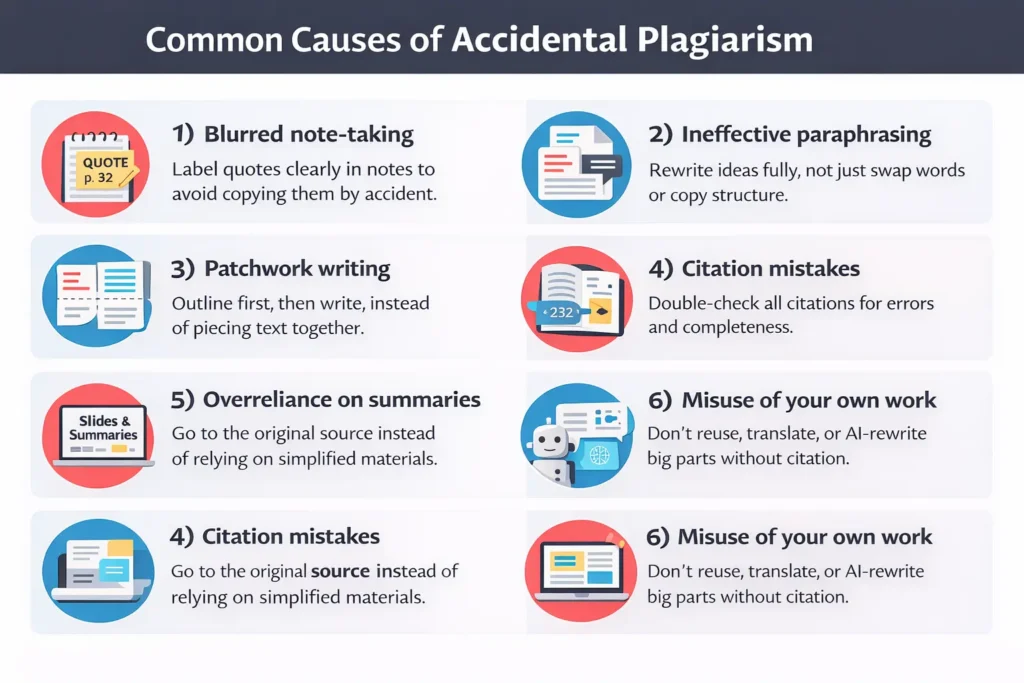
Typical reasons behind accidental plagiarism
1) Note-taking that blurs your voice and the source
A lot of accidental plagiarism starts before you even begin drafting. If you copy text into your notes and forget to label it as a direct quote, it can easily slip into your paper unchanged.
A simple fix: in your notes, clearly label copied text with “QUOTE” and paste the page number right beside it. Then write a one line summary in your own words under it so you have a clean paraphrase ready.
2) Paraphrasing that stays too close to the original
Many students think paraphrasing means swapping words with synonyms. That is exactly how paraphrasing plagiarism happens. The idea may be cited, but the sentence structure and phrasing are still too similar to the source.
Better paraphrasing means you fully understand the point, step away from the original text, and then rewrite the idea using your own framing. After that, compare against the source to make sure you did not accidentally mirror it.
3) Patchwork writing from multiple sources
When you pull phrases from several articles and stitch them together, you can create a “blended” section that looks original but still borrows too much language and structure. This is closely related to mosaic plagiarism, and it often happens when students are trying to write quickly while staying “academic.”
A cleaner approach is to outline first, then choose sources that support each point, and finally write the paragraph from your outline (not from the source text).
4) Citation mistakes and incomplete referencing
Sometimes the writing is genuinely yours, but the citations are not. Missing quotation marks, wrong page numbers, broken in-text citations, or a reference list that does not match your in-text citations can all trigger issues. This is often grouped under citation plagiarism.
If your institution uses a specific referencing style, build a checklist for it (for example: author, year, page, URL or DOI, access date if required). Consistency reduces accidental errors.
5) Overreliance on summaries, slides, or “source packs”
If you rely on lecture slides, study guides, or a single web summary, you may accidentally reproduce that same wording and sequencing in your assignment. This can become a form of source-based plagiarism, especially when many students use the same materials.
To avoid this, always trace key claims back to the original journal article, book chapter, or official report and cite that primary source when possible.
6) Confusion about reuse of your own work
Students are often surprised to learn you can plagiarize yourself if you reuse substantial parts of an earlier assignment without permission or citation. That is self-plagiarism, and it can apply even if the earlier work was yours.
If you need to build on your previous research, check your module rules and cite your earlier submission appropriately (and be transparent about what is reused).
7) Unclear authorship and group contribution
Group projects, shared drafts, and “help” from friends can blur who wrote what. When someone else writes a section for you, even with good intentions, it may cross into authorship plagiarism.
A good rule: feedback is fine, but writing your sentences for you is not. Keep your own drafts and track edits.
8) Translation and AI-assisted rewriting
Translating text from another language and submitting it without citation is still plagiarism. So is translating your source and keeping the ideas and structure while presenting it as your own. This is often discussed as translation plagiarism.
The same risk applies when you use AI or paraphrasing tools to rewrite existing text. If the underlying content comes from a source, you still need to cite that source. Tools can change wording, but they do not change ownership of ideas.
Real examples of accidental plagiarism
Example 1: “I cited the source, so I’m safe”
You paraphrase an author’s argument and cite them, but you keep their sentence structure and several distinctive phrases. The citation helps, but the wording is still too close, which can look like copying.
What to do instead: rewrite from your notes, not from the original paragraph, then cite.
Example 2: The “placeholder quote” that never got fixed
You paste a strong quote into a draft intending to paraphrase later, but you forget. You submit it without quotation marks or page number.
What to do instead: never paste raw quotes into a draft unless they are already formatted as quotes with citation details.
Example 3: Accidentally copying a definition
You use a textbook definition because it explains a key term clearly. You tweak one or two words but keep most of it.
What to do instead: either quote it properly or define the concept in your own words and cite the textbook.
Example 4: Copying a sentence from your previous assignment
You reuse a strong paragraph from last semester because it fits the new topic, but you do not mention reuse or cite it.
What to do instead: follow your department policy, cite your earlier work, and rewrite where required.
If you want to understand how these differ from deliberate misconduct, reading about direct plagiarism can clarify what institutions treat as the most clear-cut form.
How to prevent accidental plagiarism (without overcomplicating your process)
Start with systems, not stress. Prevention is mostly about workflow.
- Use a source tracking habit: Keep a running list of sources and paste full citation details as soon as you decide to use a source.
- Separate quotes from paraphrases in your notes: Visually mark quoted text so it never sneaks into your draft.
- Write from an outline first: If you write while reading, you are more likely to copy phrasing.
- Cite as you write: Add in-text citations during drafting, not at the end.
- Use quotation marks correctly: If you keep original wording, treat it as a quote and cite the page number.
- Run a similarity check early: Use the best plagiarism checker for students on sections as you draft, not only on the final file. This helps you revise calmly rather than panicking on submission day.
- Build integrity into your routine: Save drafts, keep your research notes, and document your writing process. If questions come up, being able to show your process helps.
For more academic support tools and resources, you can explore Skyline Academic and use the guidance alongside your institution’s rules.
FAQs About Accidental Plagiarism
1. What is accidental plagiarism?
Accidental plagiarism happens when a student unintentionally uses someone else’s words, ideas, or structure without proper citation.
2. What are the main causes of accidental plagiarism?
It is commonly caused by poor paraphrasing, missing citations, weak note-taking, or misunderstanding referencing rules.
3. Is accidental plagiarism still considered plagiarism?
Yes, even without intention, accidental plagiarism is treated as plagiarism in academic institutions.
4. Can paraphrasing lead to accidental plagiarism?
Yes, if the paraphrased text remains too close to the original wording or structure, it can be flagged as plagiarism.
5. Do citation mistakes result in accidental plagiarism?
Yes, incorrect references, missing quotation marks, or incomplete citations can lead to accidental plagiarism.
6. Can AI tools cause accidental plagiarism?
Yes, using AI-generated or rewritten content without proper source citation can cause accidental plagiarism.
7. How can students prevent accidental plagiarism?
Students can prevent it by citing sources correctly, paraphrasing properly, and checking their work before submission.