
Paraphrasing is supposed to be the “safe” alternative to copy-pasting. But it’s also one of the easiest ways to plagiarize by accident, especially when you’re working fast, juggling multiple sources, or writing in a second language.
And this is not a rare problem. In one study reported by The BMJ, many students admitted to questionable academic practices, including paraphrasing without acknowledgment. That’s exactly why you should treat paraphrasing as a skill with rules, not just a last-minute editing trick.
If you want a quick safety net while you learn the right method, use a free plagiarism detector for students early in your drafting process to catch risky similarity before submission.
What is paraphrasing plagiarism?
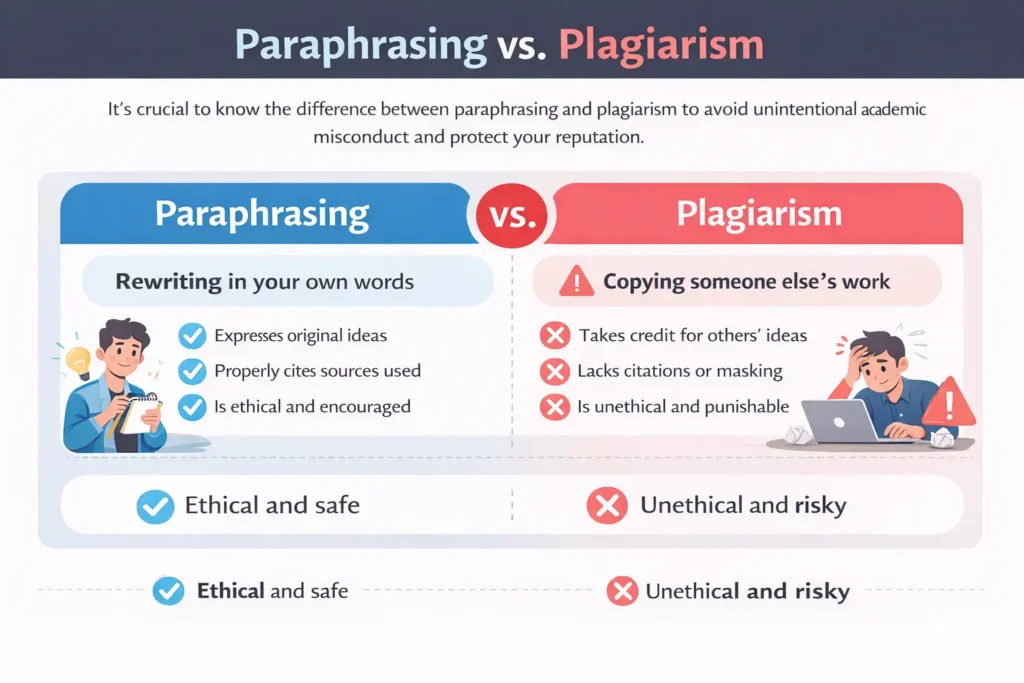
Paraphrasing plagiarism happens when you reword someone else’s ideas but fail to give proper credit, or when your “paraphrase” stays too close to the original wording and structure. In simple terms: you changed the words, but you didn’t make the thinking (or the sourcing) your own.
It can show up in a few common forms:
- No citation at all: You paraphrase a source and present it like it’s your own original idea.
- Too-close paraphrase: You swap a few synonyms but keep the same sentence pattern and key phrases.
- Patchwork rewriting: You stitch together chunks from multiple sources with light rewording (often overlapping with mosaic plagiarism).
- Translation without attribution: You translate a source from another language and submit it as original (related to translation plagiarism).
The key point: paraphrasing does not remove the need to cite. The idea still belongs to the original author.
Why paraphrasing plagiarism happens so often
Most students don’t intend to plagiarize. Paraphrasing plagiarism usually happens because of one (or more) of these:
Time pressure. When deadlines are close, “quick rewording” feels faster than careful note-taking and citation.
Weak source management. If you copy notes into your draft without marking what came from where, it becomes easy to forget which lines require a reference. This is a major cause of accidental plagiarism.
Fear of quoting. Some students think quotes are “bad writing,” so they paraphrase everything. Paraphrasing is great, but only when it’s accurate and properly cited.
Limited vocabulary or academic confidence. If you’re unsure how to express complex ideas, you may cling to the original structure and wording.
Misunderstanding what counts as plagiarism. Many people think plagiarism is only direct plagiarism. In reality, plagiarism includes a whole range of practices. If you want the big picture, read this guide to the types of plagiarism.
How paraphrasing plagiarism is different from “normal” similarity
A similarity score (Turnitin or other tools) is not the same thing as plagiarism. Similarity reports highlight matching text, but humans still interpret what’s acceptable (quotes, references, common phrases, methods sections, and so on). Turnitin itself emphasizes that similarity tools show matches, and educators decide whether plagiarism occurred. (guides.turnitin.com)
That’s why your goal shouldn’t be “beat the detector.” Your goal is to write in a way that’s ethically sound and academically defensible.
How to paraphrase correctly (and avoid plagiarism)
Here’s a practical method that works for essays, reports, dissertations, and literature reviews.
1) Read first, then look away
Read the original source until you understand the meaning. Then close it (or look away) and explain the idea in your own words from memory. This reduces the chance you’ll copy the original sentence structure.
2) Write the idea in your “natural” voice
Ask: “How would I explain this to a classmate?” Start simple, then make it more academic if needed.
3) Keep the meaning accurate
A paraphrase is not a “creative rewrite.” You must keep the original meaning and avoid adding claims the author didn’t make. If the author is cautious, your paraphrase should be cautious too.
4) Cite the source every time
If the idea came from a source, it needs a citation, even if every word is yours. If you struggle with referencing, review what counts as citation plagiarism so you don’t under-cite, mis-cite, or cite the wrong thing.
5) Use quotes when wording matters
If a phrase is especially precise, controversial, or memorable, quote it and cite it. Quoting is often safer than forcing a paraphrase that becomes inaccurate.
6) Do a final similarity and citation pass
Before submitting:
- Check your work with the free and accurate plagiarism checker.
- Confirm that every paraphrased point has a matching in-text citation and reference list entry.
- Review any “high match” areas: are they quoted, cited, and necessary?
If you want broader academic support tools and services, explore Skyline Academic.
Common traps that still count as paraphrasing plagiarism
Even careful students slip into these patterns:
1. Patchwriting (too-close paraphrase)
You keep the original sentence shape and swap a few words. This often overlaps with mosaic plagiarism and is frequently flagged in academic integrity checks.
2. Reusing your own past work without permission
Submitting parts of an old assignment can become self-plagiarism, especially if the course rules require original submissions.
3. Borrowing the structure of a source
Even when words change, copying the same flow of arguments and examples can drift into source-based plagiarism.
4. Using someone else’s work process or contribution.
If a friend, editor, or tool effectively “writes it for you,” you may risk authorship plagiarism.
5. Paraphrasing translated material without citation
Translation is not originality. That’s why translation plagiarism is treated seriously in many institutions.
When in doubt, cite. And if you’re unsure whether something crosses the line, it helps to compare it with clear examples of direct plagiarism and other categories, like accidental plagiarism.
FAQs: Paraphrasing Plagiarism
1) What is Paraphrasing Plagiarism in simple words?
Paraphrasing Plagiarism is when you rewrite someone else’s idea but don’t cite the source, or you rewrite it so closely that it still mirrors the original wording and structure.
2) Is Paraphrasing Plagiarism still plagiarism if I change all the words?
Yes. Paraphrasing Plagiarism is about ownership of ideas, not just wording. If the idea came from a source, you must cite it.
3) How do I avoid Paraphrasing Plagiarism in a literature review?
Take clean notes with source labels, paraphrase from understanding (not from the text), and cite every claim that comes from a study, author, or report.
4) Can Paraphrasing Plagiarism happen accidentally?
Absolutely. Paraphrasing Plagiarism often happens through rushed drafting, messy notes, or forgetting citations. It’s a common form of accidental academic misconduct.
5) What does Turnitin flag related to Paraphrasing Plagiarism?
Turnitin highlights text that matches existing sources. It may flag close paraphrasing, repeated phrases, or missing quotation marks, but educators still interpret whether plagiarism occurred.
6) How many words can I copy before it becomes Paraphrasing Plagiarism?
There’s no universal “safe number.” Even a short unique phrase can require quotes and a citation. Focus on proper attribution and genuine rewording.
7) What’s the fastest way to check for Paraphrasing Plagiarism risk before submitting?
Run a similarity and citation check, then review the matched sections for proper quotation and references. A plagiarism scan plus a manual citation review is the most reliable combo.