
Last updated:
Artificial intelligence writing tools are everywhere right now. From essays and research papers to blog posts and marketing copy, AI can generate content in seconds. But as AI detection tools become more advanced, many users are searching for tools that can make AI-generated text appear more human.
That is where StealthWriter AI comes in.
In this detailed StealthWriter AI review, I will walk you through what the tool claims to do, how it works, my honest test results, pricing, pros and cons, and whether it is actually safe for students. I will also compare it with three strong alternatives so you can make an informed decision.
If you are wondering whether StealthWriter AI is worth it or whether there is a safer and more transparent option, this guide will answer everything clearly. And regardless of which tool you choose, it is always better to try a free AI test before submitting your work to ensure originality, avoid academic risks, and stay on the safe side.
StealthWriter AI Review: Quick Verdict
StealthWriter (also searched as Stealth Writer) is an AI humanizer at stealthwriter.ai that rewrites AI-generated text to lower AI detection scores. It has a free plan and paid plans from $20 to $400 a month. In our test it lowered scores on some detectors but not all, and the rewritten text read worse than the original.
| What you want to know | Answer |
|---|---|
| What it is | AI humanizer that rewrites AI text to sound more human |
| Free plan | Yes: 10 humanizations a day, up to 1,000 words each, Ghost 5.2 Mini only |
| Paid plans | $20, $50, $100, $200 and $400 a month (about 17% less billed annually) |
| Can Turnitin detect it? | Sometimes. No humanizer can guarantee a clean result |
| Writing quality after rewrite | Lower: awkward transitions and more generic phrasing |
| Best for | Bloggers and marketers editing AI drafts |
| Not suited to | Students submitting graded work under strict AI policies |
Our verdict: StealthWriter works as a detector workaround some of the time, not as a writing tool. If your work is your own, keeping drafts and checking it with an AI detector before you submit is safer than humanizing it.
What Is StealthWriter AI?
StealthWriter AI (also written as Stealth Writer, at stealthwriter.ai) is an AI humanizer tool. It is not the same product as StealthGPT, which is a separate humanizer. Its primary goal is to rewrite AI-generated content in a way that reduces the chances of being flagged by AI detection systems.
The tool markets itself as a solution for:
- Students concerned about AI detection
- Bloggers and content creators
- Freelancers
- Agencies producing high volumes of content
StealthWriter AI claims to take text generated by tools like ChatGPT and transform it into more natural, human-like writing. The core promise is simple: make AI content undetectable.
But does it actually work? That is what I tested.
How to Use StealthWriter AI (Step by Step)
StealthWriter AI operates as a rewriting and humanization tool. You paste AI-generated content into its editor, and the system processes the text to modify structure, sentence flow, vocabulary, and phrasing.
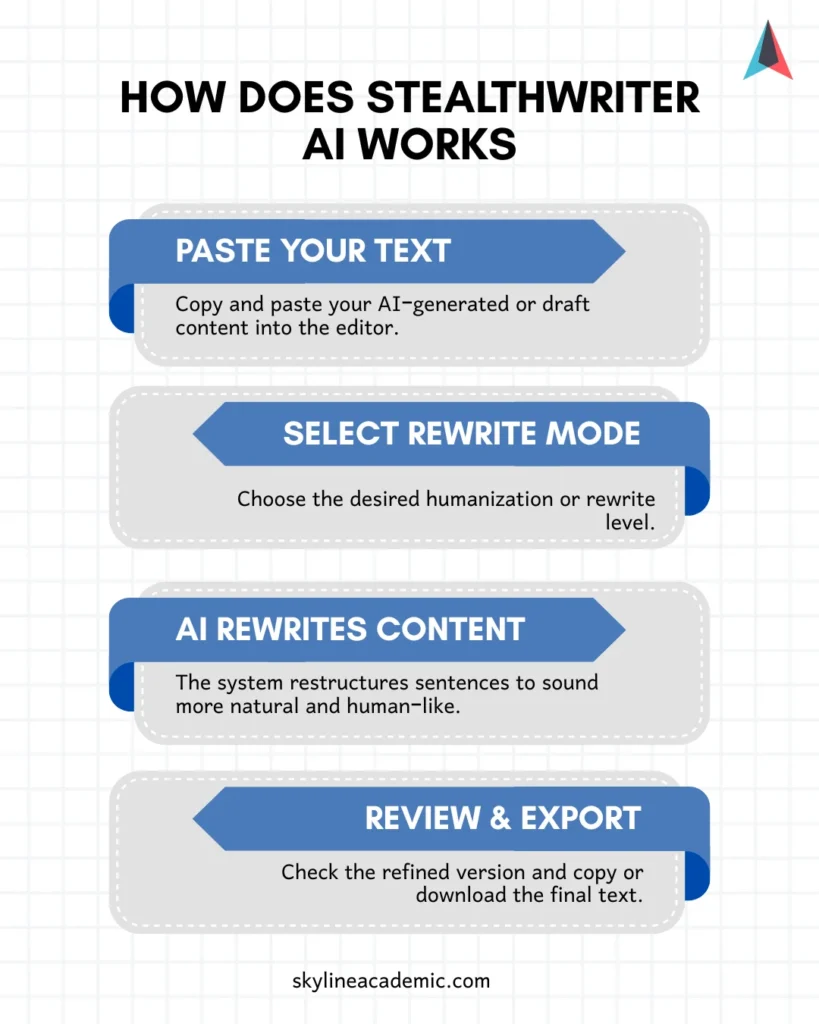
From what I observed, it appears to:
- Break predictable sentence patterns
- Introduce varied sentence lengths
- Replace commonly used AI phrases
- Adjust tone to sound more conversational
However, it does not fundamentally change the ideas. It focuses on surface-level rewriting and linguistic variation.
Most AI detectors look for statistical patterns common in large language models. StealthWriter AI attempts to disrupt those patterns. Whether that disruption is strong enough depends heavily on the quality of the input text and the detection tool being used.
My Honest StealthWriter AI Test Results
To make this StealthWriter AI review practical, I tested it using a structured process.
Step 1: Generate AI Content
I first created a 1000-word essay using a standard AI writing tool. The topic was academic in nature to simulate a student assignment.
Step 2: Run It Through AI Detection
I tested the original AI text using multiple AI detection tools. As expected, the content showed a very high AI detection score.
To better understand detection metrics, it is important to know what an AI detection percentage actually means. If you are unfamiliar with this, you can read more about the AI detection score meaning and how these tools interpret probability patterns.
Step 3: Humanize Using StealthWriter AI
I then pasted the AI-generated essay into StealthWriter AI and selected its rewriting mode. The processing took less than a minute.
Step 4: Re-Test the Humanized Version
After running the rewritten version through the same detection tools, I noticed:
- AI detection percentage decreased
- Some detectors still flagged parts of the text
- Readability slightly decreased in certain sections
- A few sentences sounded awkward
The tool did reduce detection scores in some cases, but it did not guarantee full invisibility.
Quality Evaluation
The rewritten content felt less polished than the original AI version. While it sounded more human in places, it also introduced:
- Slightly unnatural transitions
- Redundant phrasing
- Occasional grammar inconsistencies
For blog content, this might be manageable. For academic submissions, it could be risky.
StealthWriter AI Features
StealthWriter AI keeps its feature set relatively simple. It focuses mainly on rewriting and humanization.
The main features include:
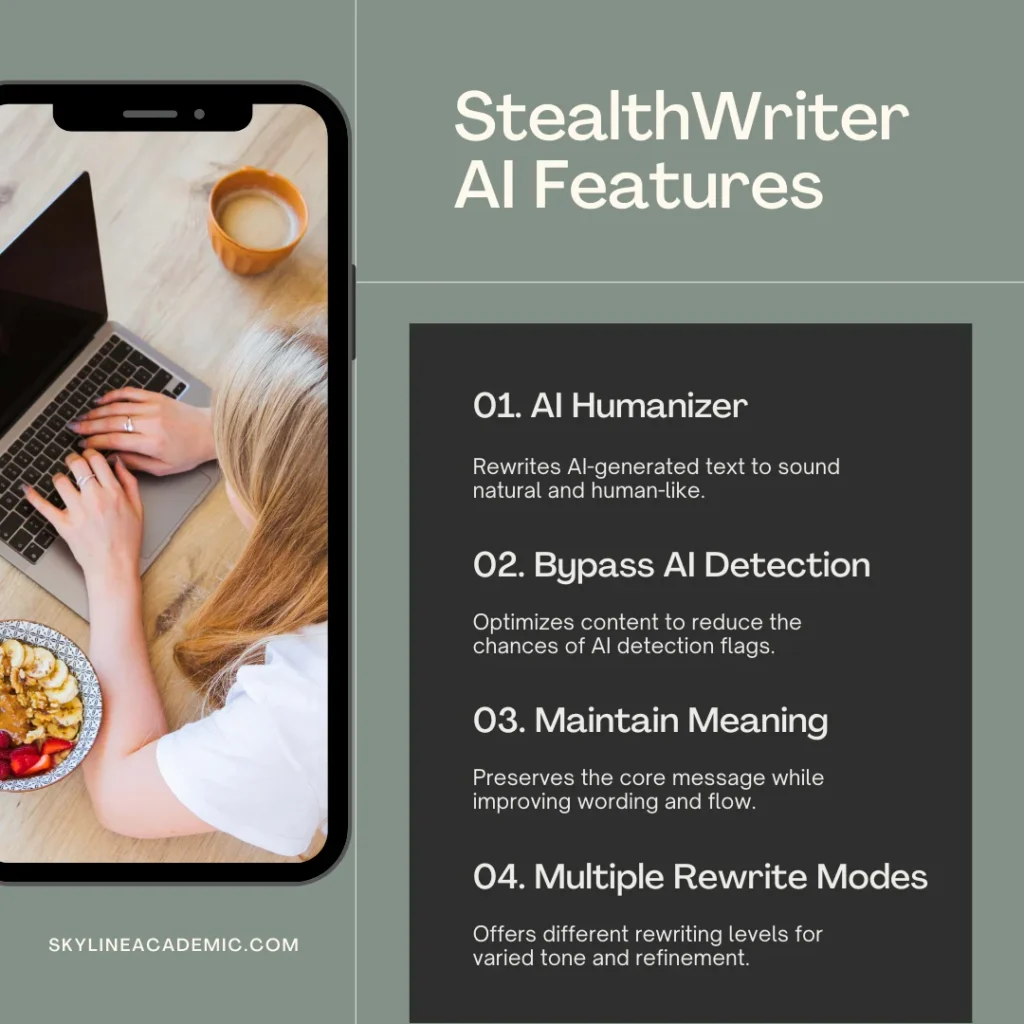
Humanization engine
The core rewriting system designed to reduce AI detectability.
Multiple rewriting modes
Some plans offer varying levels of rewriting intensity.
Fast processing
Results are delivered quickly, even for longer content.
User-friendly interface
The dashboard is clean and easy to use.
However, it does not offer built-in plagiarism detection or transparent AI reporting. This is important because many students need both AI detection clarity and plagiarism verification.
If you are submitting academic work, using a reliable and AI content detector is often just as important as rewriting.
StealthWriter AI Pricing: Plans, Costs and Free Access
StealthWriter (Stealth Writer) pricing starts with a free plan and five paid plans from $20 to $400 a month on monthly billing, with annual billing around 17% less. Each plan sets a daily number of humanizations and a maximum of 5,000 words per input (1,000 on the free plan).
| Plan | Price | Humanizations/day | AI scans/day | Words per input | Ghost models |
|---|---|---|---|---|---|
| FreeFree tierHumanize your everyday writing | $0 | 10 | 10 | 1,000 | 5.2 Mini only |
| StarterMore room for everyday writing | $20/mo | 50 | 50 | 5,000 | 5.2 Mini, 5.2 Pro, Legacy |
| PlusMost popularBest for regular creators | $50/mo | 150 | 150 | 5,000 | 5.2 Mini, 5.2 Pro, Legacy |
| ProHigh-volume daily usage | $100/mo | 350 | 350 | 5,000 | 5.2 Mini, 5.2 Pro, Legacy |
| BusinessFor agencies and teams | $200/mo | 800 | 800 | 5,000 | 5.2 Mini, 5.2 Pro, Legacy |
| ScaleMaximum self-serve volume | $400/mo | 2,000 | 2,000 | 5,000 | 5.2 Mini, 5.2 Pro, Legacy |
Prices in USD, monthly billing, checked November 2026. Annual billing is advertised at around 17% less. All paid plans include the AI detector (V1 and V2), AI deep scan and natural, human-like output. The free plan does not include priority support or the Ghost 5.2 Pro and Legacy models. StealthWriter has changed its plans before, so confirm current pricing on their site before subscribing.
From what I found:
- Entry plans are affordable for casual users
- Higher tiers can become expensive for heavy usage
- The free plan is permanent but limited to 10 humanizations a day and 1,000 words per input
For bloggers producing high volumes of content, costs can add up. For students, recurring subscriptions may not always be practical.
Value ultimately depends on how often you need rewriting and whether it consistently reduces AI detection in your specific use case.
Is StealthWriter free?
Yes. StealthWriter has a free plan with 10 humanizations a day, up to 1,000 words per input, which is enough to test the tool on a short passage but not to process a full assignment. The free version also restricts access to the newer humanizing modes, so results from the free tier will not match what the paid plans produce. If you are only testing whether the output reads naturally, the free allowance is usually enough to judge that.
How do I cancel a StealthWriter subscription?
Subscriptions renew automatically, so cancel before your renewal date if you only need the tool for one assignment period. Check the cancellation steps in your account dashboard before subscribing, and note whether cancelling ends access immediately or at the end of the billing period.
Can Turnitin Detect StealthWriter?
This is the question most people arrive with, so here is the direct answer: StealthWriter’s output can still be flagged, and no humanizer can guarantee otherwise.
Turnitin’s AI detection does not look for a watermark or a signature it can match. It estimates whether text follows patterns common in AI writing, and humanizers work by changing those patterns. That is a moving target. Turnitin updates its model, humanizers update their rewriting, and results shift between versions of both tools.
Humanizers are tested constantly by reviewers, and the pattern across those tests is consistent: results vary by detector and by how heavily the text was rewritten. A passage that clears one checker can still be flagged by another, because different tools measure different things. Treat any single “undetectable” claim, including the vendor’s own, as a snapshot rather than a guarantee.
There is a second problem that detection scores do not capture. Humanized text often loses specificity. Rewriting replaces precise wording with more generic phrasing, which can weaken an argument even when the AI score drops. If a tutor or marker reads the work closely, vague reasoning is more noticeable than a detection percentage.
Does StealthWriter bypass Turnitin reliably?
No tool can promise this. Turnitin says its AI score should not be the sole basis for action against a student, but a flagged paper still triggers a conversation you then have to explain. If your work is genuinely yours, keeping drafts, notes and version history is far stronger evidence than any humanizer output.
Pros and Cons of StealthWriter AI
Pros
- Easy to use
- Fast rewriting process
- Reduces AI detection scores in some cases
- No technical knowledge required
Cons
- No guarantee of undetectability
- Can reduce content clarity
- No integrated plagiarism reporting
- Risky for strict academic environments
- Subscription costs may increase over time
Does StealthWriter Actually Work?
It depends on what “work” means to you. If the test is whether the output reads as human to a detector, my results are in the testing section above: it reduced scores on some detectors and not others, and the outcome varied by how much of the text was rewritten. If the test is whether the output is good writing, that is a different question, and the answer is less flattering.
Rewritten text tends to flatten. Specific examples become general statements, and sentence structure becomes more uniform, which is the same quality that makes writing look machine-generated in the first place. In several passes, the humanized version scored lower on detectors while reading noticeably worse than the original.
So it works as a detector workaround some of the time. It does not work as a writing tool.
Common Problems Users Face With StealthWriter AI
One of the most common complaints about StealthWriter AI is inconsistency. While the tool may significantly reduce AI detection scores in one test, it might not perform the same way with different detectors or longer academic content. This unpredictability makes it difficult for students and professionals who need reliable results.
Another issue is content quality degradation. After aggressive rewriting, some users report awkward phrasing, unnatural transitions, or slightly repetitive wording. While the text may appear less “AI-like,” it can sometimes lose clarity and coherence. For bloggers and marketers, this can affect readability and engagement metrics.
Users also mention the lack of transparency. StealthWriter AI focuses on rewriting but does not provide detailed AI detection reports or plagiarism analysis. This becomes a concern for students who need clear documentation and academic safety, especially when institutions use strict detection systems. If you want to see where your writing actually stands before you submit, you can check your text with our free AI detector and get a sentence-level breakdown rather than a rewritten draft.
Finally, subscription costs can add up. For high-volume users, monthly word limits may feel restrictive, requiring plan upgrades that increase overall expenses.
StealthWriter AI for Bloggers and SEO Writers
For bloggers and SEO writers, StealthWriter AI can function as a secondary editing layer rather than a primary writing tool. Many content creators use AI to draft articles quickly, then run the content through a humanizer like StealthWriter AI to make it sound more natural and less formulaic.
In SEO writing, variation in sentence structure and tone is important. StealthWriter AI helps break predictable AI writing patterns, which may improve perceived authenticity. However, it should not replace proper SEO optimization. Keyword strategy, search intent alignment, internal linking, and content structure still require manual planning.
Another consideration is content quality. Search engines prioritize helpful, experience-based content. Simply rewriting AI-generated text does not automatically make it more authoritative. Bloggers should always manually edit for clarity, originality, and value before publishing.
Used correctly, StealthWriter AI can support workflow efficiency. Used blindly, it can introduce subtle quality issues that impact long-term rankings.
Common Mistakes to Avoid When Using StealthWriter AI
- One major mistake is assuming StealthWriter AI guarantees undetectable content. No humanizer tool can promise complete invisibility across all AI detection systems. Overconfidence can lead to academic or professional risks.
- Another common error is skipping manual editing. Even after rewriting, content should be reviewed for logic, flow, and accuracy. Automated rewriting may introduce minor inconsistencies that weaken the final piece.
- Users also make the mistake of ignoring plagiarism checks. Rewriting AI content does not eliminate the need to verify originality. Always confirm that your work is unique and properly structured.
- Finally, relying solely on rewriting without understanding institutional AI policies is risky. Universities often have specific guidelines about AI-generated content. Understanding those policies is far more important than simply lowering a detection score.
Is StealthWriter AI Worth the Money?
Whether StealthWriter AI is worth the money depends on your purpose.
For bloggers or freelance writers producing high volumes of AI-assisted drafts, it can serve as a convenient editing tool. If it consistently reduces detection scores and improves tone, the subscription cost may justify itself through saved time.
However, for students in strict academic environments, the value is less clear. Since StealthWriter AI does not provide detailed AI reporting or plagiarism transparency, users may still face uncertainty. In such cases, tools that focus on detection clarity and documentation may offer better long-term value.
Ultimately, StealthWriter AI is worth the money if you view it as a rewriting assistant rather than a guaranteed detection shield. Expectations matter. If you expect perfection, you may be disappointed. If you use it strategically and responsibly, it can be a useful addition to your workflow.
Is StealthWriter AI Safe for Students?
This is one of the most important questions in any StealthWriter AI review.
Many universities now use AI detection software alongside plagiarism detection systems. Even if detection percentages drop, that does not always mean your content is safe. Institutions often have policies around acceptable AI detection percentage for universities, and those policies vary widely.
Some professors tolerate limited AI assistance. Others prohibit it entirely.
It is also critical to understand the different types of plagiarism, because rewriting AI content does not automatically eliminate plagiarism risks. Improper paraphrasing or structural similarity can still trigger issues.
The consequences of plagiarism in academic settings can include grade penalties, academic warnings, or more severe disciplinary action. For that reason, relying solely on a humanizer tool without verifying originality and AI detection transparency can be dangerous.
3 Best StealthWriter AI Alternatives
If you are considering StealthWriter AI, you should also look at strong alternatives that offer either better transparency, better academic safety, or more comprehensive reporting.
1. Skyline Academic
Skyline Academic is one of the most reliable alternatives currently available, especially for students and researchers.
Unlike simple rewriting tools, Skyline Academic focuses on detailed reporting of AI detection and plagiarism analysis. It is specifically designed for academic users who need transparency and documentation.
With its AI content detector, users receive clearer insights into how their content may be interpreted by detection systems. It also provides access to a free plagiarism checker for verifying originality.
Skyline Academic stands out because:
- It offers detailed AI and plagiarism reporting
- It is built specifically for students and academics
- It provides affordable and personalized plans
- It prioritizes clarity over manipulation
For students looking for a Turnitin alternative for students, Skyline Academic offers a safer and more responsible approach compared to StealthWriter rewriting tools. You can try our free AI detector on your own draft before you submit.
2. Undetectable AI
Undetectable AI is another popular AI humanizer that rewrites text to lower detection scores. Like StealthWriter, results vary by detector and the rewritten text needs careful editing.
3. GPTZero
GPTZero is an AI detector rather than a humanizer. Instead of hiding AI use, it shows how detectable your text is, which is often more useful for students than aggressive rewriting.
We have also reviewed Humalingo and JustDone AI.
StealthWriter AI vs Alternatives: Which Is Better?
When comparing StealthWriter AI to its alternatives, the biggest difference lies in philosophy.
- StealthWriter AI focuses on reducing detectability through rewriting.
- Skyline Academic focuses on reporting, transparency, and academic integrity.
- Humanizer tools focus on pattern disruption.
- Detection platforms focus on risk assessment.
If your goal is simply lowering detection percentages for blog content, StealthWriter AI may help.
If your goal is academic safety, clear reporting, and avoiding long-term consequences, a more transparent system like Skyline Academic is generally a smarter choice.
Who Should Use StealthWriter AI?
StealthWriter AI may be suitable for:
- Bloggers optimizing AI-written drafts
- Freelancers refining generated content
- Marketers testing AI tone variation
It may not be ideal for:
- Students in strict academic institutions
- Researchers submitting formal papers
- Users who need verified plagiarism documentation
Final Verdict: Is StealthWriter AI Worth It?
StealthWriter AI does reduce AI detection scores in many cases. It is easy to use and relatively affordable for moderate users.
However, it does not guarantee invisibility. It can introduce awkward phrasing, and it lacks detailed reporting features that students often need.
If you are a content creator experimenting with AI, StealthWriter AI can be a useful editing tool.
If you are a student concerned about AI detection, plagiarism, and university policies, a platform like Skyline Academic offers a safer and more transparent solution.
The best approach is not simply avoiding detection but understanding it.
Frequently Asked Questions About StealthWriter AI
Is StealthWriter free?
Yes. StealthWriter has a free plan with 10 humanizations a day, up to 1,000 words per input, using the Ghost 5.2 Mini model only. It is enough to test the tool on a short passage, not to process a full assignment.
How much does StealthWriter cost?
Paid plans cost $20 (Starter), $50 (Plus), $100 (Pro), $200 (Business) and $400 (Scale) per month on monthly billing, as checked in November 2026. Annual billing is advertised at around 17% less.
Can Turnitin detect StealthWriter?
Sometimes. Detection depends on which version of each tool is involved and how heavily the text was rewritten. No humanizer can guarantee a clean result, and anyone claiming otherwise is overstating what these tools can do.
Does StealthWriter completely remove AI detection?
No. StealthWriter reduces AI patterns but does not fully eliminate detection risk. Results vary depending on the detector and the quality of the input text.
Does StealthWriter work on all AI detectors?
No. Results vary between detectors, and a passage that clears one can still be flagged by another. Different tools measure different things, which is why the same text produces different scores.
Is StealthWriter safe for academic submissions?
It can be risky at universities with strict AI policies. Always review your institution’s AI policy and verify originality before you submit.
Is StealthWriter legit?
It is a real product that does what it describes, not a scam. Whether using it is appropriate is a separate question, and one that depends on your institution’s academic integrity policy rather than on the tool itself.
Can StealthWriter cause plagiarism issues?
Rewriting AI text does not automatically remove plagiarism risk. Improper paraphrasing or structural similarity to a source can still be flagged, so always check originality before submitting.
How does StealthWriter compare to other AI humanizers?
StealthWriter performs similarly to most humanizer tools. It lowers detection scores on some detectors but does not consistently outperform its competitors, and like them it can reduce writing quality.
What is the best StealthWriter alternative for students?
If your goal is to check your own work rather than disguise it, Skyline Academic is a strong alternative because it gives sentence-level AI detection and plagiarism reports built for academic use.