

Last updated:
Turnitin’s AI detector is the tool most universities use to check whether a submission contains writing that was likely produced by an AI tool such as ChatGPT. It sits inside the same Turnitin report your instructor already uses for plagiarism, but it works in a completely different way. Instead of matching your words against a database, it estimates how closely each sentence resembles text written by a large language model.
This guide explains how Turnitin’s AI detection works step by step, what the score in your report means, what the tool cannot check, and how accurate it is according to Turnitin’s own published figures. It is written for students who want to understand a result and for educators who want to use it fairly.
- What it doesEstimates how much of your qualifying prose was likely written by AI, such as ChatGPT
- HowSplits text into overlapping segments, scores each sentence from 0 to 1, then combines the scores into one percentage
- What you see0%, an asterisk (*%) for results from 1% to 19%, or a percentage with highlights from 20% upward
- Minimum length300 words of long-form prose, up to 30,000 words
- Who sees itUsually only instructors and administrators
- Is it proof?No. Turnitin says the score should not be the sole basis for action against a student
What Is Turnitin’s AI Detector?
Turnitin’s AI detector, which Turnitin calls AI writing detection, is a feature built into its similarity checking products. When a qualifying file is submitted, Turnitin produces an AI writing report alongside the usual Similarity Report. The report gives an overall percentage and highlights the passages the model believes were likely generated by AI.
Turnitin built its own detection model rather than licensing a third-party detector. It is designed to recognise text produced by large language models, the technology behind tools such as ChatGPT and Gemini, and it has been updated many times since it launched in April 2023. According to Turnitin’s AI writing detection model release notes, updates in October 2025 and February 2026 focused on improving recall, meaning catching more AI text, while keeping false positives low.
Two points matter for students straight away. The AI score is separate from the similarity score, and Turnitin licenses its tools to schools, colleges and universities rather than to individual students. That means you usually cannot run your own paper through Turnitin’s AI detector before you submit it.
How Does Turnitin Detect AI Writing?
Turnitin has explained the basics of its process publicly. In simple terms, the detector checks whether your file qualifies, splits the text into overlapping segments, scores every sentence, and then combines those scores into one percentage.
- 1Checks the fileNeeds 300 to 30,000 words of long-form prose in a supported language.
- 2Splits the textBreaks it into overlapping segments so each sentence is read in context.
- 3Scores each sentenceEvery sentence gets a score from 0 (human) to 1 (AI-generated).
- 4Builds the reportCombines the scores into one percentage and highlights the flagged sentences.
Based on Turnitin’s published file requirements and its guidance for academic leaders.
Step 1: It checks whether the file qualifies
Not every submission gets an AI score. According to Turnitin’s file requirements for an AI writing report, a file must contain at least 300 words of prose in a long-form writing format, must not exceed 30,000 words, and must be written in English, Spanish, Japanese or Arabic. Accepted file types are .docx, .pdf, .txt and .rtf, and the file must be under 100 MB. If a file does not qualify, no AI percentage is produced.
Step 2: It splits the text into overlapping segments
The detector breaks the qualifying text into segments, and the segments overlap, so each sentence is read together with the sentences around it rather than in isolation. Context matters, because a single short sentence on its own carries very little signal about how it was written.
Step 3: It scores each sentence between 0 and 1
Each sentence then receives a score between 0 and 1. As Turnitin explains in its guidance for academic leaders, a sentence the model judges not to be AI-generated scores 0, and a sentence it judges to be entirely AI-generated scores 1.
Step 4: It turns the sentence scores into one percentage
The sentence-level results are combined into one prediction of how much of the qualifying text was likely AI-generated. That figure appears at the top of the AI writing report, and the sentences behind it are highlighted. The percentage describes a share of the qualifying prose. It is not the model’s confidence that you broke a rule.
What Turnitin’s AI Detector Looks For
Turnitin does not search for a hidden watermark, and it does not compare your work with a library of saved ChatGPT answers. It looks at patterns in the writing itself.
Large language models generate text by repeatedly choosing a likely next word. The result tends to be highly predictable: word choices sit close to the most probable option, sentence length and rhythm stay even, and the tone rarely shifts. Human writing usually has more variation, with unexpected word choices, uneven sentences and personal detail. The detector has been trained on large amounts of both kinds of writing so it can estimate which pattern each sentence follows.
This is also why human writing is sometimes flagged. Formal academic writing, rigid templates, heavy use of grammar tools and the simpler sentence structures common among non-native English writers can all look predictable. We cover the most common causes in our guide to why human-written content still shows an AI detection score.
What Turnitin Flags in the AI Writing Report
Since July 2024, the report splits flagged text into two categories, and you can select each one to jump to its highlights.
Text likely generated by a large language model such as ChatGPT.
Also includes text Turnitin believes was likely changed by an AI bypasser or “humanizer” tool.
Bypasser detection added August 2025
Text likely generated by AI and then reworded with a paraphrasing tool such as QuillBot.
Paraphrase detection added December 2023
Bibliographies are excluded and do not count towards the percentage. Source: Turnitin AI writing detection model release notes.
AI-generated only covers text likely produced by a large language model. Since August 2025 it also includes text Turnitin believes was likely changed by an AI bypasser tool, the kind of “humanizer” that rewrites AI output so it reads as more human.
AI-generated text that was AI-paraphrased covers text that was likely generated by AI and then reworded with a paraphrasing tool such as QuillBot. Turnitin began detecting this kind of AI word spinning in December 2023. Bibliographies are excluded from processing, so a reference list does not count towards the percentage.
How to Read Your Turnitin AI Score
How Turnitin displays the percentage depends on how much AI-like text it found.
| What you see | What it means | Highlights |
|---|---|---|
| 0% | No qualifying text was identified as likely AI-generated. | No |
| *% (1% to 19%) | Some AI-like text was found, but below Turnitin’s 20% reporting threshold. No number is shown because results in this range are less reliable. | No |
| 20% to 100% | The share of qualifying prose Turnitin estimates was likely AI-generated or AI-paraphrased. | Yes, by category |
Display rules in place since July 16, 2024. Reports created before July 8, 2024 may still show a number below 20%.
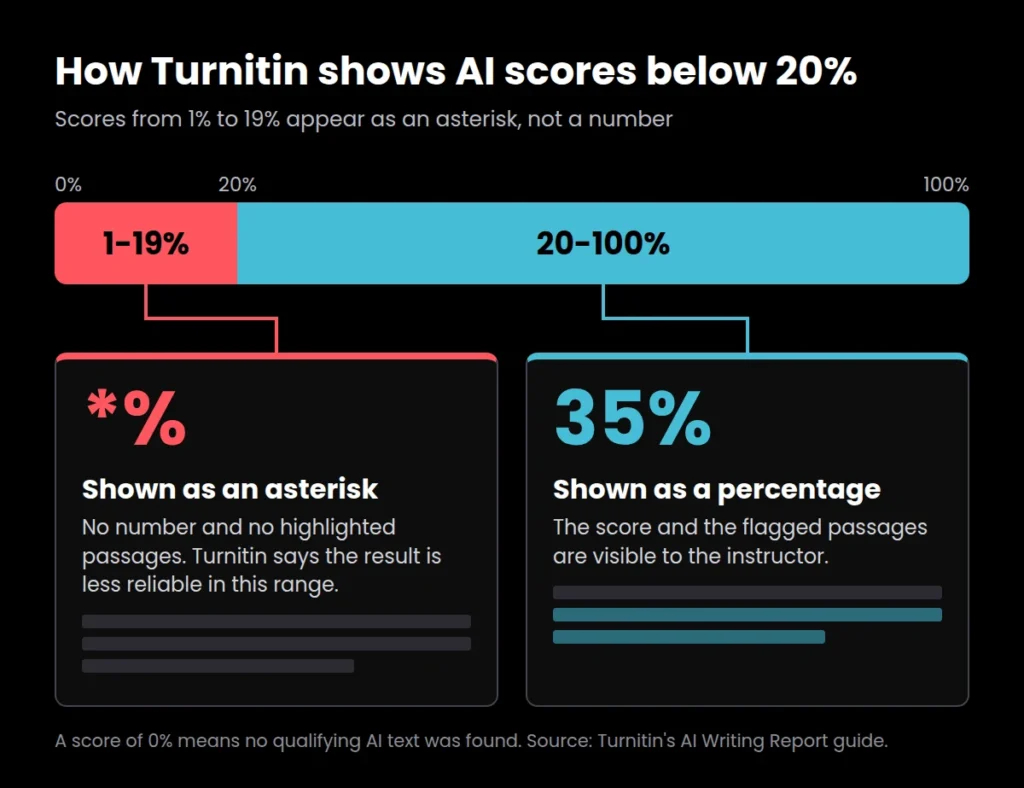
The most misunderstood rule is the asterisk. Since July 2024, scores from 1% to 19% appear as *% with no number and no highlights, because Turnitin considers results in that range less reliable. From 20% upwards you see the actual percentage and the highlighted passages.
Turnitin does not set an acceptable percentage, and each institution decides how to use the score. To see how universities treat different results, read our guide to what percentage of AI is acceptable at university.
The AI percentage is also not the same as the similarity score, which measures matching text from other sources. Our guide on Turnitin similarity score vs AI score explains how to read both side by side.
What Turnitin’s AI Detector Cannot Check
The detector only works on qualifying long-form prose. Anything outside these limits either gets no score or is a poor fit for the model.
| Requirement | Turnitin rule |
|---|---|
| Minimum length | At least 300 words of prose in a long-form writing format |
| Maximum length | No more than 30,000 words |
| File size | Less than 100 MB |
| File types | .docx, .pdf, .txt and .rtf |
| Languages | English, Spanish, Japanese and Arabic |
| Not a good fit | Poetry, scripts, code and short-form writing such as bullet-point lists |
| Excluded | Bibliographies |
Checked October 2026 against Turnitin’s file requirements for an AI writing report.
Short submissions are the biggest issue. Turnitin’s release notes say accuracy improves with a little more text and that scores on short submissions may be less accurate. The AI Writing Report guide also notes that the model does not reliably detect AI in non-prose formats such as poetry, scripts or code, or in short-form writing such as bullet points.
Model updates are not applied to old reports either. If a paper was checked before an update, its score stays the same unless it is resubmitted, so two papers checked months apart may have been scored by different versions of the model.
How Accurate Is Turnitin’s AI Detector?
Turnitin’s own figures are the best starting point, with one caveat: they come from the company that sells the product. In 2023, Turnitin’s chief product officer reported a document-level false positive rate of less than 1% for documents with more than 20% AI writing, and a sentence-level false positive rate of around 4%. Those findings are the reason scores below 20% are now shown as an asterisk.
In practice, that means two things. A high score on a long essay that was mostly written by AI is likely to be accurate. A modest score, particularly on a short or highly formal piece, deserves much more caution, because an individual sentence is more likely to be misjudged than a whole document.
Turnitin itself states that an AI writing score should not be used as the sole basis for adverse actions against a student. Some universities have gone further: Vanderbilt disabled Turnitin’s AI detection in August 2023 over false-positive concerns, and Yale’s Poorvu Center states that the AI detection feature is currently disabled at Yale.
Does Turnitin Detect ChatGPT?
Yes. Turnitin’s detector is built to recognise text from large language models, including ChatGPT, and it has been updated to catch paraphrased and humanized AI text as well. It is not perfect: heavily edited AI text can still slip through, and human writing can still be flagged. We put this question to the test in does Turnitin detect ChatGPT.
Can Students See Their Turnitin AI Score?
Usually not. Turnitin states that the AI writing score is visible only to instructors and administrators, although an instructor can choose to share it with you. If your paper is flagged, ask to see the report, including which passages were highlighted and which category they fall into.
Because Turnitin is licensed to institutions, there is no official way for an individual student to run a paper through Turnitin’s AI detector before submitting. Other detectors can give you a rough idea, but they use different models and will not produce the same number. If you want a second opinion on your own writing first, you can check your text with our free AI detector and treat the result as one signal rather than a prediction of your Turnitin score.
Why Institutions Use Turnitin’s AI Detector
For most schools, Turnitin’s AI detection arrives inside a tool they already use for plagiarism checking, so it fits existing marking workflows without extra software. Instructors see the AI writing report next to the Similarity Report, can click through the highlighted passages, and can use it to decide which submissions deserve a closer look.
Turnitin positions the feature as a way to support conversations about responsible AI use rather than as an automatic penalty. Many institutions now pair it with clear AI policies, disclosure statements and assessments that ask students to show their writing process.
What Students Should Do
The safest approach is to make your writing process easy to prove. Write in a tool that keeps version history, such as Google Docs or Word with OneDrive, and keep your outlines, notes and sources. Read your institution’s AI policy and each assignment brief, and disclose any permitted AI use in the way your instructor asks.
If your work is flagged, do not rewrite or delete the original file. Ask for the full report, gather your drafts and request a meeting to explain how you wrote the work. A human review supported by evidence is how most cases are resolved.
What Educators Should Know
Treat the AI percentage as one data point. Read the highlighted passages, compare them with the student’s earlier work and talk with the student before reaching a conclusion, which is the approach Turnitin itself recommends.
Be clear about your rules. Tell students whether AI tools are allowed for each assignment, how the AI writing report will be used and what evidence they can provide if questioned. Transparent policies reduce both misuse and false accusations.
Keep the limits in mind: no score below 300 words, an asterisk below 20%, lower reliability on short or formulaic writing, and scores that only change when a paper is resubmitted after a model update.
Frequently Asked Questions
How does Turnitin detect AI writing?
Turnitin splits qualifying text into overlapping segments, scores each sentence between 0 and 1 for how likely it is to be AI-generated, and combines those scores into one percentage. It looks for predictable patterns typical of large language models rather than matching your text to a database.
What AI detector does Turnitin use?
Turnitin uses its own in-house AI writing detection model, not a third-party tool. The model is trained to recognise text from large language models and is updated regularly, most recently to improve recall in October 2025 and February 2026.
Does Turnitin detect ChatGPT?
Yes, Turnitin’s detector is designed to recognise text produced by large language models such as ChatGPT. It is not perfect, so heavily edited AI text can be missed and human writing can occasionally be flagged.
Can students use Turnitin’s AI detector to check their own work?
Usually not. Turnitin is licensed to institutions, and the AI writing score is normally visible only to instructors and administrators. Third-party detectors can give a rough indication, but their scores will not match Turnitin’s.
What does *% mean on Turnitin?
An asterisk means Turnitin detected some AI-like text, but the result was below 20%. Since July 2024, Turnitin shows *% with no number and no highlights in that range because results there are less reliable.
Is Turnitin’s AI detector accurate?
Turnitin reports a document-level false positive rate below 1% for documents with more than 20% AI writing, and a sentence-level rate of around 4%. It is more reliable on long documents than on short or highly formal ones, and Turnitin says the score should not be the sole basis for action against a student.
Can Turnitin detect AI humanizers and paraphrasing tools?
Turnitin added detection of AI-paraphrased text in December 2023 and AI bypasser, or humanizer, detection in August 2025. Results still vary, so neither paraphrasing nor humanizing guarantees a particular result.
What is the minimum word count for Turnitin AI detection?
A file needs at least 300 words of prose in a long-form format to receive an AI writing score, and no more than 30,000 words. Shorter submissions do not get a score, and scores on short pieces may be less accurate.
Is the Turnitin AI score the same as the similarity score?
No. The similarity score shows how much of your text matches other sources, while the AI score estimates how much of it was likely generated by AI. The two are calculated independently.
Can Turnitin’s AI detector be wrong?
Yes. Like every AI detector, it can flag human writing as AI-generated and miss some AI text. If you are flagged, ask for the full report and use your drafts and version history to show how you wrote the work.
Final Thoughts
Turnitin’s AI detector is a pattern-based estimate, not a verdict. It splits your writing into segments, scores each sentence, and reports the share of qualifying prose that looks AI-generated, with an asterisk for low results and highlights from 20% upwards. It is most reliable on long, plainly AI-written text and least reliable on short or formulaic writing.
For students, the best protection is a clear record of how you wrote your work. For educators, the best practice is to treat the score as the start of a conversation. Used that way, the tool supports academic integrity without punishing honest writers.