
Updated October 2026
There is no universal acceptable AI percentage. Each university and instructor sets its own rules, and Turnitin does not set one. In Turnitin, scores below 20% appear only as an asterisk (%), so 20% is where a number first shows. As a general guide, low scores rarely cause problems and scores above about 35% often lead to questions.*
Some students panic at 15 percent, while others wonder whether 30 percent means automatic failure. Universities rarely rely on one number. AI detection is used as an indicator, not proof.
This guide covers what universities allow, how Turnitin shows scores, and what to do if your work is flagged. For what a specific score such as 15% or 50% means, see our guide to AI detection score meaning.
How we researched this: we used published university policies and Turnitin’s own documentation. Sources and the dates we checked them are in the universities table below.
Why There Is No Universal “Acceptable” AI Detection Percentage
Unlike plagiarism detection, AI detection does not measure copied content. It attempts to predict whether text resembles patterns commonly produced by AI tools. Because of this, universities do not treat AI detection percentages as definitive evidence.
Most institutions use AI detection as a preliminary screening tool. If a score appears unusual, instructors may review the work more closely. However, academic decisions are rarely made based on a single number.
Different universities also use different detection systems. If you want to understand this better, you can read which tool colleges use to detect ai, as detection results vary widely depending on the software used.
Turnitin says its AI score should not be the sole basis for action against a student, and it publishes no acceptable percentage. Keep the existing link to “which tool colleges use to detect ai”
What Universities Actually Mean by “Acceptable”
When universities talk about acceptability, they are not referring to a fixed percentage. Instead, they are asking whether the assignment demonstrates genuine student effort, original thinking, and academic integrity.
An acceptable AI detection result is one that does not raise serious concerns when viewed alongside the student’s writing history, citation quality, and ability to explain the work. Even a low percentage can be questioned if the content feels inconsistent or overly generic, while a higher percentage may be overlooked if the student can clearly prove authorship.
How Universities Typically Respond by AI Score Range
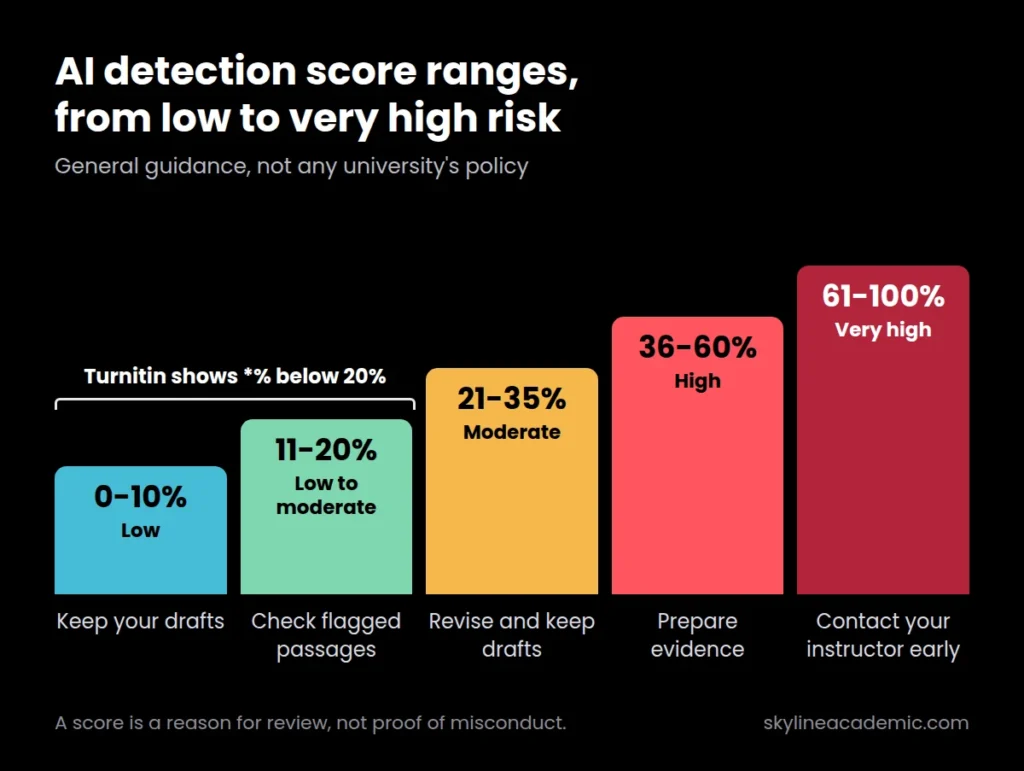
Use these ranges as general guidance only. Your syllabus and your university’s academic integrity policy decide what is acceptable.
Not sure where your draft stands? Check your text with our free AI content detector before you submit, and treat the result as one signal, not proof.
What Percentage of AI Is Acceptable on Turnitin?
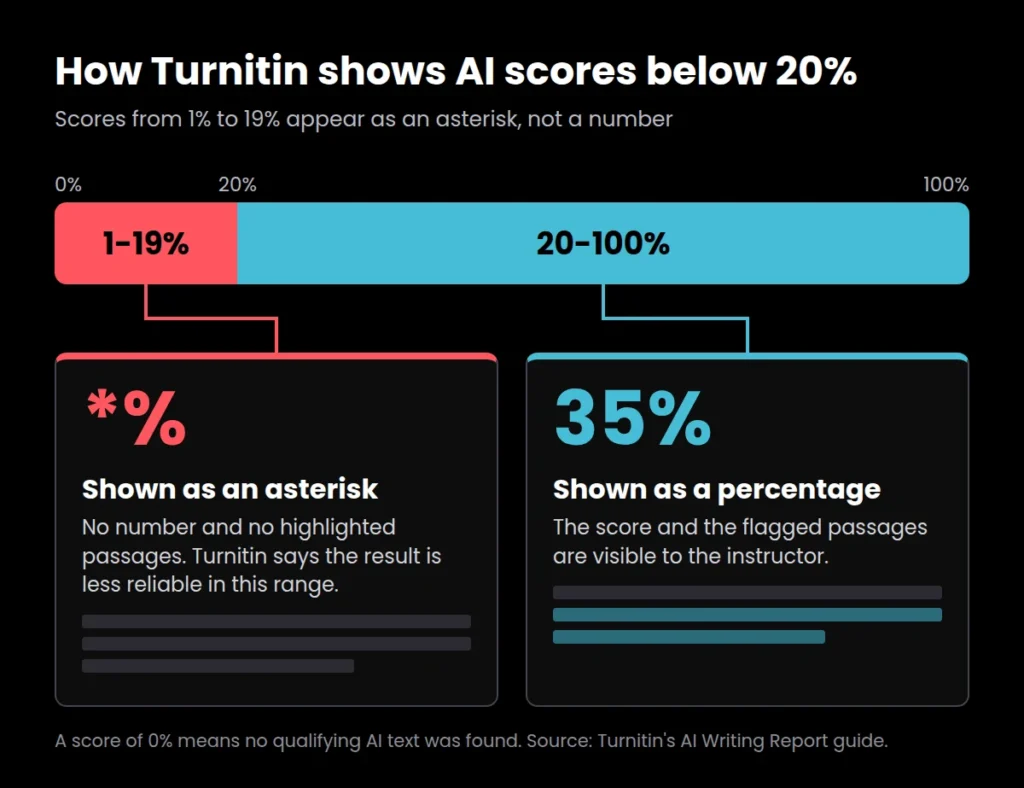
Turnitin does not publish an acceptable percentage, and it does not set your university’s rules. What it does is limit what it shows: below 20%, the report displays an asterisk (%) instead of a number, with no highlights, because Turnitin says scores in that range are less reliable. From 20% upward, the report shows the percentage and highlights the passages. Turnitin says its document-level false-positive rate is under 1% for documents above 20% AI writing, and that the score should not be the only basis for action against a student.
Turnitin’s AI score is also separate from its similarity score, which measures matching text rather than AI-like writing. Our guide on similarity score vs AI score explains how the two differ. Wondering whether Turnitin can spot ChatGPT text in the first place? See our answer to does Turnitin detect ChatGPT.
Is 20% AI on Turnitin acceptable?
There is no official pass mark. 20% is the lowest score Turnitin shows, so it is where instructors first see a number. Whether it triggers a review depends on your instructor and institution, so keep your drafts ready.
How GPTZero, Originality and Copyleaks Score Differently
The same essay can get three different percentages from three detectors, and those percentages don’t even mean the same thing. Before you compare scores, check what each tool’s percentage actually measures.
GPTZero
GPTZero’s percentage is the model’s probability that a document was written by AI or by a human, not the share of your essay that is AI. It classifies text as human, AI or mixed, and adds a certainty measure. A low certainty means the text is unlike what the model was trained on, so the result should be read with caution. GPTZero highlights the sentences that influenced the result and says an AI result should not be the only basis for academic punishment. For more on how it compares with other tools, see our GPTZero alternatives guide.
Originality.ai
Originality.ai reports a confidence score, not a share of words. A result of 60% original and 40% AI means the model is 60% confident the text was written by a human, not that 40% of it was written by AI. Its help center says a high AI score does not prove AI wrote the text, and that short, highly structured, heavily edited or translated writing can score high. To compare results fairly, scan exactly the same text with the same model. Read our Originality.ai accuracy review for the full test.
Copyleaks
Copyleaks works differently: its AI percentage is the portion of the document it identifies as likely AI-generated, not a confidence score. It scores text in larger sections rather than single sentences, so if enough of a section looks AI-like, the whole section can be marked. Its sensitivity setting also changes how aggressively text is flagged. Copyleaks says its AI percentage is separate from the similarity score, so a paper can show 0% matched text and still contain flagged AI content. See our Copyleaks accuracy review.
| Tool | What the percentage means |
|---|---|
| GPTZero | LikelihoodProbability the document is AI, human or mixed, with a certainty measure |
| Originality.ai | LikelihoodConfidence in its prediction, not the share of words written by AI |
| Copyleaks | Share of textPortion of the document flagged as likely AI-generated |
| Turnitin | Share of textPercentage of qualifying prose, shown only from 20% (below that, an asterisk) |
A likelihood score and a share-of-text score are not the same thing, so a percentage from one tool can’t be compared directly with another.
Because one tool reports a probability and another reports a share of text, 20% on one is not the same as 20% on another. Always note which tool and model produced a score, and treat none of them as proof. Our guide to what an AI detection score means explains this further, and our Turnitin AI detection guide covers how Turnitin differs again.
Why Human-Written Assignments Get Flagged as AI
Formal templates, grammar tools and non-native writing patterns can all raise scores, even for original work. Our guide to why human-written content still shows an AI detection score covers the reasons in detail.
How Professors Evaluate AI Use Beyond Percentages
Universities rely heavily on human judgement. Professors assess whether the writing style matches the student’s previous work, whether arguments are logically developed, and whether sources are credible and accurately cited.
They may also ask students to explain how they developed their argument, why they selected certain sources, or how they conducted their analysis. Students who genuinely wrote their work can usually answer these questions confidently. For more insight into this process, see how professors detect ai.
What Universities Say About AI Detection
Few universities publish an official AI percentage. Most either avoid AI detectors altogether or use a score only as a reason to look closer. The examples below come from each university’s own published pages, and the date shows when we last checked them. Policies change, so confirm your own university’s current guidance.
| University | Rule or stance | Source | Date checked |
|---|---|---|---|
| Geneva CollegePennsylvania, US | Sets a threshold Its Online Degree Programs investigate any paper with a Turnitin AI Writing Indicator of 25% or higher. A resubmitted paper must score below 25% to be acceptable. Flagged papers are also run through at least two other detectors, and if the results are not consistent the paper is graded without penalty. | Geneva ODP FAQ: AI in Academic Writing (PDF, 2025) | |
| Vanderbilt UniversityTennessee, US | Not using the tool Disabled Turnitin’s AI detection tool from August 16, 2023. It said it does not believe AI detection software is an effective tool that should be used, and advised instructors who suspect misuse to talk to the student. | Vanderbilt Brightspace blog, Aug 16, 2023 | |
| Yale UniversityConnecticut, US | Not using the tool The Poorvu Center says the AI detection feature of Turnitin is currently disabled at Yale. Its AI guidance says there is no tool or method to detect AI use with any certainty, and suggests instructors talk to the student about their concerns. | Yale Poorvu Center: Turnitin Yale Poorvu Center: AI guidance | |
| Newcastle UniversityEngland, UK | Not using the tool Says AI detection tools are highly unreliable and strongly advises against using them. It does not use the AI detection feature within Turnitin, and will only use a detection tool as part of a misconduct investigation if required. | Newcastle Library Help FAQ, updated Mar 26, 2025 | |
| Brunel University of LondonEngland, UK | Not using the tool Says it is not currently planning to use Turnitin’s AI detection tool. Its reasons are equity, because detectors are easy to fool so only weaker students are caught, and false positives, which it calls far too high for unfounded cheating allegations. Staff are told not to upload student work to third-party detectors. | Brunel Digital Education: Similarity and other related information (undated) | |
| University of GlasgowScotland, UK | Opted out An April 2023 staff memo says Glasgow, like most other Russell Group universities, took up Turnitin’s opt-out “at least for the moment”. It adds that no detection tool is yet reliable enough to be the basis of a student misconduct case. | Glasgow staff memo, April 2023 (PDF) | |
| University of Technology, JamaicaJamaica | Sets a threshold Its 2025-26 student handbook says an AI score of 0-40% is acceptable and anything above is deemed unacceptable and likely to be penalized. It also lists guideline ranges by discipline, from 5-10% in humanities and arts to 30-40% in engineering. | Student Handbook 2025-26, page 254 |
Stances change. These are the universities’ own published statements, so check your own university’s current policy before relying on them.
Two patterns stand out. Most of these universities do not use AI detection scores as evidence at all, and several say plainly that the tools are unreliable. The few that do set a number, such as 25% at Geneva College or 40% at the University of Technology, Jamaica, treat it as a trigger for review, and Geneva checks the result against other tools before acting. Neither number is a general standard, so the only limit that applies to you is the one in your own university’s policy.
How to Stay Within Your University’s AI Rules
The safest approach is to follow your institution’s rules rather than chase a score. Read the policy, check each assignment brief, disclose any permitted AI use, and keep drafts, notes and version history. If you are unsure, ask your instructor in writing before you submit. Detection scores are only one concern: quoting or paraphrasing sources without proper credit can also raise questions, even when it is unintentional, so read our guide to accidental plagiarism and cite as you write.
How Much AI Use Is Allowed at University?
Acceptable AI use is a separate question from an acceptable AI score. Policies usually fall into three groups: AI is not allowed for assessed work, AI is allowed only for tasks such as brainstorming or proofreading, or AI is allowed with disclosure. Instructors can set different rules for different assignments, so check your syllabus and assignment brief before using any AI tool. If the rule is unclear, ask your instructor in writing before you submit.
How to Reduce AI Detection Risk Naturally
The safest approach is not to “beat” AI detectors, but to write authentically. Focus on developing a clear argument, applying theory to specific cases, and using credible sources effectively. Specific examples, contextual analysis, and personal academic reasoning significantly reduce AI-like patterns.
Detection scores are only one concern. Quoting or paraphrasing sources without proper credit can also raise questions, even when it is unintentional, so read our guide to accidental plagiarism and cite as you write.
Keeping evidence of your writing process is equally important. Drafts, outlines, research notes, and version history can protect you if questions arise.
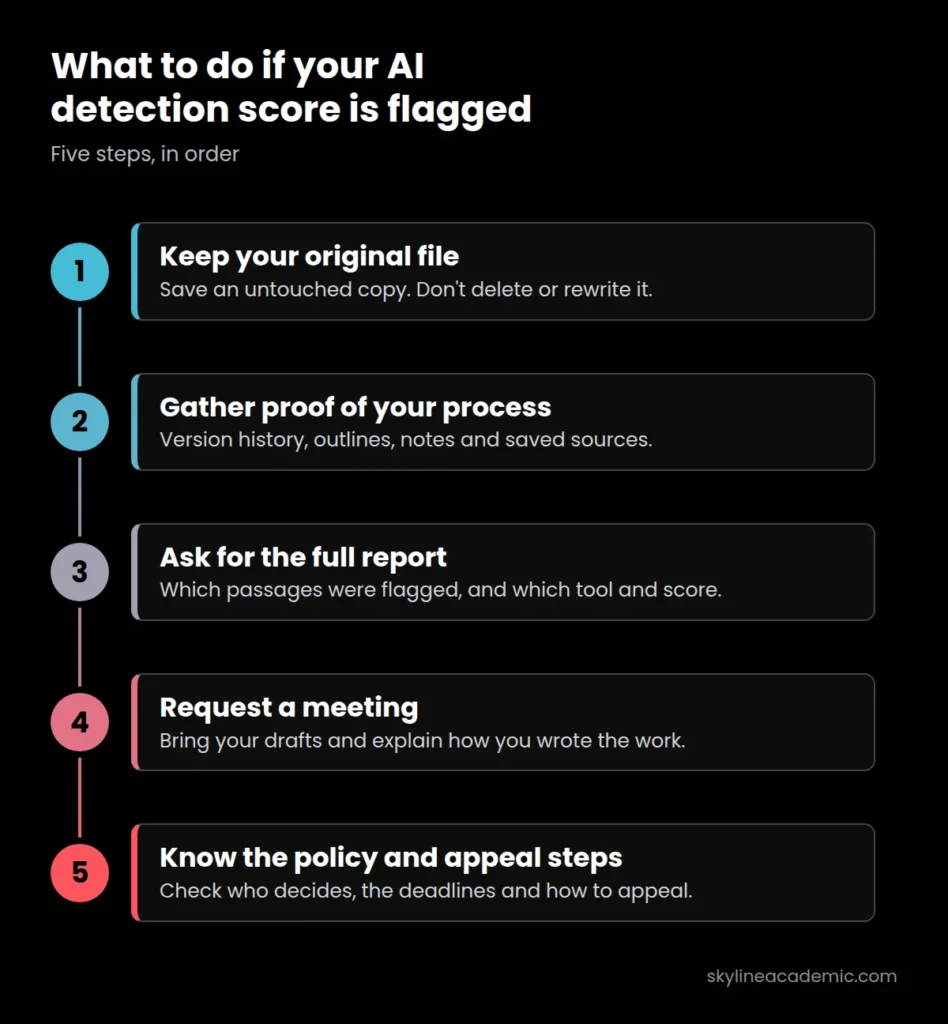
What to Do If Your University Flags Your Work for AI
Every university has its own process, so these steps focus on policy and procedure. For how to read your score and gather evidence, see what to do if your AI detection score is high.
You can also run a free scan on your own text to see which passages stand out, but different tools give different scores.
Step 1: Keep your original file
Do not delete the paper, and do not rewrite it from scratch. Save an untouched copy of the file that was flagged, with its date and file name, because it is the evidence the review will start from. Avoid running it through a rewriting or “humanizer” tool, since new edits can make your writing history harder to explain.
Step 2: Gather proof of how you wrote it
Collect anything that shows your writing process: version history from Word, Google Docs or OneDrive, outlines, handwritten or typed notes, saved sources and any drafts you emailed to yourself or a tutor. Version history is especially useful because it shows the paper growing over time. Some universities set short deadlines for this evidence. Geneva College’s online programs, for example, ask for proof within 48 hours of the instructor’s request.
Step 3: Ask for the full report and check which score it is
Ask your instructor for the full AI report and for the specific passages that were flagged. Then find out which tool produced the score and what that number means. Turnitin shows only an asterisk for results below 20% and a percentage from 20% upward, while GPTZero and Originality.ai report a probability rather than a share of your text.
Step 4: Request a meeting and explain how you wrote the work
Ask for a meeting rather than replying only by email. Bring your drafts and notes, and be ready to explain your argument, why you chose your sources and how you reached your conclusions. Students who wrote their own work can usually explain it in detail, and that conversation often settles the concern. Stay calm and factual, and avoid guessing about why the tool flagged your work.
Step 5: Read the policy and know the appeal steps
Find your university’s academic integrity policy and check four things: who decides, what evidence they must show you, how long you have to respond and how to appeal. If you are unsure, ask your students’ union advice service, student ombuds office or academic advisor for help before you submit a written response. Policies differ widely between universities, so the policy that applies to you is the one that counts.
Final Thoughts
There is no universally acceptable AI detection percentage. Each university sets its own rules, Turnitin sets none, and detection tools are imperfect. What matters is following your institution’s policy, documenting your writing process and being able to explain your work. If you want to check your draft first, you can check your text with our free AI content detector, and treat the result as one signal, not proof.
Frequently Asked Questions
What percentage of AI is acceptable at university?
There is no universal figure. Each university and instructor sets its own rules, and some publish thresholds while many leave it to instructors. Check your own university’s policy and your assignment brief.
Is 10 percent AI detection acceptable in universities?
Usually yes. A 10% score is in the low range, and formal academic writing often produces scores like this. In Turnitin you would see only *%, and your university’s policy decides what is acceptable.
Is 20% AI on Turnitin acceptable?
Turnitin does not define 20% as acceptable or unacceptable. It is the lowest score Turnitin shows as a number, with anything below displayed as *%. Whether it leads to a review depends on your instructor and university, so keep your drafts ready.
Do universities set official AI detection thresholds?
Some institutions publish guidance, and many leave the decision to instructors. Turnitin does not set an acceptable percentage. Check your own university’s policy.
How much AI use is allowed in university work?
It depends on the university, the course and the assignment. Common rules are no AI for assessed work, AI for limited tasks like brainstorming or proofreading, or AI with disclosure. Check your syllabus and ask your instructor if the rule is unclear.
Can professors rely only on AI detection reports?
Generally no. Turnitin itself says its AI score should not be the sole basis for adverse action against a student. Reports are normally used alongside human judgement and other evidence, such as drafts and a conversation with the student.
Do acceptable AI limits differ between subjects and universities?
Yes. The University of Technology, Jamaica, for example, publishes guideline ranges by discipline, from 5-10% in humanities and arts to 30-40% in engineering. Other universities, such as Yale and Vanderbilt, do not use detection scores that way at all.
What should I look for in my university’s AI policy?
Check whether AI is allowed for each type of assignment, whether you must disclose its use, who decides in a review, what evidence you can submit and how to appeal. If the policy is silent or unclear, ask your instructor in writing before you submit.