
Last updated:
You are halfway through an organic chemistry exam. The question shows an alkyl halide, a reagent and a solvent, and asks for the product. You know it is a substitution reaction, but is it SN1 or SN2? You guess, lose the marks, and the stereochemistry part goes wrong too. If that sounds familiar, you are not alone. SN1 vs SN2 is one of the most common places students get stuck, often because they memorise rules without understanding why they work. If organic chemistry feels harder than other science classes, our guide on why organic chemistry feels so hard explains why that is normal.
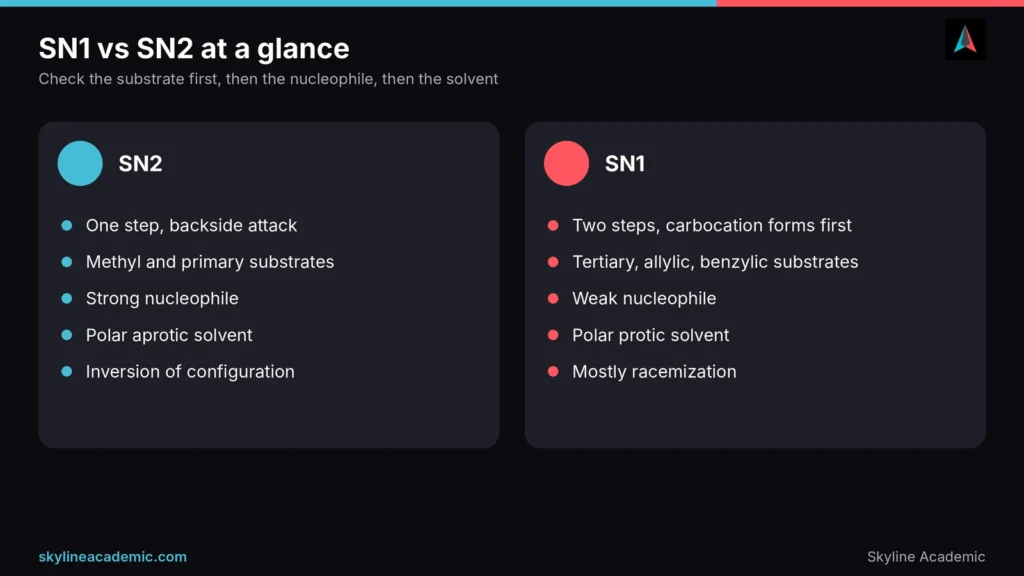
Here is the short answer. An SN2 reaction happens in one step: a strong nucleophile attacks the carbon from the back while the leaving group leaves, and the shape flips. An SN1 reaction happens in two steps: the leaving group leaves first to form a carbocation, and then a weak nucleophile attacks. To decide which one happens, look at the substrate first, then the nucleophile, then the solvent.
What nucleophilic substitution means
A substitution reaction swaps one group on a molecule for another. In nucleophilic substitution, an electron-rich particle replaces a group attached to a carbon atom. Four words come up again and again, so let us define them in plain English.
- Nucleophile: an electron-rich species, often with a negative charge or a lone pair, that attacks a carbon. Hydroxide (HO⁻), iodide (I⁻), cyanide (CN⁻) and water are common examples.
- Substrate: the molecule being attacked, usually an alkyl halide such as bromomethane or 2-bromobutane.
- Leaving group: the group that breaks away, taking a pair of electrons with it. Good leaving groups, like iodide, bromide and tosylate, are stable on their own.
- Carbocation: a carbon with only three bonds and a positive charge. It appears in SN1, but not in SN2.
The names tell you a lot. “S” means substitution, “N” means nucleophilic, and the number tells you how many molecules take part in the slowest step. SN2 is bimolecular, so two molecules are involved in its key step. SN1 is unimolecular, so only one is. If you need a refresher on how alkyl halides fit into the bigger picture, see our guide to functional groups in organic chemistry.
SN2 reaction mechanism: one step, backside attack
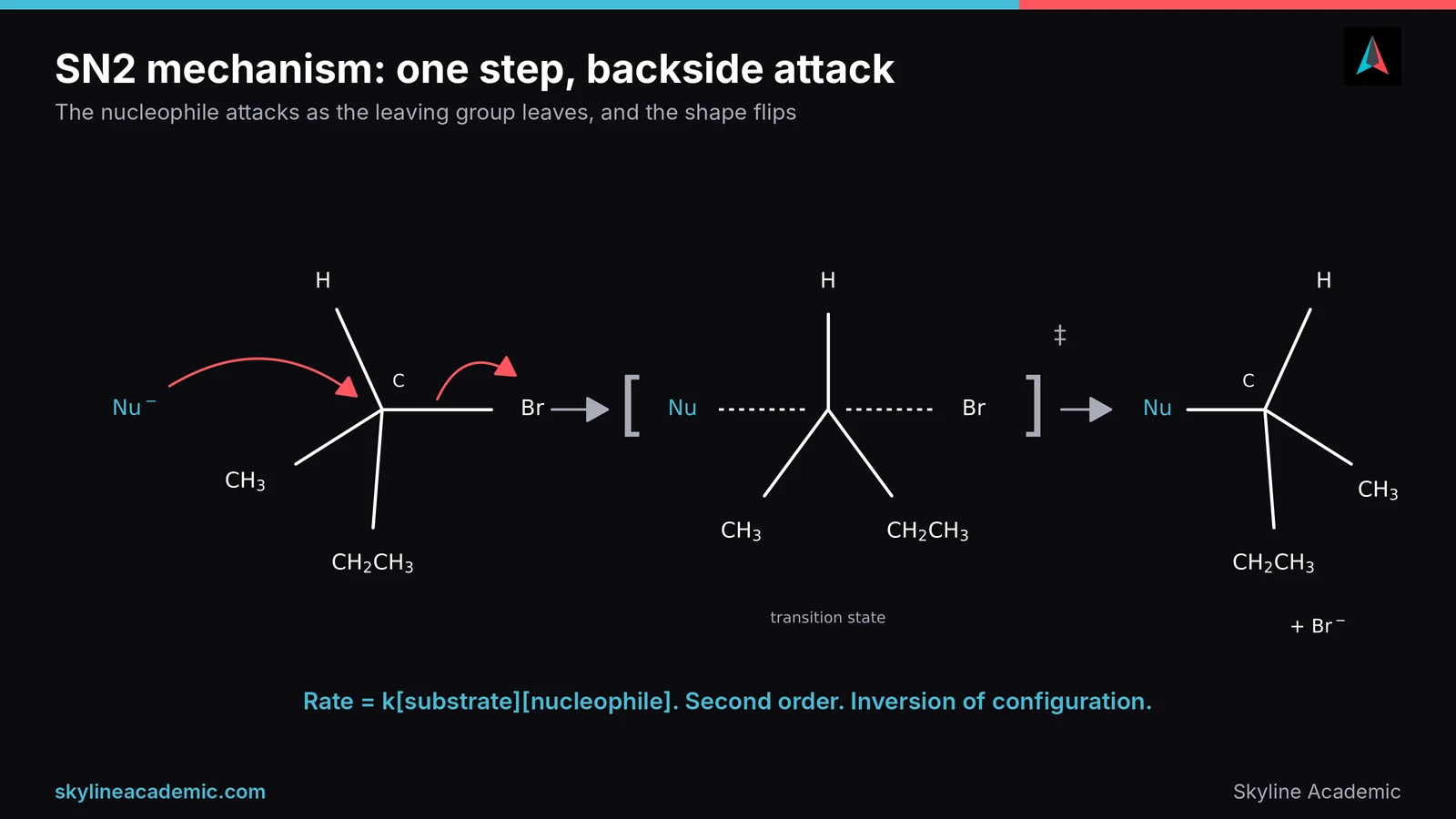
In an SN2 reaction, everything happens at once. The nucleophile attacks the carbon from the side directly opposite the leaving group. This is called backside attack. As the new bond forms, the old bond breaks, and the leaving group leaves in the same step.
Halfway through, the reaction passes through a transition state. A transition state is the highest energy point of a step, where bonds are partly formed and partly broken. In SN2, the carbon is briefly attached to both the nucleophile and the leaving group, with its other three groups flattened into a plane.
Because the nucleophile comes in from the back, the three other groups on the carbon are pushed through to the other side, like an umbrella turning inside out in the wind. This is called inversion of configuration, or Walden inversion. If you start with the R form of a chiral alkyl halide, you usually end up with the S form of the product, provided the priorities of the groups stay in the same order.
The SN2 rate law
Since the nucleophile and the substrate both take part in the one and only step, the rate depends on both. The rate law is rate = k[substrate][nucleophile]. That makes SN2 a second order reaction overall.
SN1 reaction mechanism: two steps through a carbocation
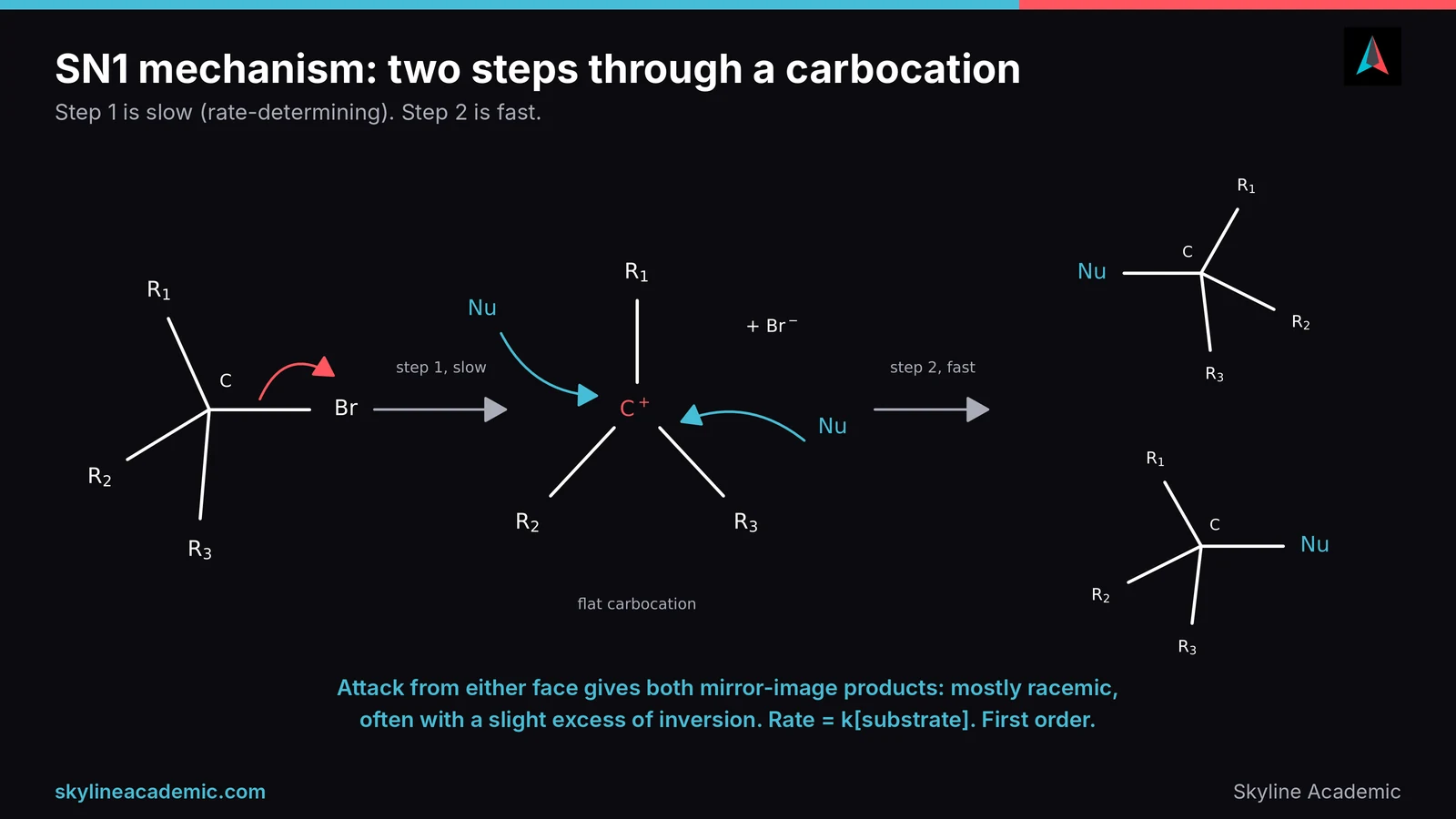
An SN1 reaction happens in two separate steps. In step one, the leaving group breaks away on its own, leaving behind a flat, positively charged carbocation. This step is slow, and it decides how fast the whole reaction goes, so it is called the rate-determining step. In step two, the nucleophile attacks the carbocation quickly.
Because the carbocation is flat, the nucleophile can attack from either side. In theory, that gives a 50:50 mix of both mirror image products, called a racemic mixture. In practice, OpenStax Organic Chemistry explains that few SN1 reactions are fully racemic. Most give a small excess of inversion, often up to about 20%, because the leaving group briefly stays close to one face of the carbocation and partly blocks it.
Carbocations can also rearrange. If moving a hydrogen or a methyl group to a neighbouring carbon creates a more stable carbocation, it often happens before the nucleophile attacks. That is why SN1 products sometimes have a different carbon skeleton than you expect.
The SN1 rate law
Only the substrate is involved in the slow first step, so the rate depends only on the substrate. The rate law is rate = k[substrate]. That makes SN1 a first order reaction. The nucleophile still ends up in the product, but its concentration does not change how fast the reaction goes.
SN1 vs SN2 chart: the key differences at a glance
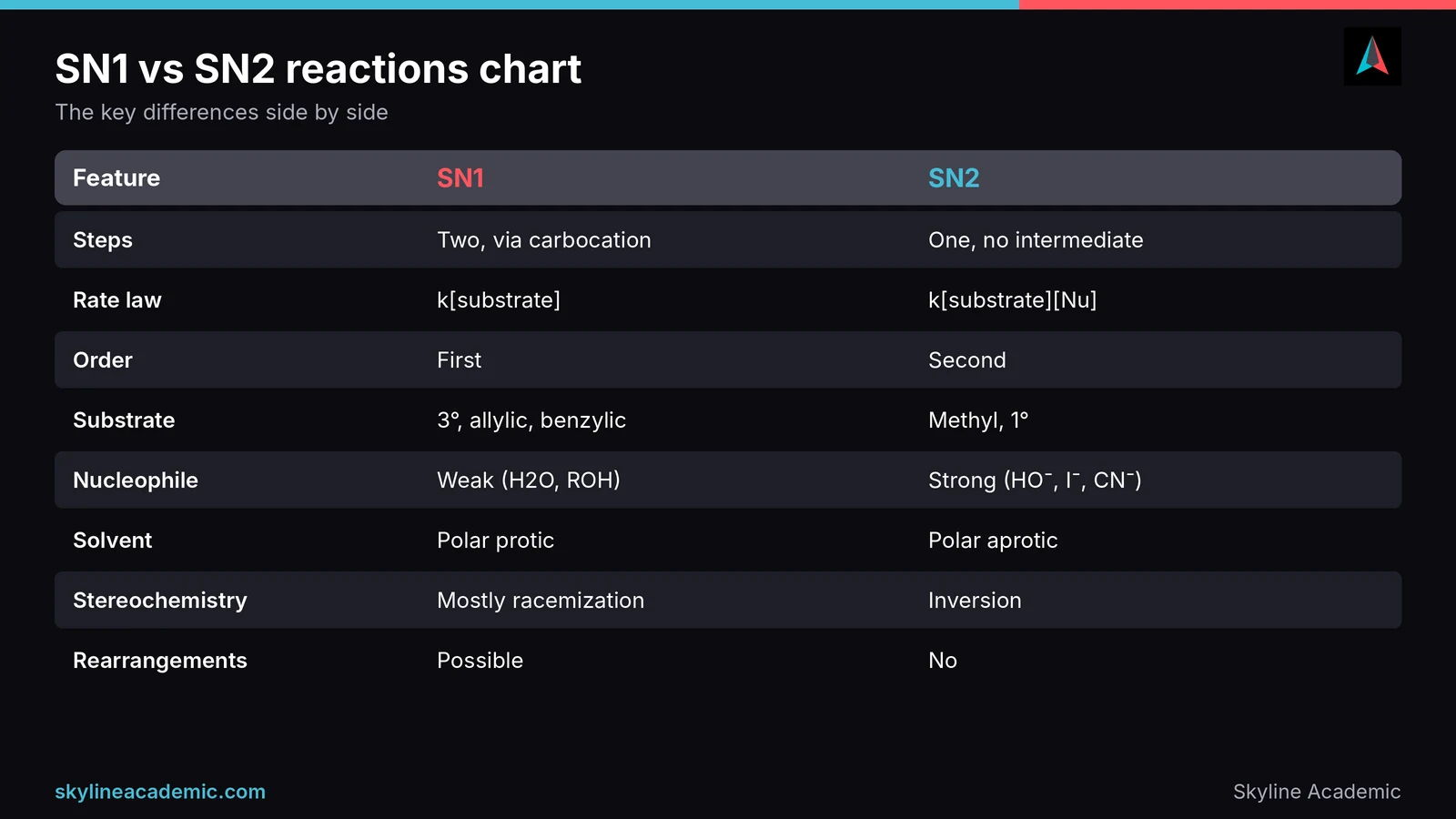
Here is the chart most students wish they had before their exam. Save it, but make sure you understand the reason behind each row.
| Feature | SN1 | SN2 |
|---|---|---|
| Steps | Two steps, through a carbocation | One step, no intermediate |
| Rate law | rate = k[substrate] | rate = k[substrate][nucleophile] |
| Order | First order | Second order |
| Best substrate | Tertiary, allylic, benzylic | Methyl and primary |
| Nucleophile | Weak, often neutral, such as water or alcohols | Strong, often negative, such as HO⁻, I⁻, CN⁻ |
| Solvent | Polar protic, such as water, methanol, ethanol | Polar aprotic, such as acetone, DMSO, DMF, acetonitrile |
| Leaving group | Good leaving group needed | Good leaving group needed |
| Stereochemistry | Mostly racemization, often slight excess inversion | Complete inversion |
| Rearrangements | Possible | Not possible |
| Energy diagram | Two humps with a valley for the carbocation | One hump |
SN1 vs SN2 rules: how to decide which one happens
When you face a new problem, check these four things in order. The first one usually gives you the answer.
1. Look at the substrate
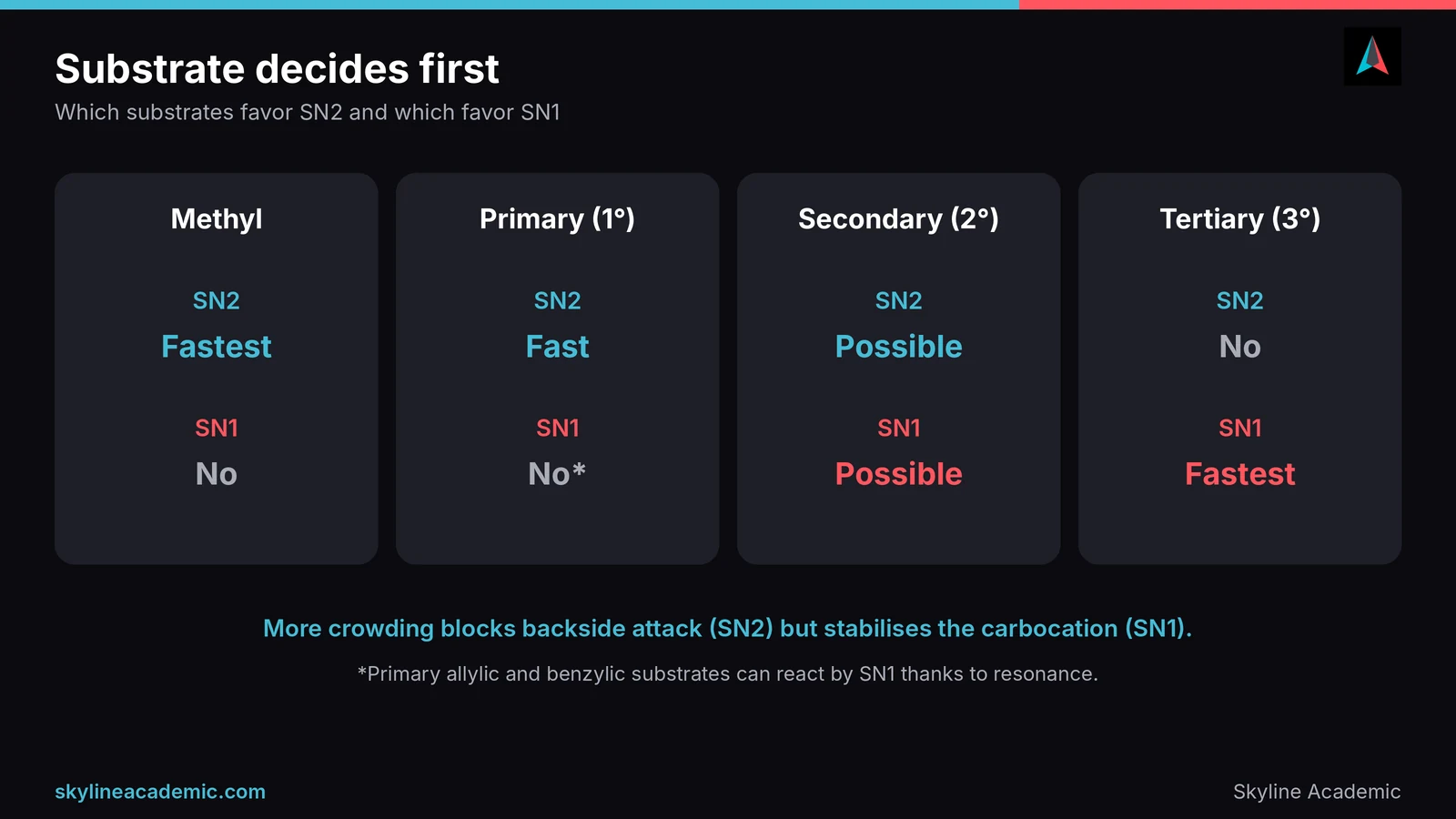
Count how many carbon groups are attached to the carbon holding the leaving group. Methyl and primary substrates go SN2, because the back of the carbon is open. Tertiary substrates go SN1, because they are too crowded for backside attack and they form stable carbocations. This crowding is called steric hindrance. OpenStax notes that tertiary substrates effectively do not react by SN2 at all, and even neopentyl substrates, which are primary but very bulky nearby, react extremely slowly.
There is one important exception. Allylic and benzylic substrates, where the carbon sits next to a double bond or a benzene ring, form carbocations that are stabilised by resonance. They can react by SN1 even when they are primary.
2. Look at the nucleophile
A strong nucleophile pushes the reaction towards SN2, because it is ready to attack straight away. A weak nucleophile, such as water or an alcohol, usually waits for a carbocation to form, so it favours SN1. OpenStax lists relative SN2 rates with bromomethane: iodide reacts about 100,000 times faster than water, and hydroxide about 10,000 times faster.
3. Look at the solvent
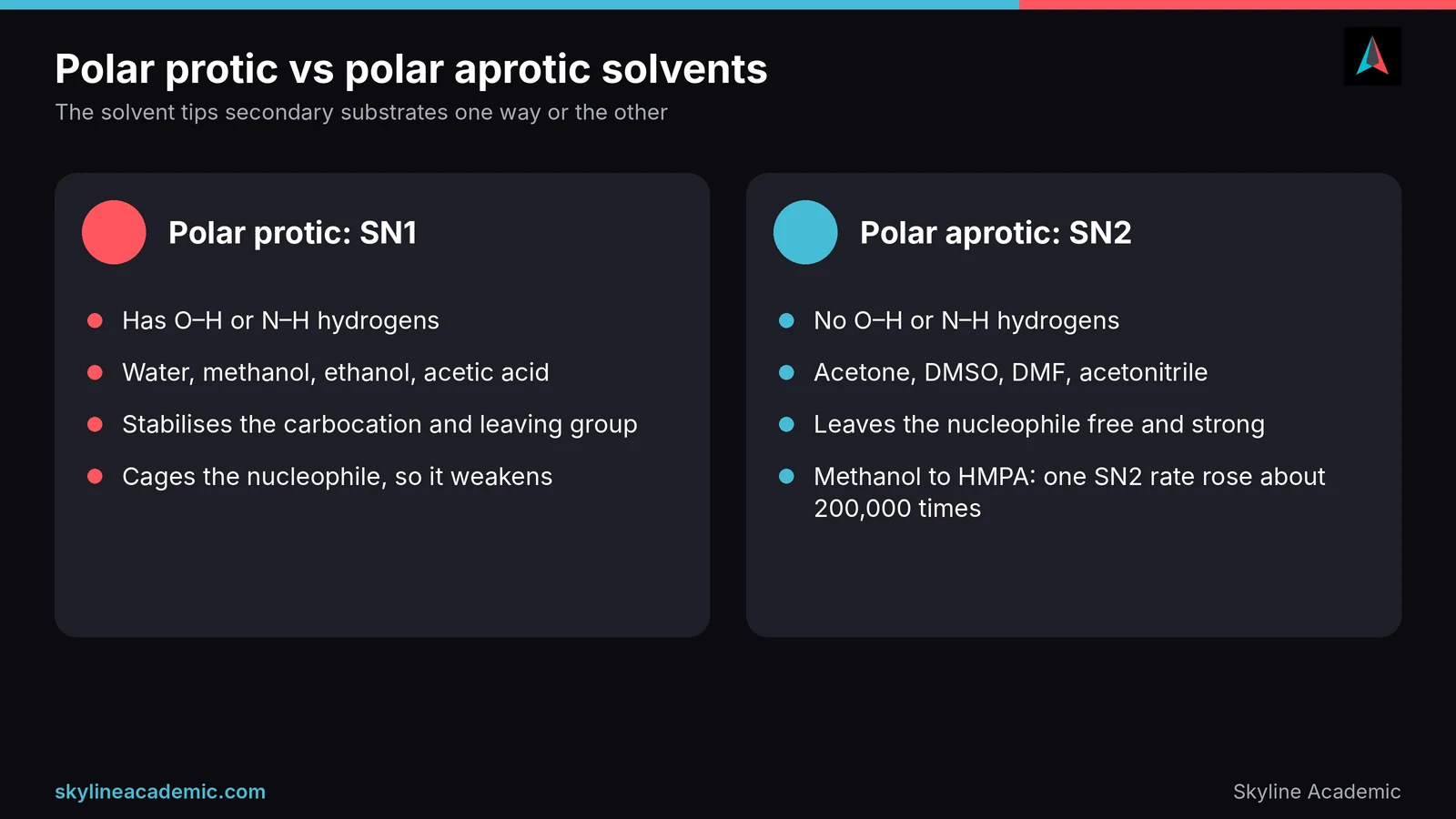
Polar protic solvents have hydrogens on oxygen or nitrogen, such as water, methanol and ethanol. They stabilise the carbocation and the leaving group, so they favour SN1. Polar aprotic solvents, such as acetone, DMSO, DMF and acetonitrile, have no such hydrogens. They do not wrap tightly around the nucleophile, so it stays strong and favours SN2. OpenStax reports that changing the solvent from methanol to HMPA increased one SN2 reaction rate about 200,000 times.
4. Check the leaving group
Both mechanisms need a good leaving group, so this rarely decides between them. It does decide whether the reaction happens at all. Iodide, bromide and tosylate are good. Hydroxide is poor, which is why alcohols are usually converted first, for example with acid.
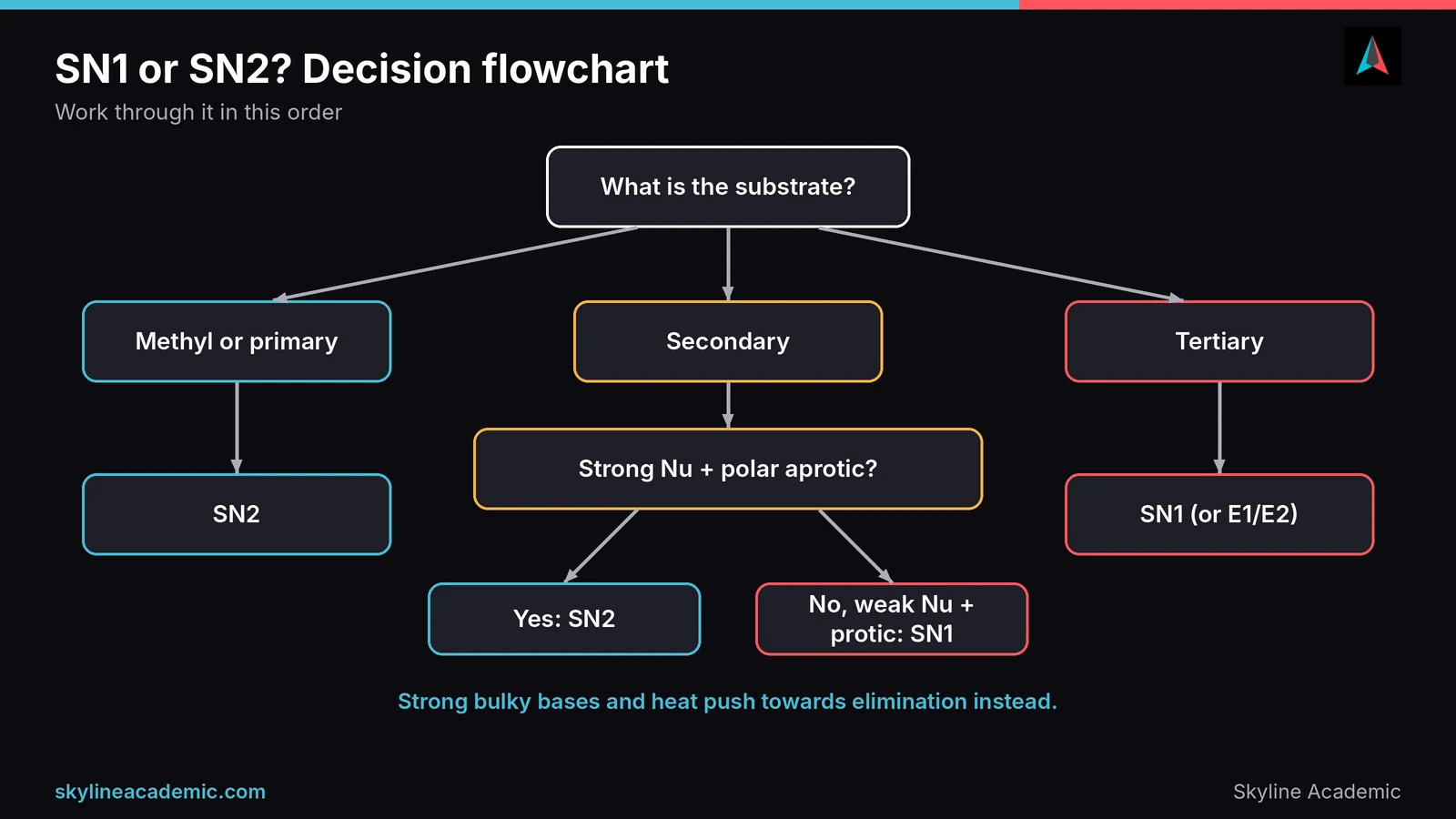
What about secondary substrates?
Secondary substrates are the tricky middle ground, and they appear on exams for exactly that reason. Here the nucleophile and solvent decide. A strong nucleophile in a polar aprotic solvent points to SN2. A weak nucleophile in a polar protic solvent points to SN1. Also watch for strong, bulky bases and heat, which push secondary and tertiary substrates towards elimination instead.
SN1 vs SN2 reaction rate: what speeds each one up
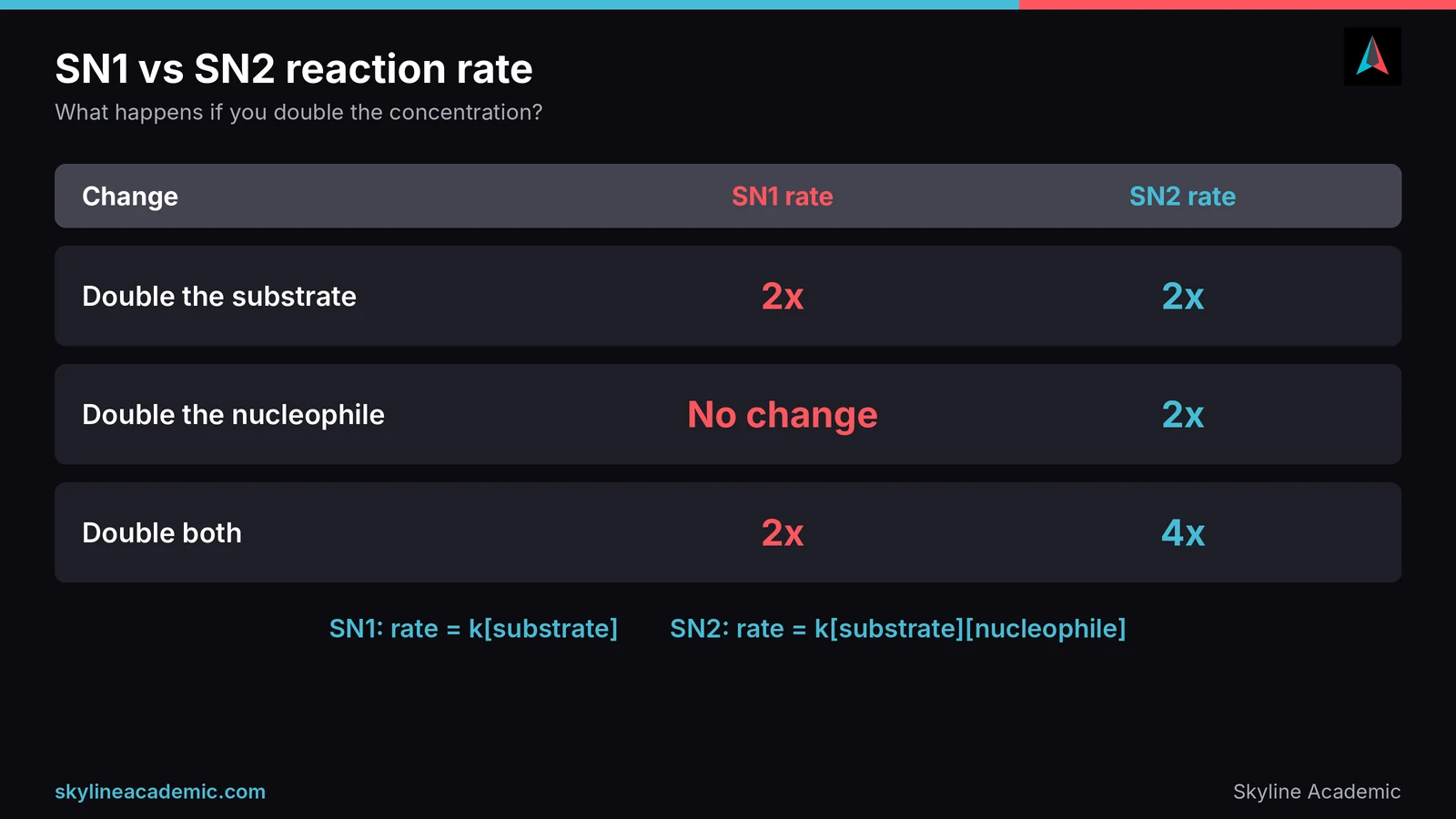
The rate laws give you a simple test. Imagine you double the concentration of each reactant.
In an SN2 reaction, doubling the substrate doubles the rate, and doubling the nucleophile also doubles the rate. Double both, and the rate goes up four times. In an SN1 reaction, doubling the substrate doubles the rate, but doubling the nucleophile changes nothing, because the nucleophile is not part of the slow step.
Other factors matter too. For SN1, anything that stabilises the carbocation speeds it up, such as more alkyl groups, resonance and polar protic solvents. OpenStax reports that the SN1 reaction of 2-chloro-2-methylpropane runs about 100,000 times faster in water than in ethanol. For SN2, anything that keeps the back of the carbon open and the nucleophile strong speeds it up.
SN1 vs SN2 reaction coordinate diagrams
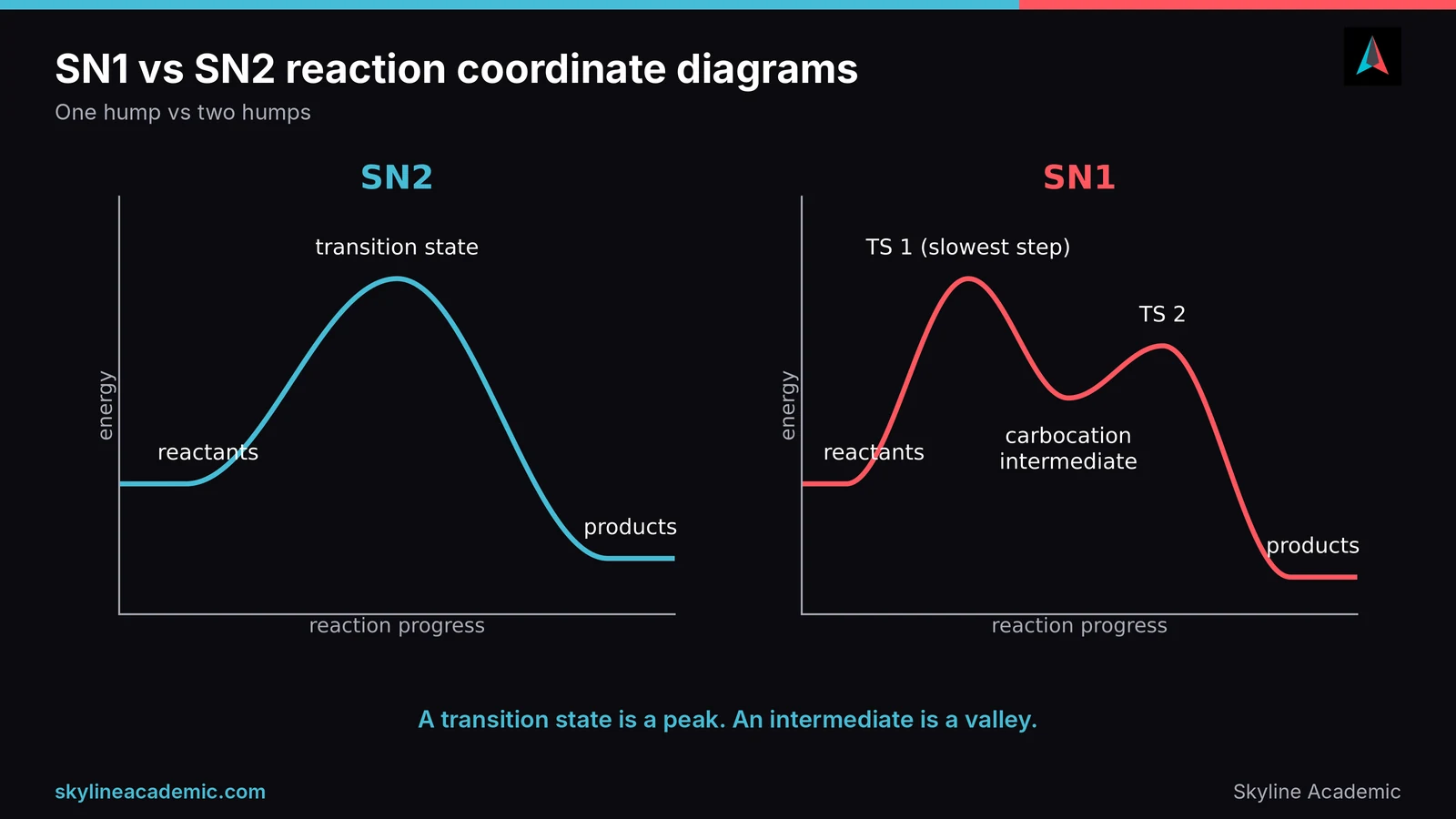
A reaction coordinate diagram, or energy diagram, shows how energy changes as reactants turn into products. It is one of the clearest ways to see the difference between the two mechanisms.
The SN2 diagram has one hump. The top of the hump is the single transition state, where the nucleophile and leaving group are both partly bonded to the carbon. There is no valley in between, because there is no intermediate.
The SN1 diagram has two humps with a valley between them. The first hump is the transition state for the leaving group breaking away. It is the highest point on the diagram, which is why the first step is rate-determining. The valley is the carbocation intermediate, a real but short-lived species. The second, smaller hump is the transition state for the nucleophile attacking. A common exam trap is to mix up a transition state, which is a peak, with an intermediate, which is a valley.
SN1 vs SN2 reactions examples: 5 practice problems
Try each one before you read the answer. Cover the last two columns if you want to test yourself.
| Substrate | Nucleophile and solvent | Mechanism | Why |
|---|---|---|---|
| Bromomethane (CH3Br) | NaOH in DMSO | SN2 | Methyl substrate, strong nucleophile, polar aprotic solvent |
| tert-Butyl bromide | Water (solvolysis) | SN1 | Tertiary substrate, weak nucleophile, polar protic solvent |
| (R)-2-Bromobutane | NaI in acetone | SN2 | Secondary, but strong nucleophile in polar aprotic solvent. Product is (S)-2-iodobutane |
| 2-Bromobutane | Methanol, warm, no added base | SN1 | Secondary with a weak nucleophile in a polar protic solvent. Some E1 may compete |
| 1-Bromobutane | NaCN in DMF | SN2 | Primary substrate, strong nucleophile, polar aprotic solvent |
Notice how problems three and four use the same substrate but give different answers. That is the secondary substrate rule in action. For more practice across the whole course, try our organic chemistry practice problems with answers.
Quick self-check quiz
Click each question to reveal the answer.
Q1. You double the nucleophile concentration in an SN1 reaction. What happens to the rate?
Answer: Nothing changes. The nucleophile is not part of the slow step, so rate = k[substrate].
Q2. tert-Butyl bromide is dissolved in water. Is this SN1 or SN2?
Answer: SN1. It has a tertiary substrate, a weak nucleophile and a polar protic solvent.
Q3. Which solvent favors SN2: acetone or methanol?
Answer: Acetone. It is polar aprotic, so the nucleophile stays strong.
Q4. (R)-2-Bromobutane reacts with sodium azide in DMF. What is the configuration of the product?
Answer: (S)-2-azidobutane. SN2 backside attack inverts the stereocentre.
Q5. On an SN1 energy diagram, is the carbocation a peak or a valley?
Answer: A valley. It is an intermediate. The peaks are transition states.
SN1 vs SN2 for the MCAT
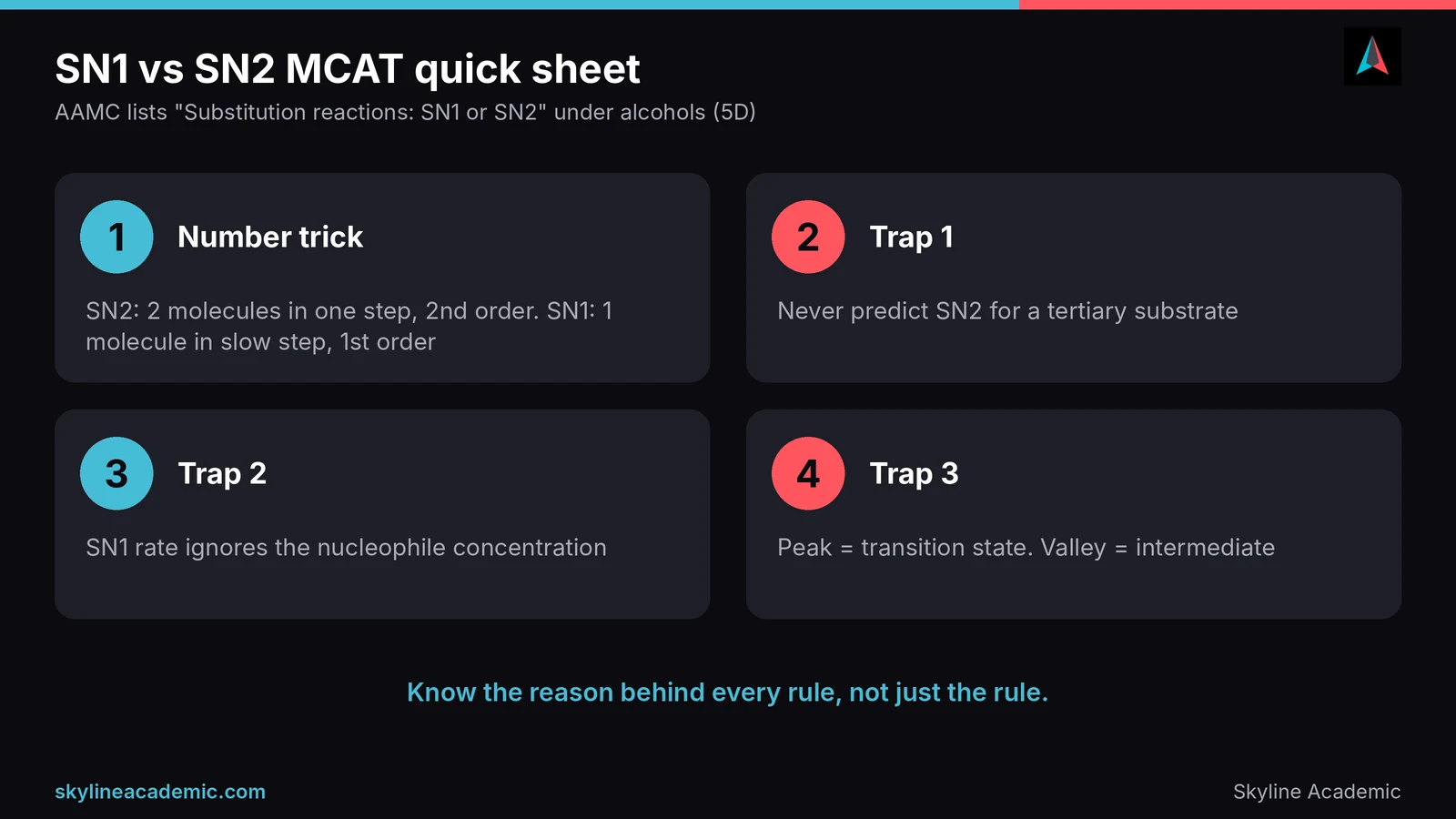
The AAMC lists “Substitution reactions: SN1 or SN2” under alcohols in MCAT content category 5D. So expect questions that test the logic of each mechanism, not just facts.
The most common MCAT traps are predicting SN2 for a tertiary substrate, forgetting that SN1 rate does not depend on the nucleophile, mixing up transition states and intermediates on an energy diagram, and getting the stereochemistry wrong. A quick memory trick: SN2 has 2 molecules in its single step and gives a 2nd order rate law. SN1 has 1 molecule in its slow step and a 1st order rate law. If you are preparing for medical school, our MCAT and medicine tutoring can help you practise passage-style questions.
SN1 vs SN2 reaction lab report: the classic experiment
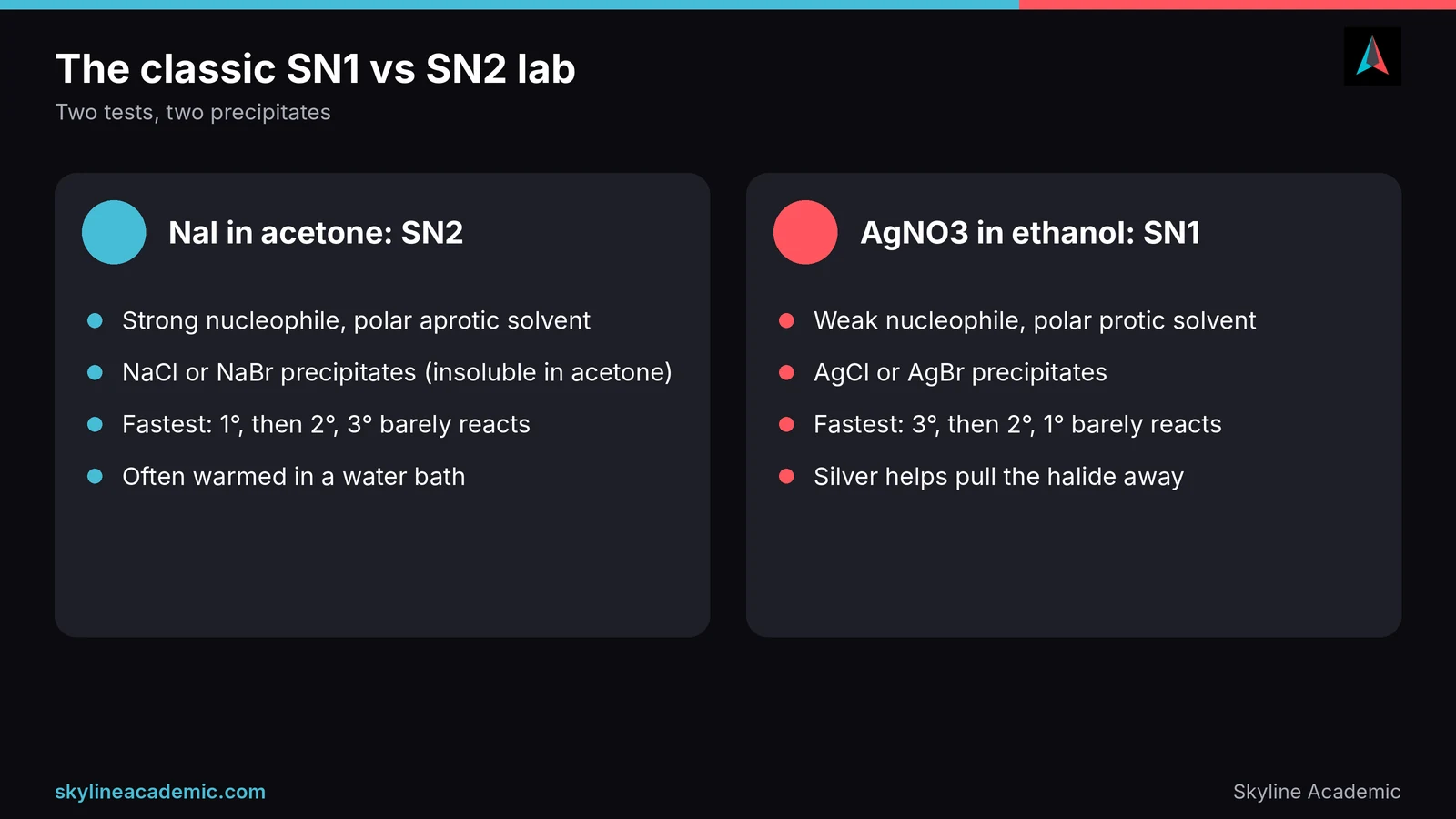
Many organic chemistry labs compare SN1 and SN2 using two simple tests on a set of alkyl halides.
The first test uses sodium iodide in acetone. Iodide is a strong nucleophile and acetone is polar aprotic, so this test favours SN2. As the reaction runs, sodium chloride or sodium bromide forms. These salts do not dissolve in acetone, so a cloudy precipitate shows that a reaction has happened. Primary substrates usually react fastest, secondary more slowly, and tertiary barely at all. Many lab handouts warm these tubes in a water bath, as in this Missouri S&T lab handout.
The second test uses silver nitrate in ethanol. Nitrate is a weak nucleophile and ethanol is polar protic, so this test favours SN1. Silver ions also help pull the halide away. Silver chloride or silver bromide forms as a precipitate. Here, tertiary substrates usually react fastest and primary ones barely react.
When you write your discussion, explain each result with the rules above: substrate structure, nucleophile strength, solvent and leaving group. Compare bromides and chlorides, and say which reacted faster and why. If a result surprised you, discuss possible reasons such as temperature or impure samples. Write it in your own words. Lab reports are often checked for similarity, so our guide on how to read a plagiarism report and our free plagiarism checker can help you spot problems before you submit.
Common mistakes students make, and how to fix them
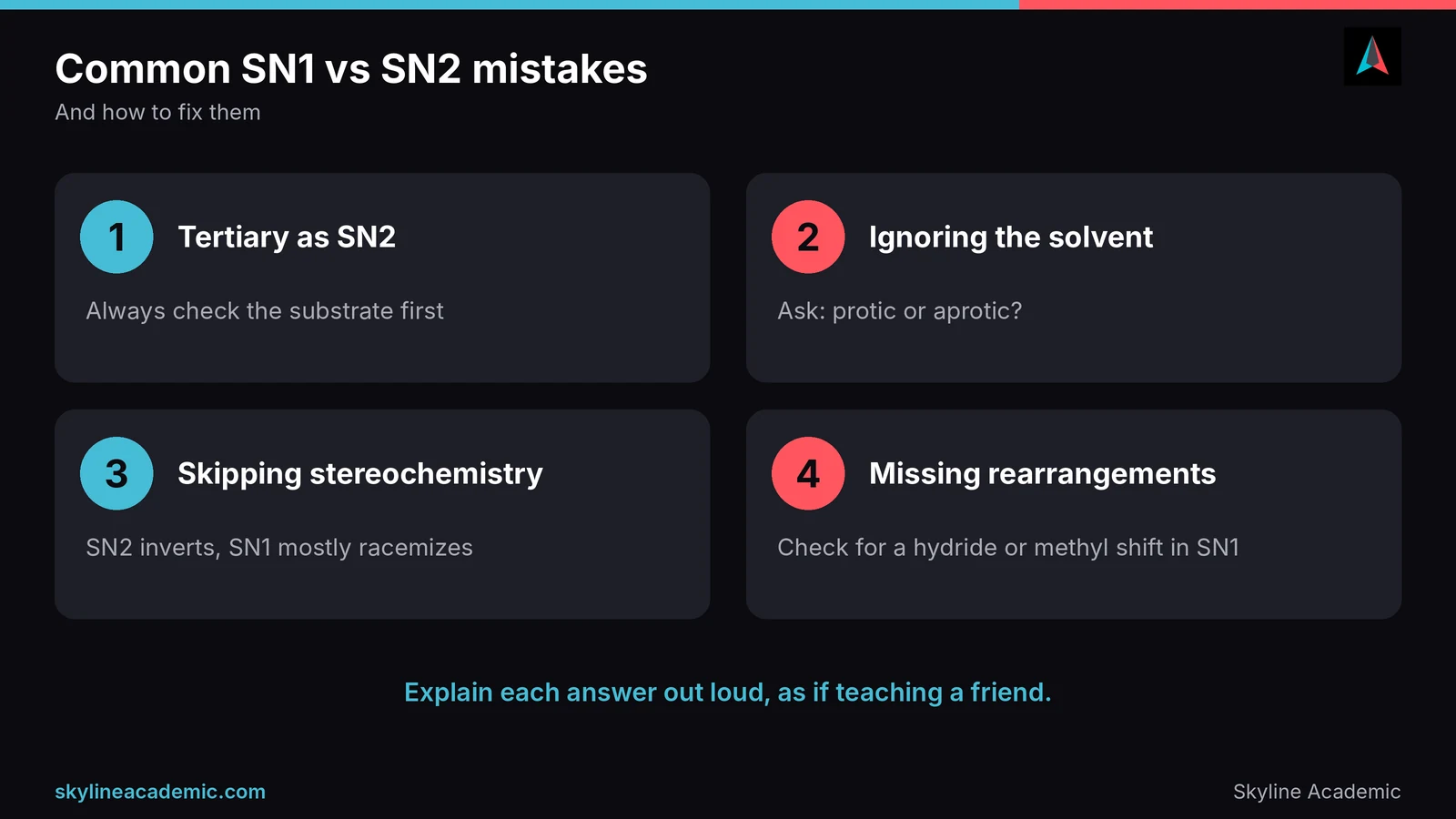
Most lost marks come from the same few mistakes. The first is calling a tertiary substrate SN2. Fix it by always checking the substrate first. The second is ignoring the solvent, especially with secondary substrates. Fix it by writing “protic or aprotic?” next to every question. The third is forgetting stereochemistry. Fix it by asking whether the carbon is a stereocentre and remembering inversion for SN2 and mostly racemization for SN1. The fourth is missing carbocation rearrangements in SN1. Fix it by checking whether a nearby hydrogen or methyl shift would make a more stable carbocation.
Understanding beats memorising here. Practise explaining each answer out loud, as if teaching a friend. Our guide to the best study techniques shows how active recall and spaced practice make this stick, and our list of AI powered study tools for students covers flashcard and quiz tools that help. If you are still stuck after that, a tutor can usually spot the gap in one session.
Still confused about SN1 vs SN2?
Organic chemistry clicks faster when someone can watch you work a problem and see exactly where your reasoning goes off track. Skyline Academic is one of the leading 1:1 live tutoring platforms, with a dedicated LMS, progress tracking, assignment quizzes, workshops and bootcamps. We also offer an AI detector and a plagiarism checker. Our 1:1 chemistry tutoring covers mechanisms, stereochemistry, MCAT organic chemistry and lab reports, at your pace. Book a session when you are ready.
Frequently asked questions
What is the main difference between SN1 and SN2 reactions?
SN2 happens in one step, with the nucleophile attacking as the leaving group leaves. SN1 happens in two steps, with a carbocation forming first and the nucleophile attacking second.
How do you know if a reaction is SN1 or SN2?
Check the substrate first: methyl and primary go SN2, tertiary goes SN1. For secondary substrates, a strong nucleophile in a polar aprotic solvent means SN2, and a weak nucleophile in a polar protic solvent means SN1.
Why does SN2 cause inversion of configuration?
The nucleophile attacks from the side opposite the leaving group. As it bonds, the other three groups flip to the other side, like an umbrella turning inside out.
Why does SN1 give a racemic mixture?
The carbocation is flat, so the nucleophile can attack from either face. In practice, most SN1 reactions give mostly racemization with a small excess of inversion.
Which solvent favors SN1 vs SN2?
Polar protic solvents like water and ethanol favour SN1. Polar aprotic solvents like acetone, DMSO and DMF favour SN2.
Why can’t tertiary substrates do SN2?
Three bulky carbon groups block the back of the carbon, so the nucleophile cannot reach it. Tertiary substrates form stable carbocations instead, so they go SN1.
Can a secondary substrate do both SN1 and SN2?
Yes. The nucleophile and solvent decide. A strong nucleophile in an aprotic solvent gives SN2, while a weak nucleophile in a protic solvent gives SN1.
What is the rate law for SN1 vs SN2?
SN1 is rate = k[substrate], which is first order. SN2 is rate = k[substrate][nucleophile], which is second order.
How do SN1 and SN2 show up on the MCAT?
The AAMC lists SN1 and SN2 under alcohol substitution reactions. Expect questions on substrates, rate laws, energy diagrams and stereochemistry.
Which reactions compete with SN1 and SN2?
Elimination reactions, called E1 and E2, often compete. Strong bulky bases and heat favour elimination, especially with secondary and tertiary substrates.
Conclusion
SN1 vs SN2 stops being confusing once you see the logic. SN2 is one step, needs an open carbon and a strong nucleophile, prefers polar aprotic solvents and flips the shape. SN1 is two steps, needs a stable carbocation, works with weak nucleophiles in polar protic solvents and mostly scrambles the shape. Check the substrate, then the nucleophile, then the solvent, and you will get most questions right. If you want a tutor to work through mechanisms with you until they click, Skyline Academic is ready to help.
Sources
- OpenStax Organic Chemistry: 11.3 Characteristics of the SN2 Reaction
- OpenStax Organic Chemistry: 11.4 The SN1 Reaction
- OpenStax Organic Chemistry: 11.5 Characteristics of the SN1 Reaction
- LibreTexts: Reactions of Alkyl Halides, Nucleophilic Substitutions and Eliminations
- AAMC MCAT Content Category 5D
- SN1 and SN2 lab handout, Missouri University of Science and Technology