
If functional groups feel impossible right now, you’re not imagining it. Two things make this topic genuinely hard, not just unfamiliar. First, you have to mentally rotate a flat, two dimensional drawing into a real three dimensional shape in your head, a specific skill called spatial reasoning that has nothing to do with how smart you are at chemistry. Second, you’re not just memorizing what a functional group looks like, you’re memorizing how it behaves and which mechanism it triggers depending on what’s attached to it. That’s two separate skills stacked on top of each other, and most courses teach them as if they were one.
What actually helps is separating those two skills instead of learning them together. Learn to recognize each functional group by its structure first, cleanly and without the reaction mechanisms attached yet. Once recognition is automatic, mechanisms get dramatically easier to layer on top. This guide goes deeper than a quick overview: every major functional group taught in a first year course, organized by category, with the hybridization and geometry behind each one, how each group affects a molecule’s physical properties, the naming priority order instructors expect you to know, the look alikes that trip almost everyone up, and a self test at the end before you move on to reaction mechanisms.
What a Functional Group Actually Is (and Why Structure Determines Function)
A functional group is a specific arrangement of atoms inside a bigger molecule that behaves the same way no matter what molecule it shows up in. An OH group attached to a carbon chain acts like an alcohol whether it’s in a two carbon molecule or a forty carbon molecule. That consistency is the entire point. Once you recognize the group, you already know roughly how that part of the molecule will react, even if you’ve never seen that exact molecule before.
This is also the direct answer to why structure determines function in organic chemistry. The shape and electron distribution around a functional group decide what kind of chemistry it can do. A carbon double bonded to oxygen pulls electron density toward the oxygen, which makes that carbon a target for anything electron rich looking to attack it. Change the atoms attached to that carbon and you turn a carboxylic acid into an ester, or an aldehyde into a ketone, while the core reactivity pattern carries through. Learn the group, and you’re learning a rule that applies across hundreds of different molecules at once, not one fact about one drawing.
There’s also a naming pattern hiding in plain sight that makes this whole subject feel less like a foreign language once you notice it. You already recognize functional groups by name more than you realize. Propane, Tylenol, ibuprofen, testosterone, and dopamine all carry suffixes, ane, ol, phen, one, amine, that map directly onto specific functional groups. Learning organic chemistry is largely a matter of connecting names you already half know to the structures behind them.
If a specific structure still isn’t clicking after reading through an explanation like this, it’s often faster to contact a live chemistry tutor and walk through the actual drawing with someone than to keep rereading the same page.
It’s also worth knowing this skill outlasts the class itself. Pharmacology depends on recognizing which functional groups make a drug more or less likely to cross a cell membrane. Biochemistry leans on the same amide and ester recognition you’ll build here to understand how proteins and lipids actually behave. Even forensic chemistry comes back to functional group identification when analyzing an unknown sample. None of that makes the current exam feel easier, but it’s a reasonable answer to why this specific topic gets so much attention compared to other parts of the course.
Why Hybridization and Geometry Matter for Every Functional Group
Carbon doesn’t bond the same way in every functional group, it adjusts its geometry based on how many multiple bonds surround it, and that geometry is part of what defines several groups you’ll meet below. Three patterns cover almost everything:
● sp3, tetrahedral, ~109.5° bond angles: any carbon with four single bonds (alkanes, the R group of an alcohol)
● sp2, trigonal planar, ~120° bond angles: any carbon in one double bond (alkenes, carbonyl carbons in aldehydes, ketones, esters)
● sp, linear, 180° bond angle: any carbon in a triple bond (alkynes, nitriles)
sp2 and sp carbons expose pi electrons above and below the plane of the molecule, which is exactly why alkenes, alkynes, and carbonyl groups react so much more readily than a plain alkane chain. Nitrogen follows a related pattern: an amine nitrogen is sp3 with a lone pair that makes the shape trigonal pyramidal rather than a perfect tetrahedron, and that exposed lone pair is what lets it act as a base. An amide nitrogen looks similar on paper, but its lone pair gets pulled toward the neighboring carbonyl instead, which is the real reason amides are so much less basic than amines.
One practical note that has nothing to do with functional groups directly but causes a large share of misidentified structures anyway: skeletal drawings leave out every carbon and hydrogen along the backbone, so confirm exactly how many bonds each vertex has before identifying anything, a rushed glance is where most functional group errors actually happen.
The Complete List of Functional Groups, Organized by Category
A typical first year organic chemistry course expects you to recognize fifteen to twenty five functional groups by sight. They cluster into families based on which atom is doing the interesting chemistry, and within each family the facts below are the ones actually worth having cold, not just recognizing when you see them.
Hydrocarbon Based Groups
Very non-polar. The only intermolecular force available is London dispersion, so boiling points stay low and none of these mix with water.
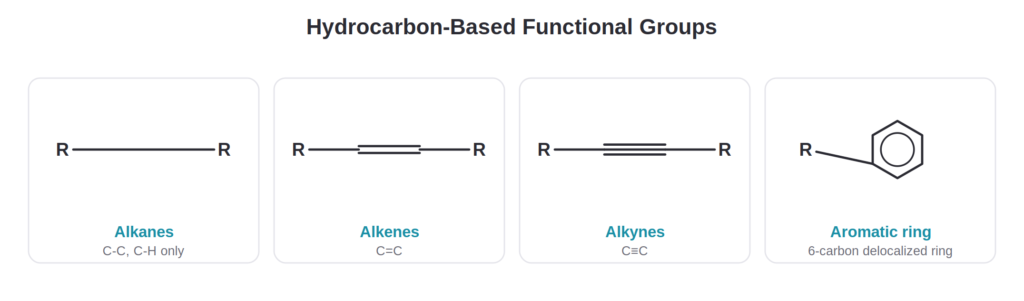
Alkanes (C-C, C-H only) carbon chains held together entirely by single bonds; substituent form is called an alkyl group (R).
● Common examples: methane, ethane, propane, octane
● Nonpolar, does not mix with water
● sp3, tetrahedral, ~109.5° bond angles
● Relatively unreactive outside combustion and free radical halogenation
● Treated as the backbone the rest of a molecule hangs off of
Alkenes (C=C) carbon-carbon double bond.
● Common examples: ethene, propene, butene
● Substituent form: alkenyl; –CH=CH2 specifically is called vinyl
● sp2, trigonal planar, ~120° bond angles
● Reactive due to exposed pi electrons above and below the plane
● Starting point for addition reactions: halogenation, hydration, hydrogenation
Alkynes (C≡C) carbon-carbon triple bond.
● Simplest example: ethyne (acetylene), used in welding torches
● Substituent form: alkynyl
● Terminal alkynes have a C-H; internal alkynes have C-C at both ends
● sp, linear, 180° bond angle
● More reactive than alkenes in many addition reactions
Aromatic rings (6-membered ring, 3 formal double bonds) stabilized by aromaticity, not related to smell.
● Benzene is the simplest example; toluene is the smell of model airplane glue
● Substituent form: phenyl (C6H5–)
● sp2, trigonal planar
● Delocalized electrons make it unusually stable and resistant to addition reactions that alkenes undergo easily
● Common core structure in pharmaceuticals
Every group from here forward centers on an atom more electronegative than carbon, and that gap is what creates the dipole driving each group’s chemistry. Carbon sits at 2.5, hydrogen at 2.2, so anything bonded to oxygen, nitrogen, a halogen, or sulfur pulls electron density away from carbon, leaving that carbon with a partial positive charge (δ+) and the more electronegative atom with a partial negative charge (δ−).
| F | O | Cl | N | Br | S | C | H |
| 4.0 | 3.4 | 3.2 | 3.0 | 2.7 | 2.6 | 2.5 | 2.2 |
Oxygen Containing Groups
Stronger intermolecular forces than hydrocarbons due to dipole-dipole interactions. Alcohols additionally hydrogen bond, which pushes boiling points higher still.
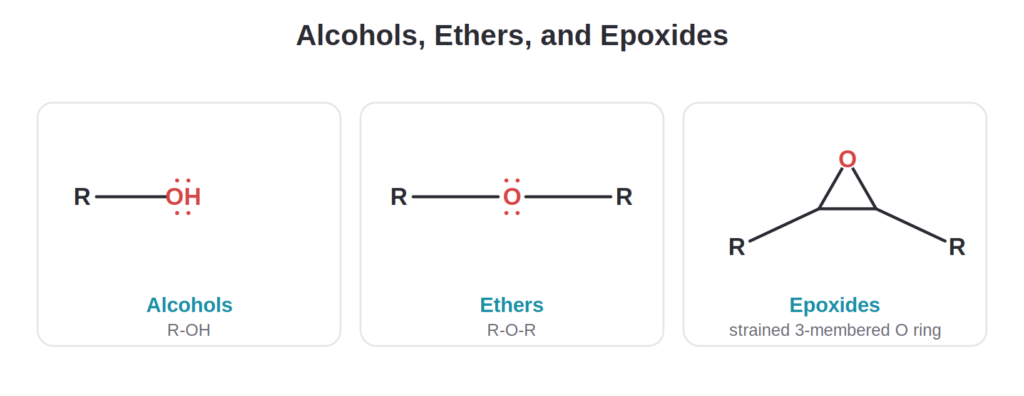
Alcohols R-OH carbon bonded to a hydroxyl group.
● Common examples: methanol, ethanol, isopropanol
● O-H bond is highly polarized and acts as a hydrogen bond donor
● Increases water solubility
● Weak acid; can also act as a Lewis base
● A hydroxyl bonded directly to a carbonyl carbon is not an alcohol, that’s a carboxylic acid
Ethers R-O-R oxygen flanked by two carbons.
● Common examples: diethyl ether, tetrahydrofuran, dioxane, all common lab solvents
● Cannot act as a hydrogen bond donor, no O-H present
● Boiling point lower than an alcohol of similar weight, higher than a hydrocarbon due to dipole-dipole forces
Epoxides a strained three-membered ring version of an ether.
● Common example: ethylene oxide, used as a sterilizing gas
● Technically an ether, but ring strain makes it far more reactive
● Readily undergoes ring-opening reactions a normal ether never would
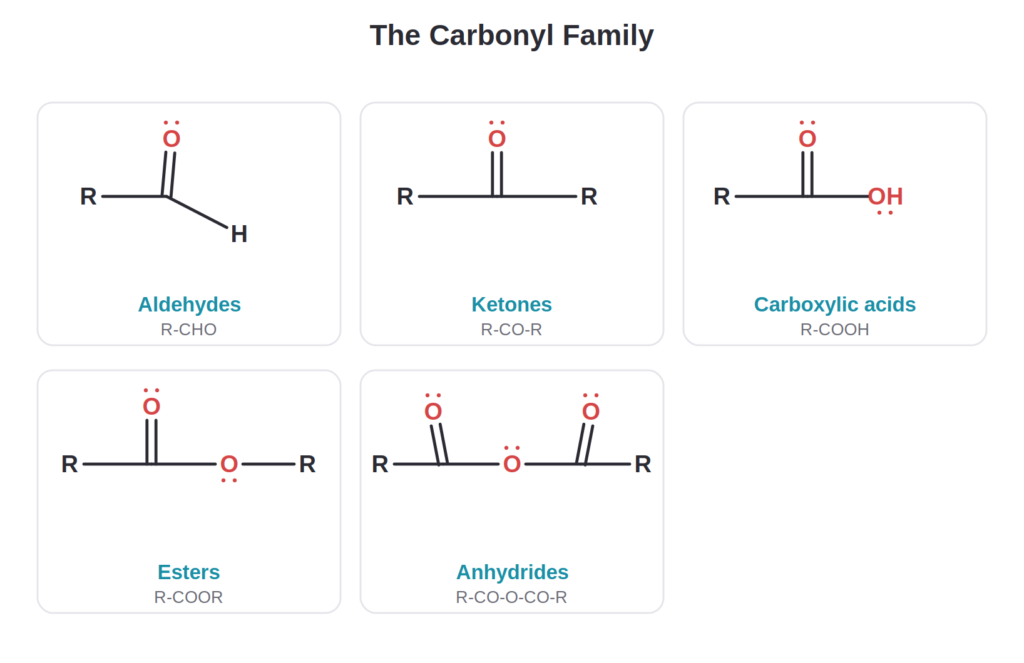
Aldehydes R-CHO carbonyl carbon bonded to at least one hydrogen.
● Common examples: formaldehyde, acetaldehyde, benzaldehyde
● Polar C=O bond; carbon carries partial positive charge
● Not a hydrogen bond donor itself
● More easily oxidized than a ketone because of that C-H on the carbonyl carbon
Ketones R-CO-R carbonyl carbon bonded to two carbons.
● Acetone (2-propanone) is nail polish remover
● No hydrogen on the carbonyl carbon, unlike an aldehyde
● More resistant to oxidation than aldehydes
Carboxylic acids R-COOH carbonyl bonded to -OH; a distinct group from a plain alcohol.
● Acetic acid (vinegar) and formic acid are the simplest examples
● Hydrogen bonds on both ends, often pairing with a second carboxylic acid molecule
● Among the highest boiling points of comparable molecular weight
● Weak acid; does not fully dissociate in water, unlike HCl or H2SO4
Esters R-COOR a carboxylic acid’s OH replaced with OR.
● Ethyl acetate is a common example and lab solvent
● Cannot hydrogen bond with itself; lower boiling point than the equivalent carboxylic acid
● Known for sweet, fruity smells
Anhydrides R-CO-O-CO-R an oxygen flanked by two carbonyls.
● Acetic anhydride, used in aspirin synthesis, is a common example
● Effectively two carboxylic acids joined with loss of water
● More reactive toward nucleophiles than an ester
Nitrogen Containing Groups
Amines -NH2, -NHR, -NR2 where R is a hydrocarbon.
● Morphine, codeine, and cocaine all contain amines
● Substituent form: amino group
● N-H bonds allow hydrogen bonding, raising boiling point and water solubility
● Nitrogen lone pair acts as a base
● sp3 nitrogen, trigonal pyramidal geometry
Amides a carbonyl carbon bonded directly to an amino group.
● Every peptide bond linking amino acids in a protein is an amide
● N-H containing amides can hydrogen bond
● Far less basic than an amine, the nitrogen lone pair is pulled toward the neighboring carbonyl
Nitriles R-C≡N carbon triple bonded to nitrogen.
● Acetonitrile is a common solvent
● Technically a carboxylic acid derivative; can be formed by dehydrating an amide
● sp hybridized, linear geometry at that carbon
Imines R2C=NR the nitrogen equivalent of an aldehyde or ketone.
● Formed when an amine reacts with an aldehyde or ketone
● Common intermediate in multi-step syntheses
● sp2 nitrogen, reacts similarly to a carbonyl
Azides R-N3 three nitrogens in a row.
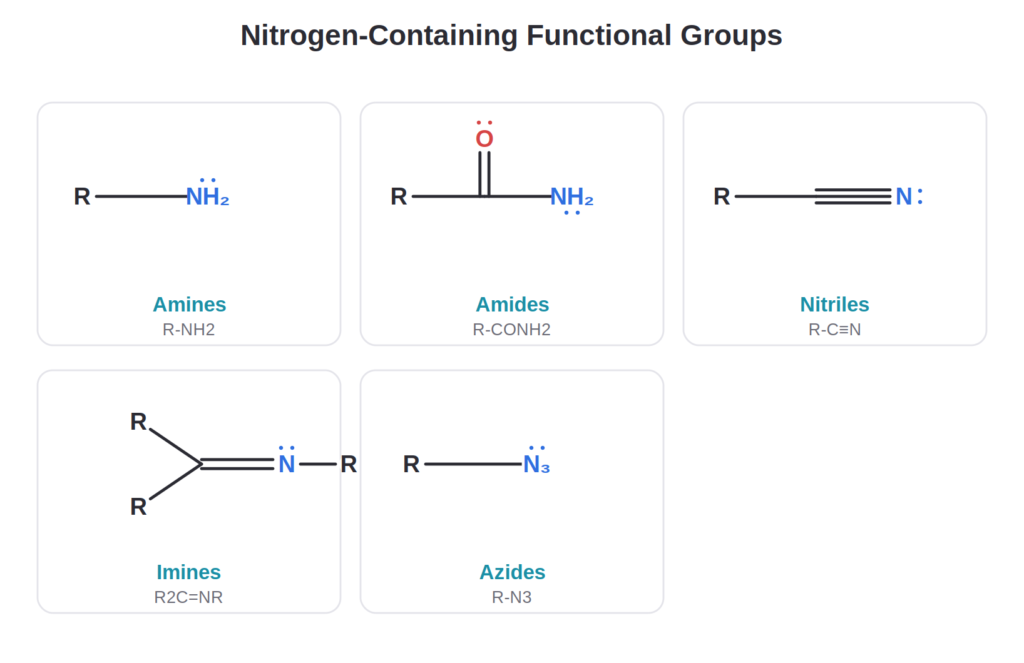
● The “A” in AZT, an anti-HIV drug, stands for azido
● Less emphasized early on, but common in pharmaceutical chemistry
● Can be explosive in concentrated or pure form; handled with care in a lab setting
Halogen Containing Groups
Haloalkanes R-F, R-Cl, R-Br, R-I alkyl halides.
● Bromobutane, methyl bromide, and chloroform are common examples
● Dipole-dipole interactions raise boiling point compared to an alkane
● Carbon-halogen bond is a strong leaving group, the starting material for most substitution and elimination reactions
● If R is an alkene, called an alkenyl halide instead
Acid halides R-CO-X a carbonyl bonded to a halogen.
● Acetyl chloride is a common example
● Most reactive of the common carbonyl-containing functional groups
● Rarely found stable in nature; mainly used as a synthesis reagent
Sulfur Containing Groups
Thiols R-SH mercaptans, the sulfur equivalent of an alcohol.
● Ethanethiol is added to natural gas specifically so leaks are noticeable by smell
● S-H bond is less polarized than O-H, sulfur is less electronegative than oxygen
● Stronger acids than alcohols
Thioethers R-S-R sulfides, the sulfur equivalent of an ether.
● Dimethyl sulfide is the most commonly encountered example
● Shows up in amino acid side chains, such as methionine
A Few More Worth Knowing
Nitro groups R-NO2 don’t fit cleanly into any family above.
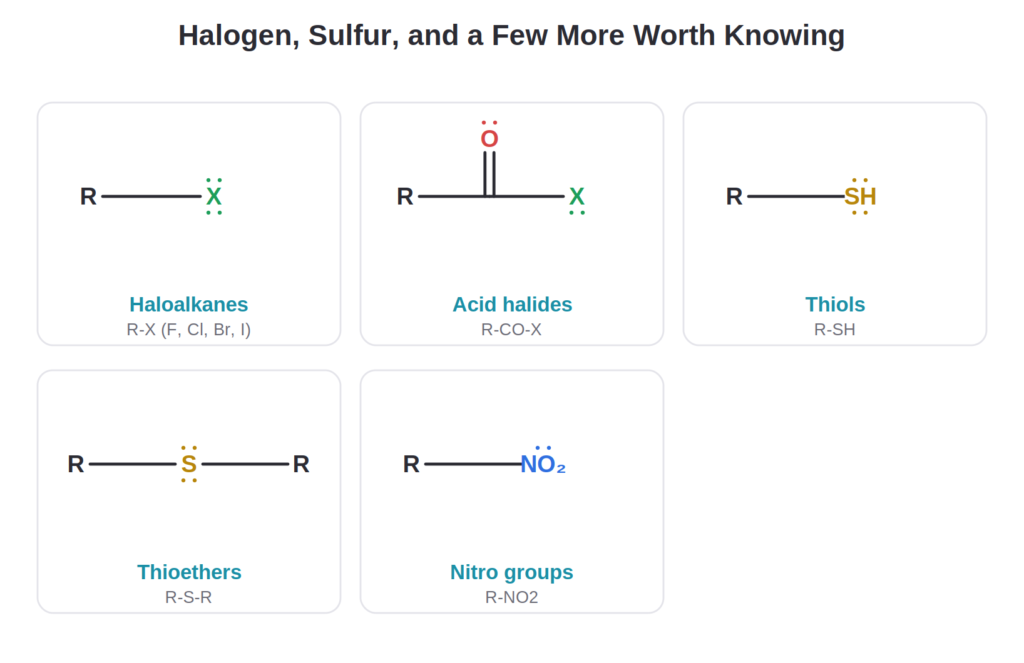
● Nitromethane is a common solvent; TNT is a well known but far less common example
● Strongly electron-withdrawing
| Functional Group | General Structure | Example Molecule | You’ll Find It In |
| Alkane | C-C, C-H only | Octane | Gasoline |
| Alkene | C=C | Ethylene | Fruit ripening gas |
| Alkyne | C≡C | Acetylene | Welding torches |
| Aromatic ring | Six-carbon delocalized ring | Benzene | Many pharmaceuticals |
| Alcohol | R-OH | Ethanol | Beverages, hand sanitizer |
| Ether | R-O-R | Diethyl ether | Early anesthesia |
| Epoxide | Strained 3-membered O ring | Ethylene oxide | Sterilizing gas, plastics |
| Aldehyde | R-CHO | Formaldehyde | Preservatives |
| Ketone | R-CO-R | Acetone | Nail polish remover |
| Carboxylic acid | R-COOH | Acetic acid | Vinegar |
| Ester | R-COOR | Ethyl acetate | Fruity scents |
| Anhydride | R-CO-O-CO-R | Acetic anhydride | Aspirin synthesis |
| Amine | R-NH2 | Methylamine | Amino acids, neurotransmitters |
| Amide | R-CONH2 | Acetamide | Protein backbone bonds |
| Nitrile | R-C≡N | Acetonitrile | Solvents, some plastics |
| Imine | R2C=NR | Acetone imine | Intermediate in many syntheses |
| Azide | R-N3 | Phenyl azide | AZT (anti-HIV drug) |
| Haloalkane | R-X (F, Cl, Br, I) | Chloromethane | Refrigerants, some pesticides |
| Acid halide | R-CO-X | Acetyl chloride | Synthesis reagent |
| Thiol | R-SH | Ethanethiol | Added to natural gas for smell |
| Thioether | R-S-R | Dimethyl sulfide | Amino acid side chains |
| Nitro group | R-NO2 | Nitromethane | Solvents, explosives |
If a full semester of memorizing all of these at once feels overwhelming, tutoring support for STEM students can help you build a study plan that breaks them into these smaller families instead of cramming the whole list at once.
How Functional Groups Control Boiling Point and Solubility
Boiling point and solubility come down almost entirely to which intermolecular forces a functional group can participate in. Three tiers, weakest to strongest:
● Dispersion forces only (weakest): alkanes, alkenes, alkynes, aromatic rings. Low boiling points, no water solubility.
● Dipole-dipole (adds a polar bond, no H-bond donor): ethers, aldehydes, ketones, esters, nitriles, acid halides, thioethers. Higher boiling point than a same-size hydrocarbon, still not very water soluble.
● Hydrogen bonding (strongest): alcohols, amines, carboxylic acids, amides, thiols. Highest boiling points and the most water soluble for a given size, since N-H, O-H, and S-H bonds can donate a hydrogen bond.
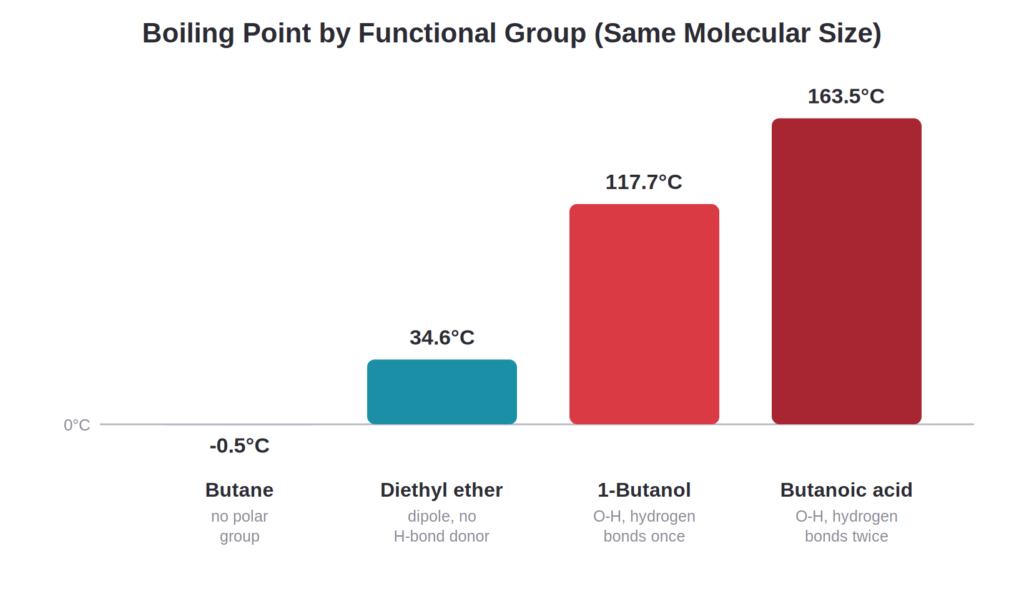
Worked example, four molecules of similar size, ranked lowest to highest boiling point:
● Butane (no polar group, dispersion only): bp ≈ −0.5°C
● Diethyl ether (dipole, no H-bond donor): bp ≈ 34.6°C
● 1-Butanol (O-H, hydrogen bonds once): bp ≈ 117.7°C
● Butanoic acid (O-H, hydrogen bonds twice per pair via its carbonyl oxygen too): bp ≈ 163.5°C
Same molecular weight range, over 160 degrees of spread, entirely explained by which functional group is attached. That’s the reasoning an exam question is almost always testing when it asks you to rank boiling points.
Solubility follows the identical logic: a group that can hydrogen bond with water (OH, NH, COOH) makes a molecule more water soluble, especially when that polar group makes up a large share of a small molecule. A long hydrocarbon tail works against it, which is why ethanol mixes completely with water but a long chain fatty alcohol barely dissolves. That same push and pull between a polar head and nonpolar tail is the entire basis for how soap and cell membranes work.
Functional Group Priority for IUPAC Naming
One detail that trips students up constantly once naming starts: a molecule with more than one functional group doesn’t get named after all of them equally. IUPAC rules rank functional groups in a priority order, and whichever group ranks highest becomes the suffix in the name, while everything else gets demoted to a prefix. A molecule containing both an alcohol and a carboxylic acid, for example, gets named as a substituted carboxylic acid, with the alcohol showing up as a hydroxy prefix, never the other way around.
| Priority | Functional Group | Naming Suffix |
| Highest | Carboxylic acid | -oic acid |
| Anhydride | -oic anhydride | |
| Ester | -oate | |
| Amide | -amide | |
| Nitrile | -nitrile | |
| Aldehyde | -al | |
| Ketone | -one | |
| Alcohol | -ol | |
| Amine | -amine | |
| Lowest (named as prefixes only) | Ether, haloalkane | alkoxy-, halo- |
This is a simplified version of the full priority table, enough to cover the groups this guide has walked through, but it’s worth treating as a general map rather than the complete picture. Full IUPAC nomenclature has additional rules for numbering, multiple instances of the same group, and less common functional groups that go beyond what a first semester course usually covers.
How to Actually Identify a Functional Group Inside a Bigger Molecule
Real exam molecules rarely show up as a clean, isolated functional group sitting by itself. They show up buried inside a much larger structure, and the actual skill being tested is picking the relevant group out of the noise. A few habits make this dramatically easier.
Start by scanning for oxygen and nitrogen atoms first, since carbon and hydrogen alone almost never define a functional group on their own. Every oxygen or nitrogen you find is attached to a specific pattern that narrows down what you’re looking at immediately. Next, check exactly what’s bonded to that atom. An oxygen bonded to one carbon and one hydrogen is an alcohol. That same oxygen double bonded to a carbon that’s also bonded to another oxygen is a carboxylic acid. The atom hasn’t changed, but its neighbors completely change the identity of the group.
Finally, practice redrawing condensed or skeletal formulas into their full structure before you try to identify anything. A large share of functional group mistakes come from misreading a skeletal line drawing, not from actually not knowing the group once it’s drawn out clearly. Spend the extra fifteen seconds expanding the drawing mentally, or on scratch paper, before committing to an answer.
Research backs this up directly. Researchers at Purdue found that students with stronger spatial reasoning scored significantly better on tasks like completing a reaction or mapping out a multi step synthesis, which lines up with what most students already suspect: this isn’t only a knowledge problem, it’s partly a visualization skill that gets better with deliberate practice.
One more habit worth building early: build physical or digital molecular models for anything that genuinely confuses you, rather than trying to hold the 3D shape entirely in your head. Even a cheap ball and stick kit, or a free molecule viewer online, turns an abstract mental rotation problem into something you can just look at from a different angle. Students who lean on models heavily in their first few weeks tend to need them less and less by midterm, because the spatial intuition eventually transfers to paper.
Functional Groups Students Mix Up Constantly
These mix ups account for a disproportionate share of lost points on functional group questions, mostly because the groups look almost identical at a glance and the actual difference comes down to one or two atoms.
| Group A | Group B | Key Difference |
| Aldehyde | Ketone | Aldehyde’s carbonyl carbon has a hydrogen attached; ketone’s has two carbon groups instead |
| Amine | Amide | Amide has a carbonyl (C=O) sitting right next to the nitrogen; amine does not |
| Ester | Carboxylic acid | Ester’s oxygen connects to another carbon; carboxylic acid’s connects to a hydrogen |
| Alcohol | Ether | Alcohol’s oxygen is bonded to one carbon and one hydrogen; ether’s oxygen bonds to two carbons |
| Ester | Anhydride | Anhydride has a second carbonyl where an ester has a plain carbon chain |
| Nitrile | Amine | Nitrile’s nitrogen is triple bonded to carbon; amine’s nitrogen only forms single bonds |
Aldehydes and ketones both center on a carbon double bonded to oxygen, which is why students lump them together constantly. The real difference is what else is attached to that same carbon. An aldehyde always has a hydrogen sitting directly on the carbonyl carbon, which is part of why aldehydes tend to be more reactive and easier to oxidize. A ketone has two carbon groups on either side instead, with no hydrogen on that carbon at all. If you can find an H attached straight to the C=O carbon, you’re looking at an aldehyde every time.
Amines and amides get confused because both involve nitrogen bonded to carbon, but an amide has a carbonyl sitting right next to that nitrogen and an amine doesn’t. That one carbonyl completely changes the behavior: amines act like weak bases, willing to grab a proton, while amides are far less basic because that nitrogen’s electron pair gets pulled toward the neighboring oxygen instead. This is also why every peptide bond in your body is an amide, not an amine, even though a lot of students draw it as one at first.
Esters and carboxylic acids share the same carbonyl core, but a carboxylic acid has an OH hanging off that carbon while an ester has an OR group instead, meaning that oxygen connects to another carbon rather than a hydrogen. It’s a one atom difference that changes everything from smell, esters are behind most fruity scents, to acidity, since carboxylic acids can actually donate that proton and esters can’t.
Alcohols and ethers cause a quieter kind of confusion, mostly early in the semester before students have fully separated the two in their head. An alcohol has that oxygen bonded to one carbon and one hydrogen, which is exactly what allows it to hydrogen bond and gives alcohols their relatively higher boiling points and water solubility. An ether has the same oxygen bonded to two separate carbons instead, with no hydrogen on the oxygen at all, so it can’t hydrogen bond with itself the same way. That’s the whole reason diethyl ether evaporates so much faster than ethanol despite the two molecules looking deceptively similar on paper.
Esters and anhydrides get mixed up less often, but it happens once anhydrides enter the picture. An ester has a single carbonyl attached to an oxygen that connects to a plain carbon chain. An anhydride has that same oxygen flanked by a second carbonyl group on the other side instead, effectively two acyl groups joined through one oxygen, which makes anhydrides noticeably more reactive than esters toward nucleophiles.
Nitriles and amines cause confusion mostly because both center on nitrogen, but a nitrile’s nitrogen is triple bonded to carbon with no hydrogens attached at all, while an amine’s nitrogen only forms single bonds and usually carries at least one hydrogen. The triple bond is the giveaway every time.
Quick Self-Test: Can You Spot the Functional Group?
Try identifying the functional group in each of these before reading the answer that follows it.
Formaldehyde has a carbon double bonded to oxygen, with a hydrogen also attached to that same carbon. What group is this? Answer: an aldehyde, because of that hydrogen sitting directly on the carbonyl carbon.
Acetone’s central carbon is double bonded to oxygen and attached to two separate carbon groups, with no hydrogen on that carbon. What group is this? Answer: a ketone.
Vinegar’s active ingredient has a carbonyl carbon attached to an OH group. What group is this? Answer: a carboxylic acid, specifically acetic acid.
A molecule contains a carbon double bonded to oxygen sitting directly next to a nitrogen atom. What group is this? Answer: an amide, identifiable by that carbonyl positioned right next to the nitrogen.
A common refrigerant molecule has a carbon bonded directly to a chlorine atom in place of a hydrogen. What group is this? Answer: a haloalkane.
The compound responsible for the smell added to natural gas has a sulfur atom bonded to both a hydrogen and a carbon chain. What group is this? Answer: a thiol.
A common sterilizing gas has an oxygen bonded to two carbons that are also bonded directly to each other, forming a strained three atom ring. What group is this? Answer: an epoxide.
A common lab solvent has a carbon triple bonded to a nitrogen atom. What group is this? Answer: a nitrile.
A reactive synthesis reagent has a carbonyl carbon bonded directly to a chlorine atom instead of an OH or OR group. What group is this? Answer: an acid halide.
Still Confused and Need Help?
If you’ve read through all of this and a specific molecule from your actual homework still isn’t clicking, that’s completely normal. Functional groups are one of those topics that clicks with repetition and a second set of eyes far more than with rereading the same page again.
This isn’t a small or rare struggle either. One California State University system review found organic chemistry’s average drop, fail, or withdraw rate sat at 34 percent over a ten year period, so if this course feels disproportionately hard compared to everything else on your schedule, that’s a documented pattern, not just how it feels to you personally. Chemistry education researchers have also specifically studied what separates students who learn functional groups efficiently from those who struggle, and the short version is that active recall and repeated self testing consistently outperforms passive rereading, which is exactly why the self test above exists.
Skyline Academic exists for exactly this moment. Beyond this guide, Skyline offers 1:1 personalized live tutoring through an interactive LMS dashboard, so you can work through your actual assignment with a tutor in real time, track your progress across the semester, and join workshops or bootcamps built specifically around courses like organic chemistry. If you’re also double checking written lab reports or assignments for originality before submission, the same platform includes AI detection and a plagiarism checker, so you’re covered on both the chemistry and the writing side of the course.
Once the structures start clicking, organic chemistry practice problems is the natural next step to build speed before an exam.
Frequently Asked Questions
What is a functional group in organic chemistry, in simple terms?
A functional group is a specific cluster of atoms within a molecule that behaves the same way no matter what molecule it’s attached to. Once you recognize the group, you already know roughly how that part of the molecule will react.
How many functional groups do I actually need to memorize for organic chemistry?
Most introductory courses focus on 15 to 20 core groups, covering hydrocarbon, oxygen, nitrogen, halogen, and sulfur containing groups, plus a few miscellaneous ones like nitro groups. Advanced courses add more, but this core list covers the large majority of exam questions.
What’s the easiest way to tell an aldehyde from a ketone?
Check the carbon attached to the double bonded oxygen. If there’s a hydrogen directly on that carbon, it’s an aldehyde. If it’s attached to two carbon groups instead, it’s a ketone.
Why do amines and amides get confused so often?
Both involve nitrogen bonded to carbon, but an amide has a carbonyl group sitting right next to the nitrogen while an amine doesn’t. That one carbonyl changes the nitrogen’s behavior significantly.
Is there a quick way to identify functional groups in a complex molecule?
Scan for oxygen and nitrogen atoms first, since carbon and hydrogen alone rarely define a functional group on their own. Then check exactly what’s bonded to that atom, since the neighbors determine the identity of the group.
What’s the difference between an ester and a carboxylic acid?
A carboxylic acid has an OH group attached to its carbonyl carbon, while an ester has an OR group instead, meaning that oxygen connects to another carbon rather than a hydrogen.
Why does organic chemistry feel so much harder than general chemistry?
It leans heavily on spatial reasoning, mentally rotating flat drawings into 3D shapes, on top of memorizing how each functional group actually reacts, not just what it looks like. Most students haven’t had to combine those two skills before.
Are there flashcards or a quiz I can use to practice functional groups?
A written self test works just as well as flashcards for this topic, since the real skill is pattern recognition, not repetition. Try identifying the functional group in a few real molecules, then check your answer against the structure.
Which functional group gets named first when a molecule has more than one?
IUPAC rules rank functional groups by priority, and the highest ranked one becomes the suffix while the rest become prefixes. Carboxylic acids sit at the top of that list, followed by anhydrides, esters, amides, and so on down to ethers and halogens, which are only ever named as prefixes.
What’s the fastest way to get help if I’m still stuck on functional groups?
Talking through an actual molecule from your homework with a tutor tends to clear up confusion faster than rereading a guide, since a second set of eyes usually catches the exact point where your understanding breaks down.
The Bottom Line
Functional groups aren’t hard because you’re bad at chemistry, they’re hard because they ask you to combine spatial reasoning with pattern memorization at the same time, often before either skill is fully built. Learn to recognize the groups by structure first, lean on the categories instead of a flat list, understand why each one behaves the way it does through hybridization and polarity, and pay extra attention to the handful of look alikes that trip up almost everyone. Once recognition becomes automatic, the mechanisms that build on top of it get a lot less intimidating.