
If you’ve typed “is organic chemistry hard” into Google at 11pm before an exam, you already know the short answer: yes, and not because you’re bad at chemistry. Three things make organic chemistry different from every science class you’ve taken before. It stops rewarding memorization and starts requiring you to reason through unfamiliar problems. It asks you to think in three dimensions, mentally rotating molecules you can only see as flat drawings. And it moves fast, building on itself week after week, with exams that rarely give partial credit for a partially right answer.
None of that means you’re not cut out for it. It means the way you studied for biology or general chemistry probably won’t work here, and once you understand why, you can actually fix it.
This guide walks through what’s actually driving the difficulty, how organic chemistry stacks up against the other classes students compare it to, the specific pain points that trip people up week to week, and the study approach that tends to close the gap fastest. If you’re here because you’re mid-semester and stuck, skip ahead to the pain points and study strategies sections. If you’re trying to figure out what you’re walking into before the course even starts, the next section is the one to read first.
Quick definition before diving in: organic chemistry, often shortened to “ochem” or “orgo” in student slang, is the study of carbon-containing compounds and how they react. It’s called “organic” for historical reasons, chemists once believed these compounds could only come from living organisms, a theory disproven in the 1800s, but the name stuck.
What Makes Organic Chemistry So Hard
These three reasons show up again and again when students try to explain what makes this class different from everything before it. Here’s what’s actually going on with each one.
It’s Not a Memorization Course, It’s a Reasoning Course
Most science classes before this one reward recall. You learn a fact or a formula, and you repeat it back. Organic chemistry works differently. A typical exam question hands you a molecule you’ve never seen and asks you to predict what happens to it, based on reasoning through the mechanism rather than remembering a similar example.
That’s the shift that catches people off guard. Curved arrow notation, the small hooked arrows that show electrons moving during a reaction, isn’t decoration. It’s the actual logic behind why a reaction happens the way it does. Once you can follow the electrons instead of memorizing the outcome, you can work through a reaction you’ve never encountered before, which is exactly what the exam is testing.
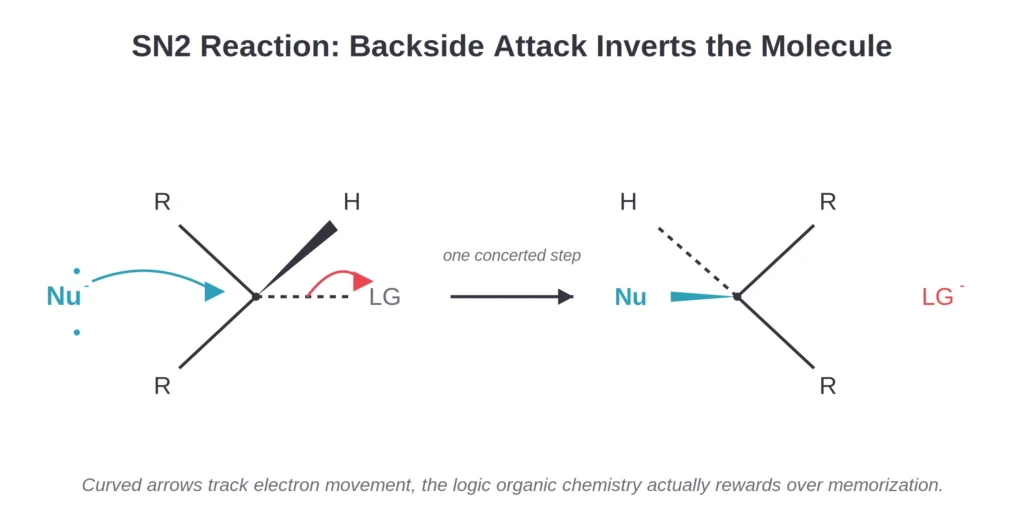
A simplified SN2 mechanism: the nucleophile attacks from the side opposite the leaving group, which is why the product comes out inverted. This kind of reasoning, not memorized reaction lists, is what actually gets tested.
You Have to Think in 3D
A flat drawing on paper isn’t what a molecule actually looks like. Organic chemistry asks you to mentally rotate that flat structure into three dimensions constantly, especially once stereochemistry shows up. Two molecules can have the exact same atoms connected in the exact same order and still behave completely differently because of how they’re arranged in space.
Most students have never been asked to do this kind of visualization before. Geometry and physics touch on spatial reasoning, but rarely at the level organic chemistry demands, which is part of why this specific skill feels like such a wall the first time you hit it.
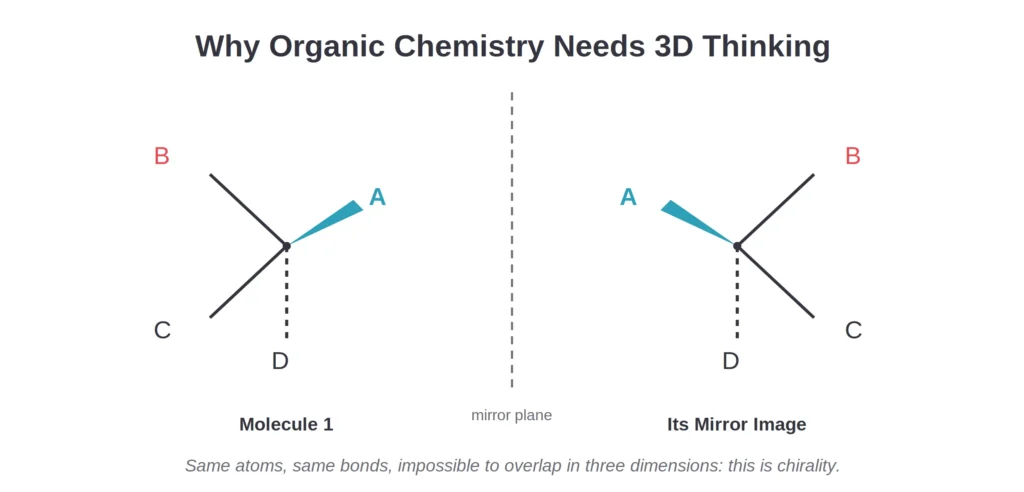
Two enantiomers: identical atoms and bonds, but non-superimposable mirror images of each other. You can’t see this difference without learning to think in three dimensions.
The Pace Never Slows Down
Organic chemistry is cumulative in a way a lot of intro science courses aren’t. Week four builds directly on week two, so a gap early in the semester doesn’t stay small, it compounds. Combine that with exams that are frequently multiple choice or fill in the blank, with little room for partial credit, and a single missed concept can cost you more than it would in a class where showing your work still earns points.
A concrete example: a student who never quite locks down how to identify the more stable carbocation in week three will struggle with elimination and substitution reactions in week five, then hit a wall entirely once those same principles reappear inside a multi-step synthesis problem in week ten. The concept never goes away, it just keeps showing up wearing a different outfit, which is why professors who say “keep up as you go” aren’t exaggerating.
Is Organic Chemistry Harder Than Your Other Classes
This comes up constantly: students comparing organic chemistry to whatever else is on their schedule that semester. Here’s how it stacks up against the courses people ask about most.
| Course | How It Compares to Organic Chemistry |
| General Chemistry | Usually easier to start but harder to finish. General chem leans on calculation, organic chemistry leans on reasoning and pattern recognition. |
| Biochemistry | Builds directly on organic chemistry. Most students find biochem more manageable once organic chemistry’s mechanisms already make sense. |
| Physics | Comparable difficulty for most students, but different in kind. Physics is math heavy, organic chemistry is spatial and mechanism heavy. |
| Calculus | Generally rated as more predictable since it follows consistent rules. Organic chemistry has more exceptions and case by case reasoning. |
| Microbiology | Closer to a memorization heavy course, which can make organic chemistry feel harder specifically because memorization alone doesn’t work here. |
| Anatomy and Physiology | Also memorization intensive. Students who do well in A&P sometimes struggle with organic chemistry’s shift to reasoning based questions. |
None of this means one course is objectively harder for everyone. It means organic chemistry tests a different skill set, reasoning and spatial visualization instead of recall, which is why students who did well in memorization heavy classes sometimes hit a wall here for the first time. The reverse is also true: students who found general chemistry’s math heavy approach frustrating sometimes find organic chemistry a relief, since the logic, once it clicks, is more intuitive than another page of equations.
Is Orgo 1 or Orgo 2 Harder
Ask around and you’ll get a genuine split on this one. Organic Chemistry 1 tends to feel harder to students who are encountering mechanism based reasoning and 3D visualization for the first time, since it’s the semester that introduces the whole new way of thinking. Organic Chemistry 2 is often described as more content heavy, building on everything from the first semester while adding more complex synthesis problems and spectroscopy.
A common pattern: Orgo 1 is the harder adjustment, Orgo 2 is the harder workload. If you struggled with the foundational logic in the first semester, expect the second to feel demanding in a different way, since it assumes you’ve already got that reasoning down.
Roughly speaking, Organic Chemistry 1 covers nomenclature, functional groups, stereochemistry, and the core substitution and elimination reactions, the foundational vocabulary and reasoning patterns everything else depends on. Organic Chemistry 2 builds on that with aromaticity, carbonyl chemistry, and multi-step synthesis problems that string several reactions together, plus an introduction to spectroscopy for identifying unknown compounds. If Orgo 1 is where you learn the individual words, Orgo 2 is where you’re asked to write full paragraphs with them, which is why the workload, not the concepts themselves, tends to feel heavier.
The Real Pain Points Students Run Into
Beyond the big picture reasons, here’s where students actually get stuck week to week, and what tends to fix each one.
Falling Behind After One Missed Concept
Because the material builds on itself, missing the logic behind one topic, say, how resonance stabilizes a molecule, doesn’t just cost you that one topic. It shows up again three weeks later in a synthesis problem that assumes you already have it down. The earlier you catch a gap, the cheaper it is to fix.
This is why so many students describe a specific moment where the class suddenly felt unmanageable, usually somewhere around week five or six, rather than a gradual slide. It’s rarely one hard week. It’s several small, unaddressed gaps from earlier weeks arriving at once, disguised as a single hard topic.
Reaction Mechanisms Blurring Together
By midterm, most students have seen dozens of reactions, and without a system for organizing them by mechanism type rather than by memorized example, they start to blend into a blur. Grouping reactions by the electron movement pattern they share, rather than by the specific molecules involved, is what actually makes them stick.
In practice, this means sorting your notes by category, substitution reactions in one group, elimination in another, addition reactions in a third, rather than by chapter or by the specific reagent used. Once you see that three “different” reactions from three different chapters actually share the same underlying electron-pushing pattern, the total number of things you’re memorizing drops sharply, even though the number of reactions on the syllabus stays the same.
Exams With No Partial Credit
Multiple choice and fill in the blank formats are common in organic chemistry, and they don’t reward being 80 percent right the way a partial credit rubric would. This format alone accounts for a lot of the anxiety students report, since a small error in a multi-step mechanism can tank an entire question.
A five-step synthesis problem where you get the first four steps correct and misplace one curved arrow on the fifth often earns the same score as getting the whole problem wrong, which feels disproportionate but is simply how the format works. The fix isn’t to work faster, it’s to slow down on the step you’re least confident in rather than rushing through it to get to the parts you already know.
This isn’t just a feeling. A breakdown of premed “milestones” by StudentDoctor.net found that 23 percent of the surviving premed cohort fail to successfully complete the first semester of organic chemistry, the steepest drop of any single course in the sequence.
Struggling With Functional Groups and Nomenclature
Before any of the reasoning heavy material makes sense, you need to be fluent in recognizing functional groups on sight, since they’re what determine how a molecule reacts in the first place. Confusing an aldehyde for a ketone, or missing that a molecule has a carboxylic acid instead of an ester, throws off everything downstream. Skyline’s functional groups breakdown is a useful reference to keep open while you’re still building that fluency.
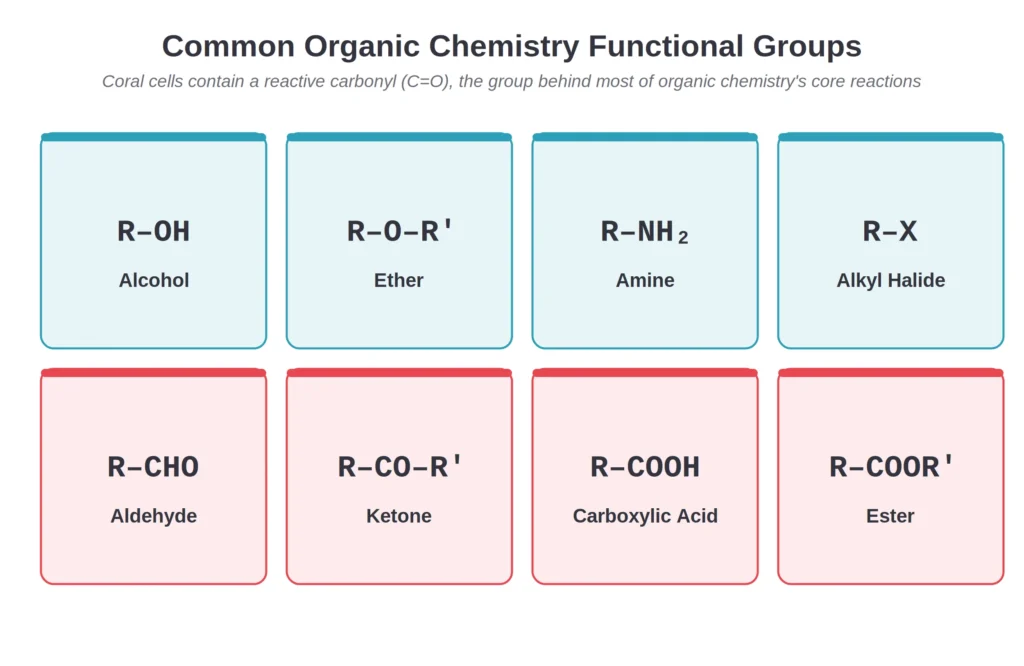
The functional group determines the chemistry. Learning to spot these on sight, especially the carbonyl-containing ones in coral, is foundational to everything that follows.
How Long It Actually Takes to Get Good at Organic Chemistry
Most estimates put consistent study time at six to eight hours a week for organic chemistry, on top of class and lab time, and that’s assuming the time is spent actively working problems rather than just rereading notes. Students who underestimate this are usually the ones who describe the course as impossible later, not because the material is unlearnable, but because the actual time commitment caught them off guard.
The numbers back this up. A peer reviewed study published in Chemistry Education Research and Practice found that attrition in year long organic chemistry sequences for pre-medical majors typically ranged from 30 to 50 percent before targeted curriculum changes at the institution studied. That’s not a small number, and it’s worth sitting with, not because it should scare you off, but because it makes clear that underestimating the time commitment is a common, well documented mistake, not a personal failing.
The failure point usually isn’t ability, it’s realistic time budgeting. Six to eight hours of genuine problem solving a week is a very different commitment than six to eight hours of passively reviewing slides, and only one of those actually builds the skill the exams test.
Study Strategies That Actually Work
Once you know what’s actually being tested, reasoning and spatial thinking, not recall, the right study approach becomes a lot clearer.
Learn Mechanisms, Not Reactions
Instead of memorizing that “reagent X plus molecule Y gives product Z,” learn why the electrons move the way they do. Once the mechanism makes sense, you can predict the outcome for a molecule you’ve never seen, which is the actual skill being tested.
Practice Problems Every Day, Not Just Before Exams
Organic chemistry is a skill, closer to learning an instrument than memorizing a textbook, and skills degrade fast without regular practice. Short daily problem sets beat one long study session the weekend before an exam, since spaced repetition is what actually moves mechanisms from short term to long term memory. Skyline’s tutoring support for stem students page includes structured organic chemistry practice sets if you want a starting point beyond your textbook’s back pages.
A useful habit: after finishing a practice problem, don’t just check if the final answer matches the key. Walk back through your own curved arrows and ask whether each step actually makes chemical sense, or whether you got lucky guessing the product. Getting the right answer for the wrong reason feels like progress but doesn’t transfer to a new problem on exam day, which is exactly where it tends to fall apart.
Use Models and Visual Tools for 3D Structures
If stereochemistry isn’t clicking on paper, stop trying to force it there. Physical molecular model kits, or even just building the habit of sketching wedge and dash bonds consistently, can turn an abstract concept into something you can actually manipulate and see.
Know When to Get a Tutor
There’s a real difference between being stuck for an afternoon and being stuck for two weeks. If a concept still isn’t clicking after a genuine attempt to work through it, a tutor who can walk through your specific gap, rather than reteaching the whole topic from scratch, tends to close it faster than another pass through your notes. You can contact a live chemistry tutor if you’re at that point.
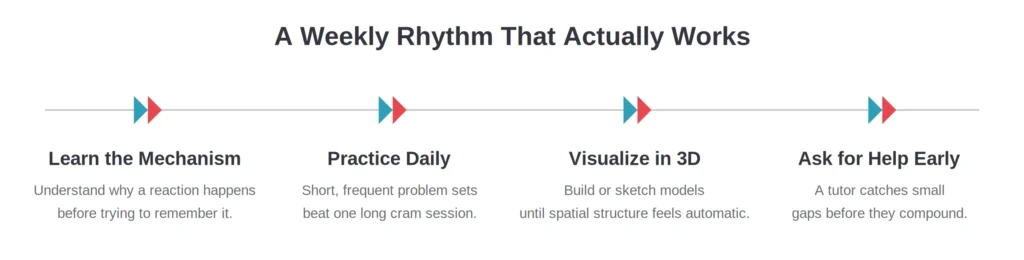
A realistic weekly rhythm beats a single long cram session, since mechanisms and 3D reasoning are skills built through spaced, repeated practice.
Organic Chemistry for Pre-Med, Pharmacy, and Other STEM Paths
Organic chemistry shows up as a requirement across more majors than just pre-med, and the stakes look a little different depending on where you’re headed. It’s a required course, not an elective, for most of the following paths:
● Pre-med, pre-dental, and pre-veterinary tracks
● Pharmacy and pharmaceutical sciences
● Biochemistry and molecular biology
● Chemical, biomedical, and environmental engineering
● Nursing programs with a strong science emphasis
For pre-med students, the subject carries outsized weight because it’s treated as an early filter, and a rough semester here can shake confidence in the whole track even though organic chemistry itself is only a small slice of the MCAT. For pharmacy and biochemistry majors, it’s less a filter and more a foundation, since a huge amount of upper level coursework assumes you already have this reasoning down cold. Engineering and other STEM majors who take it as a general requirement sometimes find the spatial reasoning genuinely transfers well from coursework they’ve already done, which can make this specific course feel more approachable than their peers expect.
Whatever the path, the subject rewards the same things: understanding mechanisms over memorizing them, and getting comfortable with 3D structure early. If you want support tailored to your specific major’s course sequence, live tutoring for stem students covers organic chemistry alongside the other STEM courses that tend to stack up in the same semester.
Still Confused and Need Help?
Reading about study strategies only gets you so far. At some point, the fastest way through a mechanism you genuinely don’t understand is talking it through with someone who can see exactly where your reasoning breaks down.
That’s what Skyline Academic is built for. Beyond the study tips in this guide, Skyline is a full hub for students working through courses like this one: an AI detection and plagiarism checker for written work, and 1:1 personalized live tutoring delivered through an interactive LMS dashboard that includes workshops, bootcamps, ongoing progress tracking, and assignment quizzes, so you can actually see where you stand instead of guessing.
Now, back to the parts of organic chemistry that trip students up most, starting with the questions we get asked most often.
Frequently Asked Questions
Is organic chemistry 1 or 2 harder?
Organic Chemistry 1 is usually the harder adjustment, since it introduces mechanism based reasoning and 3D thinking for the first time. Organic Chemistry 2 tends to be more content heavy, building on that foundation with more complex synthesis and spectroscopy.
Is organic chemistry harder than general chemistry?
Most students find general chemistry more calculation heavy and organic chemistry more reasoning and pattern based. Many describe organic chemistry as harder specifically because memorization, which worked in general chemistry, stops being enough on its own.
Is organic chemistry harder than physics?
They’re difficult in different ways. Physics leans heavily on math and formulas, while organic chemistry leans on spatial visualization and mechanism based logic, so which one feels harder often depends on which skill set comes more naturally to you.
How hard is organic chemistry on the MCAT?
Organic chemistry makes up a relatively small portion of the MCAT, often cited around six to twelve questions, but the reasoning skills it builds show up throughout the exam’s chemistry and biochemistry sections, which is why premed students still take it seriously.
Is it hard to get an A in organic chemistry?
It’s genuinely difficult but not rare among students who consistently practice problems rather than just reviewing notes. Grade distributions vary widely by school and professor, so consistent weekly effort matters more than any single exam.
Why do so many students say organic chemistry is hard?
Because it’s the first class that requires reasoning through unfamiliar problems instead of recalling familiar ones, combined with a 3D visualization demand most students have never faced before. That combination, not the raw difficulty of the facts themselves, is what surprises people.
Is organic chemistry harder online than in person?
It can be, mainly because the spatial and mechanism heavy material benefits from live, interactive explanation. Students taking it online often need to be more proactive about seeking out tutoring or study groups to replace that in-person clarification.
How many hours a week should you study for organic chemistry?
Most estimates suggest six to eight hours a week of active problem solving, separate from class and lab time. Passive review, like rereading notes, generally doesn’t count toward building the actual skill the exams test.
Is organic chemistry harder than biochemistry?
Most students find organic chemistry harder, since biochemistry tends to build directly on organic chemistry’s mechanisms rather than introducing an entirely new way of thinking. Once organic chemistry clicks, biochemistry usually feels like an extension rather than a new mountain.
What part of organic chemistry is hardest?
Stereochemistry and reaction mechanisms are the two most commonly cited sticking points, since both require the 3D reasoning and electron pushing logic that earlier science classes rarely teach. Once those two clear up, most other topics get noticeably easier.
The Bottom Line
Organic chemistry is hard for specific, identifiable reasons: it demands reasoning instead of memorization, it requires 3D visualization most students have never practiced, and it moves at a pace that punishes gaps early on. None of that makes it impossible. It means the study habits that worked in every class before this one need an update, and the students who make that switch early are the ones who come out the other side saying it wasn’t as bad as its reputation.