
Last updated:
You are staring at a molecule on your organic chemistry homework. The question says “draw all resonance structures,” or worse, “which resonance structure contributes most?” You know arrows go somewhere, but you are not sure where they start, where they end, or why your answer keeps getting marked wrong. If that sounds familiar, you are not alone. Resonance is one of the first topics where organic chemistry stops feeling like memorising and starts asking you to think, and our guide on why organic chemistry feels so hard explains why that jump catches so many students.
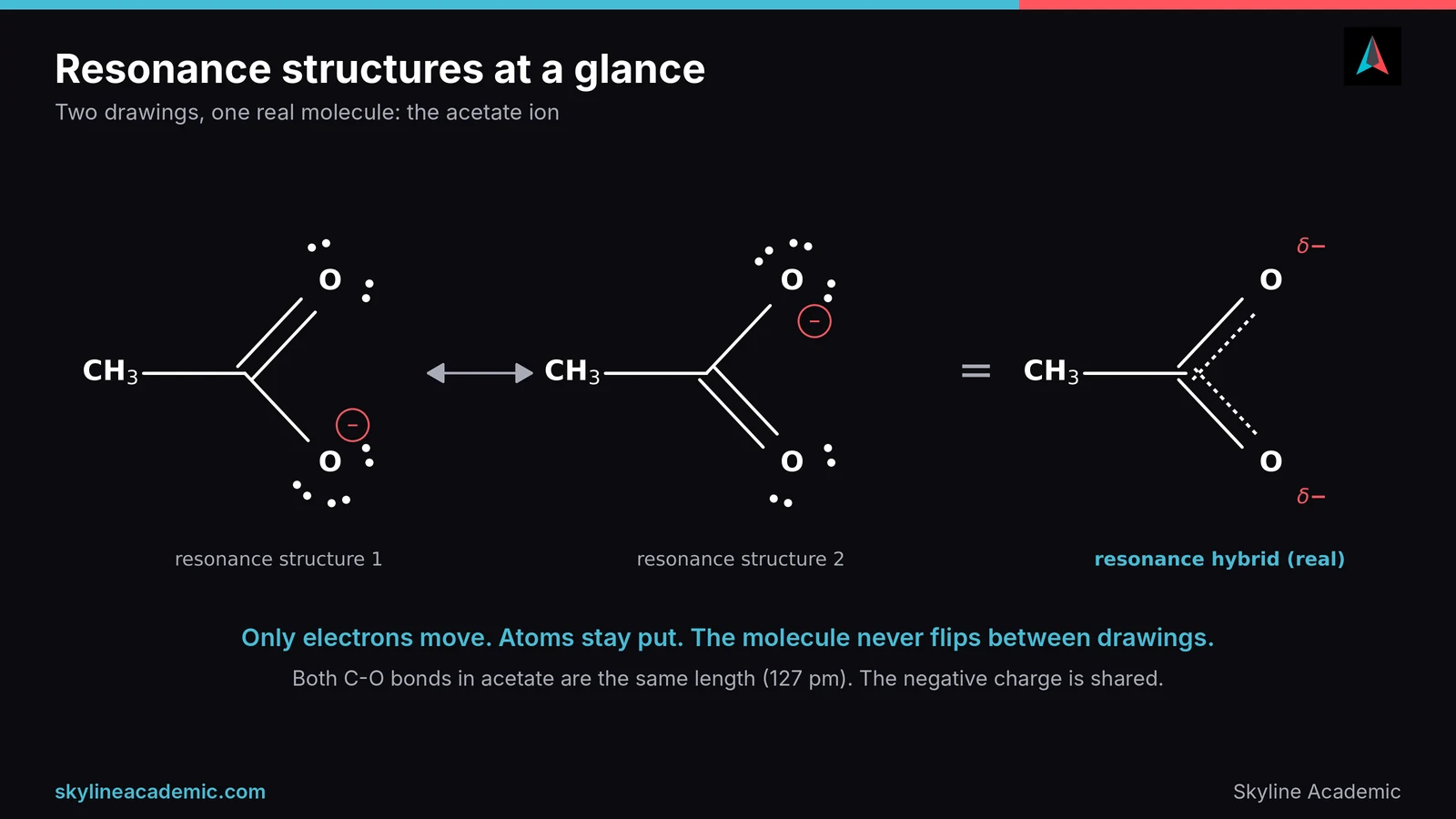
Here is the short answer. Resonance structures are different drawings of the same molecule in which only the electrons move, never the atoms. No single drawing is correct on its own. The real molecule is a blend of all of them, called the resonance hybrid. Once you learn a few rules and five common patterns, drawing them becomes a routine you can do in under a minute.
What are resonance structures in organic chemistry?
Resonance structures are two or more valid Lewis structures for the same molecule or ion that differ only in where the pi electrons and lone pairs are placed. We need them because a single line drawing cannot show electrons that are spread over several atoms at once.
Resonance structure definition in plain English
A Lewis structure puts every electron pair in one exact place: in a bond, or as a lone pair on one atom. That works for most molecules. But in some molecules, a pair of electrons is shared across three or more atoms. One drawing cannot show that, so chemists draw several drawings and connect them with a double-headed arrow (↔). Each drawing is called a resonance structure, resonance form or resonance contributor. The IUPAC Gold Book describes resonance as a way of representing electronic structure as a mix of these contributing structures.
Do resonance structures flip back and forth?
No, and this is the most common misunderstanding. The molecule does not switch between the drawings. OpenStax Organic Chemistry is clear that the acetate ion does not spend part of its time in one form and part in the other. It has one single, unchanging structure. The drawings are imaginary. Only the hybrid is real.
A helpful picture: imagine describing a rhinoceros to someone who has never seen one as a cross between a dragon and a unicorn. Neither of those animals is real, but together they give a good idea of the one animal that is. Resonance structures are the dragon and the unicorn. The hybrid is the rhinoceros.
Are resonance structures in organic chemistry equivalent?
Sometimes, but often not. In the acetate ion, the two structures are identical except for which oxygen carries the double bond, so they are equivalent and contribute equally. In many other molecules, one structure is more stable than another. The less stable ones still count, but the hybrid looks more like the most stable one. You will learn how to rank them later in this guide.
The rules of resonance: what can move and what cannot
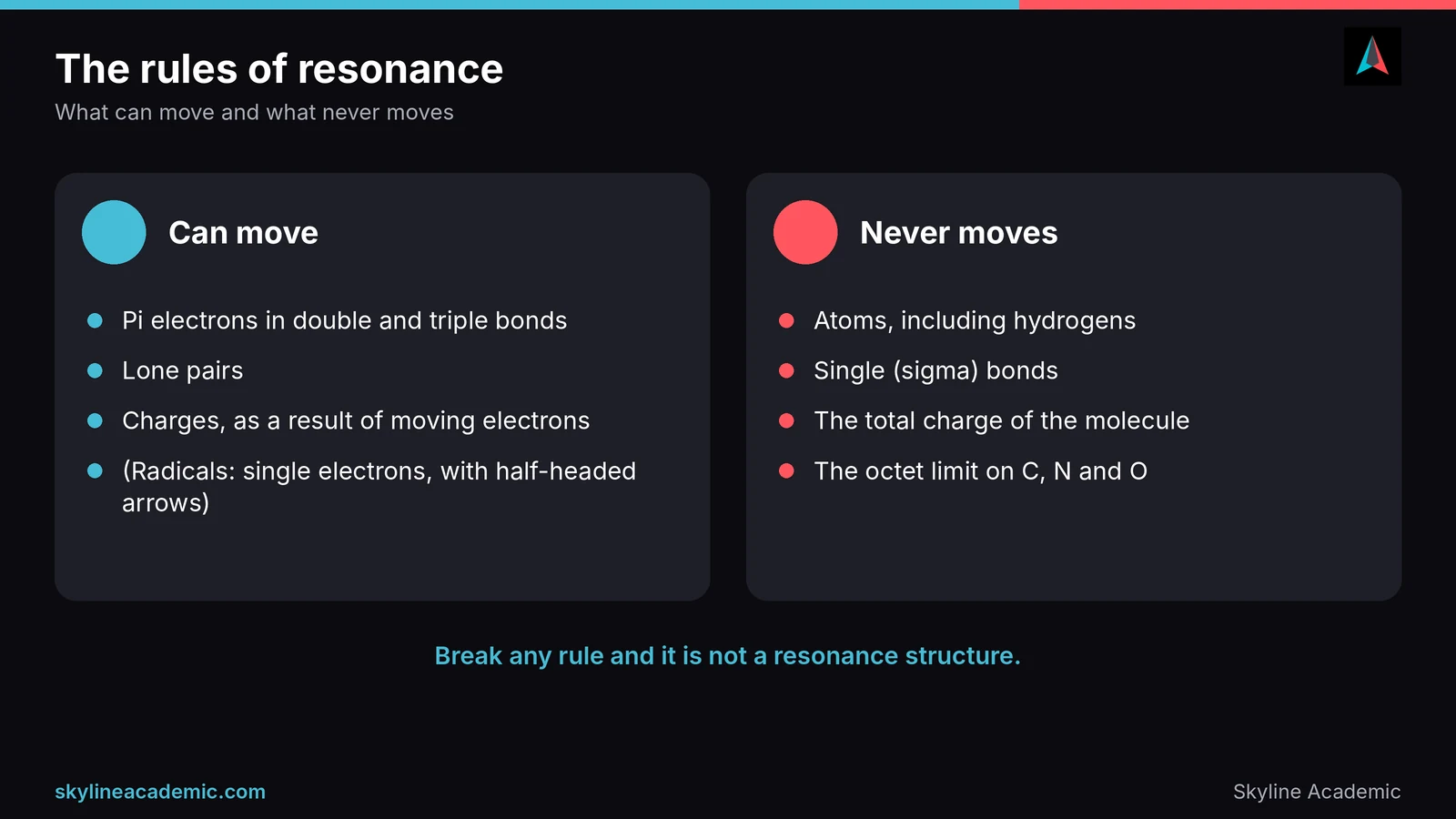
Resonance follows strict rules. If your drawing breaks any of them, it is not a resonance structure. These rules, adapted from OpenStax section 2.5, are the ones markers check first.
- Atoms never move. Every atom stays in the same place, bonded to the same neighbours. If an atom moves, you have drawn a different molecule.
- Only pi electrons and lone pairs move. Electrons in double bonds, triple bonds and lone pairs can shift. Single (sigma) bonds never break.
- The total charge stays the same. If the molecule has a charge of minus one, every resonance structure must add up to minus one.
- Second-row atoms cannot go over an octet. Carbon, nitrogen and oxygen can never have more than eight valence electrons. A carbon with five bonds is always wrong.
- The number of unpaired electrons stays the same. This matters for radicals.
- The hybrid is more stable than any single structure. Spreading electrons out lowers energy.
How to draw resonance structures in organic chemistry, step by step
To draw resonance structures, find a pi bond or lone pair next to an atom that can accept electrons, push the electrons one step over with a curved arrow, then add formal charges and check every octet. Repeat until you get back to a structure you have already drawn.
Curved arrows in 30 seconds
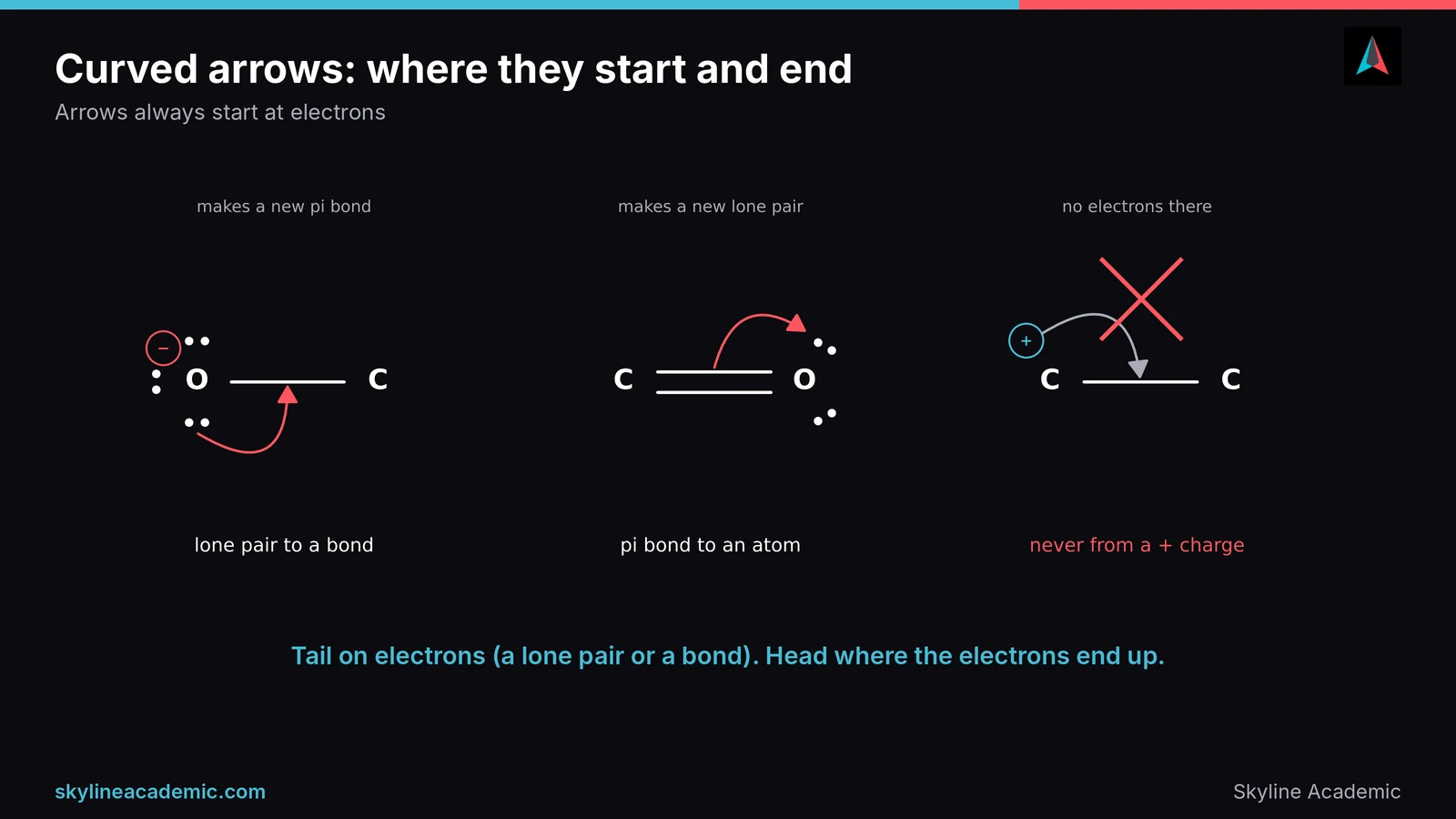
A curved arrow shows where a pair of electrons goes. It always starts at electrons, either a lone pair or a bond, and ends where those electrons will be: on an atom as a new lone pair, or between two atoms as a new bond. An arrow never starts from a positive charge or from an atom with no lone pair, because there are no electrons there to move. If you remember only one thing, remember this: arrows start at electrons.
Worked example: the acetate ion
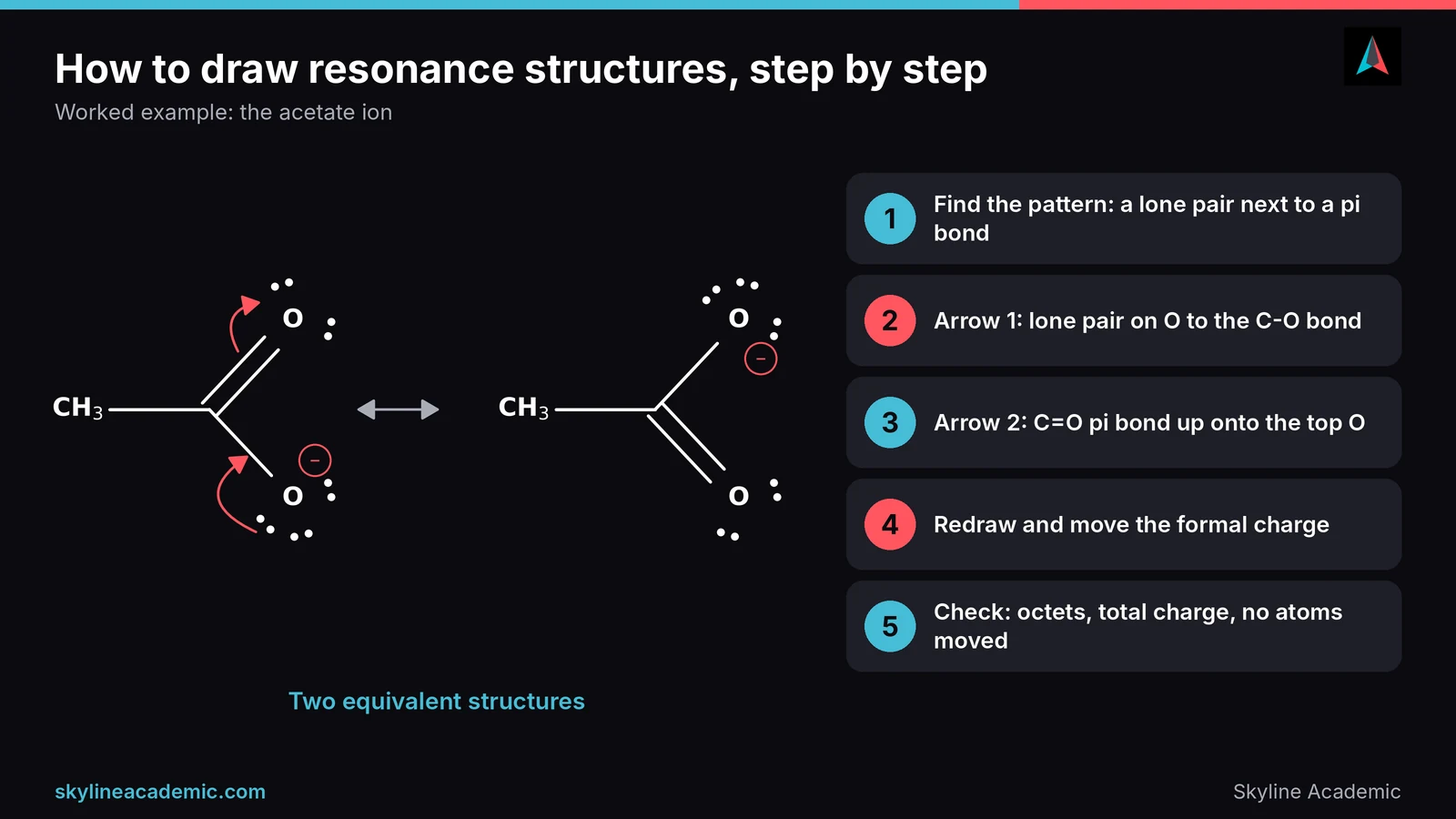
The acetate ion (CH₃CO₂⁻) is the classic first example. Draw it with a carbon double bonded to one oxygen and single bonded to a second oxygen that carries three lone pairs and a negative charge.
- Step 1: find the pattern. The negative oxygen has a lone pair sitting next to the C=O double bond. That is a lone pair next to a pi bond.
- Step 2: draw the first arrow. Start at a lone pair on the negative oxygen and point it to the bond between that oxygen and carbon. This makes a new double bond.
- Step 3: draw the second arrow. Carbon cannot have five bonds, so the old C=O pi bond must move. Start an arrow in the middle of that double bond and point it to the top oxygen, where it becomes a lone pair.
- Step 4: redraw and fix the charges. The bottom oxygen now has a double bond and no charge. The top oxygen now has three lone pairs and a negative charge.
- Step 5: check. Every atom still has an octet, the total charge is still minus one, and no atoms moved. You have two equivalent resonance structures.
Formal charge without the headache
Formal charge tells you which atom “owns” a charge in each structure. The quick formula is: valence electrons minus lone pair electrons minus the number of bonds. An oxygen with two bonds and two lone pairs has a formal charge of zero (6 minus 4 minus 2). An oxygen with one bond and three lone pairs has a formal charge of minus one (6 minus 6 minus 1). You do not need to calculate every atom every time. Learn the common neutral patterns, such as carbon with four bonds, nitrogen with three bonds and one lone pair, and oxygen with two bonds and two lone pairs, and anything different will jump out.
Five patterns that cover most exam questions
Most resonance questions use one of five patterns. OpenStax section 2.6 explains that any three-atom group with a multiple bond next to an atom that has a p orbital will have resonance. In practice, that gives you these five shapes.
- A lone pair next to a pi bond. Push the lone pair in to make a new pi bond, and push the old pi bond out onto the far atom. The acetate ion and enolates use this pattern.
- A positive charge next to a pi bond. Push the pi bond toward the positive charge. The charge moves to the other end. The allyl cation (CH₂=CH-CH₂⁺) works this way, giving two equivalent forms.
- A lone pair next to a positive charge. Push the lone pair in to form a new pi bond. This removes both charges or moves the positive charge onto the atom that donated the lone pair, as in a protonated carbonyl.
- A pi bond between two atoms of different electronegativity. Push the pi bond toward the more electronegative atom. For C=O, this gives a minor form with a positive carbon and a negative oxygen, which explains why carbonyl carbons attract nucleophiles.
- Alternating pi bonds around a ring. Move each pi bond one position around the ring. Benzene is the famous example.
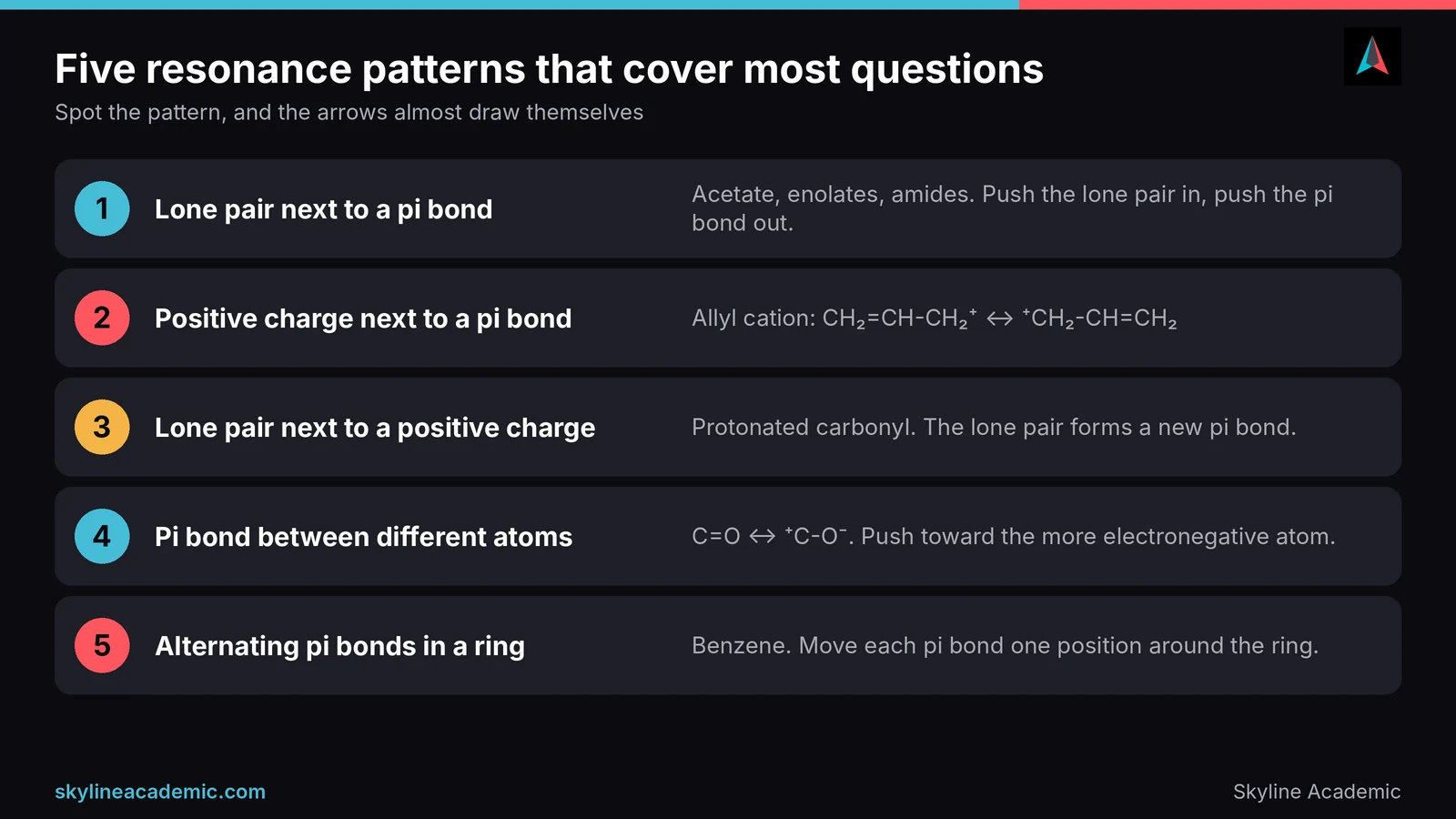
Once you spot one of these patterns, the arrows almost draw themselves. When you are stuck, ask: “Where are the movable electrons, and where is the space next to them?”
Examples of resonance structures in organic chemistry
These are the examples that show up most often in lectures, problem sets and exams. If you need a refresher on the groups themselves, our guide to functional groups in organic chemistry covers each one.
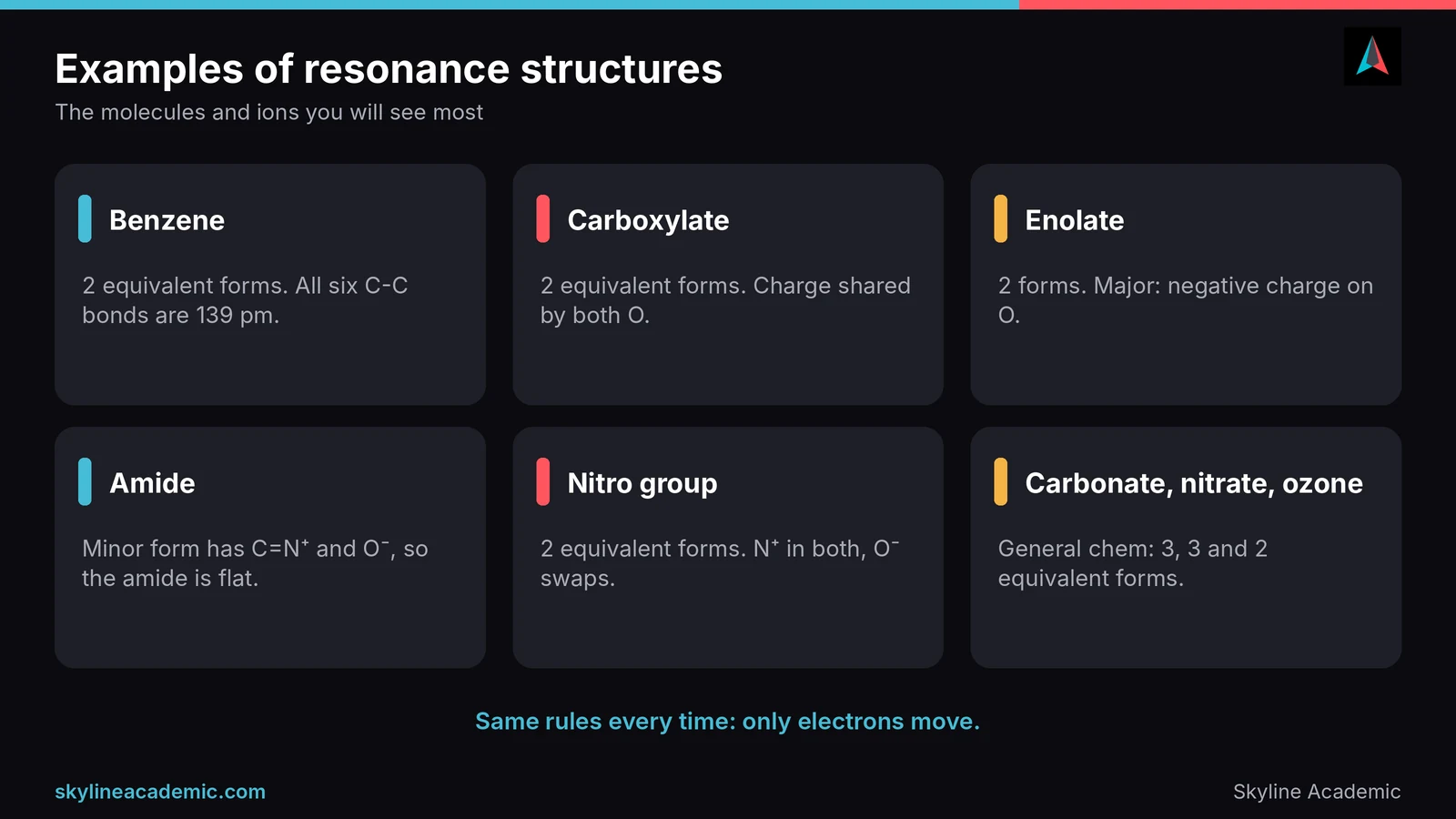
Benzene
Benzene has two equivalent structures with alternating single and double bonds. Neither is real. OpenStax reports that all six carbon-carbon bonds in benzene are the same length, 139 pm, which sits between a normal single and a normal double bond. That is why benzene is often drawn as a hexagon with a circle inside.
Carboxylates
The acetate ion and other carboxylates have two equivalent structures that share the negative charge across both oxygens. This is the reason carboxylic acids are much more acidic than alcohols, which we explain below.
Enolates
An enolate forms when a base removes a hydrogen from the carbon next to a C=O group. It has two structures: one with the negative charge on carbon and one with the negative charge on oxygen. They are not equivalent, which makes enolates a favourite “which is major” question.
Amides
In an amide, the lone pair on nitrogen can push into the C=O group. This gives a minor structure with a C=N double bond, a positive nitrogen and a negative oxygen. That partial double bond keeps the amide flat and slows rotation around the C-N bond, which is why protein backbones are rigid.
Nitro groups
A nitro group (-NO₂) has two equivalent structures. Nitrogen carries a positive charge in both, and the negative charge sits on one oxygen or the other.
General chemistry examples: carbonate, nitrate and ozone
If you are in General Chemistry, you will meet resonance in inorganic ions too. Carbonate (CO₃²⁻) and nitrate (NO₃⁻) each have three equivalent structures, with the double bond on each oxygen in turn. Ozone (O₃) has two equivalent structures, with a positive central oxygen and a negative end oxygen. The same rules apply.
Major vs minor resonance structures: how to pick the best one
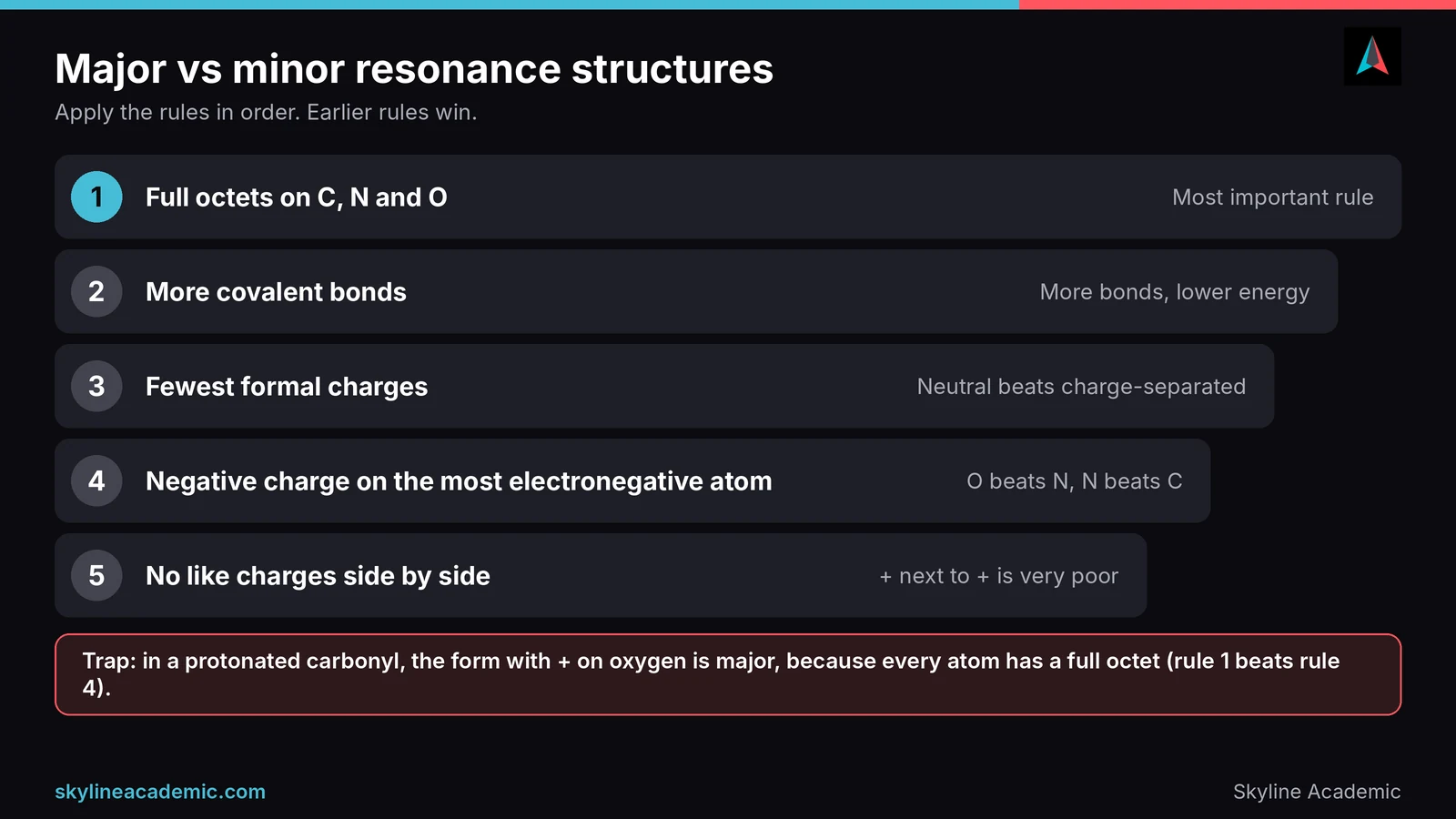
The major resonance structure is the one with full octets, the most bonds and the fewest charges. When charges are needed, the best structure puts the negative charge on the most electronegative atom. The real molecule looks most like this structure.
Use these rules in order. The first rule beats all the others.
| Rule (in order of importance) | What to look for | Example |
|---|---|---|
| 1. Full octets | Every carbon, nitrogen and oxygen has eight electrons | CH₂=O beats ⁺CH₂-O⁻, where carbon has only six |
| 2. More covalent bonds | The structure with more bonds is usually lower in energy | The neutral C=O form beats the charged C-O form |
| 3. Fewest formal charges | No charges beats separated charges | A neutral amide beats the ⁻O-C=N⁺ form |
| 4. Negative charge on the more electronegative atom | Oxygen beats nitrogen, and nitrogen beats carbon | An enolate with the charge on oxygen beats charge on carbon |
| 5. No like charges side by side | Two positive charges next to each other is very poor | Avoid structures with ⁺ next to ⁺ |
Here is one trap. Rule 1 can beat rule 4. In a protonated carbonyl, the structure with a positive charge on oxygen is the major one, because every atom has a full octet. The form with a positive charge on carbon looks nicer for charge placement, but carbon only has six electrons, so it is minor.
The resonance hybrid: why resonance matters
The resonance hybrid is the real molecule. It spreads electrons and charge over several atoms, which lowers energy. That one idea explains stability, acidity, reaction speed and even the shape of molecules.
Stability
Spreading out electrons makes a molecule more stable. Benzene is the clearest proof. According to OpenStax, benzene is about 148 kJ/mol more stable than you would expect for a ring with three normal double bonds. That extra stability is why benzene resists reactions that break up its ring.
Acidity
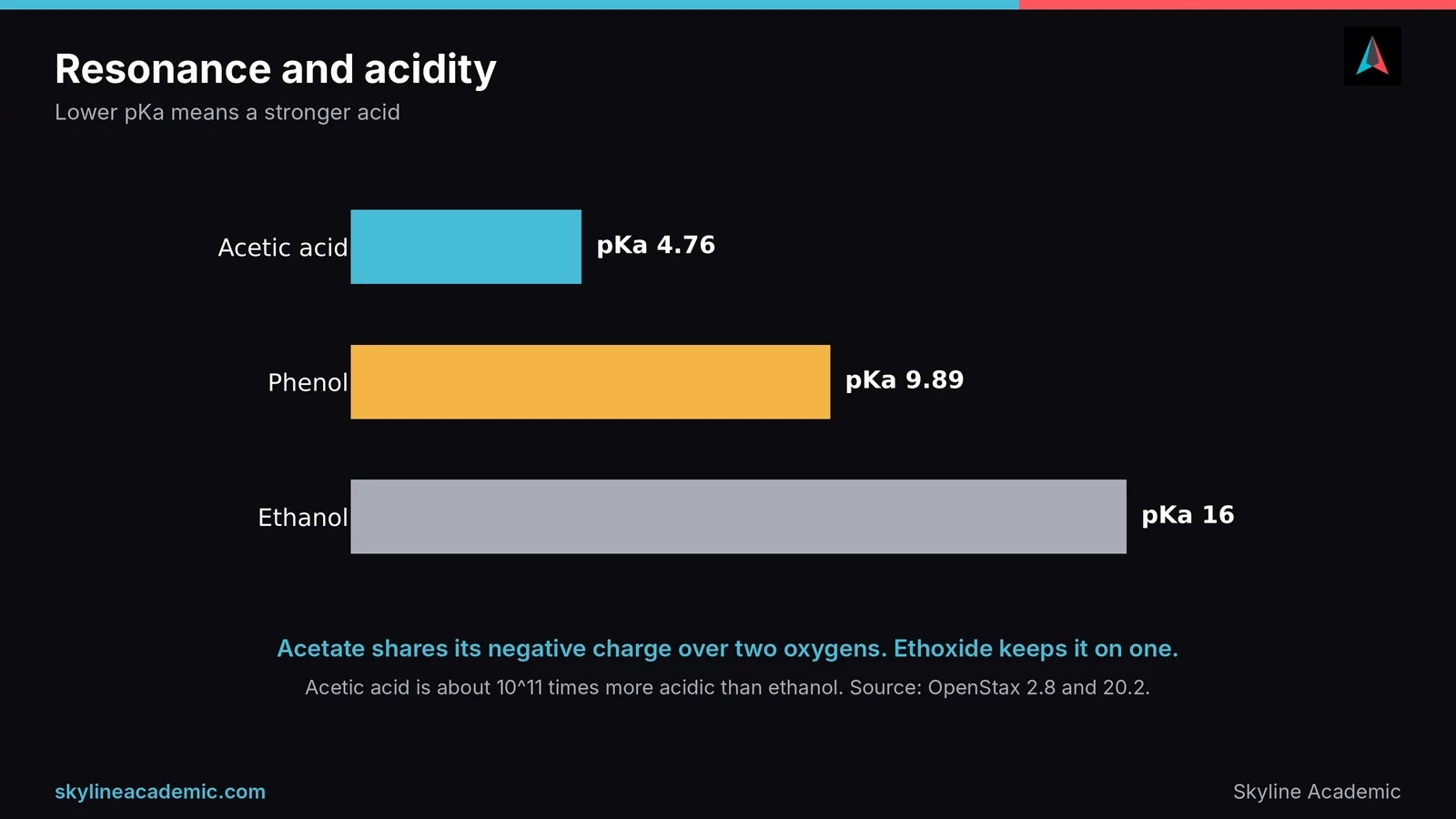
An acid gives away a proton and leaves behind a conjugate base. The more stable that base, the stronger the acid. Acetic acid has a pKa of 4.76, while ethanol has a pKa of about 16, as listed in OpenStax’s pKa table. That makes acetic acid about 10¹¹ times more acidic. OpenStax section 20.2 explains why: the acetate ion shares its negative charge over two oxygens by resonance, while the ethoxide ion keeps its charge on one oxygen. Phenol (pKa 9.89) sits in between, because its negative charge can spread into the benzene ring.
Reactions and carbocations
Resonance also decides how fast reactions go. A carbocation next to a double bond or a benzene ring, called allylic or benzylic, can spread its positive charge by resonance. That makes it more stable and easier to form, which is why these substrates often react by SN1 even when they are primary. Our guide to SN1 vs SN2 reactions shows how this changes the mechanism.
Shape and real-world molecules
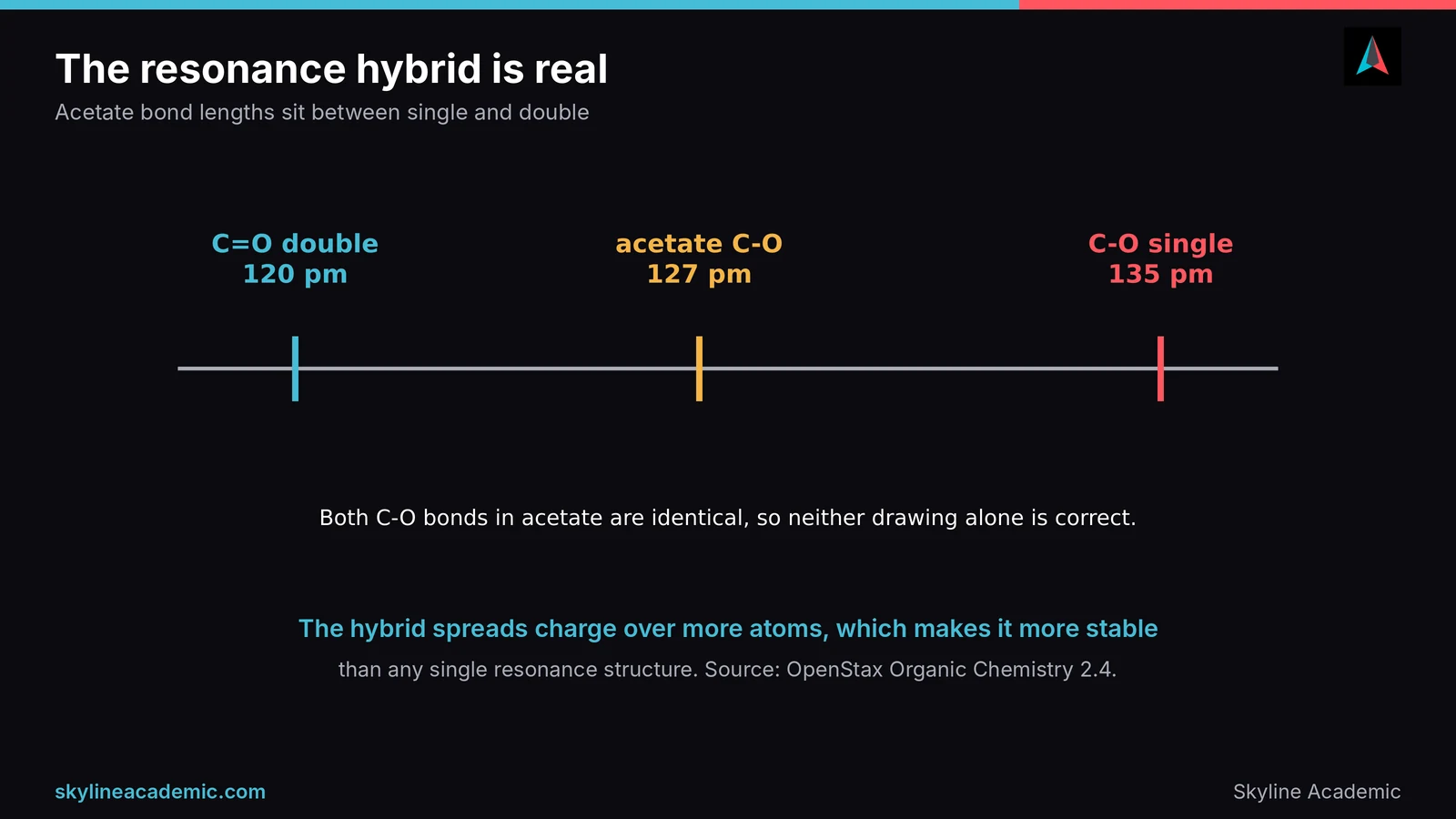
Resonance changes bond lengths and shapes. In acetate, both C-O bonds are 127 pm long, between a single bond (135 pm) and a double bond (120 pm), according to OpenStax. In amides, resonance keeps the bond flat. This matters far beyond the exam. Drug molecules, dyes and proteins all depend on resonance for their shape and behaviour, which is why pharmacy and medicine students meet it again and again. Our pharmacy tutoring covers how these ideas carry into medicinal chemistry.
Resonance vs isomers vs tautomers
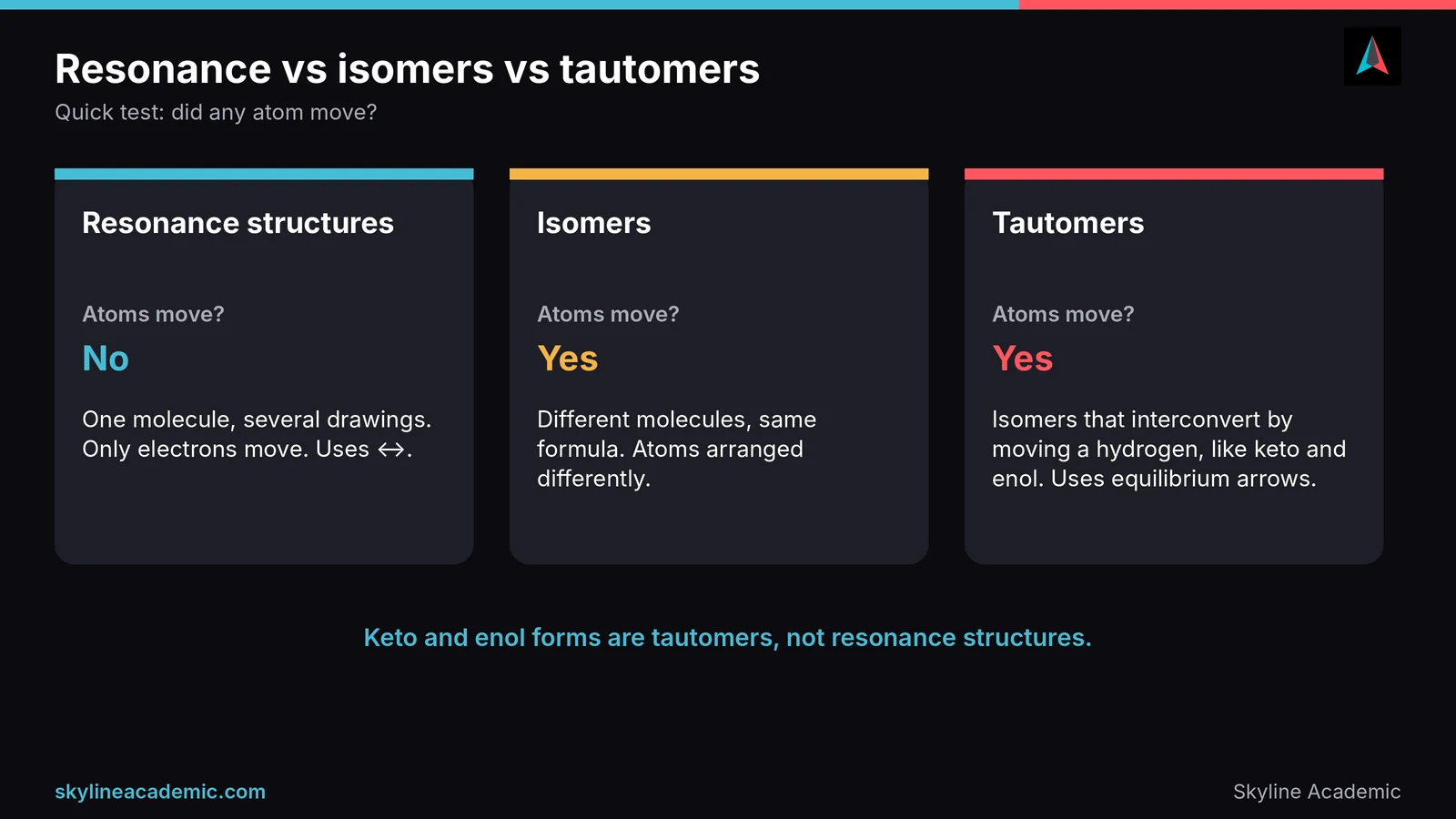
Resonance structures are different drawings of one molecule where only electrons move. Isomers are different molecules with the same formula where atoms are arranged differently. Tautomers are a special kind of isomer that turn into each other by moving a hydrogen atom.
The quick test is simple. Did any atom move? If no, it is resonance. If yes, it is not resonance. Keto and enol forms are the classic trap. Acetone and its enol form look similar, but a hydrogen moves from carbon to oxygen, so they are tautomers. They are two real molecules in equilibrium, not two drawings of one molecule. Resonance uses a double-headed arrow (↔). Equilibrium uses two half arrows (⇌). Using the wrong arrow can cost you marks.
Tips for drawing resonance structures in organic chemistry
Most lost marks come from the same handful of mistakes. Here they are, with the fix for each.
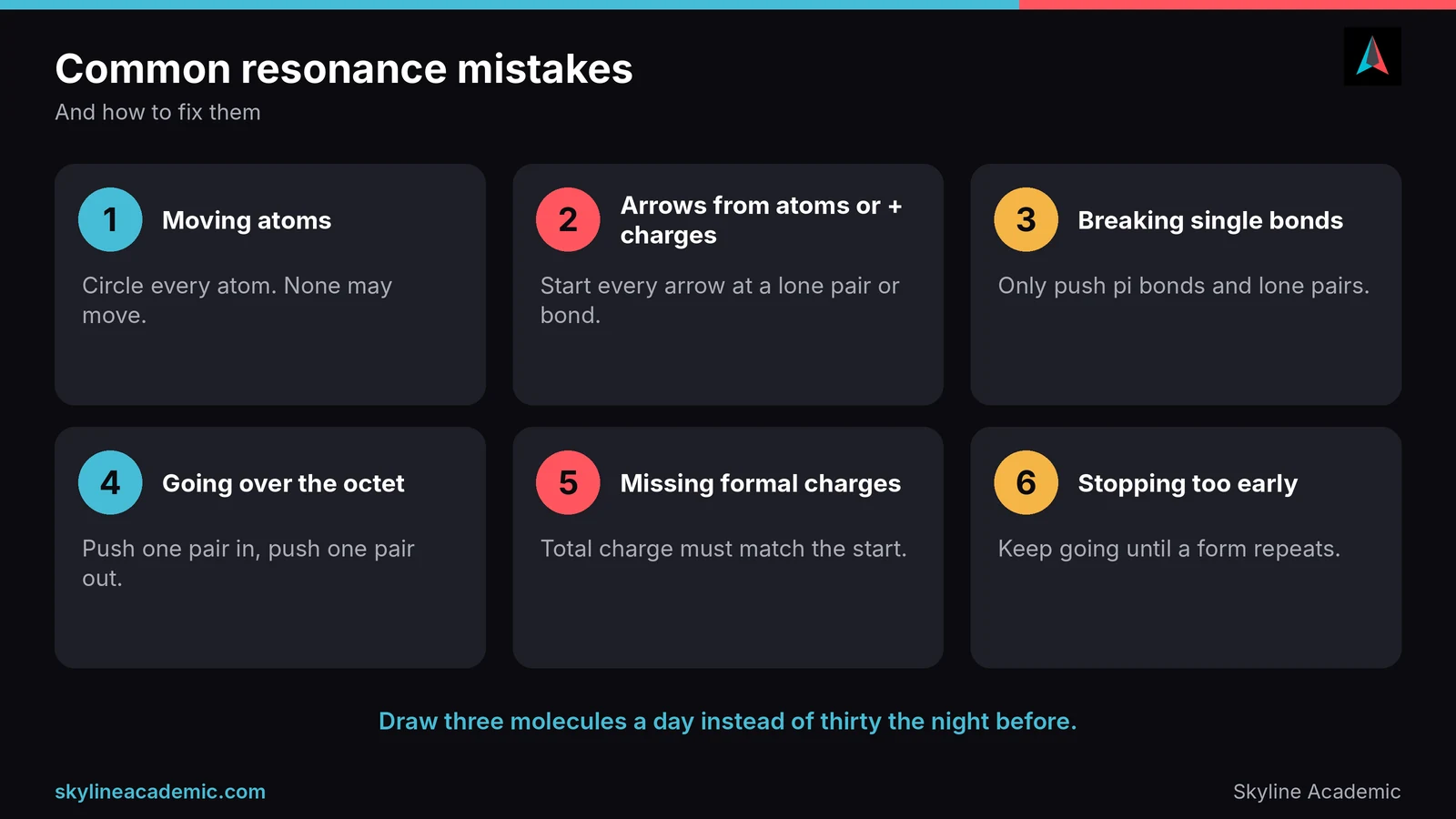
- Moving atoms. If a hydrogen or any other atom changes position, it is not resonance. Fix: before you draw arrows, circle every atom and make sure each one stays put.
- Starting arrows from atoms or positive charges. Arrows must start at electrons. Fix: put the tail of every arrow on a lone pair or a bond.
- Breaking single bonds. Sigma bonds never move in resonance. Fix: only push pi bonds and lone pairs.
- Going over the octet. A carbon with five bonds, or a nitrogen with five bonds, is never allowed. Fix: whenever you push electrons into an atom, push another pair out.
- Forgetting formal charges. A structure without the right charges is marked wrong even if the bonds are right. Fix: check the total charge matches the starting structure.
- Stopping too early. Some molecules, like carbonate or the pentadienyl cation, have three or more structures. Fix: keep pushing until you reach a structure you have already drawn.
The best way to make this automatic is short, frequent practice. Draw three molecules a day for a week instead of thirty the night before your exam. Our guide to the best study techniques explains why spaced practice and active recall work so much better than rereading notes.
Resonance structures practice problems
Try each problem before you read the answer. Cover the last two columns to test yourself.
| Molecule or ion | Question | Answer | Why |
|---|---|---|---|
| Allyl cation (CH₂=CH-CH₂⁺) | Draw the other resonance structure | ⁺CH₂-CH=CH₂ | Positive charge next to a pi bond. The two forms are equivalent |
| Acetone enolate | Which structure is major? | Negative charge on oxygen | Oxygen is more electronegative than carbon |
| Formaldehyde (CH₂=O) | Which contributes more: CH₂=O or ⁺CH₂-O⁻? | CH₂=O | Full octets and no charges |
| Acetone and its enol | Are these resonance structures? | No, they are tautomers | A hydrogen atom moved |
| Nitrate ion (NO₃⁻) | How many resonance structures? | Three, all equivalent | The double bond moves to each oxygen in turn |
For more practice across the whole course, try our organic chemistry practice problems with answers.
Quick self-check quiz
Click each question to reveal the answer.
Q1. In resonance structures, what can move: atoms or electrons?
Answer: Only electrons, meaning pi electrons and lone pairs. Atoms always stay in place.
Q2. Does benzene switch back and forth between its two structures?
Answer: No. Benzene is one resonance hybrid with six identical carbon-carbon bonds, each 139 pm long.
Q3. Which resonance structure of the acetone enolate contributes more?
Answer: The one with the negative charge on oxygen, because oxygen is more electronegative than carbon.
Q4. Why is acetic acid more acidic than ethanol?
Answer: Acetate shares its negative charge over two oxygens by resonance, while ethoxide keeps it on one oxygen.
Q5. Can a single (sigma) bond break when you draw a resonance structure?
Answer: No. Only pi bonds and lone pairs move. Single bonds always stay.
Resonance structures on the MCAT and in exams
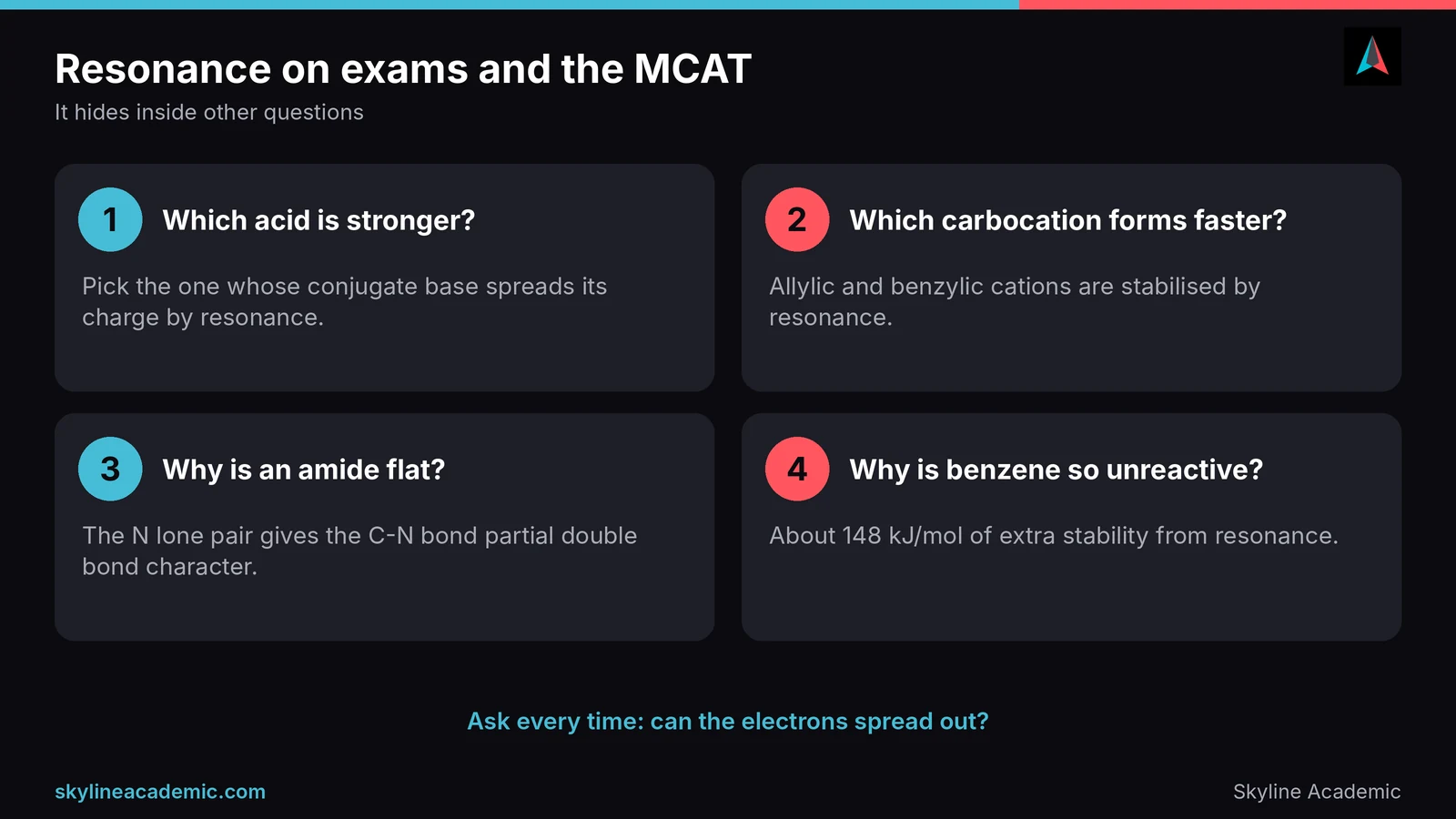
On university exams and the MCAT, resonance is rarely asked on its own. It hides inside other questions. You might be asked which acid is stronger, which carbocation forms faster, why an amide is flat, or why benzene does not react like an alkene. In every case, the answer depends on whether electrons can spread out.
The most common traps are calling keto and enol forms resonance structures, choosing a structure with a carbon that lacks an octet as the major form, and forgetting that the hybrid, not any single drawing, is real. If you are preparing for medical school, our MCAT and medicine tutoring can help you practise passage-style questions where resonance is one step in a longer argument.
Still stuck on resonance?
Resonance is one of those topics that clicks quickly when someone watches you draw the arrows and catches the exact moment your reasoning goes wrong. Skyline Academic is one of the leading 1:1 live tutoring platforms, with a dedicated LMS, progress tracking, assignment quizzes, workshops and bootcamps. We also offer an AI detector and a plagiarism checker. Our 1:1 chemistry tutoring covers resonance, mechanisms, acidity, stereochemistry and exam preparation at your pace, so you can stop guessing and start understanding. Book a session when you are ready.
Frequently asked questions
What is a resonance structure in organic chemistry, in simple words?
A resonance structure is one of several drawings of the same molecule where only the electrons are in different places. Together, these drawings describe a molecule whose electrons are spread over more than two atoms.
Do resonance structures actually exist?
No. Each resonance structure is an imaginary drawing. The real molecule is the resonance hybrid, a single structure that blends all of them and does not switch between forms.
Are resonance structures in organic chemistry always equivalent?
No. Some are equivalent, like the two forms of the acetate ion. Others are not, like the two forms of an enolate, and the more stable one contributes more to the hybrid.
How do I know which resonance structure is the most stable?
Check four things in order: full octets, the most bonds, the fewest charges, and negative charge on the most electronegative atom. The structure that wins on the earliest rule is the major one.
How can I tell if a molecule has resonance?
Look for a pi bond or lone pair sitting next to another pi bond, a positive charge, or an atom with a p orbital. If electrons can shift one step without moving any atoms, the molecule has resonance.
What is the difference between resonance and isomers?
In resonance, only electrons move and you are drawing one molecule. In isomers, atoms are arranged differently and you have two different molecules.
Why does resonance make a molecule more stable?
Resonance lets electrons and charge spread over more atoms. Spread-out charge is lower in energy than charge stuck on one atom, so the hybrid is more stable than any single structure.
How does resonance affect acidity?
If the conjugate base can share its negative charge by resonance, it is more stable, so the acid gives up its proton more easily. That is why acetic acid is far more acidic than ethanol.
Do I need to show formal charges on resonance structures?
Yes. Formal charges are part of every resonance structure, and missing them is one of the most common reasons answers get marked wrong. The charges in each structure must add up to the same total.
What are some tips for drawing resonance structures faster?
Learn the five common patterns, always start arrows at electrons, and never move atoms or break single bonds. Practise a few molecules every day until spotting the pattern feels automatic.
Conclusion
Resonance structures look confusing at first, but the logic is simple. Atoms stay still, only pi electrons and lone pairs move, and the real molecule is a blend called the resonance hybrid. Learn the rules, spot the five patterns, rank structures by octets, bonds, charges and electronegativity, and you will handle most exam questions with confidence. Resonance then becomes a tool that explains acidity, stability and reactions across the rest of organic chemistry. If you want a tutor to work through it with you step by step, Skyline Academic is ready to help.