
You wrote your essay yourself. You are tired, the deadline is close, and a friend says to run it through a free AI checker first. You paste it into Proofademic, and a number pops up. Is 17 good? Is 5 safe? And can you even trust a tool you have barely heard of?
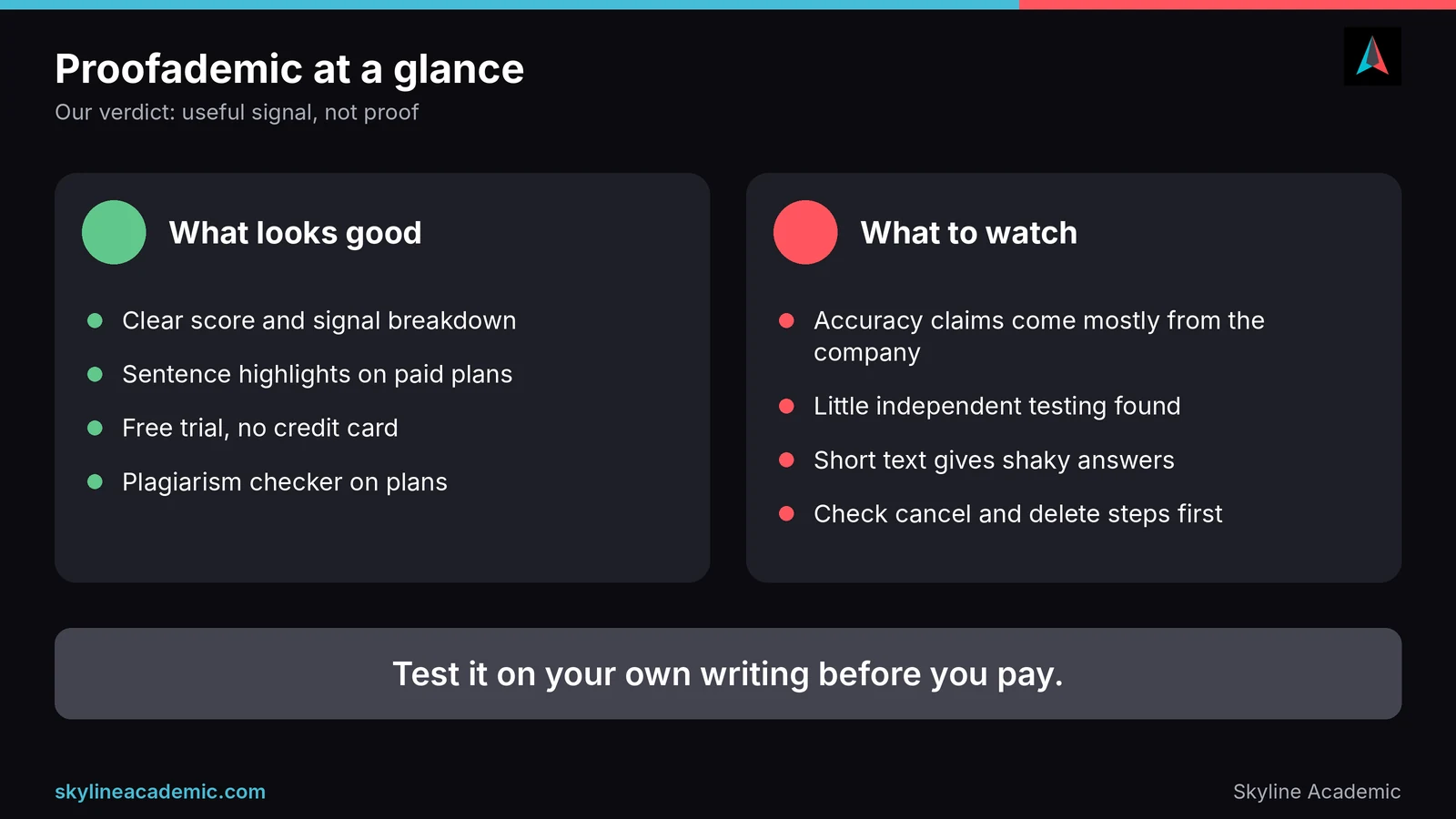
So, is Proofademic AI detector accurate? Here is the short answer. Proofademic is a working AI detector with a simple score, sentence-level highlights and clear plans, and its makers claim very high accuracy. But we could not find a proper independent study that confirms those numbers, and independent reviewers say the same. So Proofademic looks useful as a quick signal. It is not proof, and one score should never decide anything important.
What Proofademic AI detector is and how it works
Proofademic is an AI text detector made for academic writing. You paste in an essay or upload a document, and it gives you an “AI-likeness score” from 0 to 100, a short label such as “Reads as human-written”, and a small signal breakdown. Its paid plans add things like batch scanning, a built-in plagiarism checker and sentence-level highlighting.
Like most detectors, it does not know who wrote your text. It looks for patterns that tend to show up in machine writing, such as predictable phrasing and generic structure, and then estimates how likely it is that an AI tool wrote it. That estimate can be useful on a long, normal essay. It gets less reliable on short texts, very formal writing and writing by students who use simple, careful English.
How to read Proofademic’s results
The results panel is easy to read once you know the pieces.
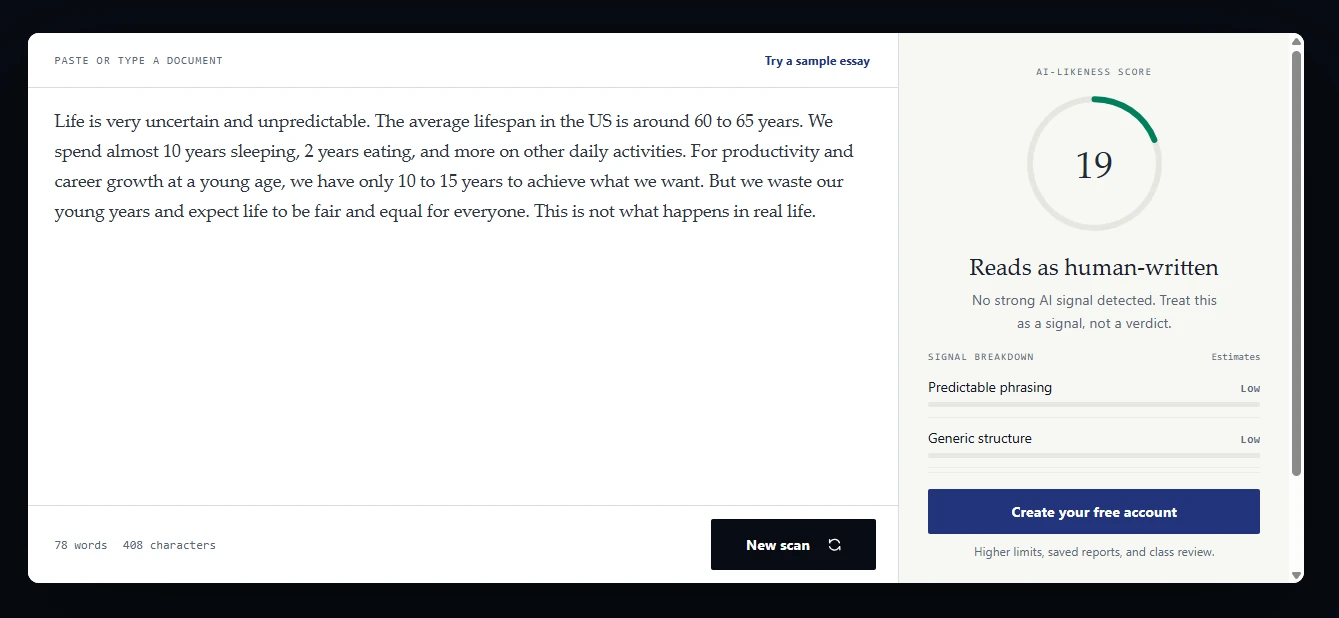
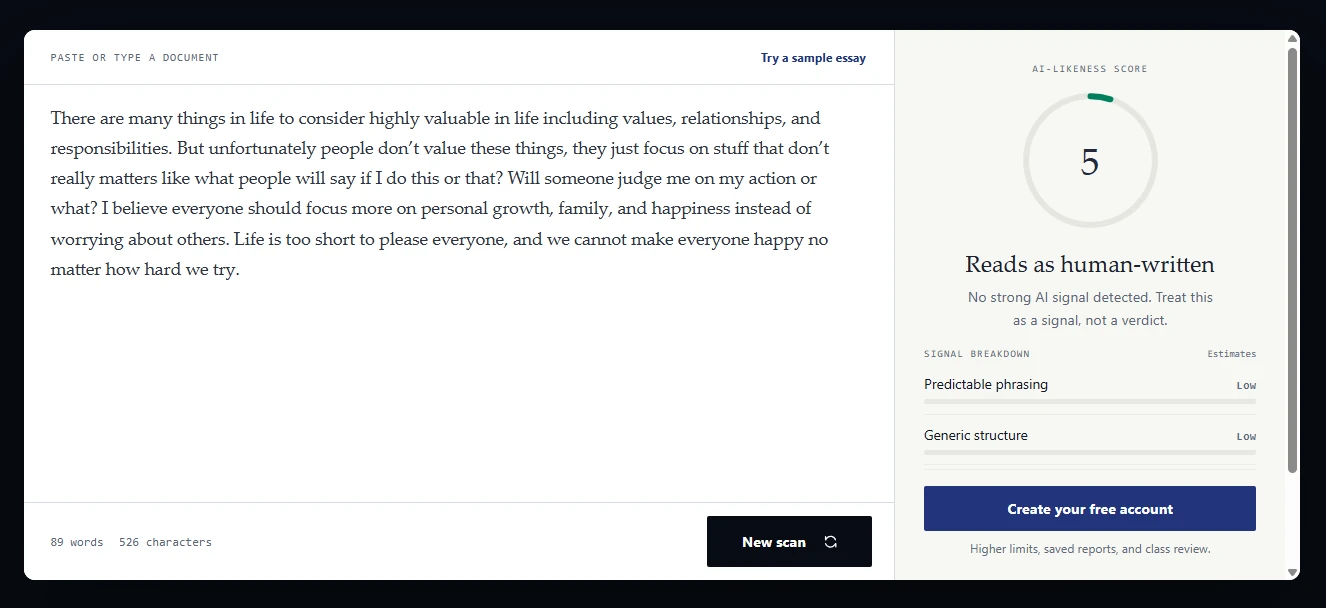
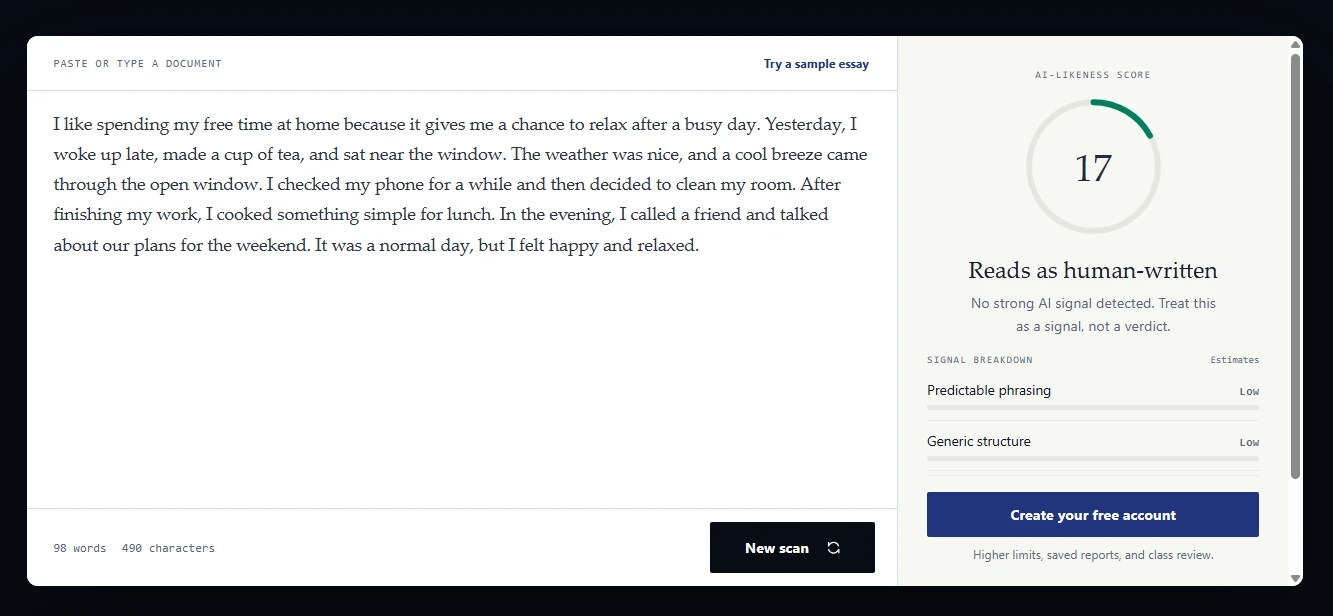
- The score. A lower number means less AI signal. In our tests, scores of 17, 5 and 19 came with the label “Reads as human-written”.
- The label. It gives you a plain sentence, such as “No strong AI signal detected”.
- The reminder. The tool itself says: “Treat this as a signal, not a verdict.” That is good advice, and we agree with it.
- The signal breakdown. It shows items such as predictable phrasing and generic structure, rated Low, Medium or High, and marks them as estimates.
- Sentence highlights. On paid plans, sentence-level highlighting shows which lines drove the result. This is the most useful part when you want to edit.
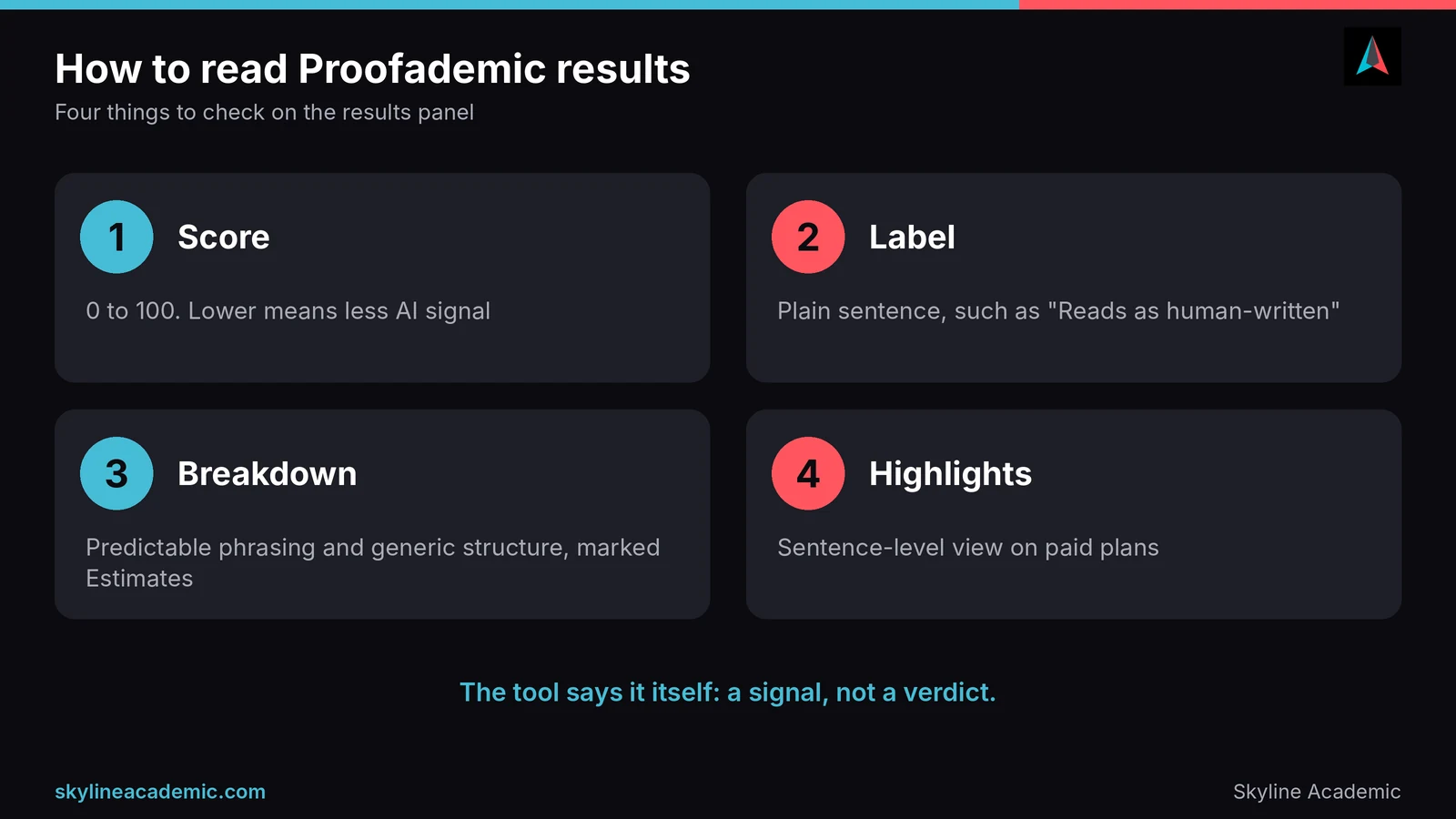
Notice the word “Estimates” on the breakdown. It is the tool admitting that these are guesses, not facts. Keep that in mind whenever you see a score.
Proofademic features, free trial and pricing
Proofademic has a free trial with no credit card, and three paid plans. Here is how the plans looked on the pricing page we checked in October 2026, with yearly billing selected.
| Plan | Price with yearly billing | Words per month | Features listed on the page |
|---|---|---|---|
| Free trial | $0 for 3 days | 1,000 words | Multilingual AI detection, plagiarism checker, report export |
| Essential | $8 a month, billed $99 a year | 200,000 | Adds batch scan, sentence-level AI highlighting, full document scans |
| Premium | $14 a month, billed $165 a year | 400,000 | Batch scan, sentence-level AI highlighting, multi-page documents |
| Professional | $25 a month, billed $300 a year | 600,000 | Batch scan, top-up words, sentence-level AI highlighting, priority support |
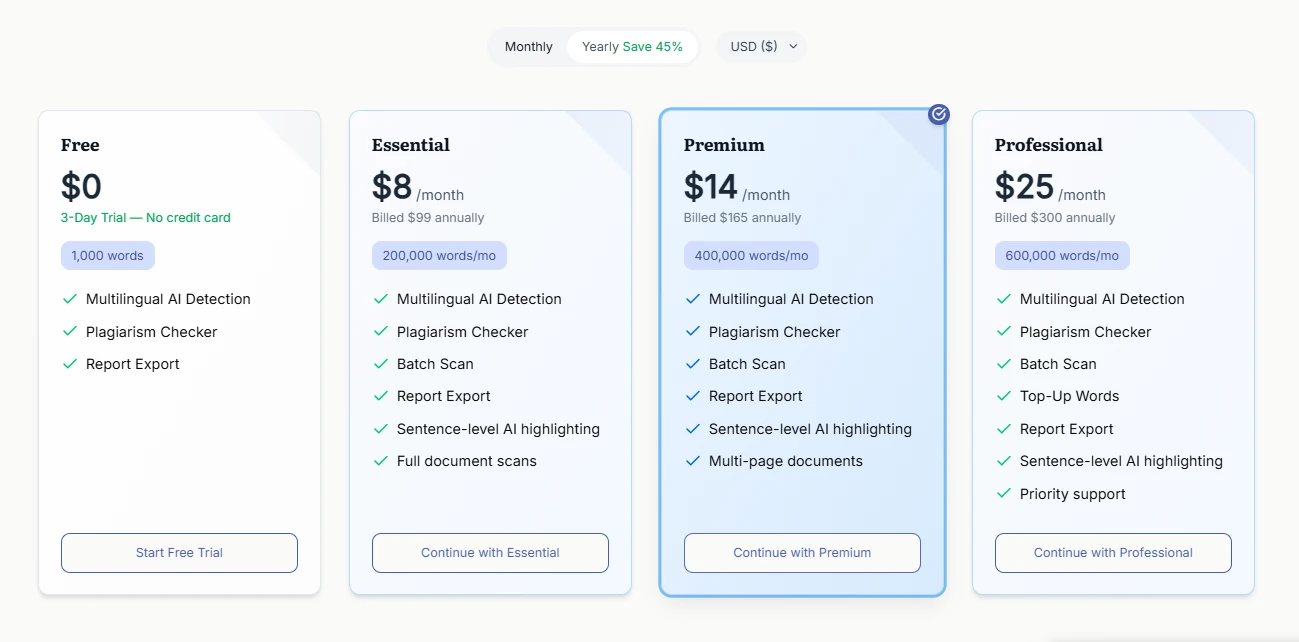
Two things to know before you pay. First, the prices above assume yearly billing. A March 2026 review reported monthly billing at about $15, $25 and $45 for the three paid plans, so paying month to month can cost much more. Second, the same review lists limits per scan of about 3,500, 8,000 and 25,000 words. These details come from a third party, so check the live pricing page before you pay.
A simple way to think about it: 200,000 words a month is plenty for most students, because an average essay is around 1,500 words. If you only need to check one or two papers a month, the free trial or a free tool may be enough.
Is Proofademic AI good and legit? What the evidence shows
In this section we use one simple rule. A company claim is a claim, and an independent test is evidence. We label each one so you can see the difference.
What Proofademic claims
According to reviewers who read its pricing page, Proofademic advertises “99.8% detection accuracy for academic workflows”. One review also describes a May 2026 research paper from the company reporting a 0.2% false positive rate on 4,200 human-written texts, and a 0.5% rate on non-native English writing. A false positive means human writing wrongly labeled as AI. The same review says it could not audit the data behind the paper, so we treat all of this as company claims.
What independent reviewers and tests found
We did not find a peer-reviewed or independent academic study that tests Proofademic. One professor who uses it weekly says its accuracy figure “has not been independently peer-reviewed” and that his own testing was observational, with no measured rates. He also says it caught raw AI text and handled citation-heavy student essays well, but he warns that non-native speakers, very formal writers and templated writing such as lab reports can still be flagged.
One benchmark reports different numbers. A March 2026 test of 2,400 samples by Poignant Guide listed Proofademic at 93% accuracy, a 5% false positive rate and a 10% false negative rate. That is far from the company’s 0.2%. The publisher also says it uses referral links for another detector it ranks first, so treat this as one data point and not a final answer.
The gap between 0.2% and 5% is the real story here. Different tests, different texts and different settings give different results, which is why no single number should be trusted on its own.
Our mini test
We ran three short texts through the Proofademic app. The 78 word paragraph about life being uncertain scored 19. The 89 word paragraph about the things people value in life scored 5. The 98 word paragraph about spending free time at home scored 17. All three came back as “Reads as human-written”, with no strong AI signal detected.
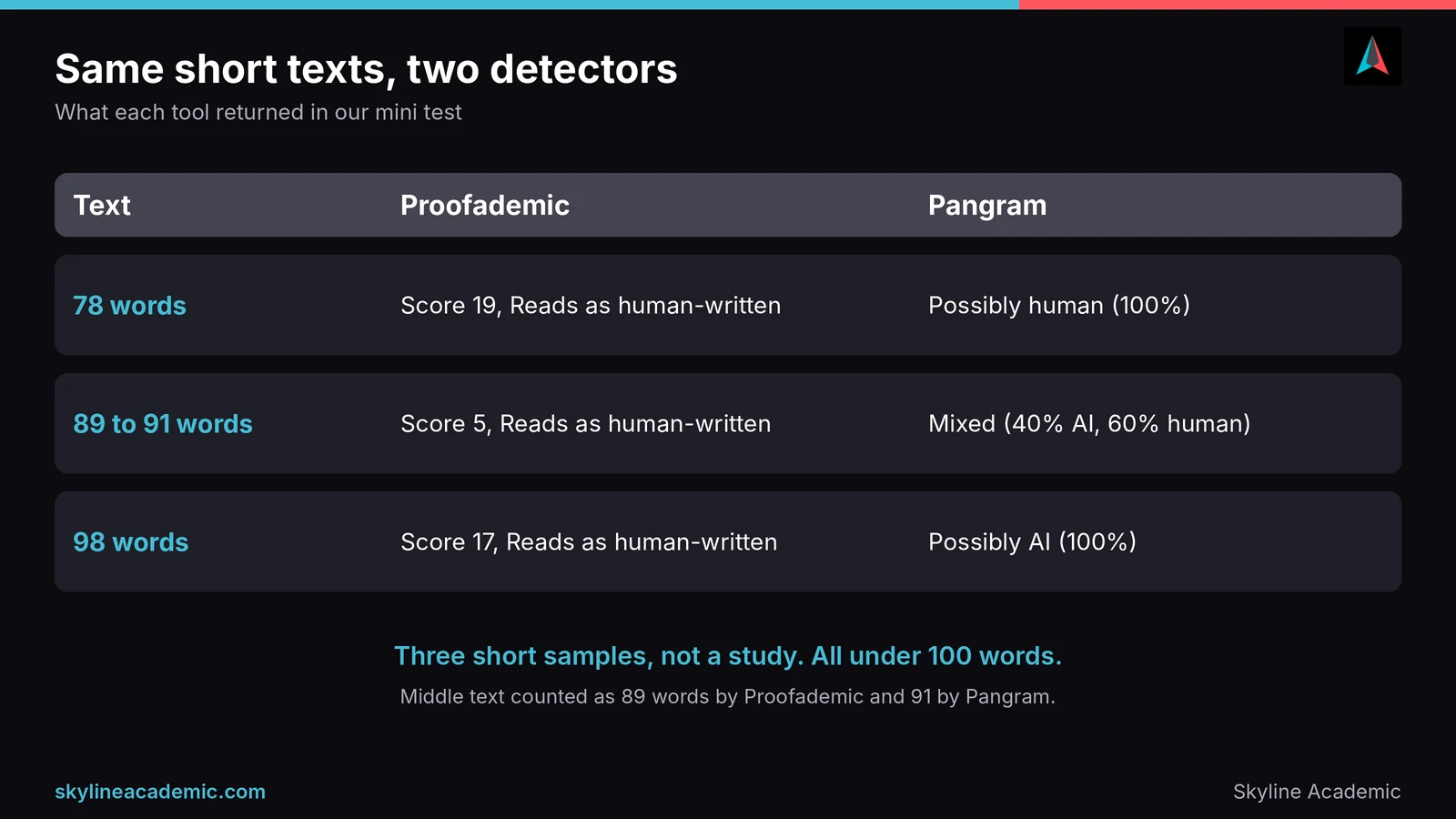
Please read this the right way. Three samples is not a study, and all three texts were under 100 words. We are describing what the tool returned, and we are not claiming any result was right or wrong. The useful part is the comparison. When we put the same short texts through our Pangram accuracy review, Pangram labeled them “Possibly human”, “Mixed” and “Possibly AI”. Two tools, the same short texts, very different answers.
What Reddit users say
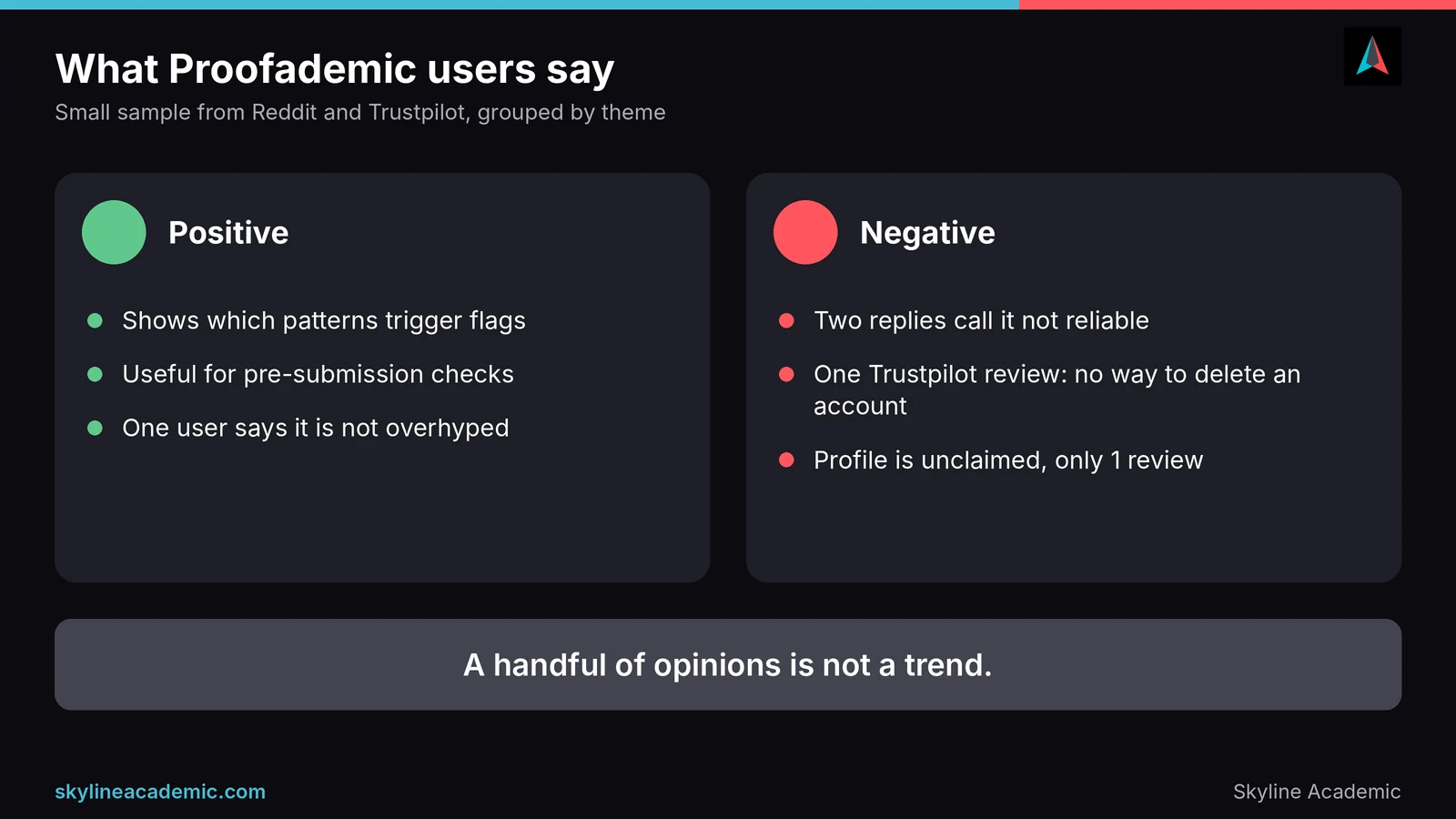
Reddit opinions are mixed and the sample is tiny. One older comment praises Proofademic for showing which patterns trigger a flag, instead of giving only a percentage, and says it helps catch false positives before submission. In other threads, two replies call it “not reliable” while another says it is good and not overhyped. A few comments is not a trend, and some posts in detector forums can be promotional, so read them as opinions, not proof.
What Trustpilot shows
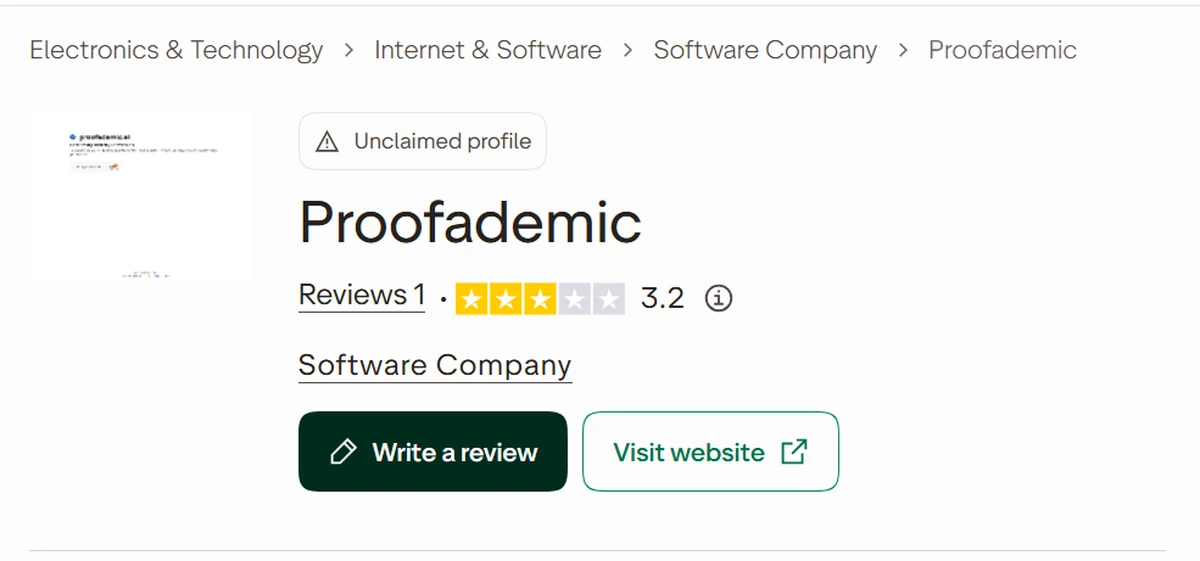
Proofademic’s Trustpilot profile is marked “Unclaimed” and shows only one review. That review is 1 star, was left without an invitation in May 2026, and complains that there is no setting to delete an account or change the email, so you have to contact support. One review proves nothing either way. It does tell you one thing worth knowing: if you try the free trial, find out how to cancel or delete your account before you give it your email and card.
So is Proofademic legit?
If by “legit” you mean a real product that works, it is. It has a working app, clear plans and a free trial. If you mean “proven accurate”, the honest answer is not yet. The strongest claims come from the company, and the independent evidence is thin and mixed. A fair verdict is that Proofademic is a useful signal tool you should test yourself, not a judge.
Why detectors misjudge honest writing
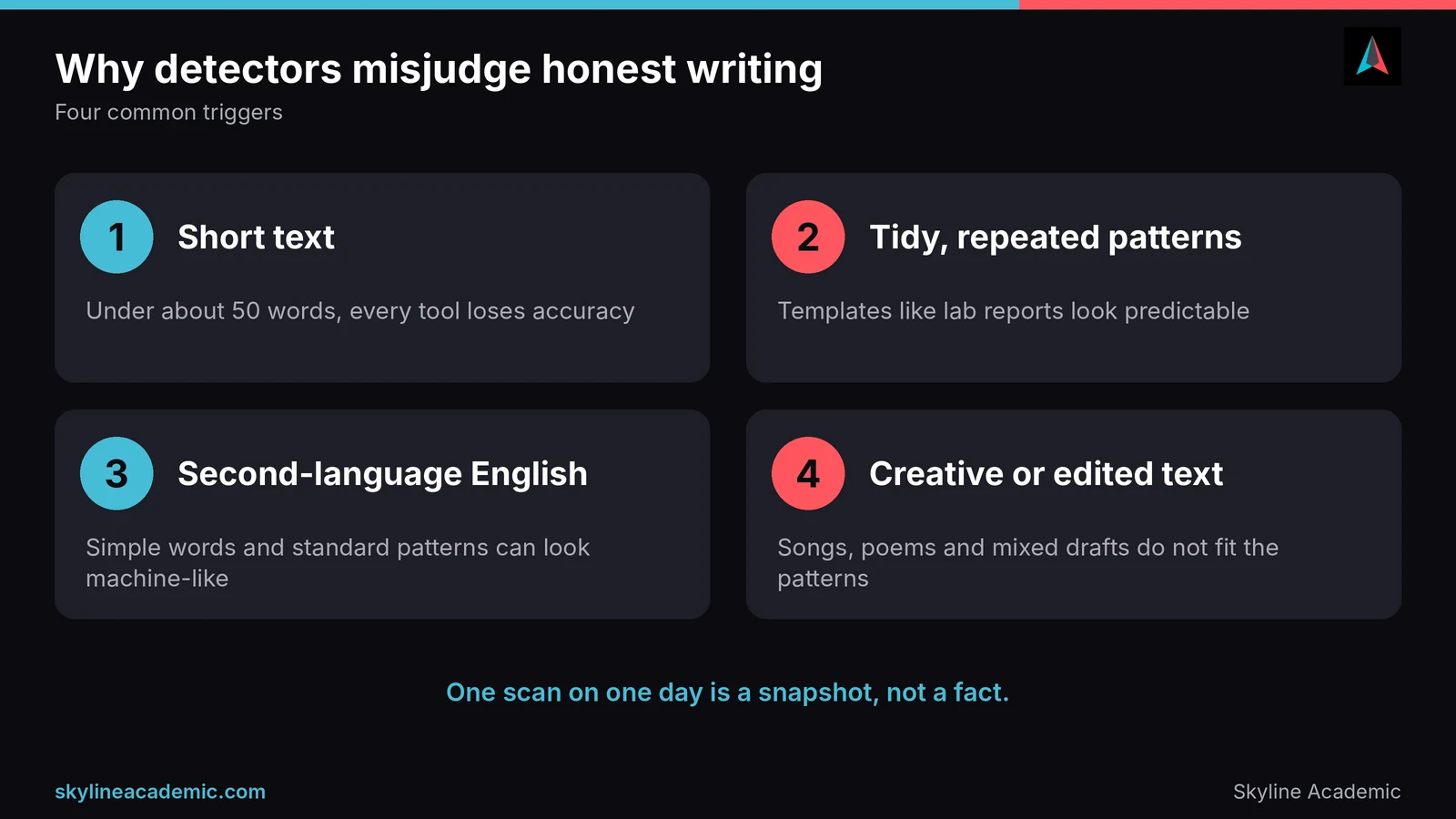
Short text gives shaky answers
A paragraph gives a detector very little to study. All three of our tests were under 100 words, and the Chicago Booth working paper found that detectors lose accuracy on very short passages. If you scan only a few sentences, treat the result as a rough hint.
Tidy or repeated patterns can look machine-like
Clear, simple writing is what most teachers ask for, yet it can look predictable to a detector. Essays that follow a strict template, such as lab reports, cover letters and five paragraph essays, get flagged more often. Our guide on AI detection false positives explains why this happens and what you can do.
Second-language writers face extra risk
If English is your second language, you may use simpler words and standard sentence patterns. A well-known Stanford study found that older detectors labeled 61.22% of essays by non-native writers as AI generated. Proofademic says it reduces this problem, and it reports a lower rate on non-native writing, but we have not seen independent proof. Keep your drafts and notes either way.
Edited and creative text confuses detectors
Songs, poems and heavily edited drafts do not follow the patterns detectors were built on. Text that is partly human and partly AI is harder to judge. A small edit can change a score, so one scan on one day is a snapshot, not a fact.
Proofademic vs alternatives
Students ask which detector is the best, and the honest answer is that it depends on the test, the text length and the settings. Here is a simple side by side, using the evidence we have. We also run our own AI content detector, so weigh this comparison with that in mind. We are not claiming our tool beats any of these.
| Detector | Known for | Watch for |
|---|---|---|
| Proofademic | Clear score, signal breakdown, sentence highlights, plagiarism checker on plans | Strong company claims, little independent testing |
| Pangram | Lowest false positive rate in the Chicago Booth study | Users report false flags and score changes on short text |
| GPTZero | Low false positives in the same study, widely used in schools | Its data handling in that study is disputed |
| Originality.ai | Popular with publishers and writers | Missed more AI text in the same study |
| Skyline AI content detector | A quick self-check alongside our plagiarism checker and tutoring | Like every detector, a signal and not proof |
If you want to dig into the others, read our reviews of GPTZero accuracy and Originality.ai accuracy. The lesson repeats every time: strong marketing numbers, useful tools, and real users who still get flagged. Your university also decides which detector it uses, so a good score on one tool does not guarantee the same result elsewhere.
Who should and should not use Proofademic
Proofademic is a reasonable choice if you want a quick self-check on a full essay, if you like seeing which sentences drive a score, or if you are a teacher who wants one more signal before talking to a student. It is also a good prompt to keep your own drafts and notes.
It is a poor choice if you plan to use a score as proof in a dispute, if you are only checking a short paragraph, or if you think a low score means nobody can question your work. No detector can promise that. It is also worth testing the free trial before you pay for a full year, since the yearly price is a bigger commitment than it looks.
How to test Proofademic yourself before you pay
The best way to judge any detector is to try it on text you understand. Here is a simple way to do that during the free trial, which only covers 1,000 words, so plan your tests.
- Pick one piece of writing you know you wrote yourself, ideally a few hundred words long, and scan it.
- Scan one short paragraph from the same piece and compare. If the scores are far apart, you have learned how much length matters.
- Make a small edit, such as changing a few words, and scan again to see how steady the score is.
- Scan the same text on a second detector and note where the two tools disagree.
- Check how to cancel and how to delete your account before you enter any card details.
If the results look steady and sensible on your own writing, a paid plan may be worth it. If scores jump around, use the tool only as a rough hint.
A simple rule for company claims
When any detector says it is 99% accurate, ask three questions. Who ran the test? How long were the texts? Can anyone outside the company repeat it? A strong number with no outside check is a good reason to test the tool yourself, and a poor reason to trust it with your grades. That is the standard we try to apply to every detector we review, including our own.
What to do if a detector flags your writing
A high score can feel like an accusation. Here is a calm way to handle it.
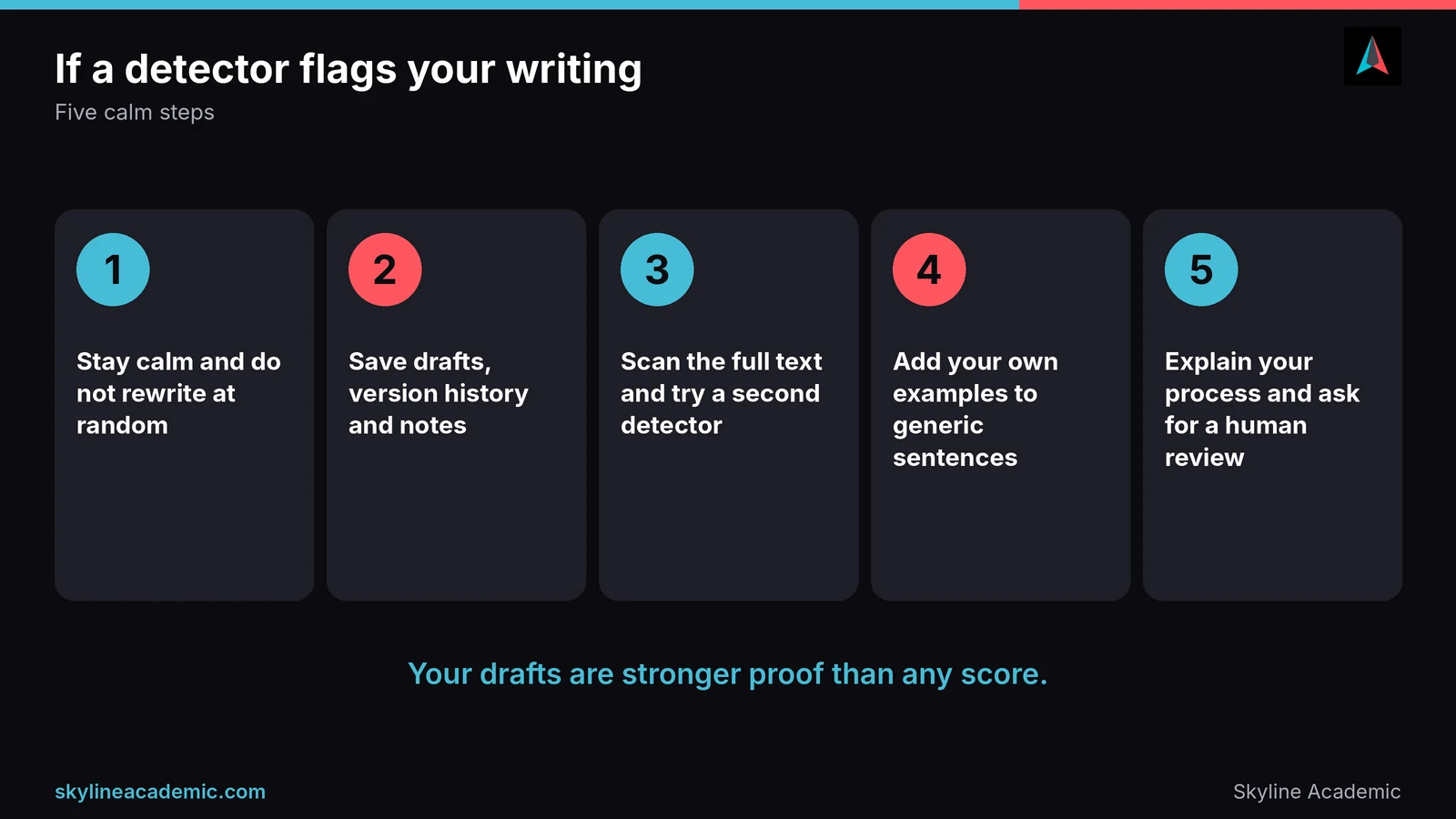
- Do not panic, and do not rewrite everything at random to chase a better score. That often makes the writing worse.
- Save your evidence: drafts, version history, notes, outlines and the sources you used.
- Scan the full text, not a short section, and try a second detector to see if they agree.
- Read the highlighted sentences out loud. If they sound generic, add your own examples, details and opinions.
- If your teacher raises concerns, explain your writing process calmly and ask for a human review. Our guide on being falsely accused of using AI shows how to respond step by step.
Still confused and need help?
If you are unsure whether your work will pass, you do not have to guess. Skyline Academic is one of the leading 1:1 live tutoring platforms, with a dedicated learning management system that includes progress tracking, assignment quizzes, workshops and bootcamps. Alongside tutoring, we offer a plagiarism checker and an AI content detector so you can scan your own draft before you submit it, and a live tutor can help you strengthen your own voice and show how you built your work. Book a session when you are ready.
Frequently asked questions
Is Proofademic AI good?
It is a useful tool for a quick check, with clear scores and sentence highlights. But its accuracy claims come mostly from the company, so use it as a signal and not as proof.
Is Proofademic AI legit?
It is a real, working product with clear plans and a free trial. Whether it is proven accurate is a different question, because we found little independent testing.
Is Proofademic AI detector accurate?
The company claims 99.8% accuracy and a 0.2% false positive rate. One third-party benchmark reported a 5% false positive rate, so real results may vary.
How much does Proofademic cost?
On the page we checked, yearly billing was $99, $165 and $300 for three paid plans, plus a free 3-day trial. Reviewers report higher monthly prices, so check the live page.
Is Proofademic free to use?
There is a free trial with no credit card, covering 1,000 words for 3 days. After that you need a paid plan, so test your own text early.
Is Proofademic accurate on short text?
Be careful. Short text gives any detector very little to work with, and our three tests were all under 100 words. Scan a full essay if you can.
Can Proofademic flag human writing as AI?
Yes, any detector can. Reviewers say formal, templated or non-native English writing can still be flagged, even if the false positive rate is low overall.
What are good Proofademic alternatives?
Popular options include Pangram, GPTZero, Originality.ai and Skyline’s AI content detector. Using two tools and comparing results is safer than trusting one score.
Does Proofademic detect paraphrased or humanized text?
The company says its Paraphrase Shield catches it, and one reviewer agrees. We did not test this ourselves, so treat it as a claim.
Can I use a Proofademic score as proof of my innocence?
No. A score is one signal, and the tool itself says to treat it as a signal, not a verdict. Your drafts, notes and sources are much stronger proof.
Conclusion
Proofademic is a real, easy to use AI detector with a helpful breakdown and clear plans. Its accuracy claims are strong, but they come mostly from the company, and independent testing is thin and mixed. Use it as a rough check, test the free trial before you pay for a year, keep your drafts as proof of your work, and never let one number decide your grade. If you want a tutor to help you write with confidence and show your process, Skyline Academic is here to help.
Sources
- Proofademic review, Working Educators (pricing and company claims as reported; links carry referral tracking)
- Proofademic Review: What I Think as a Professor Who Uses It Every Week
- AI detector benchmark, 2,400 samples, Poignant Guide (publisher uses referral links to another detector)
- Do AI Detectors Work Well Enough to Trust? Chicago Booth Review
- AI-Detectors Biased Against Non-Native English Writers, Stanford HAI