
You finished your essay at midnight. You wrote every line yourself, so you paste it into Pangram just to be safe. The screen says “AI”. Your stomach drops. Was it your writing style? Your English? A short paragraph? Or is the tool simply wrong, and what happens if your lecturer sees a score like that?
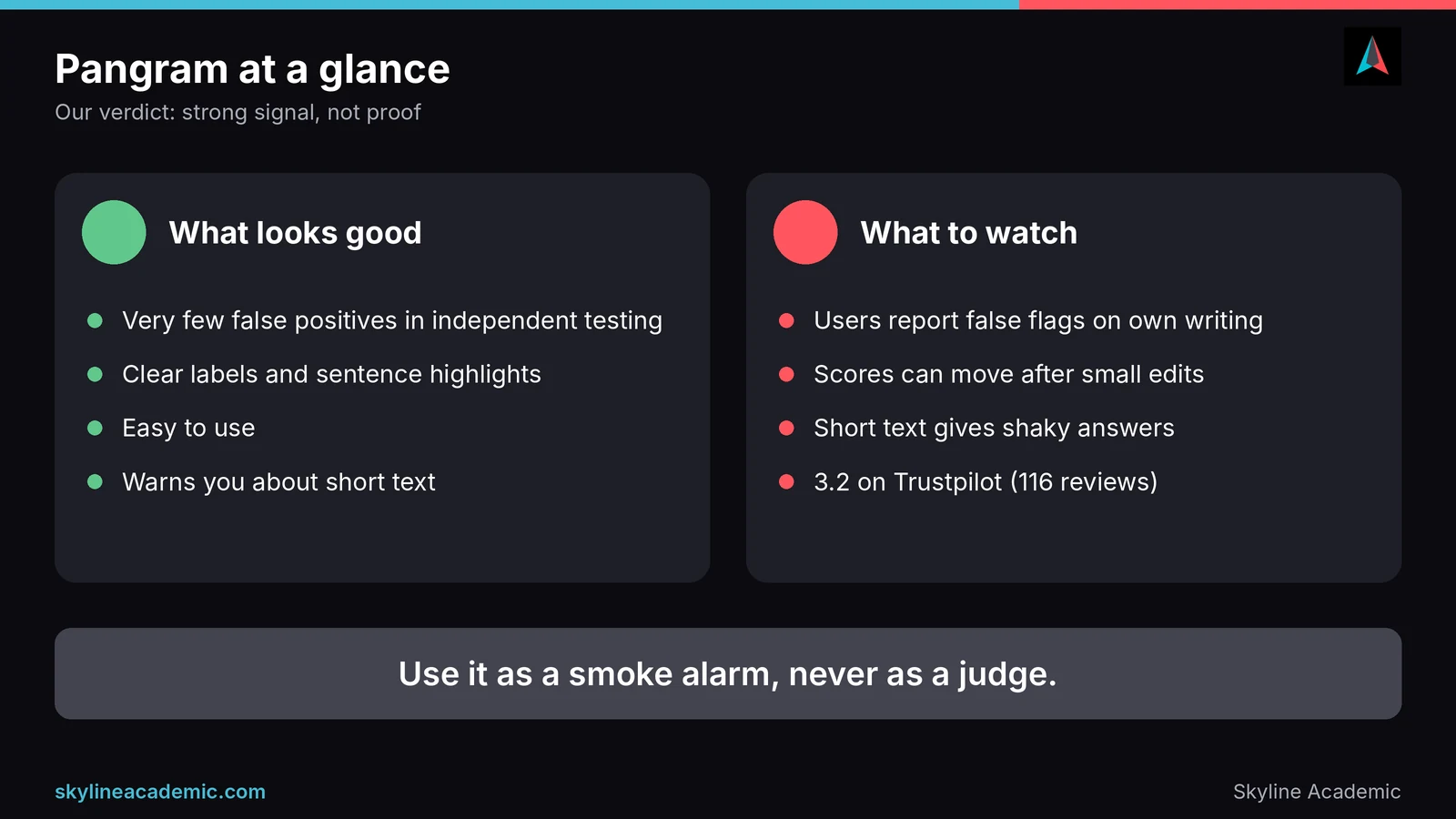
Here is the short answer. In independent testing, Pangram has looked like one of the stronger AI detectors, with very few false alarms on medium and long text. But real users still report their own writing being flagged, scores that change after small edits, and Pangram itself warns that it is less accurate on short text. So Pangram is a useful signal, not proof. Treat it as a smoke alarm, never as a judge.
What Pangram AI detector is and how it works
Pangram is an AI text detector. You paste in your writing, and it estimates how much of it was written by an AI model such as ChatGPT, Claude or Gemini. It then shows a label, a percentage and sentence highlights, so you can see which parts looked suspicious. Users also mention a browser extension, an image checker and a Google Docs feature that lets you look at typing history.
Like most detectors, Pangram does not read your mind or check your drafts. It looks at patterns in the words and sentences and guesses how likely they are to come from a machine. That guess can be very good on long, ordinary writing. It gets shakier when the text is short, very structured, creative or written by someone using simple, careful English. That is why honest students sometimes get flagged.
How to read Pangram’s results
Pangram’s results screen is simple once you know what to look for.
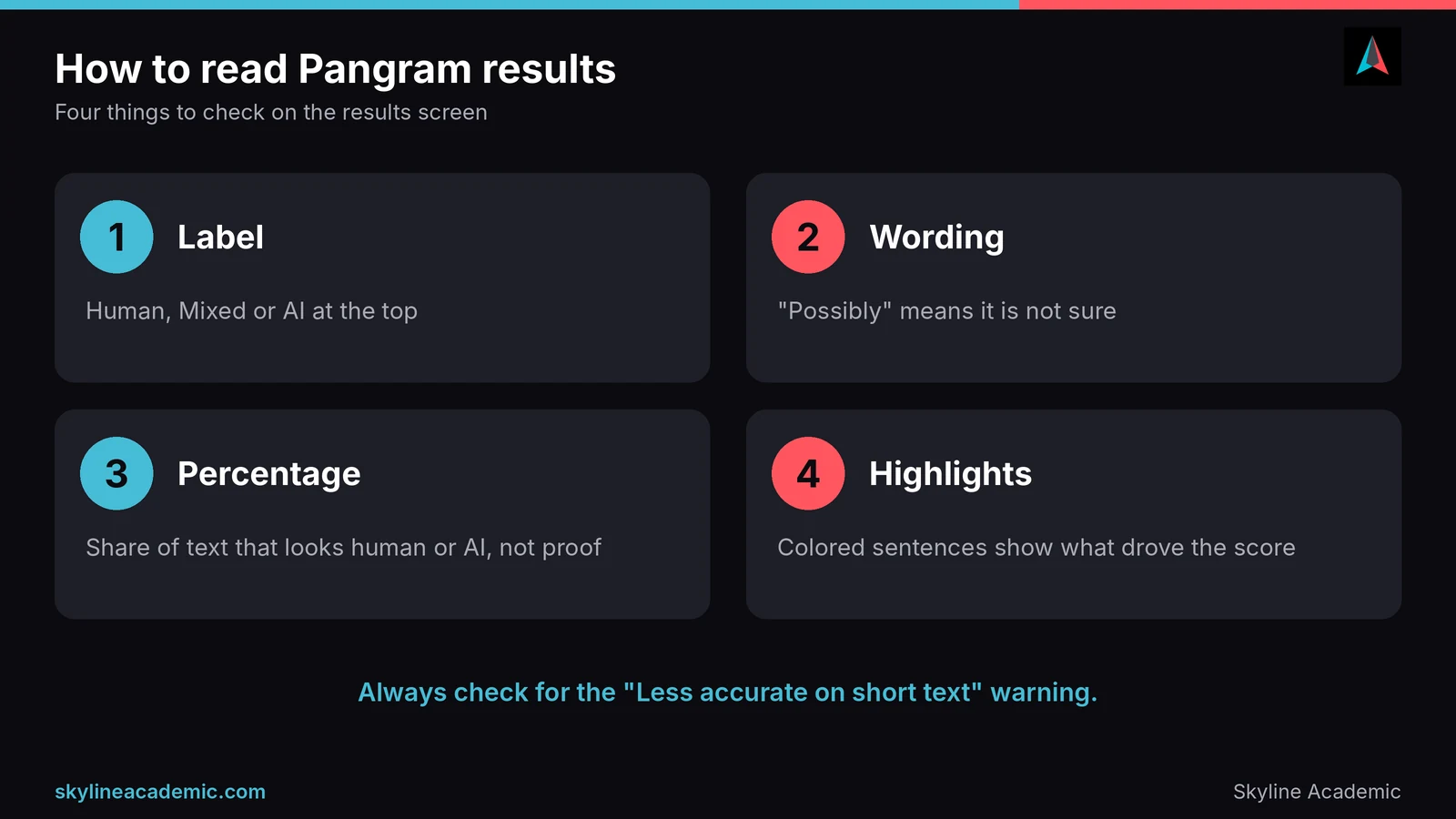
- The label. You will see Human, Mixed or AI at the top. Mixed means some parts looked human and some did not.
- The wording. On short texts, Pangram uses cautious wording such as “Possibly human” or “Possibly AI”. That is a signal that it is not sure.
- The percentage. The circle shows how much of the text looked human or AI. A result like 40% AI means the tool thinks part of the text looks machine written, not that 40% was proven to be.
- The highlights. Sentences are colored so you can see which parts drove the result. This is the most useful part for editing.
- The short text warning. In our tests, Pangram displayed “Less accurate on short text”. Take that message seriously.
How to get a more useful result
A few habits make any Pangram result easier to trust. Scan the whole document in one go, because whole-text scans give the tool more to work with than small chunks. Check the word count shown next to the title, and be careful with anything that says “Short text”. Look at the highlighted sentences before you look at the percentage, because the highlights show you where the tool is reacting. And run the scan on a finished draft, not a half-edited one, since small edits can move the score.
If a result surprises you, do not argue with it or panic. Scan the same text again later, try a second detector and compare. When two tools disagree, that is a sign the text sits in a gray area, and it is a good moment to review your own draft for flat, generic sentences.
Pangram features, free credits and pricing
According to reviewers, Pangram has a free plan with a small number of credits each day, and paid plans for individuals, teams and developers. One credit is reported to cover about 1,000 words, so a long essay uses several credits. Reviewers report that the Individual plan costs about $20 a month and includes a 7 day trial, but Pangram’s own pricing page could not be opened for this article, so check the live page before you pay.
Our own screenshots show a credit counter in the app, which dropped by one or two credits after each short test. That is a good reminder to scan the full piece of writing once, instead of testing small chunks again and again.
Is Pangram AI detector accurate? What the evidence shows
What Pangram claims
Pangram says its false positive rate is extremely low, about one in 10,000 according to coverage of its claims. A false positive means a human text wrongly labeled as AI. These are the company’s own figures, so we treat them as claims. The most useful checks come from people outside the company.
What independent studies found
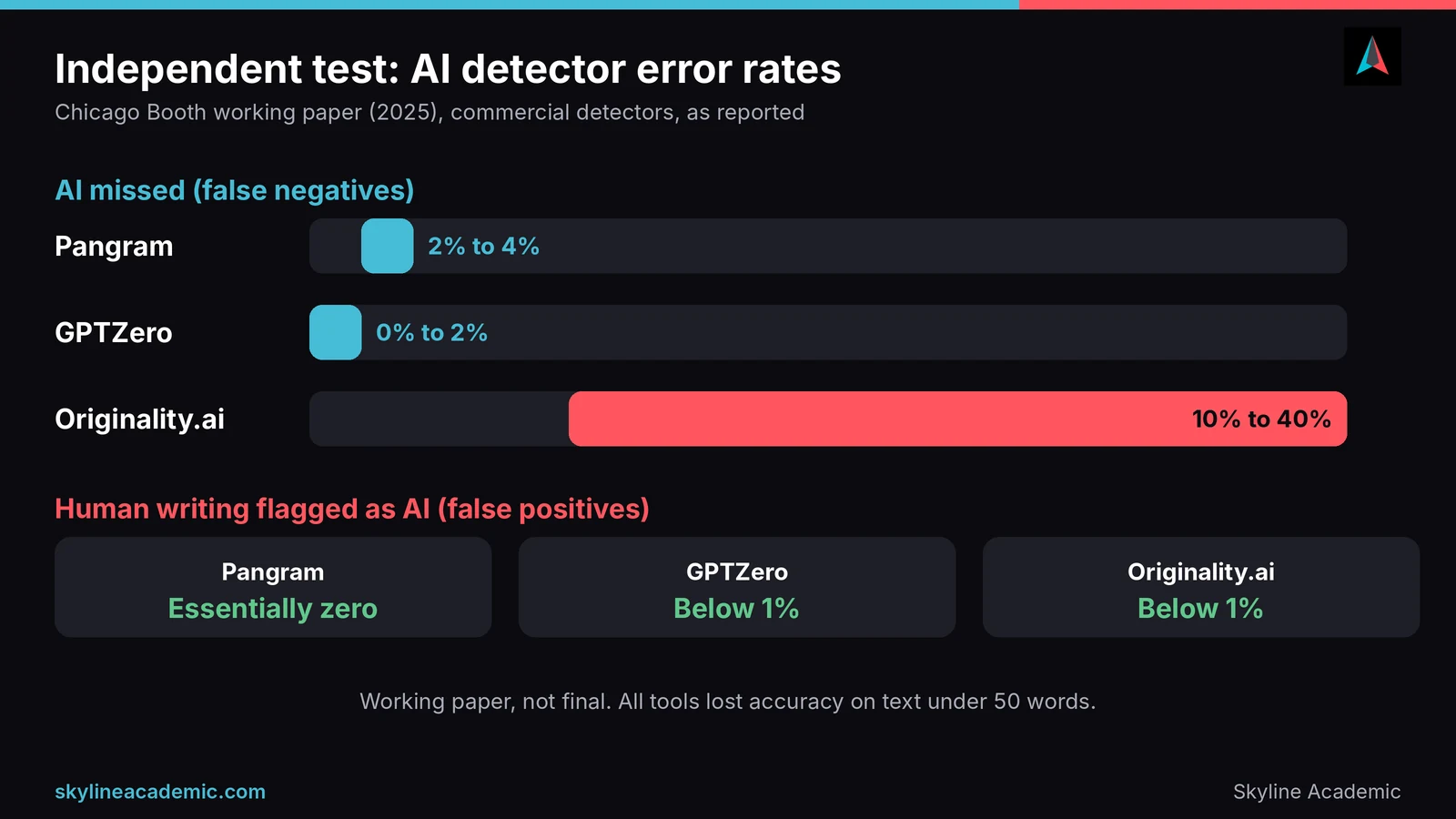
The strongest independent evidence is a 2025 working paper by Brian Jabarian and Alex Imas at Chicago Booth. They tested about 2,000 human passages, from blogs and reviews to news articles, novels and résumés, along with matching AI versions from four large language models. Here is what they reported for the commercial detectors.
| Detector | False positives (human flagged as AI) | False negatives (AI missed) |
|---|---|---|
| Pangram | Essentially zero at most settings | About 2% to 4% |
| GPTZero | Below 1% | About 0% to 2% |
| Originality.ai | Below 1% | About 10% to 40%, depending on the model |
Three points matter for students. First, Pangram had the lowest false alarm rate in this test, which is exactly what matters if you are worried about being wrongly accused. Second, all the tools lost accuracy on very short passages of under 50 words. Third, the authors say every detector is at least slightly imperfect, and it is still a working paper, not a final verdict. GPTZero has also disputed how its results were handled, so the ranking is not settled.
It is also worth knowing what Pangram is built to do. One independent reviewer who tested it for three weeks said its main weakness is not accusing humans, but sometimes letting AI-assisted text pass as human. In other words, a “human” result mostly means the text fell below the tool’s threshold. It does not prove nobody used AI.
Our mini test
We ran three short texts through the Pangram app on 27 October 2026. The first, a 78 word paragraph about life being uncertain, came back as “Possibly human”, with 100% of the text rated possibly human. The second, a 91 word paragraph about the things people value in life, came back as Mixed, with 40% AI and 60% human, and the sentences were highlighted in two colors. The third, a 98 word paragraph about spending free time at home, came back as “Possibly AI”, with 100% rated possibly AI.
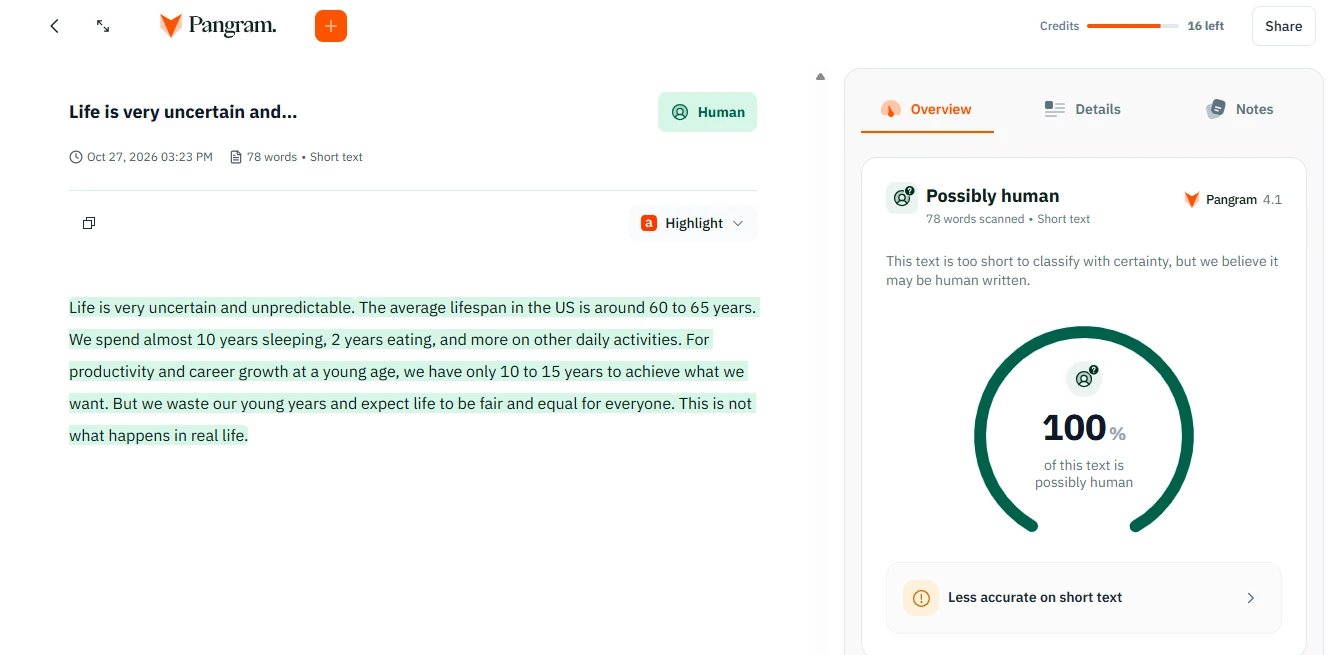
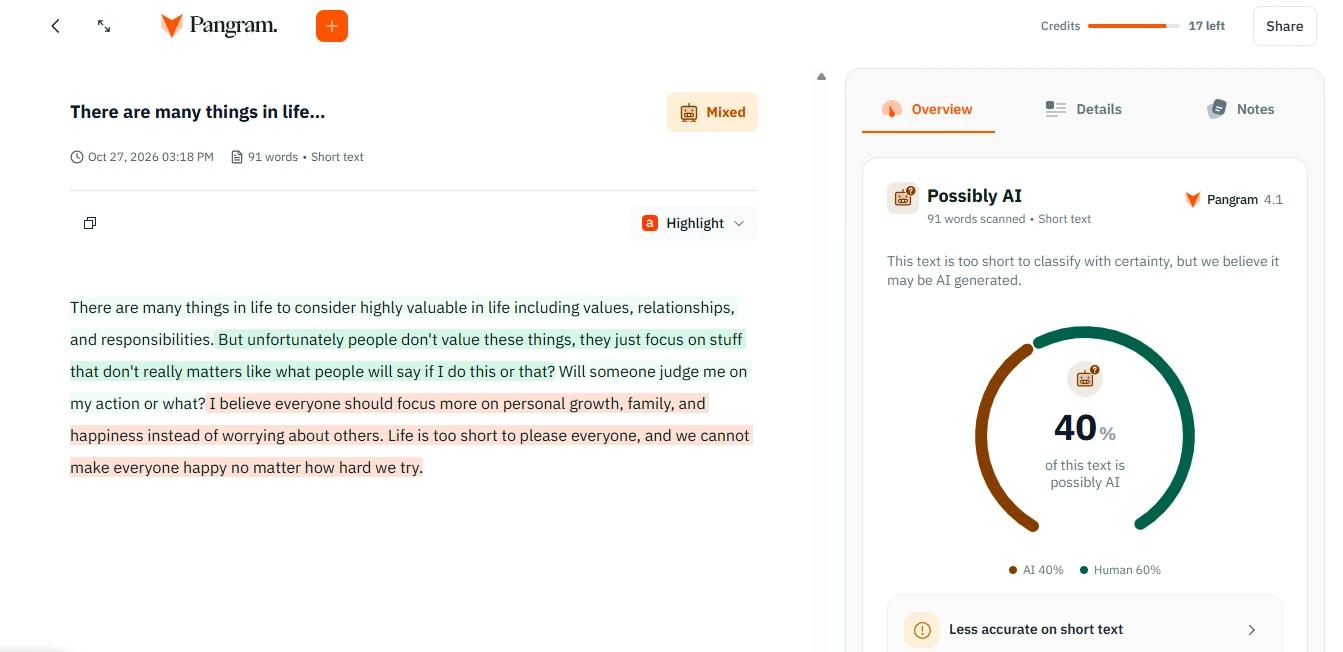
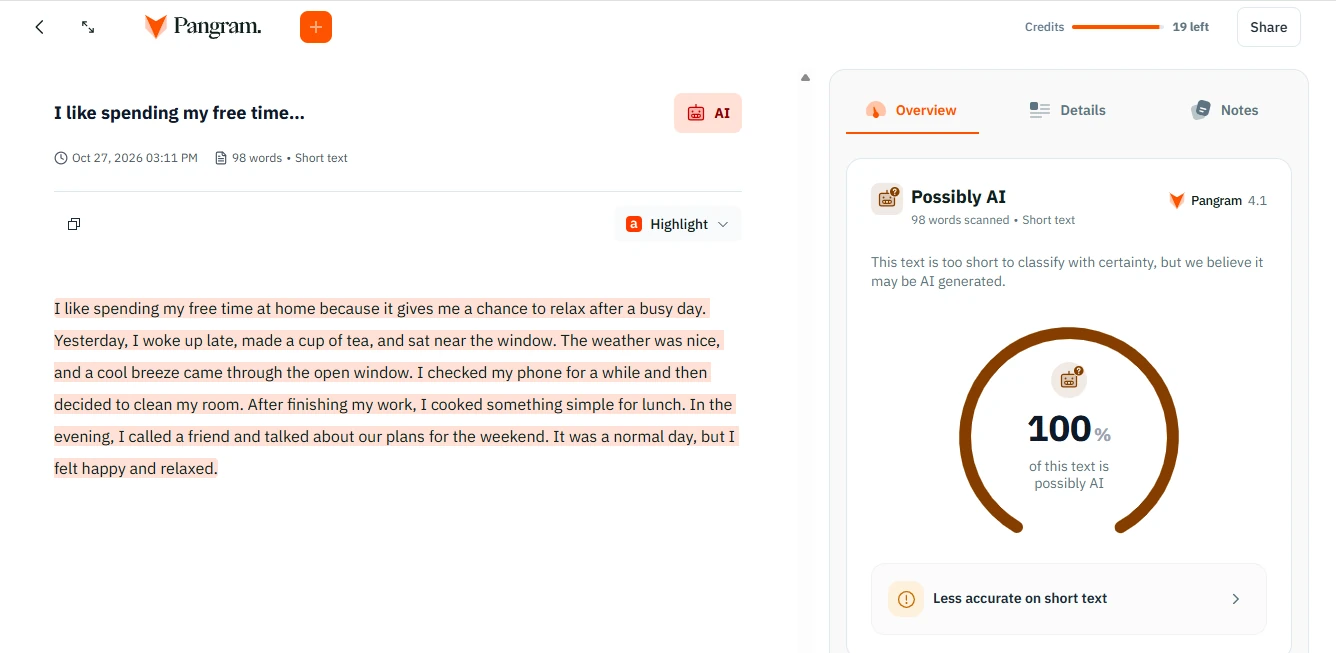
Please read this the right way. Three samples is not a study. All three texts were under 100 words, and Pangram itself showed the message that the text was “too short to classify with certainty”. We are describing what the tool returned, and we are not claiming any of these results was right or wrong. The point is that short texts can give very different answers from the same tool, so one short check should never decide anything important.
What Trustpilot reviewers say
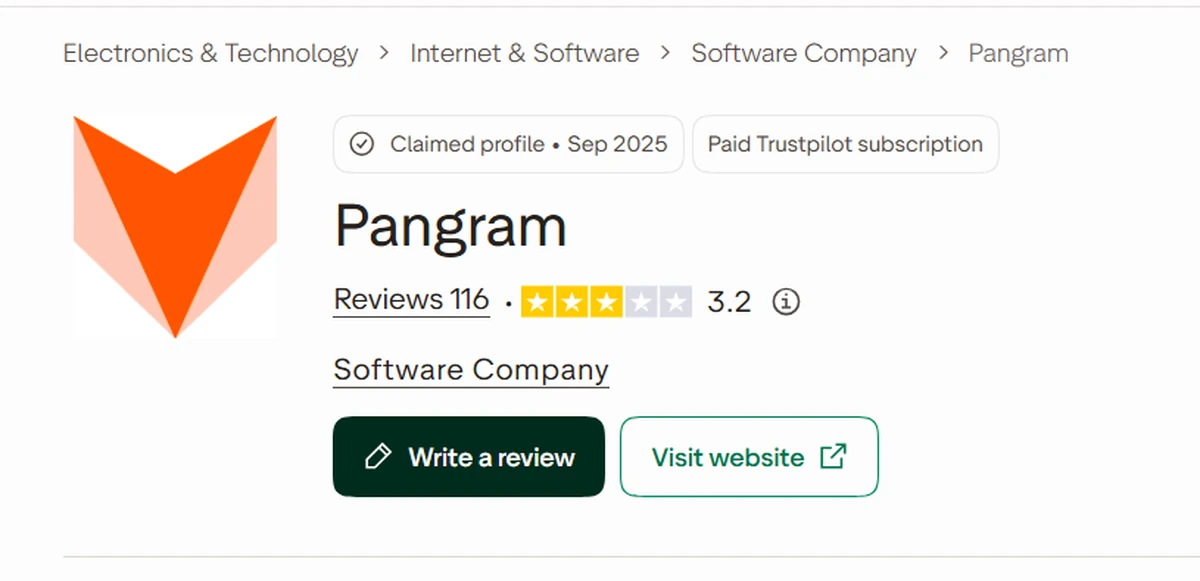
Pangram holds a 3.2 rating from 116 reviews on Trustpilot. That is lower than the glowing independent test numbers, and the gap is worth understanding.
The reviews split into two clear groups.
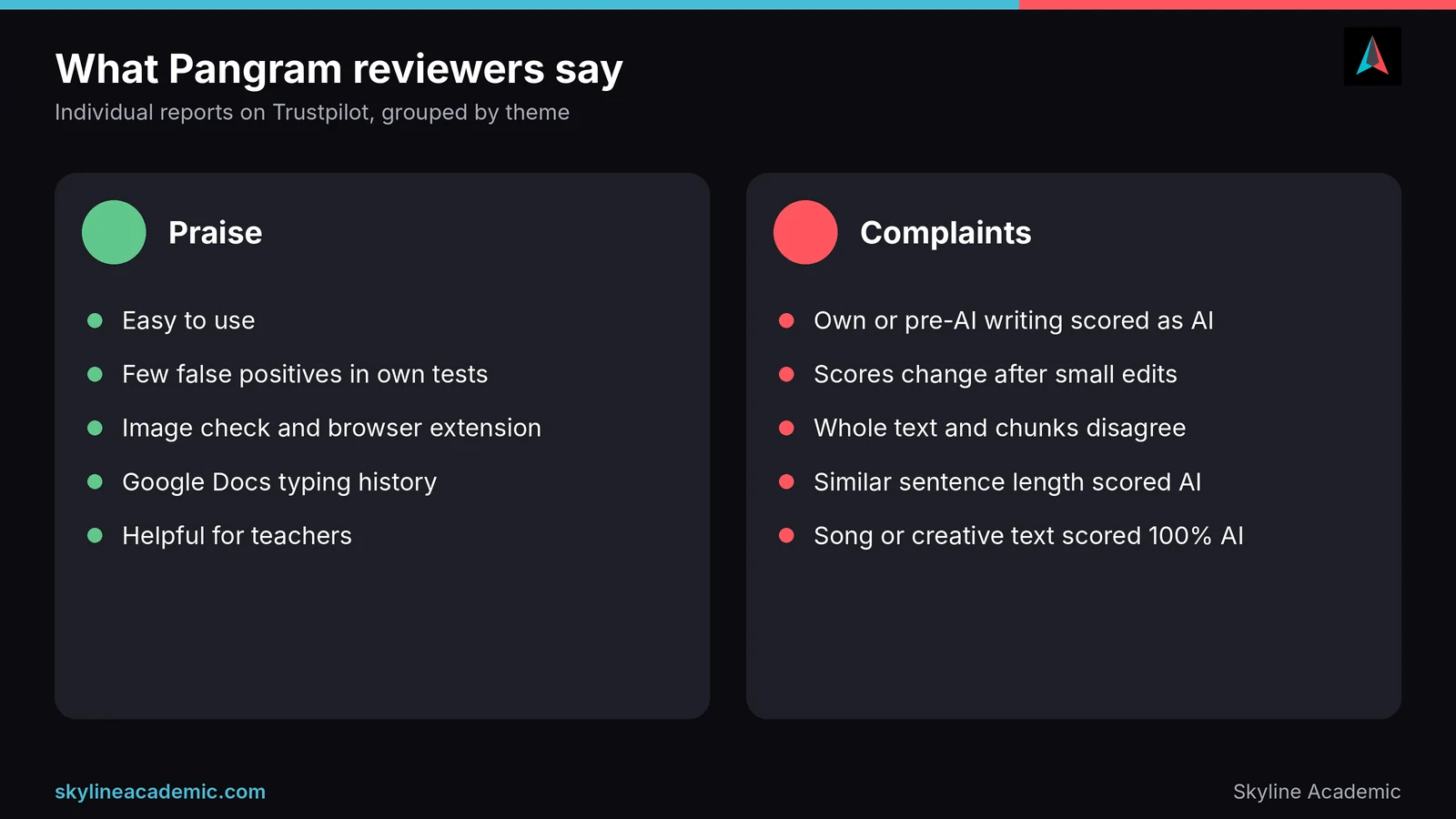
| What users praise | What users complain about |
|---|---|
| Easy to use | Their own old or pre-AI writing scored as AI |
| Few false positives in their own testing | Scores that change after small edits |
| Image detection and a useful browser extension | Whole documents scoring differently from their chunks |
| Google Docs typing history check | Similar sentence lengths or limited vocabulary scored as AI |
| Helpful for teachers and writers | Creative writing, such as a song, scored 100% AI |
Several negative reviewers describe the same story. They wrote something themselves, sometimes years before AI tools existed, and Pangram still rated it as AI. One professional writer said a sample scored 73% AI because her sentences were a similar length and her vocabulary was limited. Another reviewer said changing a few words flipped the same piece from AI to human and back again. A third said that scanning small chunks gave “human” but scanning the whole piece gave a percentage of AI.
One more fair point: the praise is more mixed than the star score suggests. One positive reviewer said the tool only gets it wrong when text has lots of noun phrases or short, terse sentences, and added that this is typical of AI but also of many human writers.
How to read the “Invited” tag
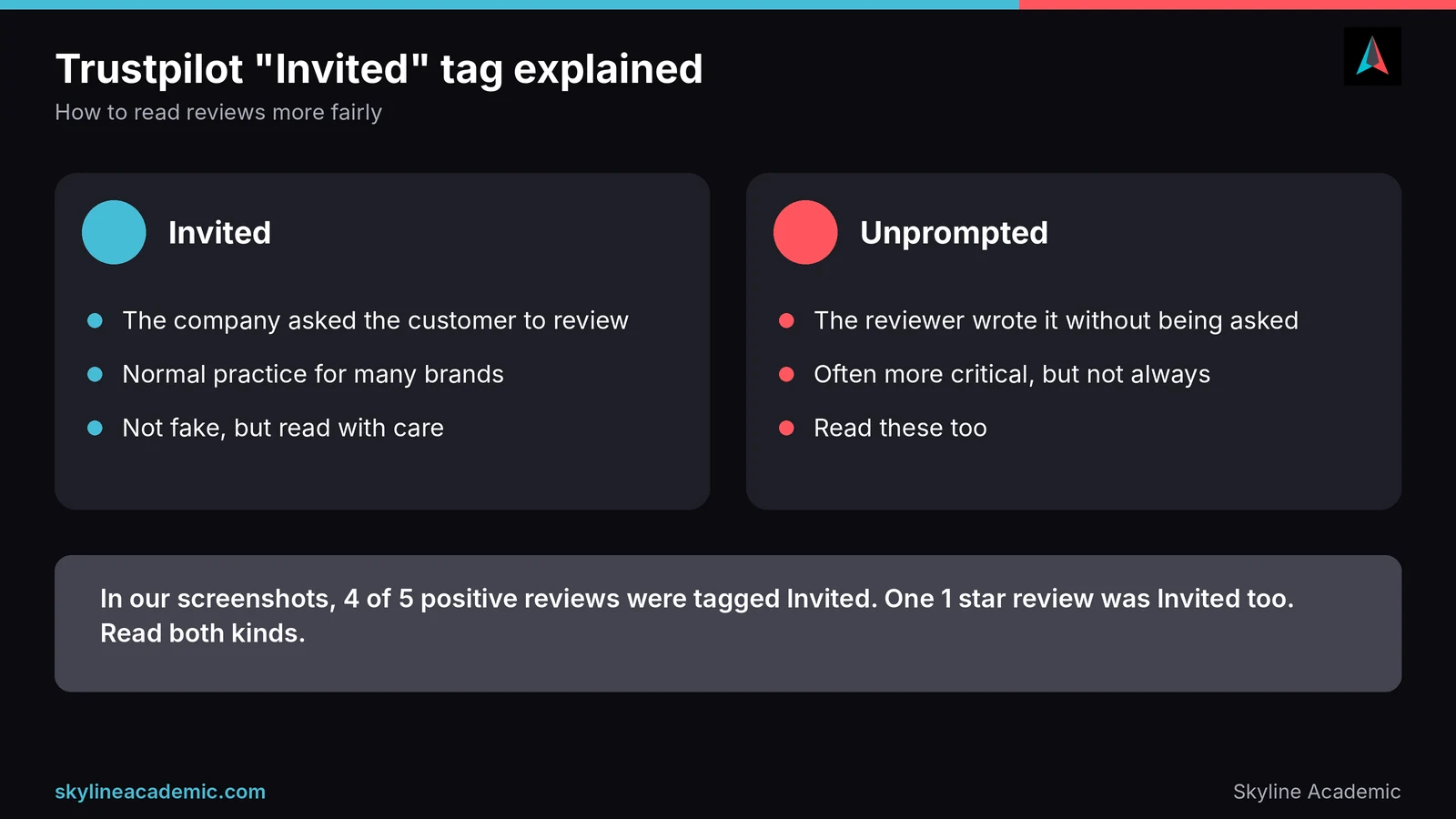
When you read the positive reviews, you may notice a small tag that says “Invited”. On Trustpilot, this means the company asked the customer to leave a review. An “Unprompted” tag means the person wrote it on their own. Four of the five positive reviews in our screenshots were tagged “Invited”, while the negative reviews we saw were mostly unprompted. This does not mean the invited reviews are false. Invited reviews are normal for many companies, and one of the 1 star reviews we saw was also invited. It simply means you should read both kinds, and not rely on the star average alone.
Why Pangram or any detector can misjudge honest writing
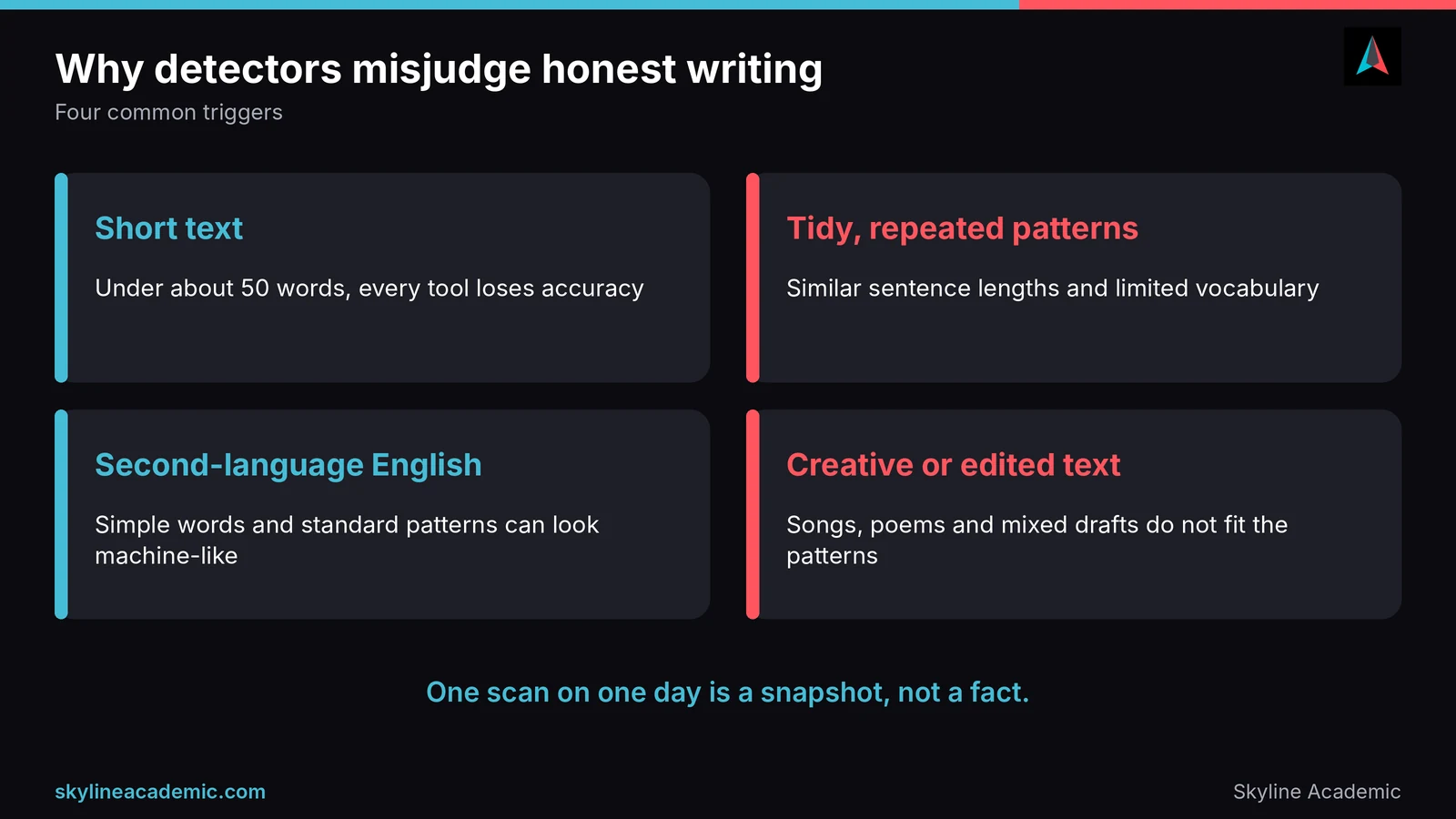
Short texts give shaky answers
A paragraph gives a detector very little to study. Pangram’s own screen warns that short text is less accurate, and the Chicago Booth study found that every tool lost accuracy below about 50 words. If you only scan a few sentences, treat the result as a rough hint.
Structured or repetitive writing can look machine-like
Clear, tidy writing is what most teachers ask for, yet it can look predictable to a detector. Reviewers say text with similar sentence lengths, limited vocabulary or lots of noun phrases was flagged. If your essay follows a strict template, such as a lab report or a cover letter, expect more false alarms. For a deeper look at why this happens, read our guide on AI detection false positives.
Non-native English writers face extra risk
If English is your second language, you may use simpler words and more standard sentence patterns. A well-known Stanford study found that older detectors labeled 61.22% of essays by non-native writers as AI generated. Pangram was not part of that study, and newer tools may do better, but the risk is a good reason to keep proof of your work. Our guide on AI detection for non-native English students explains what to do about it.
Creative text and edited text confuse detectors
Songs, poems and heavily edited drafts do not follow the patterns detectors were built on. Text that is part human and part AI is also harder to judge, which is why Pangram has a Mixed label. A small edit can change the score, so a single scan on a single day is a snapshot, not a fact.
Pangram vs Turnitin, GPTZero and Originality
Students often ask which detector is the most accurate. The honest answer is that it depends on the test, the text length and the settings, and no single study settles it. In the Chicago Booth paper, Pangram had the lowest false positive rate among the commercial tools tested, GPTZero was close behind, and Originality.ai missed more AI text. Turnitin was not part of that study, and its numbers mostly come from the company itself.
If you want to compare tools, read our reviews of GPTZero accuracy and Originality.ai accuracy. The same lesson comes up each time: strong marketing numbers, useful tools, and real users who still get flagged. Your university also decides which detector it uses, so a good Pangram score does not guarantee the same result elsewhere.
Our overall verdict
Putting the evidence together, our honest view is simple. Pangram looks strong on false positives in independent testing, it has a clear and readable results screen, and its sentence highlights are genuinely helpful. On the other side, its Trustpilot rating is average at 3.2, a number of reviewers describe false flags on their own writing, and our three short tests gave three very different answers. Both pictures can be true at once. A tool can be very accurate across thousands of test passages and still make a painful mistake on your one essay.
That is why we call it a useful signal and not proof. If you are a student, use it to improve your draft and keep your evidence. If you are a teacher, use it to start a conversation and never to end one.
Who should and should not use Pangram
Pangram is a reasonable choice if you want a quick self-check on a long piece of writing, if you like sentence highlights to find flat or repetitive passages, or if you are a teacher or editor who wants a second opinion before talking to a student or writer. It is also useful as a reminder to keep your own drafts and notes.
It is a poor choice if you plan to use a score as proof in a dispute, if you are only checking a short paragraph, or if you think a “human” result clears you of any rule. No detector can promise that, and Pangram’s own warnings say so.
What to do if Pangram flags your own writing
A bad score can feel like an accusation. Here is a calm way to handle it.
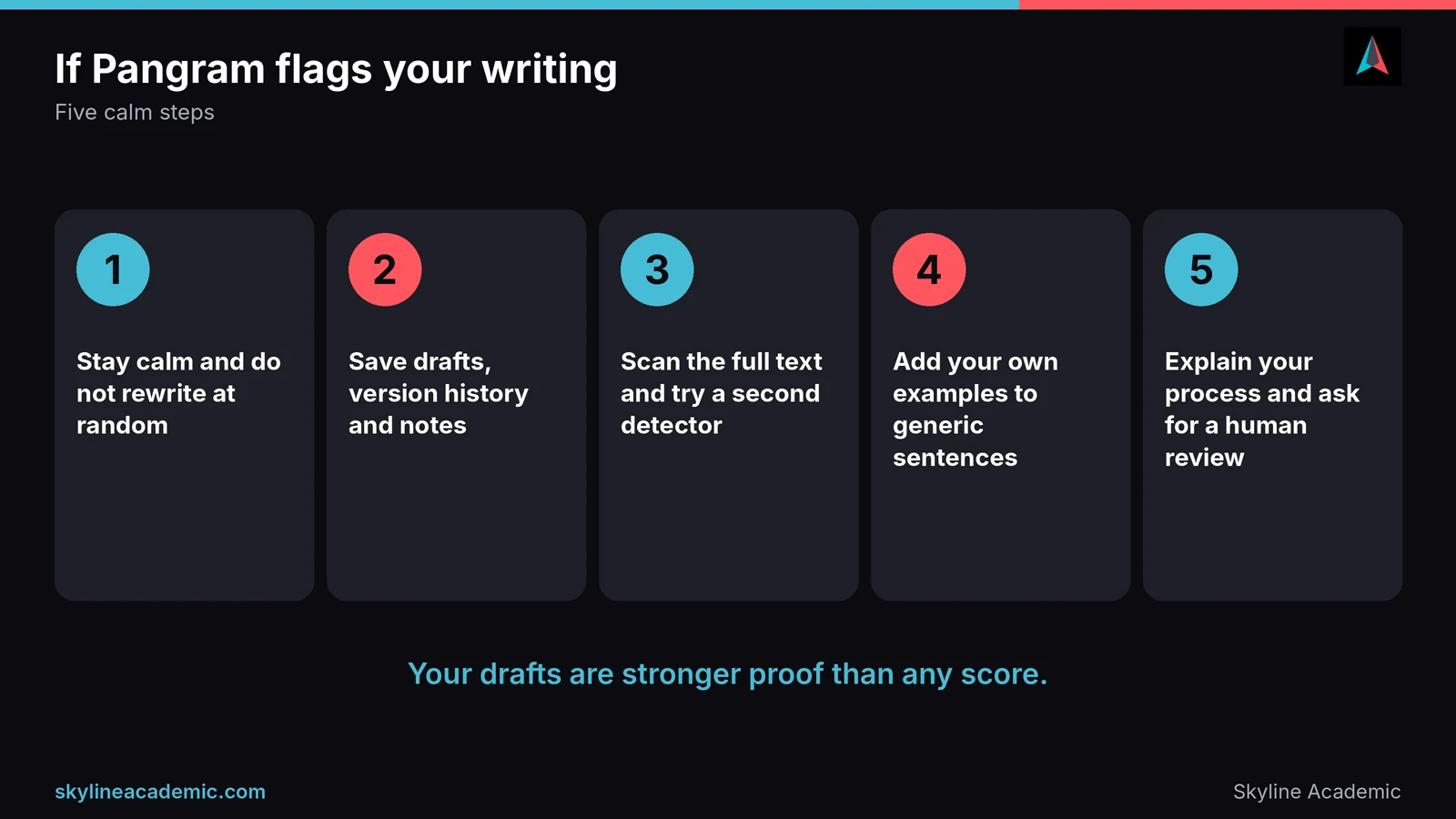
- Do not panic, and do not rewrite everything at random to chase a better score. That often makes the writing worse.
- Save your evidence: drafts, version history, notes, outlines and the sources you used.
- Scan the full text, not just a short section, and try another detector to see whether they agree.
- Read the highlighted sentences out loud. If they sound generic, add your own examples, details and opinions.
- If your lecturer raises concerns, explain your writing process calmly and ask for a human review. Our guide on being falsely accused of using AI shows how to respond step by step.
Still confused and need help?
If you are unsure whether your work will pass, you do not have to guess. Skyline Academic is one of the leading 1:1 live tutoring platforms, with a dedicated learning management system that includes progress tracking, assignment quizzes, workshops and bootcamps. Alongside tutoring, we offer a plagiarism checker and an AI content detector so you can scan your own draft before you submit it, and a live tutor can help you strengthen your own voice and show how you built your work. Book a session when you are ready.
Frequently asked questions
Is Pangram AI detector accurate?
In independent testing, Pangram showed very few false positives on medium and long text. But users report false flags, and the tool warns it is less accurate on short text, so treat results as a signal, not proof.
Is Pangram AI detector accurate on short text?
Not as accurate. Pangram displays a “less accurate on short text” warning, and the Chicago Booth study found all detectors lost accuracy below about 50 words.
Can Pangram flag human writing as AI?
Yes, it can. Several Trustpilot reviewers say their own writing, including old pre-AI work, was scored as AI. Independent tests found false positives to be rare, but not impossible.
Is Pangram AI detector free?
Reviewers report a small free daily credit allowance, with paid plans starting at about $20 a month. Check Pangram’s live pricing page before you pay.
Does Pangram detect humanized or AI-edited text?
Sometimes. Independent reviewers say text edited heavily by AI or by humanizer tools is harder to catch, so a human result does not prove no AI was used.
How does Pangram compare with Turnitin and GPTZero?
In one Chicago Booth study, Pangram had the lowest false positive rate among Pangram, GPTZero and Originality.ai. Turnitin was not tested there, so there is no fair head-to-head.
What does the Mixed label mean in Pangram?
Mixed means the tool thinks part of the text looks human and part looks AI. It is a hint to review the highlighted sentences, not proof of cheating.
Is Pangram safe for students to use?
Yes, as a self-check on your own draft. Do not use it to hide AI-written work, and always follow your course’s AI policy.
What should I do if Pangram says my essay is AI?
Keep your drafts and notes, scan the full text, try another detector and ask for a human review if needed. Do not rewrite blindly to chase a score.
Is Pangram AI detector reliable enough to use as proof?
No. Even the study authors say every detector is imperfect. A score is one piece of evidence, and your drafts and sources count for more.
Conclusion
Pangram looks like one of the stronger AI detectors in independent testing, especially for avoiding false accusations on longer text. But it is not perfect. Users report false flags, scores that move after small edits and shaky results on short writing, and Pangram itself warns about short text. Use it as a rough check, keep your drafts as proof of your work, and never let one number decide your grade. If you want a tutor to help you write with confidence and show your process, Skyline Academic is here to help.
Sources
- Do AI Detectors Work Well Enough to Trust? Chicago Booth Review
- AI-Detectors Biased Against Non-Native English Writers, Stanford HAI
- Pangram reviews on Trustpilot
- Pangram: third-party evaluations (published by Pangram)
- Pangram Review 2026, Detection Drama
- Pangram Review 2026, Hack’celeration (affiliate links disclosed)
- AI Detector False Positive Rates Compared, GradPilot (publisher sells detection tools)