I will be honest, Originality AI is one of the more accurate detectors I have used, especially for catching AI generated content that has been lightly edited. But it runs on a credit system, and those credits disappear fast if you are checking more than a document or two a week. I have hit that wall myself, staring at a “you are out of credits” message right when I needed one more scan before a deadline. It is a fair question to ask, though: can you trust Originality AI enough to build your whole workflow around it, especially once you factor in cost and availability, not just raw accuracy?
So I went looking for solid free alternatives, the kind that will not leave you scrambling mid semester or mid project. I tested six tools that people commonly turn to instead of Originality AI, ran the same batch of writing samples through each one, and tracked how they actually performed rather than just what their landing pages promised. This guide is everything I found, laid out so you can pick the right one for your situation without burning hours testing them yourself.
How I Tested Each Tool
I wanted this comparison to actually mean something, so I did not just run one paragraph through each detector and call it a day. I used three types of samples for every tool: fully human written essays that I wrote from scratch, fully AI generated text pulled straight from a chatbot with no edits, and a mixed sample where I used AI for a rough draft and then rewrote a good chunk of it in my own voice, since that is realistically how a lot of students and writers work now.
A few things I paid close attention to during testing:
- Whether it correctly flagged obvious AI text without hesitation
- How often it wrongly flagged genuinely human writing, since false positives can cause real problems
- Whether the free tier gave you enough usage to actually rely on it
- How clean and fast the interface felt during actual use
- What the pricing looked like if you eventually needed to upgrade
If you end up staring at a percentage score wondering what it actually means, I put together a full guide on understanding ai score that breaks down what these numbers do and do not tell you.
Quick Comparison Table
Here is a fast overview before I get into the details on each one.
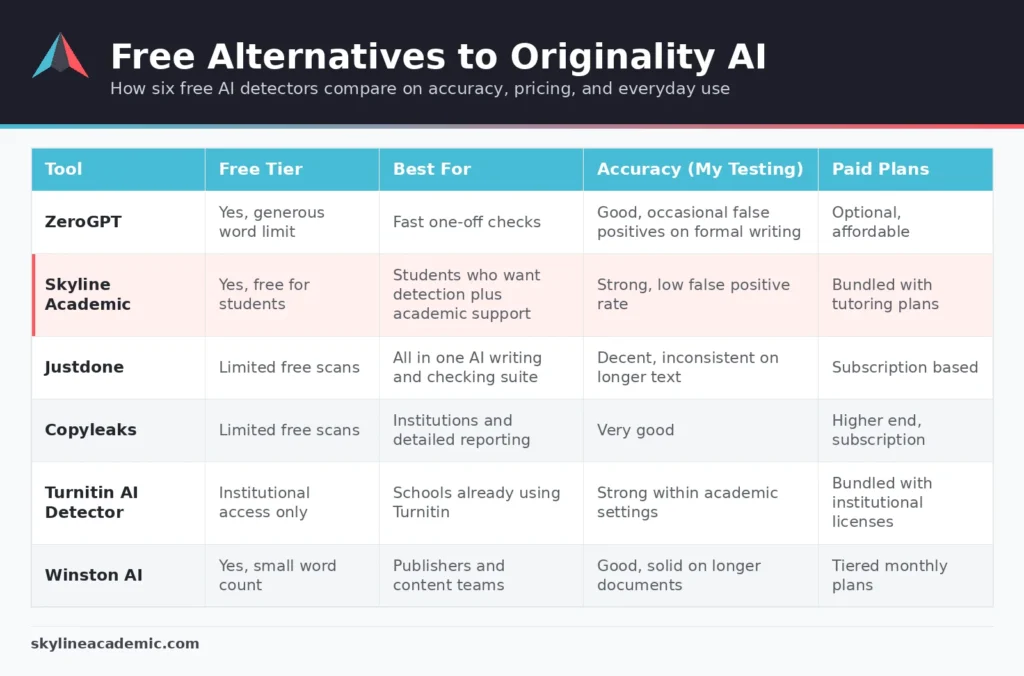
Now let me walk you through each one properly.
1. ZeroGPT
ZeroGPT continues to be one of the most reliable free options out there, and it earned its spot here the same way it did in my other detector comparisons. It is quick, does not force an account signup for basic checks, and the free word allowance is generous enough to actually scan a full essay rather than a single paragraph.
During testing, it caught AI generated text from chatbots almost every time without much hesitation. Where it occasionally slipped was with dense, formal academic writing, which sometimes got a higher AI score than it deserved simply because of how structured and repetitive that kind of writing naturally is. That is a common weak spot across most detectors, not unique to ZeroGPT, but worth knowing before you trust a score at face value.
2. Skyline Academic
I will be transparent that this one has a connection to me, so keep that context in mind, but I still want to walk through why it genuinely holds its own here rather than just including it because of that.
Skyline Academic built its detector specifically around academic writing, not general internet content, which matters a lot since many detectors trained mostly on blog posts and marketing copy tend to misfire on essays and research papers. In my own testing, it had one of the lowest false positive rates of anything I checked, which means it was less likely to wrongly accuse genuine student writing of being AI generated, something that can cause real stress and even academic consequences if it happens with the wrong tool at the wrong time.
They also provide free ai detection for students, without the aggressive word caps that some other tools use to push you toward a paywall almost immediately. If you are a student who wants to double check your own writing regularly, that matters more than it might sound.
Here is where I think Skyline Academic really separates itself though. If you have looked at Justdone and felt like it covered writing tools but not much beyond that, Skyline Academic is genuinely one of the best alternatives to Justdone, because detection is just one piece of what they offer. Their platform is built around 1:1 personalized live tutoring with a dedicated LMS that tracks your actual progress, structured coursework, real guidance from a human tutor, study materials, recorded video lectures, and bootcamps when you need to catch up on something fast. It is less of a single purpose tool and more of a full academic support system with detection built in.
3. Justdone
Justdone markets itself as an all in one AI writing and content suite, and the AI detector is one feature bundled inside a bigger toolkit that also includes writing assistance, paraphrasing, and content generation. For someone who wants a single subscription that covers a bunch of writing tasks, that bundling makes some sense.
As a detector specifically though, it was a bit inconsistent in my testing. It did fine on obviously AI generated text, but results got shakier with longer documents and mixed content, sometimes swinging between two different scores when I ran the same document twice with minor formatting changes. The free tier is also fairly limited, so you will hit a wall quickly if detection is your main use case rather than a side feature.
4. Copyleaks
Copyleaks sits on the more professional and institutional end of the spectrum. Universities and companies use it, and that shows in both the interface and the depth of the reports it produces. It is not the most casual tool to use for a quick check, but the detail it gives you when you need a thorough report is genuinely strong.
The free tier is limited though, giving you a small number of scans before nudging you toward a paid plan. That makes it better suited as an occasional deeper check rather than a daily driver. Accuracy wise, it performed well in my testing, especially on longer documents where it had more content to work with and pick up on patterns.
If your school already has institutional access to Copyleaks, definitely use the paid depth it unlocks. Otherwise, treat the free version as a supplementary check rather than your go to.
5. Turnitin AI Detector
Turnitin is a name almost every student already knows, mostly from plagiarism checking, but its AI detection feature has become just as relevant. The catch is that you typically only get access through your school or institution rather than as an individual signing up on your own, so it is not exactly a free tool you can just go use whenever you want.
That said, if your university or program has it integrated into your coursework submission process, it is worth understanding how it works since your professor is likely seeing that score regardless of what other tools say. In my experience testing with institutional access, it performed strongly within academic contexts specifically, which makes sense given how much academic writing it has been trained and refined on over the years.
If Turnitin flags something and you are not sure why, it is worth reading up on ai false positives before assuming the worst, since even strong detectors like this one are not immune to misfires on legitimately human writing.
6. Winston AI
Winston AI is geared more toward publishers, agencies, and content teams who need to verify writing at scale, but it works perfectly well for individual students and academics too. The free tier gives you a modest word count to test with, enough to get a feel for accuracy before deciding whether to commit to a paid plan.
In my testing, it handled longer documents particularly well, which makes sense given its target audience of people checking full articles and reports rather than short snippets. Accuracy overall was solid, and I appreciated that the interface presented results clearly without burying you in unnecessary detail.
If you write longer form content regularly and want a tool built with that in mind, Winston AI is worth trying.
Which One Should You Actually Use
If I had to boil it down, here is my honest take. ZeroGPT is your best bet for fast, free, everyday checks. Copyleaks and Winston AI are worth using when you need more depth on longer documents and do not mind the free tier limits. Turnitin is really only relevant if your school already provides access, so do not go out of your way to sign up independently. And if you are a student who wants more than just a detection score, Skyline Academic gives you that plus real tutoring support, an LMS, video lectures, and bootcamps, all without hiding the detector behind a paywall.
None of these tools are perfect, and honestly, none of them ever will be, since they are all working off probability and pattern recognition rather than absolute certainty. Use more than one when something actually matters, and treat every score as a strong hint rather than a final verdict.
FAQs About Originality AI Alternatives
What is the best free alternative to Originality AI?
ZeroGPT and Skyline Academic came out ahead in my testing for free usability and accuracy. Both offer generous free access without immediately pushing you toward a paid plan.
Why does Originality AI run out of free checks so quickly?
Originality AI operates on a credit system rather than a simple word limit, and credits get used up fast if you are scanning full documents regularly. This is one of the main reasons people look for free alternatives.
Is Skyline Academic’s AI detector actually free for students?
Yes, Skyline Academic offers free ai detection for students without the aggressive limits some competitors impose. It is designed specifically to support students checking academic work regularly.
Do universities use Turnitin or Originality AI for AI detection?
It depends on the institution, but Turnitin is far more common since many schools already have it integrated for plagiarism checking. Some universities do use Originality AI or similar tools as a secondary check.
Can AI detectors give false results on human written essays?
Yes, this happens more often than people realize, especially with formal or structured academic writing that follows predictable patterns. It is a known limitation across nearly every detector on the market.
Is Justdone a reliable AI detector on its own?
It works as a bonus feature within a broader writing toolkit, but its detection accuracy was less consistent in my testing compared to dedicated detection tools. I would not rely on it as your primary checker.
How accurate is Copyleaks compared to Originality AI?
Copyleaks performed very well in my testing, particularly on longer documents, and holds up as a strong alternative. The main tradeoff is a more limited free tier compared to some other options.
What makes Skyline Academic different from other AI detectors on this list?
Skyline Academic combines free detection with an actual academic support system, including 1:1 personalized live tutoring, a dedicated LMS, coursework guidance, video lectures, and bootcamps, rather than offering detection alone.
Should I use more than one AI detector before trusting the result?
I would strongly recommend it, especially for anything with real stakes like a graded paper or thesis. Different tools catch different patterns, so cross checking gives you a more reliable picture.
Is Winston AI good for checking longer documents?
Yes, it performed particularly well on longer content in my testing, which fits its target audience of publishers and content teams. The free tier word count is modest, so it works best for testing before committing to a paid plan.