
Authorship plagiarism is one of those academic integrity issues that feels “obvious” until you’re under pressure, short on time, and someone offers a shortcut. With essay mills, paid “helpers,” and even classmates willing to “fix” your assignment, it’s easier than ever to submit work that isn’t truly yours. The problem is that universities treat authorship plagiarism as a serious form of misconduct because it breaks the core rule of assessment: your grade must reflect your learning.
If you’re not sure whether something counts as authorship plagiarism, start by checking your work for originality and proper attribution.
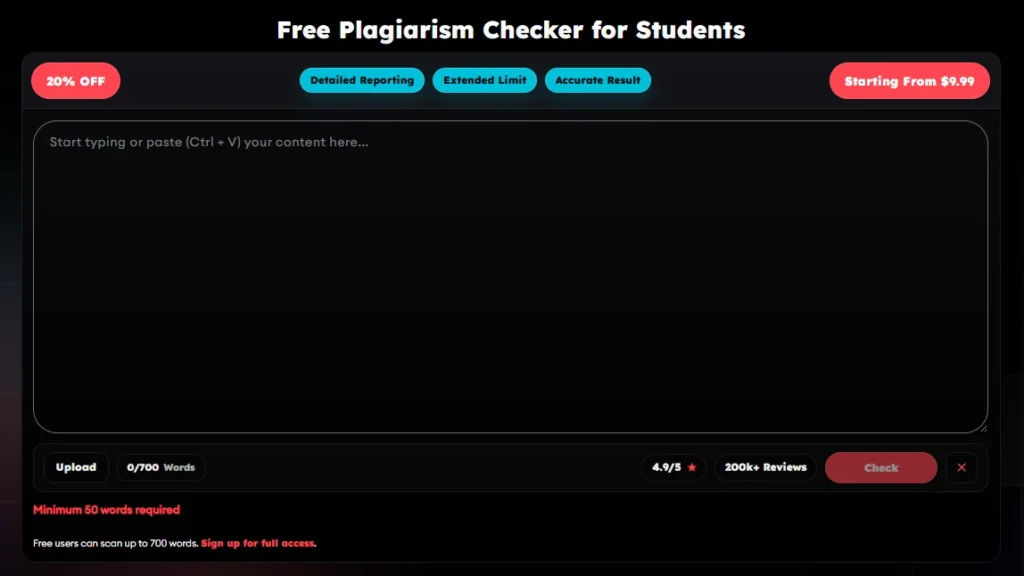
A quick scan using a free plagiarism detector for students can help you spot copied passages and citation gaps early, before your submission is reviewed by your lecturer or academic integrity office.
What is authorship plagiarism?
Authorship plagiarism happens when you submit work that was written (fully or partly) by someone else, but you present it as your own original work. It’s closely linked to contract cheating and ghostwriting, where a third party produces an assignment in exchange for payment or another benefit.
Unlike typical plagiarism, where you copy text from a source, authorship plagiarism is about misrepresenting who created the work. Even if the assignment is “original” in the sense that it hasn’t appeared online, it can still be misconduct because the authorship is false.
This is also why universities often treat authorship issues differently from direct plagiarism (copy-paste) or paraphrasing plagiarism (rewriting someone else’s ideas too closely). The key question becomes: Did you actually do the work you’re claiming credit for?
Why universities take it so seriously
Assessments are designed to test your understanding, thinking, and skills. When someone else writes your work, the assessment becomes meaningless—and it creates unfair advantage over students who did the work honestly.
Research consistently shows academic misconduct is widespread, which is one reason institutions enforce strict rules. For example, the International Center for Academic Integrity (ICAI) summarizes survey-based research indicating more than 60% of university students admit to cheating in some form, with studies also tracking behaviors like getting someone else to do academic work and submitting it as one’s own.
That doesn’t mean universities assume everyone is cheating. It means they have clear policies and procedures because the risk is real, and the credibility of grades and degrees is on the line.
Common examples of authorship plagiarism
Authorship plagiarism can show up in more ways than people expect. Here are practical, student-relevant examples:
Buying or commissioning an assignment
You pay an essay-writing service, freelancer, or “academic helper” to write your coursework, lab report, reflection, dissertation chapter, or take-home exam. Even if they “custom write” it, submitting it under your name is still authorship plagiarism.
Asking a friend (or senior student) to write it
A classmate writes your paper “as a favor,” or a senior student shares a finished assignment and you submit it with minor edits. This can overlap with self-plagiarism if you reuse your own earlier submissions, but when someone else is the real author, it’s an authorship issue.
Paying someone to heavily rewrite your work
Editing is usually allowed, but when “editing” becomes rewriting whole sections, building arguments, adding references, and changing the voice so much that the final version is not yours, it crosses into authorship misrepresentation. This can also blur into mosaic plagiarism if the rewritten content is stitched together from multiple sources.
Using translation as a disguise
Some students translate content from another language and submit it as “original.” That’s a known pathway into translation plagiarism, and if someone else does the translation and writing for you, you’re also misrepresenting authorship.
Submitting “AI + human for hire” work
AI adds a modern twist: a student generates a draft with AI, then pays someone to “humanize” it, add citations, and finalize. Depending on your institution’s policy, AI misuse can be treated separately—but paying another person to produce the final work still fits the authorship plagiarism definition.
How authorship plagiarism is detected
There’s no single “gotcha” tool. In many cases, detection is a pattern of signals:
- Mismatch in writing style compared with your earlier work (tone, vocabulary, sentence structure, argument quality).
- Citation red flags, like missing page numbers, inconsistent formatting, or references that can’t be located (see citation plagiarism).
- Turnaround time that doesn’t match the complexity of the work (for example, a polished 3,000-word critical analysis produced overnight).
- Viva-style questions or informal interviews where you can’t explain your own arguments, methodology, or sources.
It’s also common for authorship plagiarism to show up alongside other forms of plagiarism. If you want the bigger picture, Skyline Academic’s guide on types of plagiarism helps students understand how these categories connect.
Academic and institutional consequences
Consequences vary by university, level of study, and severity, but authorship plagiarism is often treated as major misconduct because it undermines the authenticity of assessment.
Typical outcomes include:
- A failing grade (zero) for the assignment
Some institutions apply a capped mark; others give an automatic fail. - Failure of the module or unit
Especially if the assignment is a core component. - Academic misconduct record
This can affect progression, resits, or future disciplinary decisions. - Suspension or expulsion
More likely for repeat offenses or large, high-stakes submissions (e.g., dissertation, final project). - Loss of scholarships or professional placement issues
Some programs report misconduct to placement partners or professional bodies where relevant. - Visa and immigration complications (international students)
If your enrollment is affected, your visa status can become complicated quickly—so it’s not a risk to take lightly.
If you’re worried your work might be flagged, checking it early with tools and tightening your citations is far safer than hoping it “passes.” Using Skyline Academic’s free plagiarism checker can help you catch overlaps and fix referencing before submission, and their main site Skyline Academic includes student-focused resources on integrity and writing support.
How to avoid authorship plagiarism (without panicking)
The safest approach is simple: keep ownership of the thinking and the writing process.
- Start early with outlines and rough drafts so you’re not forced into desperate shortcuts.
- Use legitimate support: feedback on structure, clarity, grammar, and citations is usually fine—submitting someone else’s writing is not.
- Keep evidence of your process: notes, drafts, article PDFs, version history, and references.
- If you’re unsure what’s allowed, check your university’s academic integrity policy and ask your tutor before you submit.
Also remember: not all plagiarism is intentional. Many students get flagged for accidental plagiarism because of rushed paraphrasing, missing citations, or sloppy referencing, problems that are fixable with better process.
FAQs
1) What is Authorship Plagiarism in simple terms?
Authorship Plagiarism is when you submit work written by someone else and claim it as your own. It includes ghostwriting, contract cheating, or having a friend produce your assignment.
2) Is Authorship Plagiarism the same as contract cheating?
Authorship Plagiarism and contract cheating overlap heavily. Contract cheating is the “transaction” (paying or arranging help), while authorship plagiarism is the misconduct of submitting that work under your name.
3) Can Authorship Plagiarism happen if the work is “original” and not copied?
Yes. Authorship Plagiarism is about who wrote the work, not whether it’s copied from the internet. A custom-written essay can still be misconduct if you didn’t write it.
4) How do universities detect Authorship Plagiarism?
They look for patterns like sudden changes in writing style, suspicious citations, and inability to explain your own arguments. Investigations often combine software signals with academic judgment.
5) What are the consequences of Authorship Plagiarism?
Consequences can include a zero grade, module failure, misconduct records, suspension, or expulsion. Penalties are often stricter than for minor citation mistakes because authorship is fundamental.
6) Does using AI automatically count as Authorship Plagiarism?
Not automatically. It depends on your university policy and how you used it. But if you pay someone to finalize or rewrite AI output and submit it as your own, that can become Authorship Plagiarism.
7) How can I avoid Authorship Plagiarism if I’m struggling with deadlines?
Break the task into smaller steps, ask for allowed support (feedback, tutoring, writing guidance), and keep drafts to prove your process. Checking originality and citations early also reduces risk.