
Last updated:
Your dissertation data is finally cleaned. You sit down to run the analysis and SPSS will not open. Your campus licence has expired, or you just switched to a new Mac and the installer will not cooperate, or you checked the price and realised you cannot pay it for one semester. The deadline does not move. If that sounds familiar, the good news is that you have plenty of options, and several of them are free.
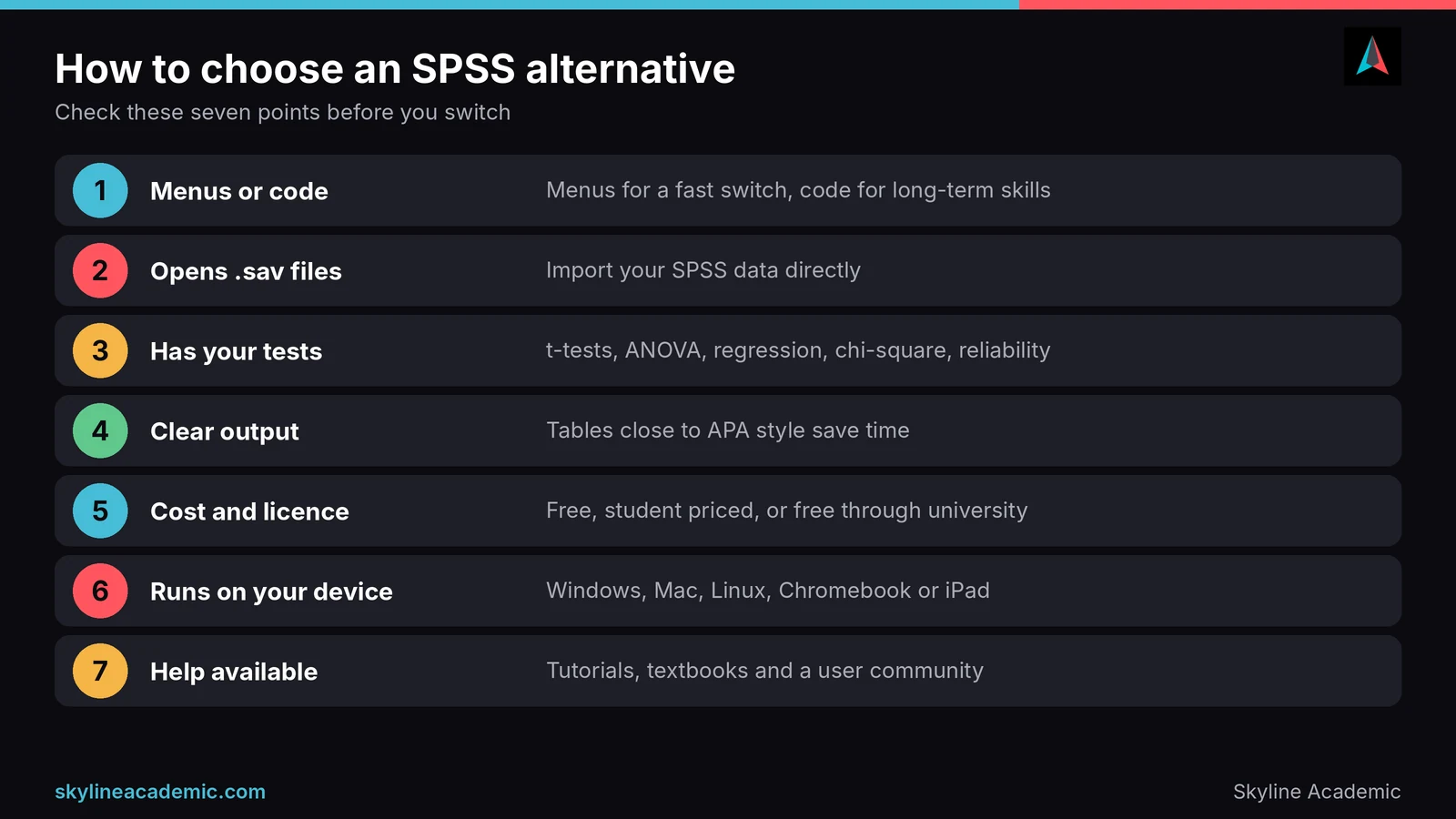
Here is the short answer. The best free SPSS alternatives for students are jamovi, JASP and PSPP if you want point-and-click menus like SPSS, and R or Python if you are willing to learn some code. jamovi and JASP are the easiest switch, PSPP looks the most like SPSS, and R is the most powerful. If your course already uses a paid tool, Stata, Minitab and GraphPad Prism are solid choices, often with student pricing.
Why students look for SPSS alternatives
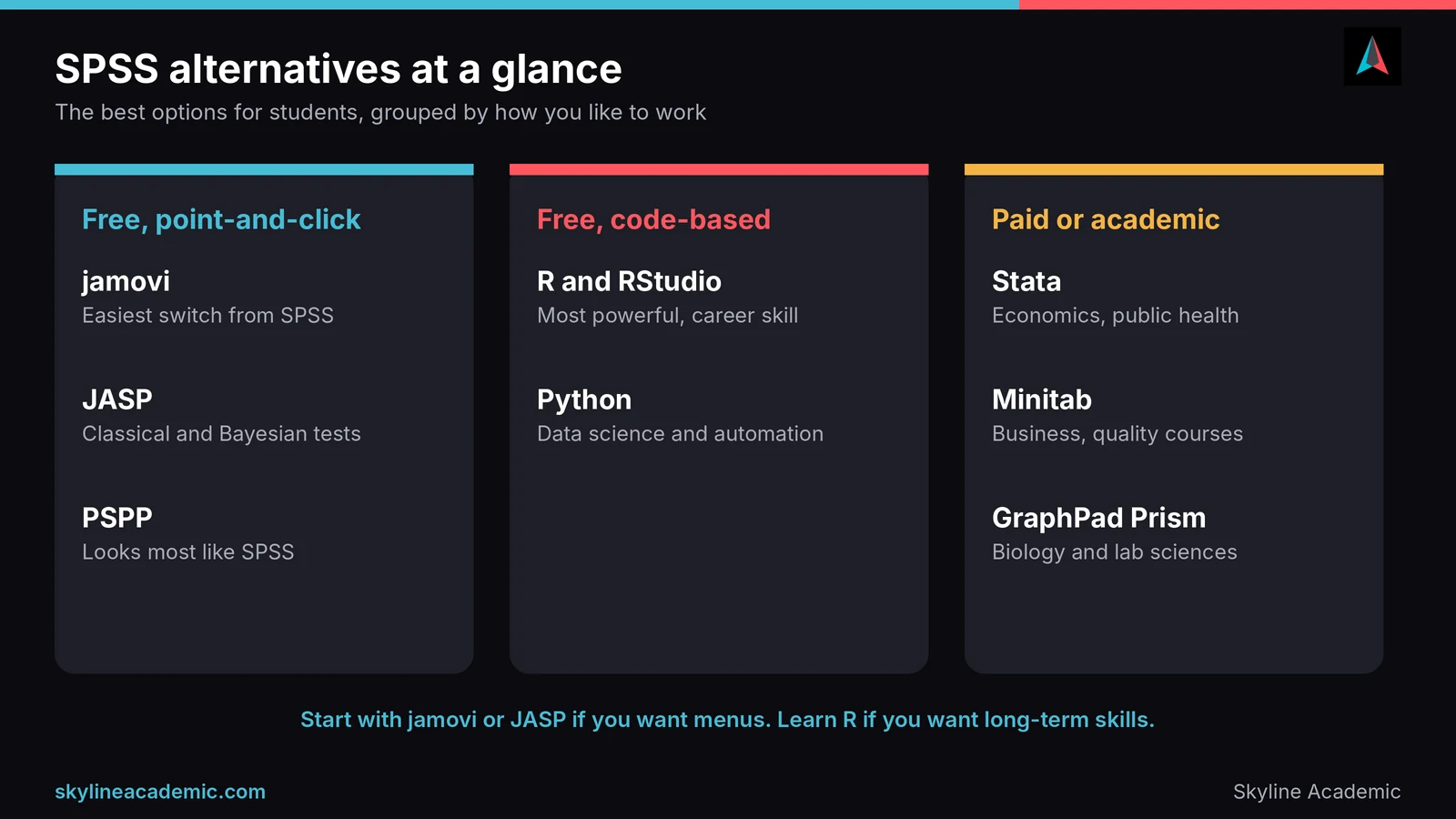
Most students do not leave SPSS because they dislike it. They leave because they lose access to it, cannot afford it, or their computer or course points them somewhere else.
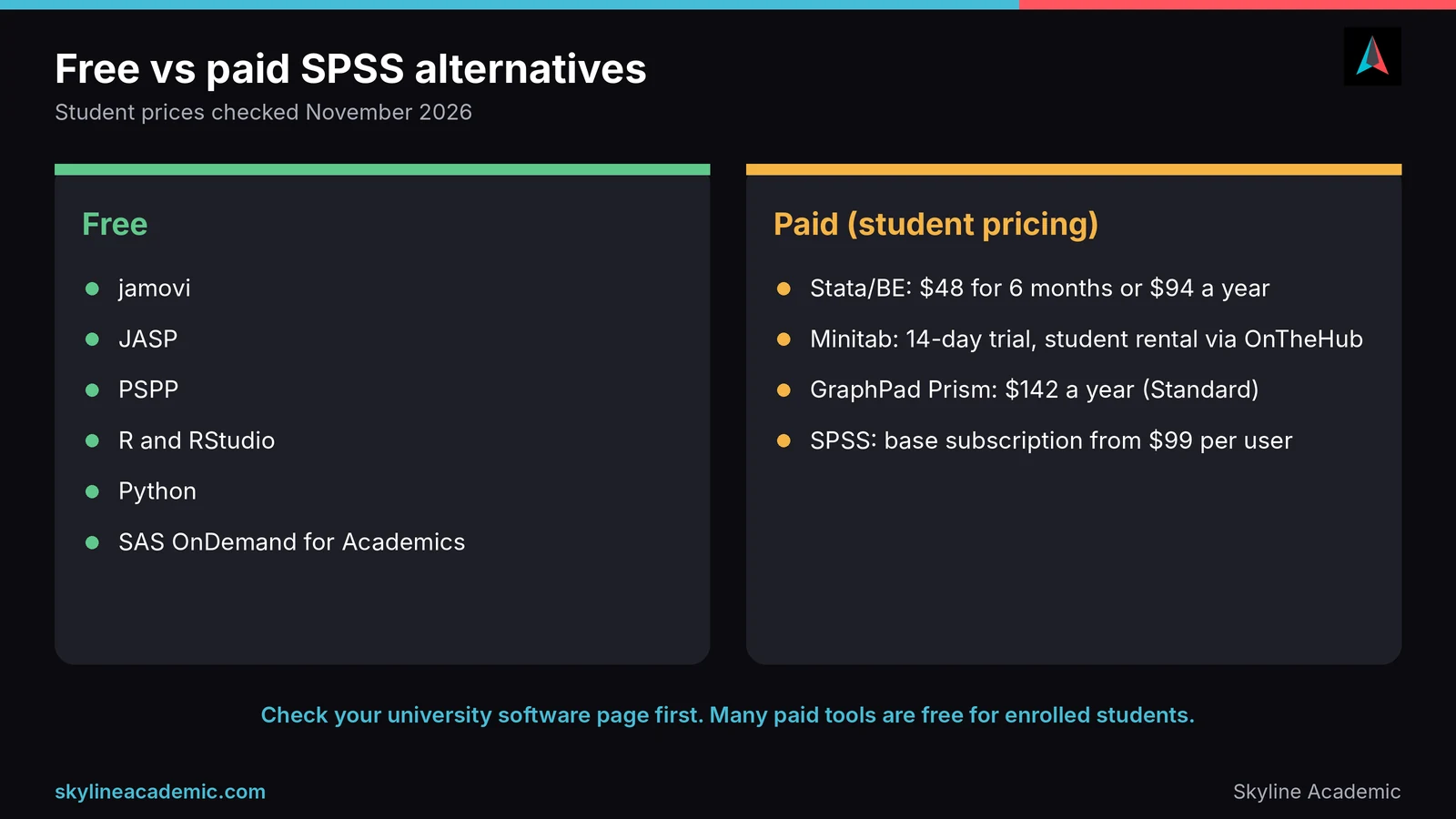
Cost is the biggest reason. On IBM’s SPSS Statistics pricing page, the base subscription starts at $99 per authorized user, with add-on packages for custom tables and advanced statistics starting at $79 each (checked November 2026). That is a lot to pay out of pocket when your university licence ends after graduation, or when you only need the software for one module.
Access is the second reason. Many students only have SPSS on campus computers or through a licence that runs out at the end of term. Others find their course has moved to R or jamovi, or their supervisor works in Stata and wants files they can open. And some simply cannot install it on the device they own, such as a Chromebook or an iPad. If you are still deciding whether to learn SPSS at all, our SPSS guide for students explains what it does well and where students usually get stuck.
To be fair to SPSS, it is popular for good reasons. The menus are familiar, it is still widely taught, and its documentation is excellent. The goal here is not to say SPSS is bad. It is to help you find the tool that fits your budget, your device and your course.
What to look for in an SPSS alternative
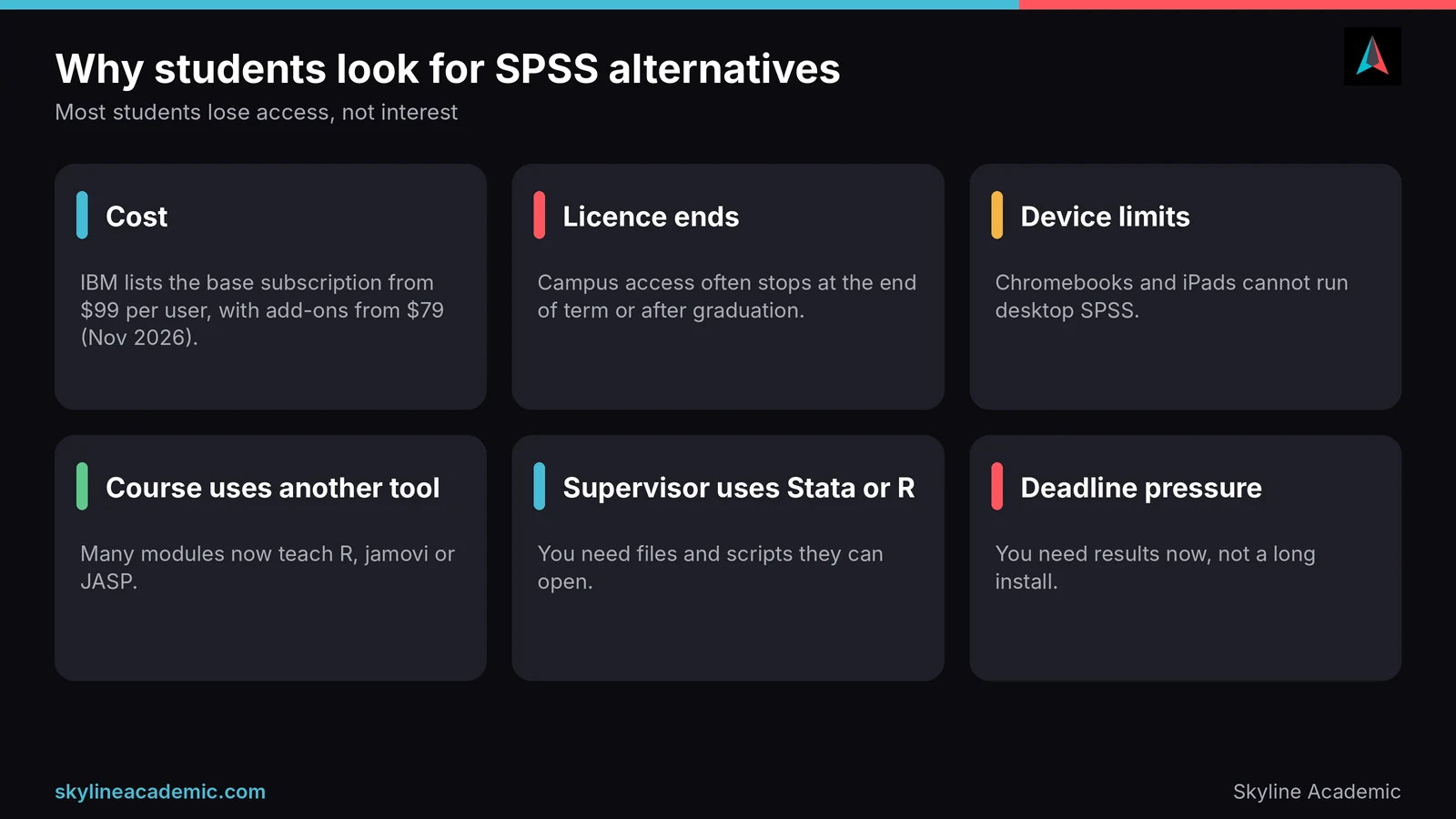
The best SPSS alternative is the one that runs the tests your course needs, opens your data, works on your device and does not take weeks to learn. Check these points before you switch.
- Point-and-click or code. If you have never coded, start with a menu-based tool like jamovi, JASP or PSPP. If you want long-term skills, R or Python pays off.
- Opens SPSS files. If your data is already in .sav format, pick a tool that can import it directly.
- The tests you need. Most students need descriptive statistics, t-tests, ANOVA, correlation, regression and chi-square. Psychology students often also need reliability (Cronbach’s alpha) and factor analysis.
- Clear output. Tables that look close to APA style save you time when you write up results.
- Cost and licence. Free, student priced, or free through your university.
- Your device. Windows, Mac, Linux, Chromebook or iPad.
- Help available. A large user community, tutorials and textbooks make learning faster.
The best free point-and-click SPSS alternatives
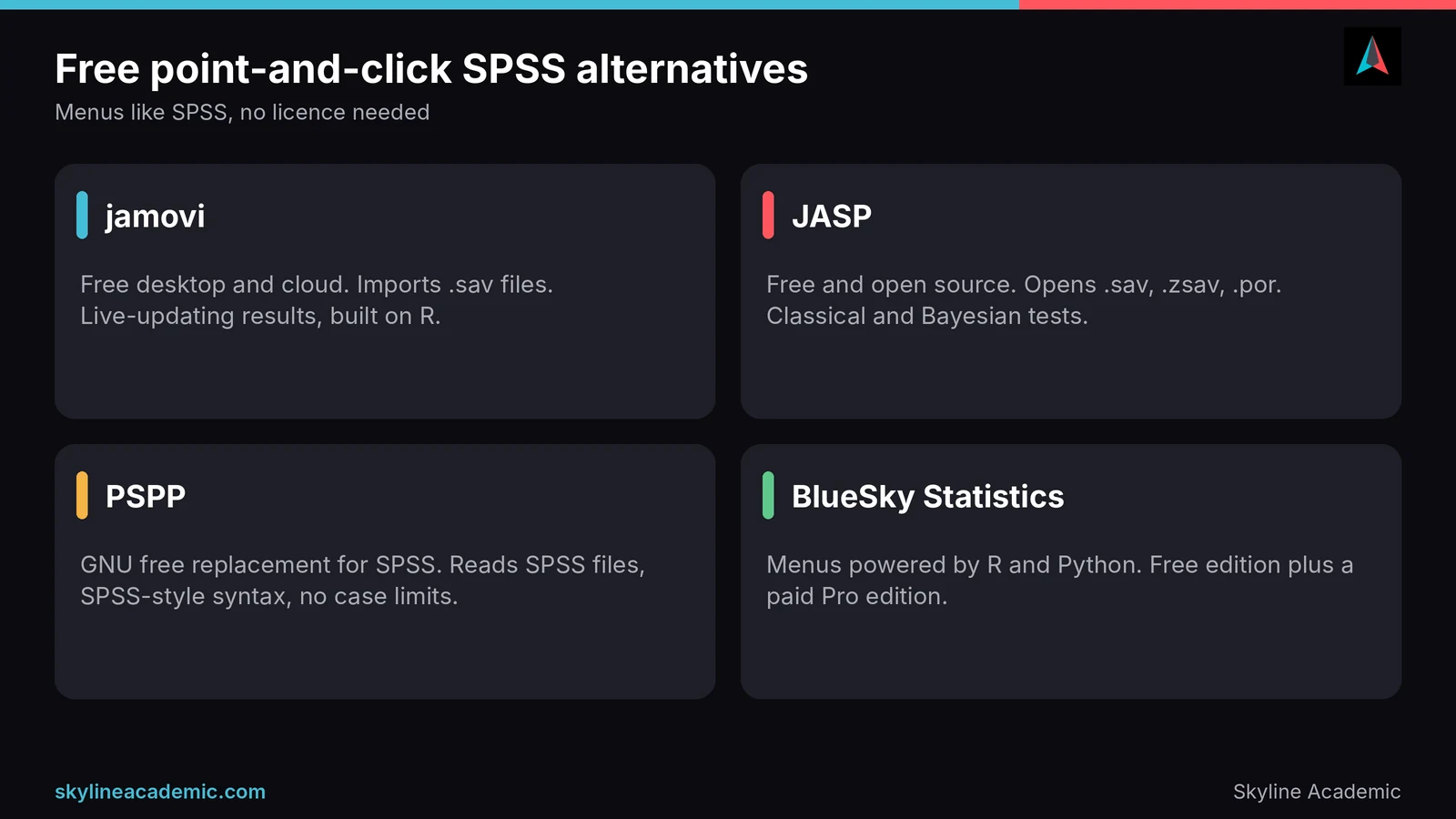
These tools work like SPSS: you load data, pick a test from a menu and get a results table. They are the fastest switch for students who do not want to code.
jamovi
jamovi is a free statistics program built on R, with a clean spreadsheet view and results that update live as you change options. The jamovi website says the desktop version is always free, and there is also a free cloud version that runs in a browser, including on Chromebooks and tablets. According to the free textbook Learning Statistics with jamovi, jamovi can import SPSS .sav files as well as Stata, SAS, Excel and other formats. It covers t-tests, ANOVA, regression, correlation, chi-square, reliability and factor analysis, and you can add extra modules from its library. Its one limitation is that very advanced or niche models may need a module or R itself.
JASP
JASP is a free, open source program from the University of Amsterdam that feels a lot like jamovi, with the bonus of offering many tests in both the classical and Bayesian form. JASP’s download page lists versions for Windows, macOS, Linux and Chromebooks from 2019 or later, but not iPad or Android. The JASP FAQ confirms it opens SPSS .sav, .zsav and .por files, along with Stata, SAS, Excel, R and Minitab files. Output tables are tidy and easy to copy into a report. Its limitation is a smaller module library than jamovi for some specialist analyses.
PSPP
PSPP is the free alternative that looks most like SPSS itself. GNU describes PSPP as a free replacement for SPSS that appears very similar to it, with no time limits and no limits on cases or variables. The PSPP manual shows it reads SPSS system and portable files, and it uses a syntax language modelled on SPSS. It covers descriptive statistics, t-tests, ANOVA, linear and logistic regression, factor analysis, reliability and non-parametric tests. The trade-off is that its interface feels dated and it lacks some advanced procedures and polished charts.
BlueSky Statistics
BlueSky Statistics is a point-and-click interface powered by R and Python. Its official site offers a free edition and a paid Pro edition with extra features. It is a good middle ground if you want menus now but would like to see the R code behind your analysis. It is less widely taught than jamovi or JASP, so you will find fewer student tutorials.
The best free code-based SPSS alternatives
Code-based tools take longer to learn, but they are free, extremely powerful and highly valued by employers. Your analysis also becomes a script you can rerun and share.
R and RStudio
R is a free, open source language built for statistics, and RStudio is the friendly app most students use to write R code. It can do almost anything SPSS can and much more, from basic t-tests to multilevel models and publication-quality charts. The haven package reads SPSS .sav files, keeping variable and value labels. R is free on Windows, Mac and Linux, and Posit Cloud offers a free browser version for Chromebooks. The limitation is the learning curve, especially the first few weeks. Our RStudio guide for students walks through the most common errors and how to fix them.
Python
Python is a general programming language with strong data libraries such as pandas for data handling and statsmodels and SciPy for statistics. The pandas read_spss function opens SPSS files with the pyreadstat package installed. Python is free on every desktop system, and Google Colab runs it in a browser, which helps on Chromebooks. It suits students in data science, engineering or business analytics more than psychology, where R and jamovi are more common. If you are new to it, our Python guide for students covers the basics.
Paid and academic SPSS alternatives
Paid tools make sense when your course or supervisor uses them, or when your university gives you free access. Always check your university software page before you pay.
Stata
Stata is popular in economics, public health and political science, and it combines menus with a powerful command language. Stata’s student pricing page lists Stata/BE at $48 for 6 months, $94 a year or $298 perpetual (checked November 2026). It runs on Windows, Mac and Linux and can import SPSS files. Our Stata guide for students explains how it compares with SPSS for coursework.
Minitab
Minitab is common in business, engineering and quality improvement courses, with simple menus and strong charts. Minitab’s pricing FAQ says the free trial lasts 14 days and that students can rent discounted licences through OnTheHub. Its support pages note the desktop app runs only on Windows, so Mac users usually rely on the web version through their university or a virtual machine.
GraphPad Prism
GraphPad Prism is a favourite in biology, medicine and lab sciences because it makes clear scientific graphs and guides you through common tests. GraphPad’s pricing page lists student licences at $142 a year for Standard and $213 for Pro (checked November 2026), with licences for Windows and Mac. It is less suited to survey data and large social science datasets.
SAS OnDemand for Academics
SAS is a long-standing professional statistics package. SAS OnDemand for Academics is a free, cloud-based version for students, educators and independent learners, using SAS Studio in a web browser with up to 5 GB of storage. It is a good choice if your course teaches SAS or you want it on your CV, but it is code-heavy for beginners.
Excel and Google Sheets for simple jobs
For quick descriptive statistics, a basic t-test or a simple regression, a spreadsheet can be enough. Excel’s Analysis ToolPak adds these tools for free. It is not a real replacement for a dissertation, though, because it lacks many tests, makes mistakes easy and does not produce report-ready tables.
SPSS alternatives compared
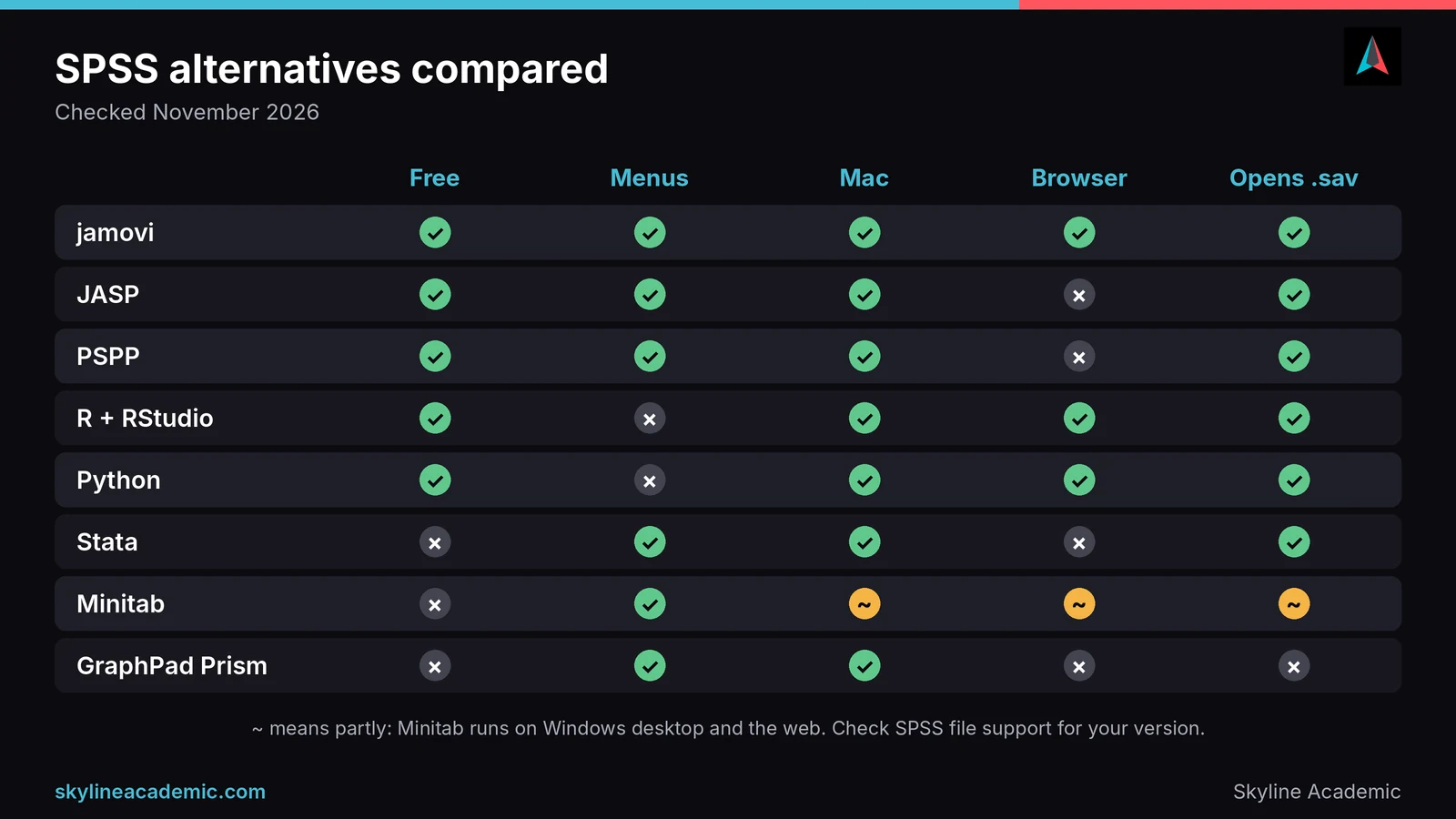
Here is a side-by-side view of the main options so you can shortlist two or three quickly. Prices and features were checked in November 2026.
| Tool | Cost | Menus or code | Runs on | Opens SPSS files | Best for |
|---|---|---|---|---|---|
| jamovi | Free | Menus | Windows, Mac, Linux, browser | Yes | Easiest switch from SPSS |
| JASP | Free | Menus | Windows, Mac, Linux, Chromebook | Yes | Psychology, Bayesian tests |
| PSPP | Free | Menus and syntax | Windows, Mac, Linux | Yes | Feels most like SPSS |
| R with RStudio | Free | Code | Windows, Mac, Linux, browser | Yes, with haven | Power, flexibility, careers |
| Python | Free | Code | Windows, Mac, Linux, browser | Yes, with pyreadstat | Data science, automation |
| Stata | From $48 for 6 months (student) | Menus and code | Windows, Mac, Linux | Yes | Economics, public health |
| Minitab | Paid, student rental | Menus | Windows, web | Check your version | Business, quality courses |
| GraphPad Prism | From $142 a year (student) | Menus | Windows, Mac | Not its focus | Biology and lab sciences |
| SAS OnDemand | Free for learners | Mostly code | Browser | Yes | Courses that teach SAS |
Free and open source SPSS alternatives
If your budget is zero, you can still do everything a typical dissertation needs. jamovi, JASP, PSPP, R and Python are all free and open source, so you can use them forever without a licence. For most students, the choice comes down to menus versus code.
If you want menus and the fastest switch, start with jamovi or JASP. If you want something that looks and behaves almost exactly like SPSS, try PSPP. If you want skills that last beyond your degree, put the effort into R. And if your work is mostly data mining rather than classic statistics, see the SPSS Modeler section below.
SPSS alternatives for Mac, Linux, Chromebook and iPad
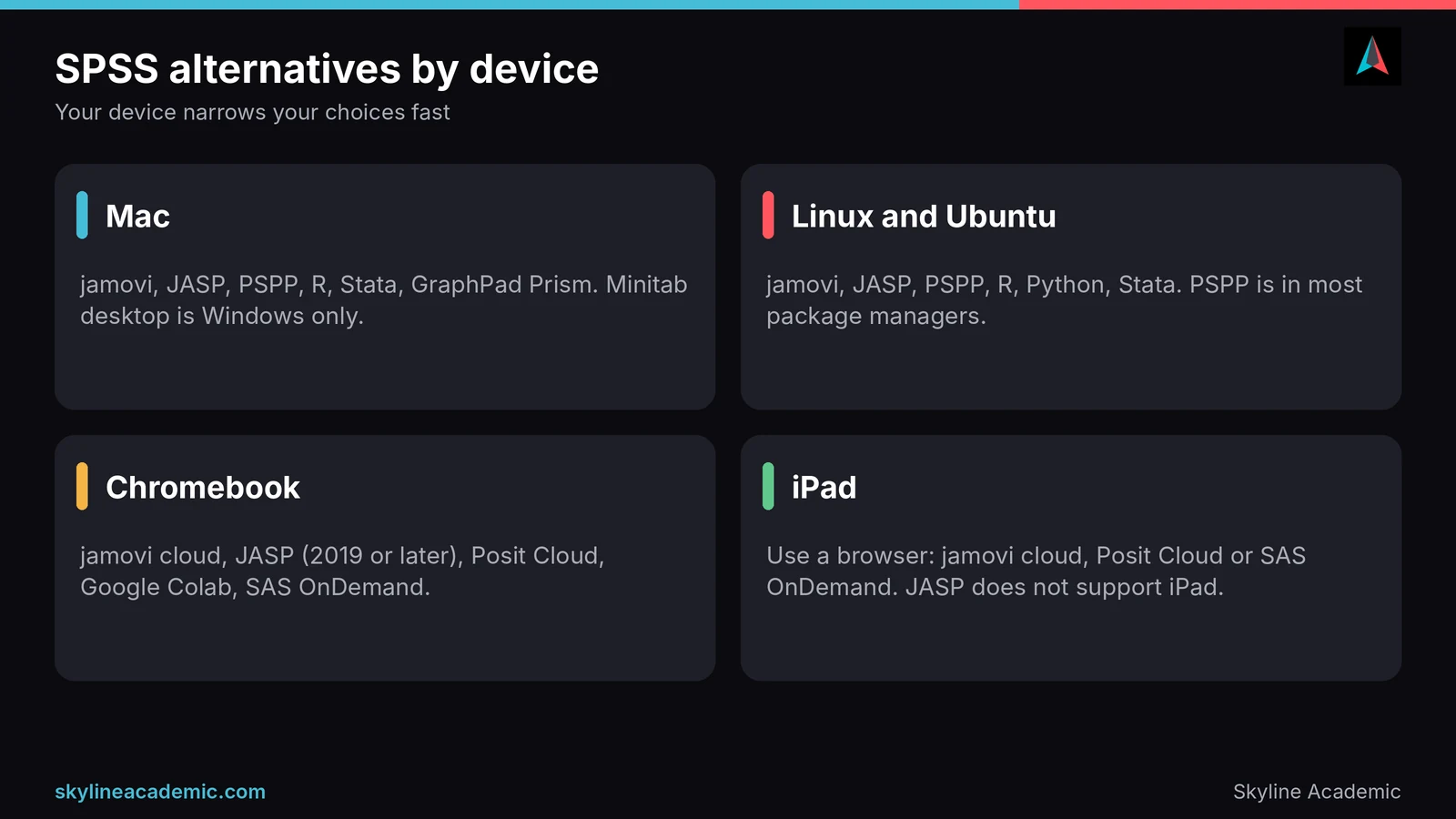
Your device narrows your choices fast. Mac and Linux users have almost every free option, while Chromebook and iPad users need tools that run in a web browser.
| Device | Best options | Notes |
|---|---|---|
| Mac | jamovi, JASP, PSPP, R, Stata, Prism | All have native Mac versions. Minitab desktop does not |
| Linux and Ubuntu | jamovi, JASP, PSPP, R, Python, Stata | PSPP is in most Linux package managers |
| Chromebook | jamovi cloud, JASP, Posit Cloud, Google Colab, SAS OnDemand | JASP supports Chromebooks from 2019 or later |
| iPad | jamovi cloud, Posit Cloud, SAS OnDemand | Use a browser. JASP does not support iPad |
A tablet can handle smaller assignments, but for a full dissertation a laptop, or a campus computer, will save you a lot of frustration with typing, screen space and file handling.
Best alternative to SPSS for market researchers
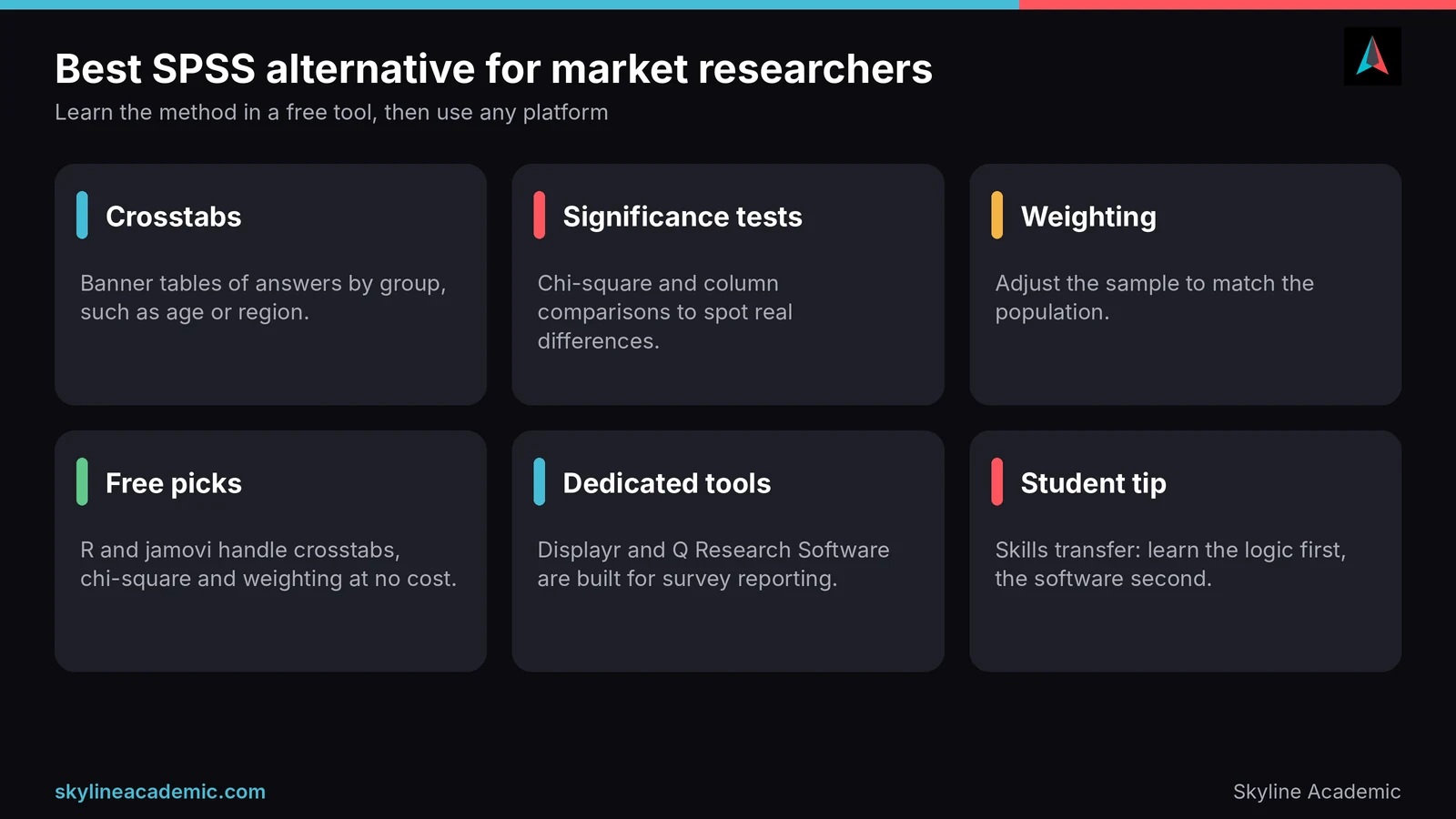
For market and survey research, the best SPSS alternative depends on whether you need quick crosstabs or full reporting. For students and small projects, R and jamovi handle crosstabs, chi-square tests and weighting at no cost. Dedicated survey platforms such as Displayr and its sister product Q Research Software are built for survey tables, weighting and reports, and Displayr offers a free tier for small data sets, though its paid plans are priced for professional teams.
If you are studying marketing or business analytics, the practical approach is to learn the logic of survey analysis, such as crosstabs, significance testing and weighting, in a free tool first. That way the skills carry over to whatever platform an employer uses. Our business analytics tutoring helps students build exactly that foundation.
SPSS Modeler alternatives
SPSS Modeler is a different product from SPSS Statistics. It is a visual tool for data mining and machine learning, where you connect boxes to build a workflow. Two free alternatives work the same way. KNIME Analytics Platform is an open source, drag-and-drop workflow tool, and Orange is a free, visual data mining tool that is very friendly for beginners. Python and R are the code-based options for the same jobs.
SPSS alternatives that support syntax
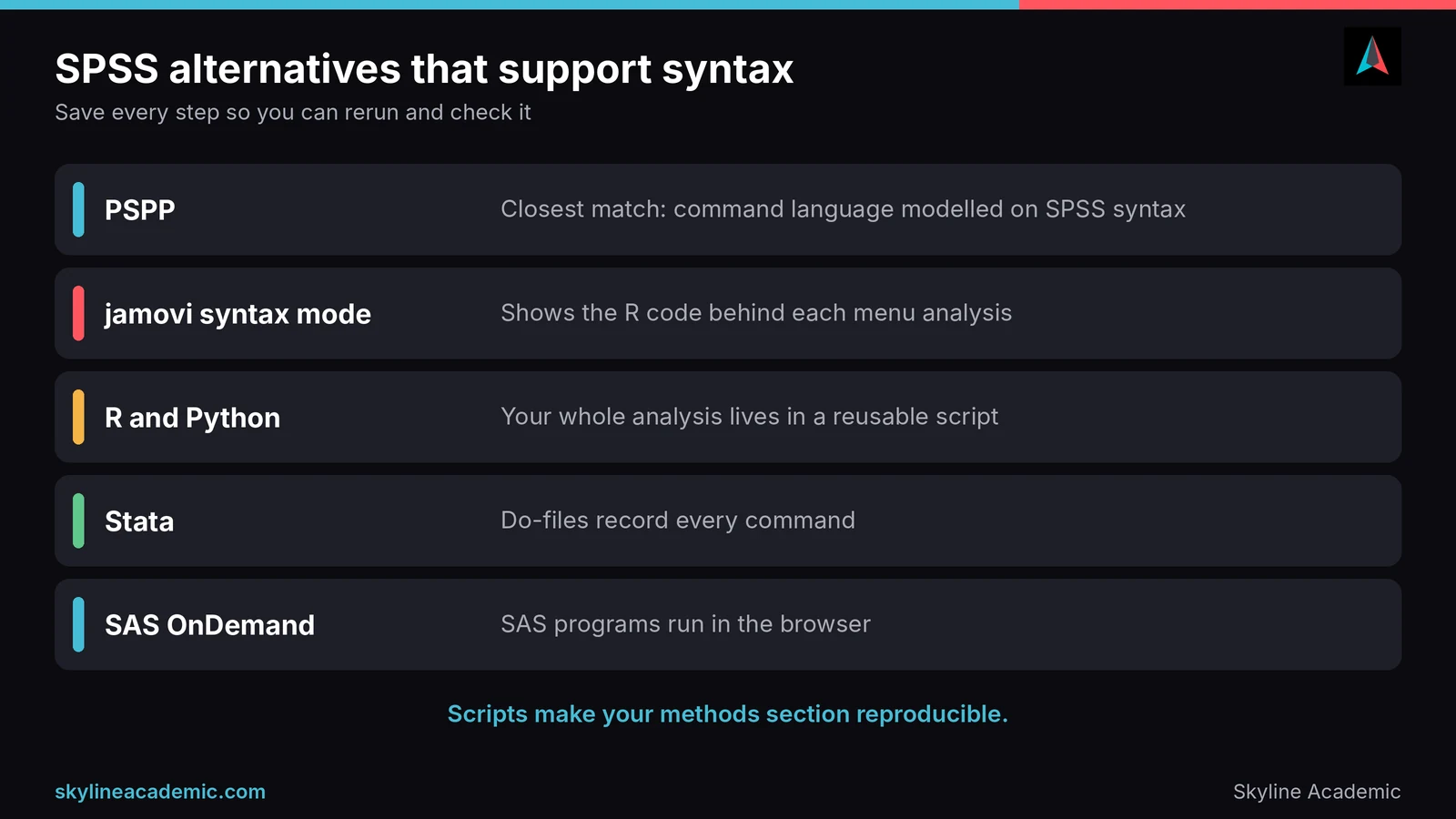
SPSS syntax lets you save every step of your analysis as text, so you can rerun it, fix mistakes and show your supervisor exactly what you did. Several alternatives give you the same benefit.
PSPP is the closest match, because its command language is modelled on SPSS syntax, so many simple SPSS scripts run with few changes. R and Python go further, since your whole analysis lives in a script. Stata uses do-files for the same purpose. jamovi has a syntax mode that shows the R code behind each analysis, which is a gentle way to start learning R without leaving the menus. If you want help turning menu clicks into reliable scripts, our RStudio tutors can work through your own data with you.
How to switch from SPSS without losing your work
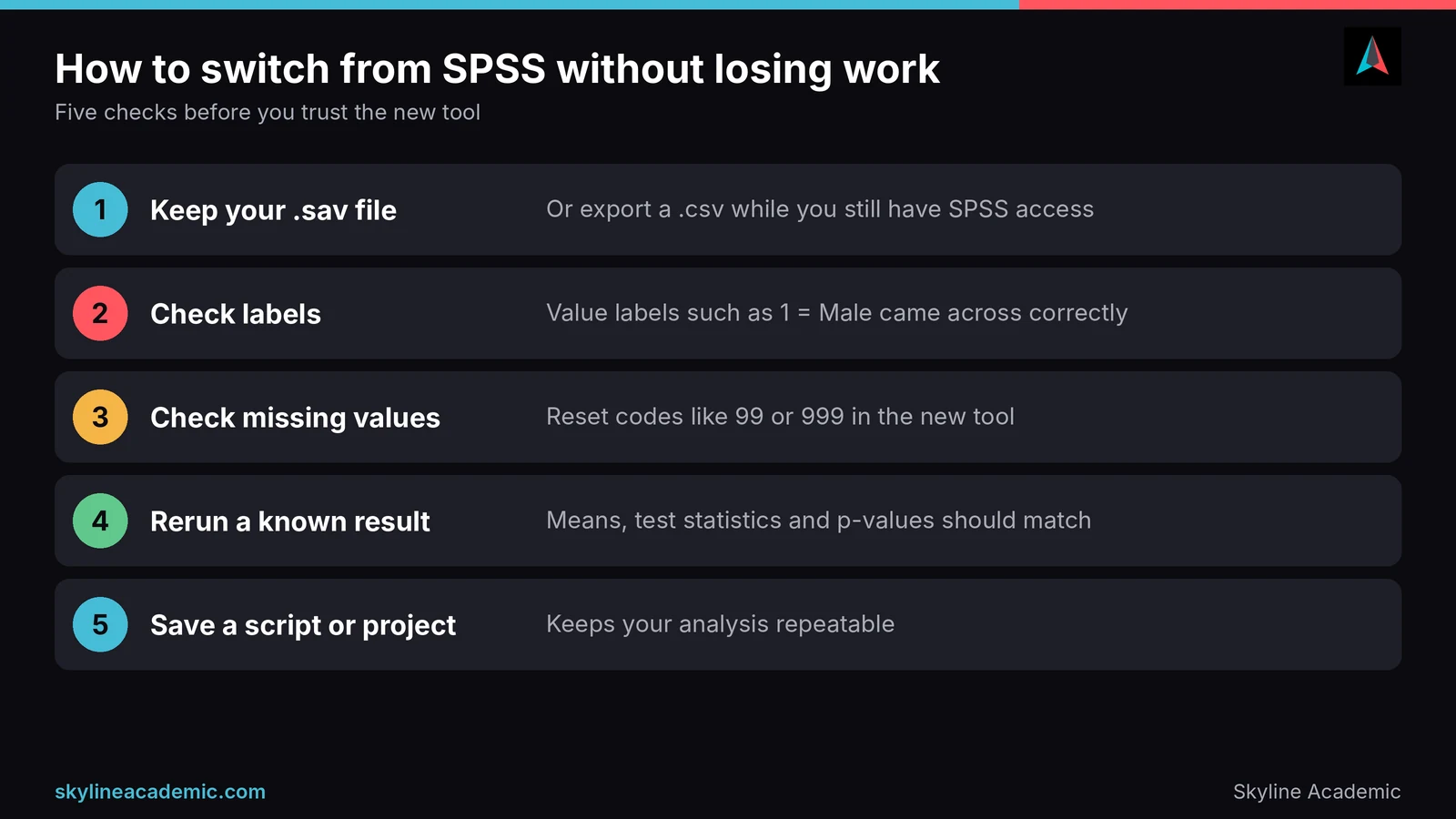
Switching is safe if you check your data and rerun one known result before trusting the new tool. Follow these steps.
- Export or keep your .sav file. Most alternatives above open it directly. If not, save a copy as .csv from SPSS while you still have access.
- Check variable labels and value labels. Make sure codes like 1 = Male and 2 = Female came across correctly.
- Check missing values. SPSS user-defined missing codes, such as 99 or 999, may need to be set again in the new tool.
- Rerun one analysis you already know. Compare the means, test statistics and p-values with your SPSS output. If they match, you can trust the setup.
- Save a script or project file. This keeps your analysis repeatable for your methods section.
If you still have a module that requires SPSS, an SPSS tutor can help you get through it quickly while you build skills in a free tool.
Which SPSS alternative should you choose?
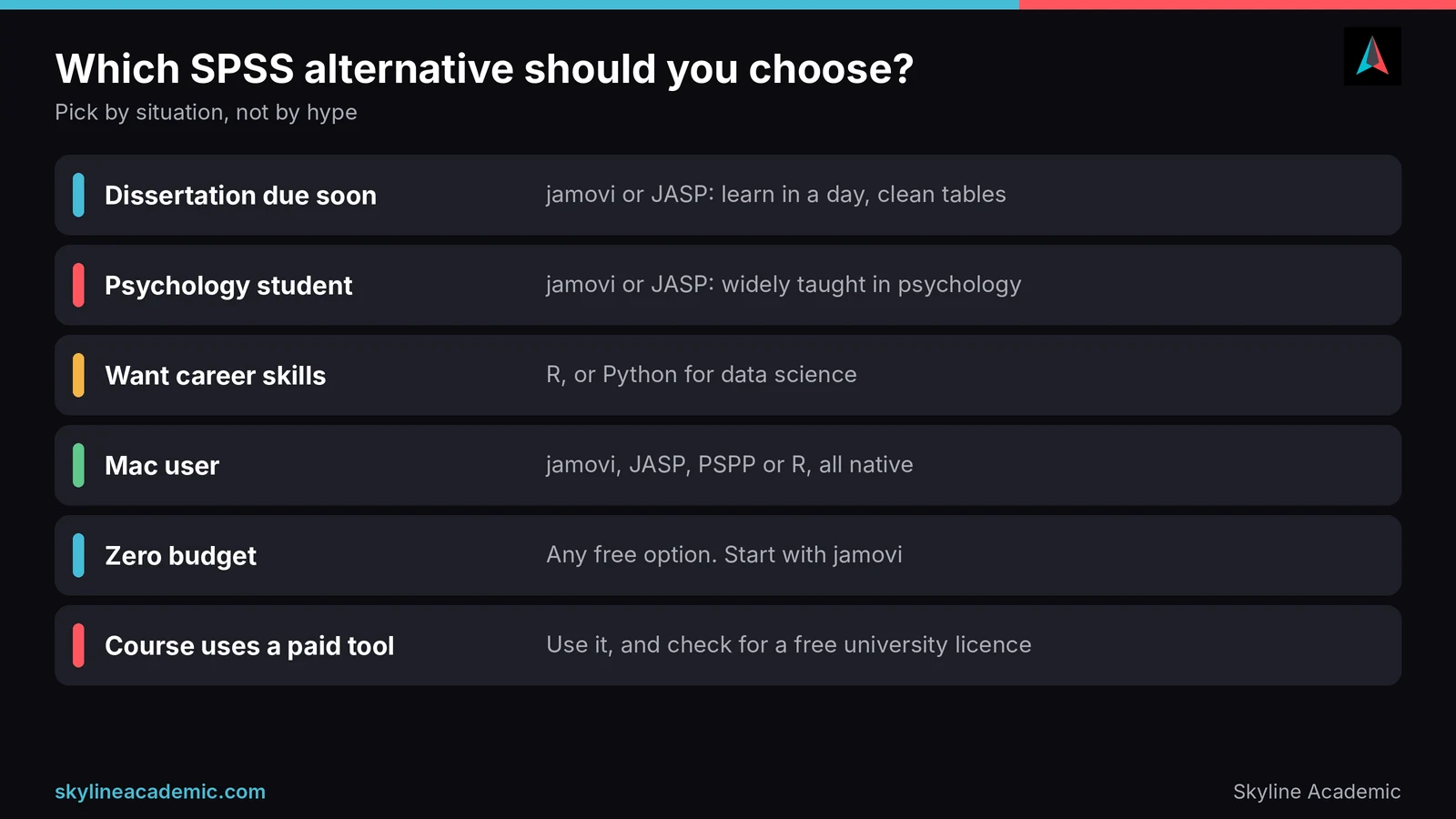
The right choice depends on your situation more than on which tool is “best”. Here is a quick guide.
- Your dissertation is due soon. Use jamovi or JASP. They are free, easy to learn in a day, and give clean tables. Our dissertation tutors can help you choose the right tests and write up results.
- You study psychology. jamovi or JASP, since many psychology departments now teach them.
- You want career skills. Learn R, or Python if you lean toward data science.
- You are on a Mac. jamovi, JASP, PSPP or R all work natively.
- You have zero budget. Any free option above. Start with jamovi.
- Your course uses a paid tool. Use what your course uses, and check whether your university provides a free licence.
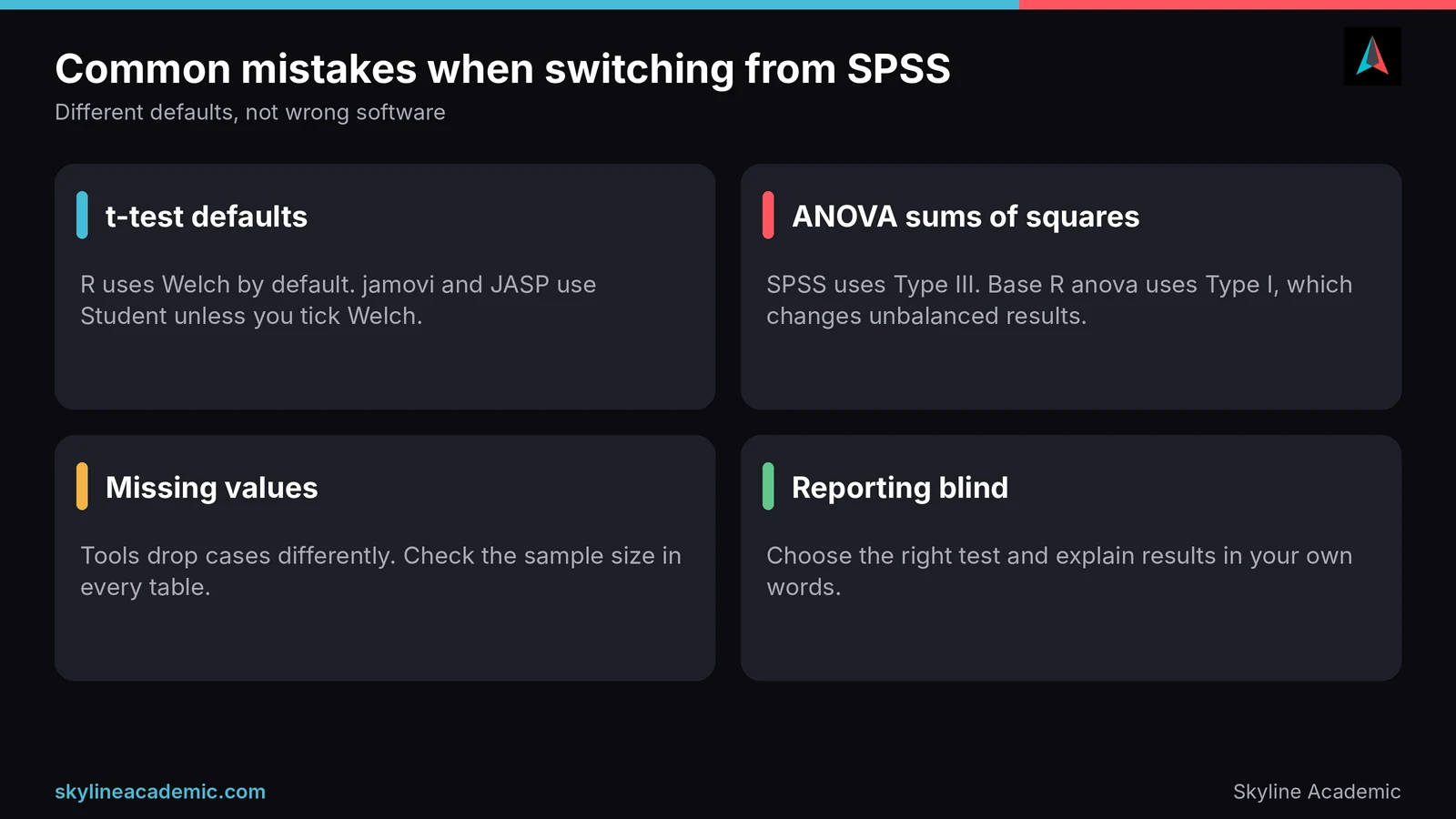
Common mistakes when switching from SPSS
Most problems after switching come from different defaults, not wrong software. Watch for these.
- Different t-test defaults. SPSS shows both the equal-variance and Welch versions. R’s t.test uses Welch by default, while jamovi and JASP default to the Student version unless you tick Welch. Know which one you are reporting.
- Different ANOVA sums of squares. SPSS uses Type III by default. Base R’s anova function uses Type I, which can change results in unbalanced designs.
- Missing values handled differently. Some tools drop cases differently, so check your sample size in every table.
- Reporting numbers you do not understand. Every tool gives output. Your marks depend on choosing the right test and explaining the results correctly.
Need help with your analysis?
Choosing a tool is only half the battle. The other half is knowing which test fits your research question, checking assumptions, and explaining your results clearly in your own words. Skyline Academic is one of the leading 1:1 live tutoring platforms, with a dedicated LMS, progress tracking, assignment quizzes, workshops and bootcamps. We also offer an AI detector and a plagiarism checker. Our statistical software tutoring covers SPSS, jamovi, JASP, R, Stata and more, so you learn to run and interpret the analysis yourself. Book a session when you are ready.
Frequently asked questions
What is the closest free alternative to SPSS?
PSPP is the closest in look and feel, since it was designed as a free replacement for SPSS and reads SPSS files. Many students find jamovi or JASP easier to use day to day, even though they look a little different.
Can jamovi open SPSS files?
Yes. jamovi can import SPSS .sav files, along with Stata, SAS, Excel and CSV files. Check your variable labels and missing values after importing.
Is PSPP the same as SPSS?
No, but it is similar. PSPP is free GNU software that mimics the SPSS interface and syntax and covers the common tests, but it lacks some advanced procedures and polished charts.
What can I use instead of SPSS on a Mac?
jamovi, JASP, PSPP and R all run natively on Mac and are free. Stata and GraphPad Prism are good paid options with Mac versions.
Is there an SPSS alternative for Chromebook or iPad?
Yes, use a browser-based option. jamovi cloud, Posit Cloud for R, Google Colab for Python and SAS OnDemand for Academics all run in a web browser, and JASP also supports newer Chromebooks.
Is R harder than SPSS?
At first, yes, because you type commands instead of clicking menus. After a few weeks of practice most students find R faster and more flexible, and the skills are valued by employers.
Will my university accept results from jamovi or JASP?
Usually yes, because the statistics are the same and many universities teach these tools. Check your module guidance, and report the software and version in your methods section.
Is SPSS free for students?
Not usually. IBM sells student licences through authorised resellers, but many universities provide SPSS free on campus or for the length of your course, so check your IT services page first.
What is the best SPSS alternative for a dissertation?
For most students, jamovi or JASP, because they are free, quick to learn and produce clean tables. If you already know R, it is an excellent choice for complex models.
Can I run SPSS syntax in another program?
Partly. PSPP runs much of the common SPSS syntax with few changes, while R, Python and Stata use their own languages. Rewriting your syntax is a good chance to check every step of your analysis.
Conclusion
Losing access to SPSS does not have to derail your coursework or dissertation. jamovi, JASP and PSPP give you familiar point-and-click analysis for free, R and Python build powerful long-term skills, and Stata, Minitab and GraphPad Prism are strong choices when your course uses them. Pick the tool that matches your device, budget and deadline, check your data carefully when you switch, and make sure you understand every number you report. If you want a tutor to guide you through the analysis step by step, Skyline Academic is ready to help.
Sources
- IBM SPSS Statistics pricing
- jamovi download page
- Learning Statistics with jamovi: loading data
- JASP download page
- JASP FAQ
- GNU PSPP
- PSPP manual: GET command
- BlueSky Statistics
- haven package for R
- Posit Cloud
- pandas read_spss documentation
- Stata student pricing
- Minitab pricing FAQ
- Minitab desktop software on Mac
- GraphPad Prism pricing
- SAS OnDemand for Academics
- Microsoft: Analysis ToolPak
- Displayr pricing