
You spent three evenings on your essay. You wrote every sentence yourself. Then, just to be safe, you paste it into Winston AI, and the screen says it is likely written by AI. Your stomach drops. Was it your clear writing? Your English? Or is the tool simply wrong? And what if your university sees the same score?
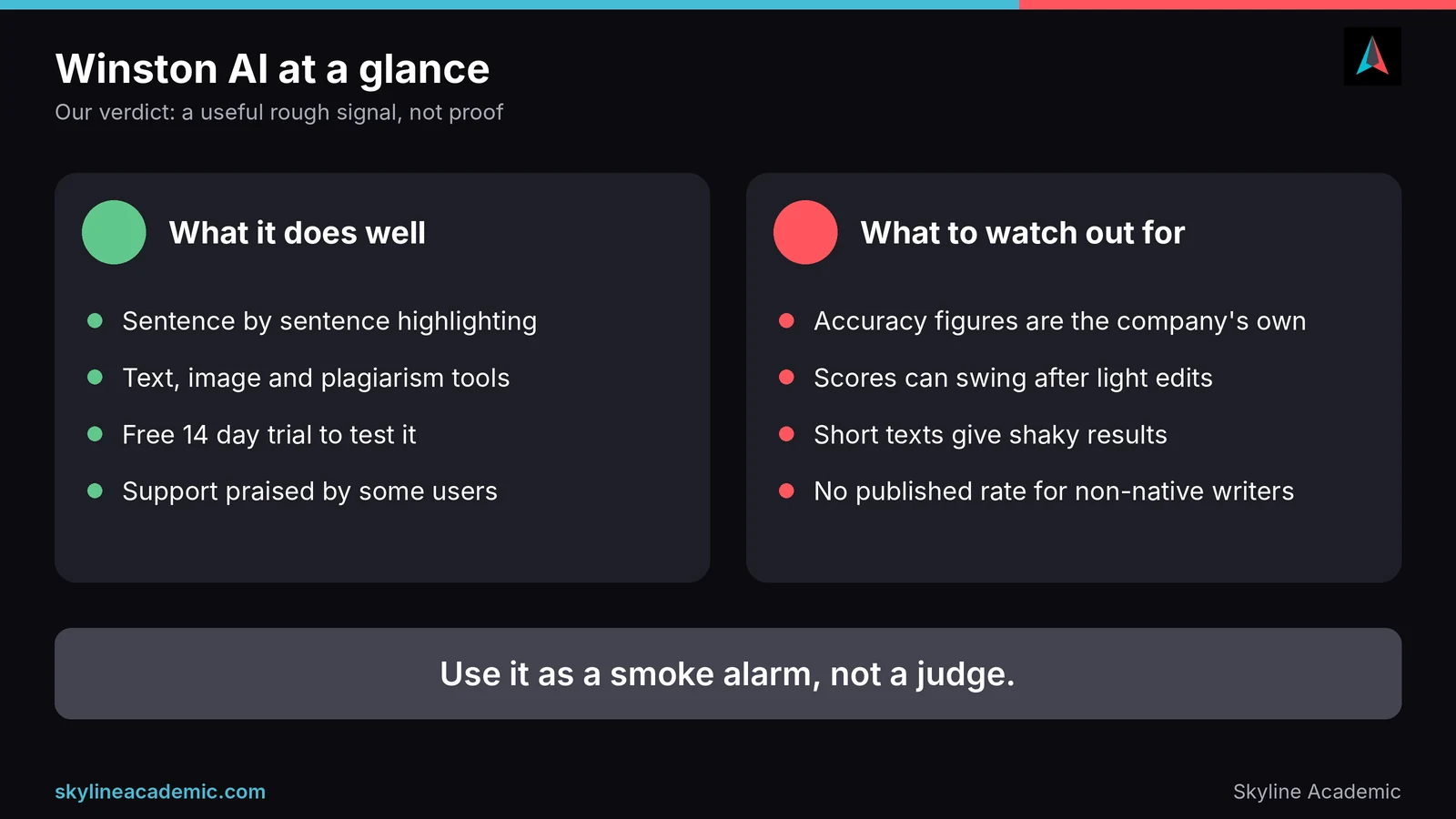
If that is you, take a breath. Winston AI is accurate enough to be a rough signal, but not accurate enough to be proof. Winston says its detector is 99.87% accurate, yet independent research shows that AI detectors in general can be fooled and can wrongly flag honest writers, and Winston’s own help page says a score is only evidence. Use it to spot passages that read oddly, never as a final verdict on your work.
What Winston AI is and how it works
Winston AI is an online AI content detector that gives your text a human score from 0 to 100. A high score means the tool thinks a person wrote it. A low score means it thinks an AI model such as ChatGPT, Claude or Gemini did. It also colors each sentence, so you can see which parts it considers most suspicious. Beyond text, it offers image and deepfake detection, a plagiarism checker, document scanning for photos and handwriting, and shareable reports.
Winston describes its method as machine learning that has learned the patterns that separate human and AI writing. Most detectors lean on two simple ideas. Perplexity measures how predictable your word choices are. Burstiness measures how much your sentence length and rhythm change. AI text tends to be smooth and predictable, while human writing tends to be uneven. The trouble is that plenty of honest writing is also smooth and predictable, especially academic writing and writing in a second language. That is where false flags come from.
Winston AI features and pricing
What you get on the free plan
The free plan gives you 2,000 credits over a 14 day trial. That is enough to test a few short pieces of writing, but it is not an ongoing free tool. Some features, such as shareable PDF reports, advanced plagiarism detection and team invites, are locked on the free plan.
Paid plans
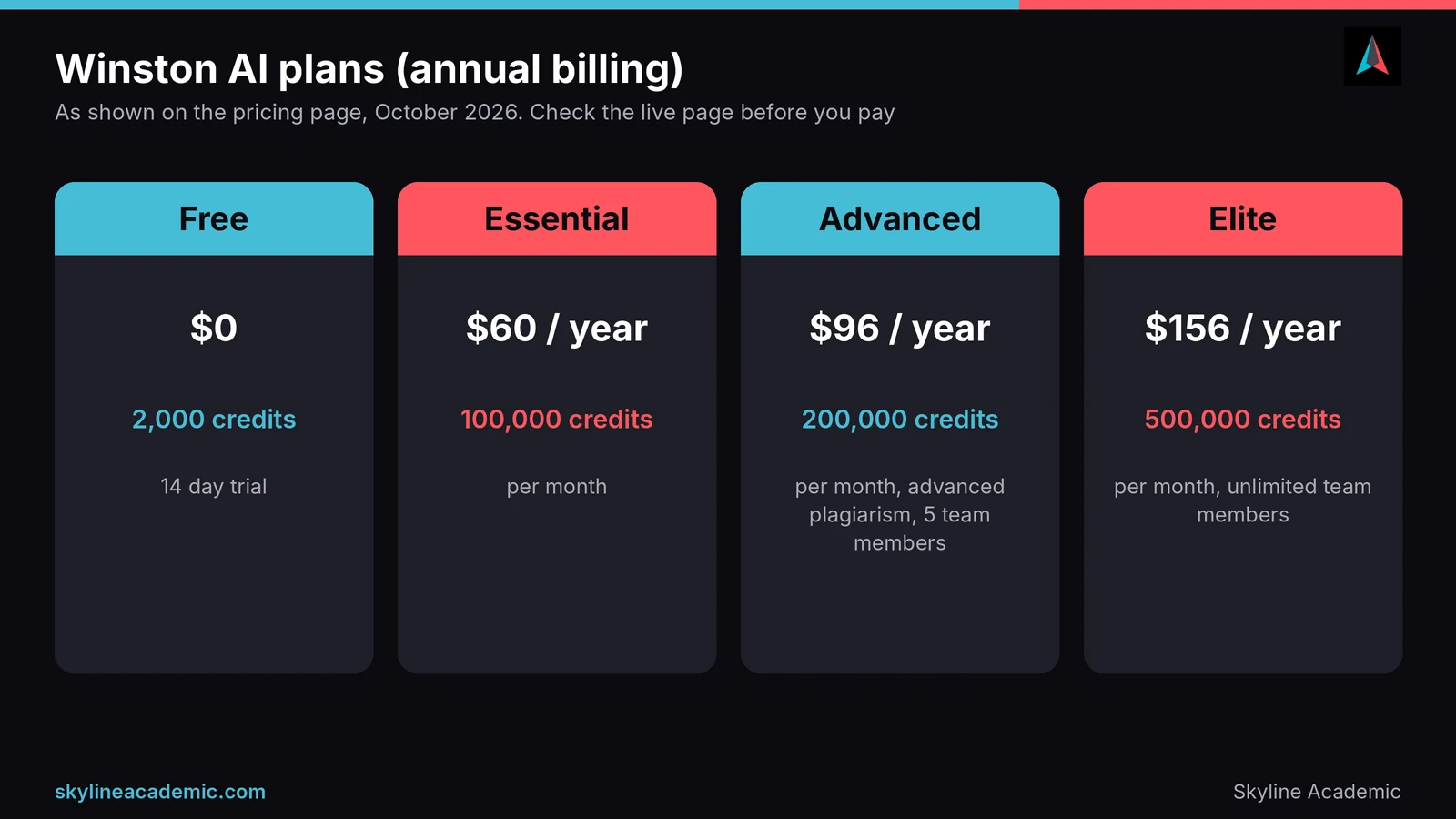
Here are the plans as shown on Winston’s pricing page at the time of writing, using annual billing. Monthly billing costs more per month, and prices can change, so check the live page before you pay.
| Plan | Price per year | Credits per month | Notable extras |
|---|---|---|---|
| Free | $0 | 2,000 (14 day trial) | AI text and image detection, document scans |
| Essential | $60 | 100,000 | Writing feedback, longer monthly allowance |
| Advanced | $96 | 200,000 | Advanced plagiarism detection, up to 5 team members |
| Elite | $156 | 500,000 | Everything in Advanced, unlimited team members |
What to check before you pay
First, the pricing page does not clearly say what one credit equals, so use your free credits to see how many a typical essay uses. Second, Winston’s terms say annual plans cannot be cancelled during the plan term, so be sure before you choose the yearly option. Third, if you only need to check one or two assignments a month, the free trial or a monthly plan may be enough.
Is Winston AI worth it for students?
For most students, the free trial is enough to learn how the tool behaves, and a paid plan only makes sense if you check long documents often. Think about what you actually need. If your goal is to improve your writing and avoid accidental AI-like patterns, a tutor’s feedback will teach you more than a score will. If your goal is to prove you wrote something, drafts and version history are far stronger evidence than any detector result.
Is Winston AI accurate? What the evidence shows
What Winston claims
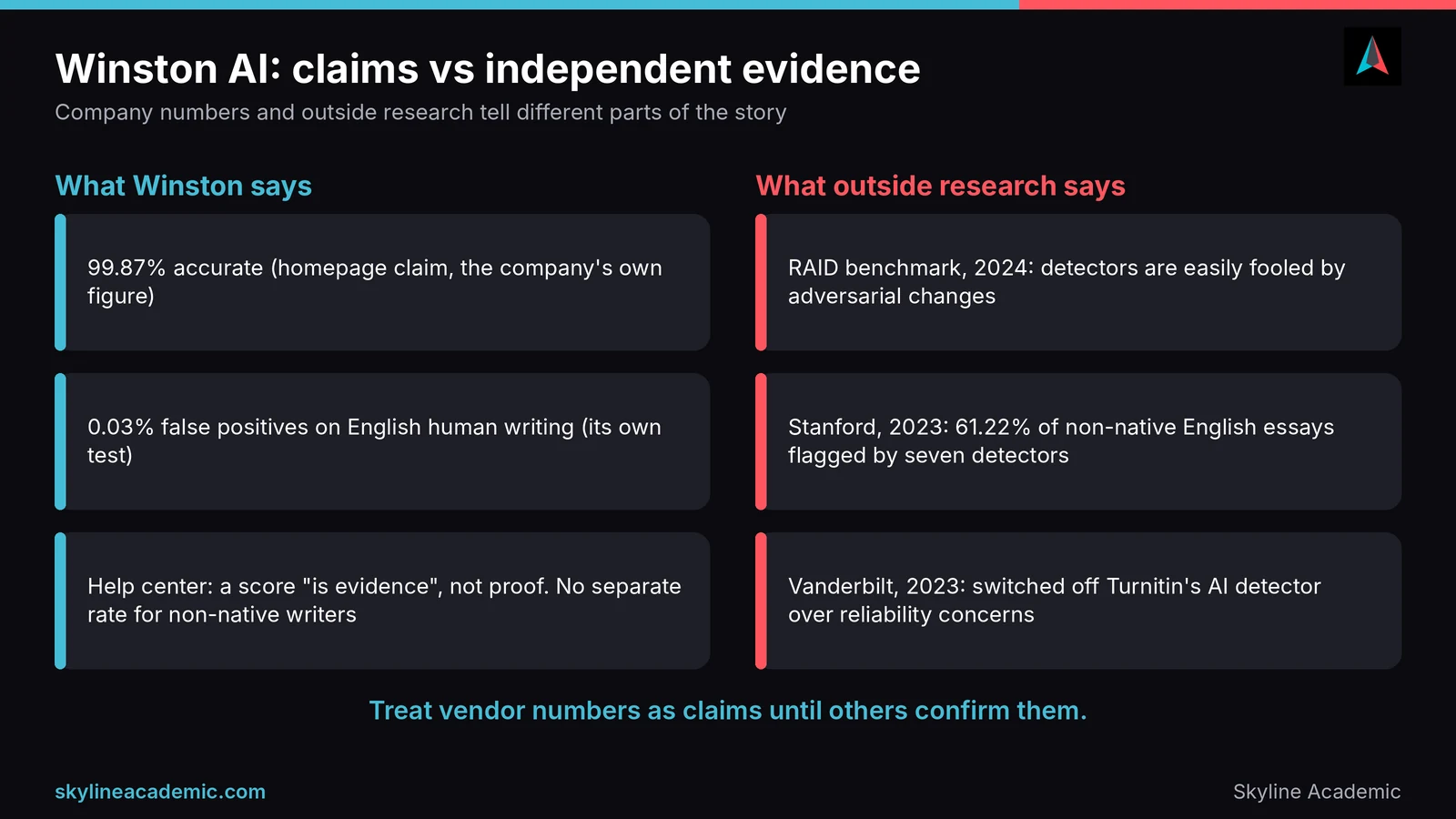
Winston’s homepage describes it as the only AI detector with a 99.87% accuracy rate, and it cites benchmark results, including a first place ranking on the RAID benchmark and no false positives on a large set of student essays. Its help center also reports a false positive rate of 0.03% on English human writing in its own evaluation, and 0.50% in an earlier one. These are the company’s own numbers, so treat them as claims until independent testing confirms them.
The help center is also open about limits. It says each rate applies only to the tested model, language and samples, that it publishes no separate rate for non-native English writers, and that a detector score “is evidence” to be weighed alongside drafts, revision history and citations. That is a more careful message than “99.87% accurate” on the front page.
What independent research says
The independent picture is less flattering to detectors as a group. The RAID benchmark, a large academic test of more than 6 million AI texts, found that current detectors are easily fooled by adversarial changes and struggle with models they have not seen before. It does not tell us how often a detector wrongly flags a real student.
For that question, the best-known evidence comes from a Stanford study. Researchers tested seven AI detectors and found that they labeled 61.22% of essays by non-native English writers as AI generated, while doing well on essays by US-born students. All seven detectors agreed that 19% of those essays were AI written, and 97% were flagged by at least one. Winston was not necessarily one of the seven, so this does not measure Winston itself. But it shows why a score should never be treated as proof, especially for international students.
Universities have noticed too. Vanderbilt disabled Turnitin’s AI detector in 2023, pointing out that even a 1% false positive rate could wrongly flag around 750 papers out of the 75,000 it submitted in a year.
Our quick test: how much can the score move?
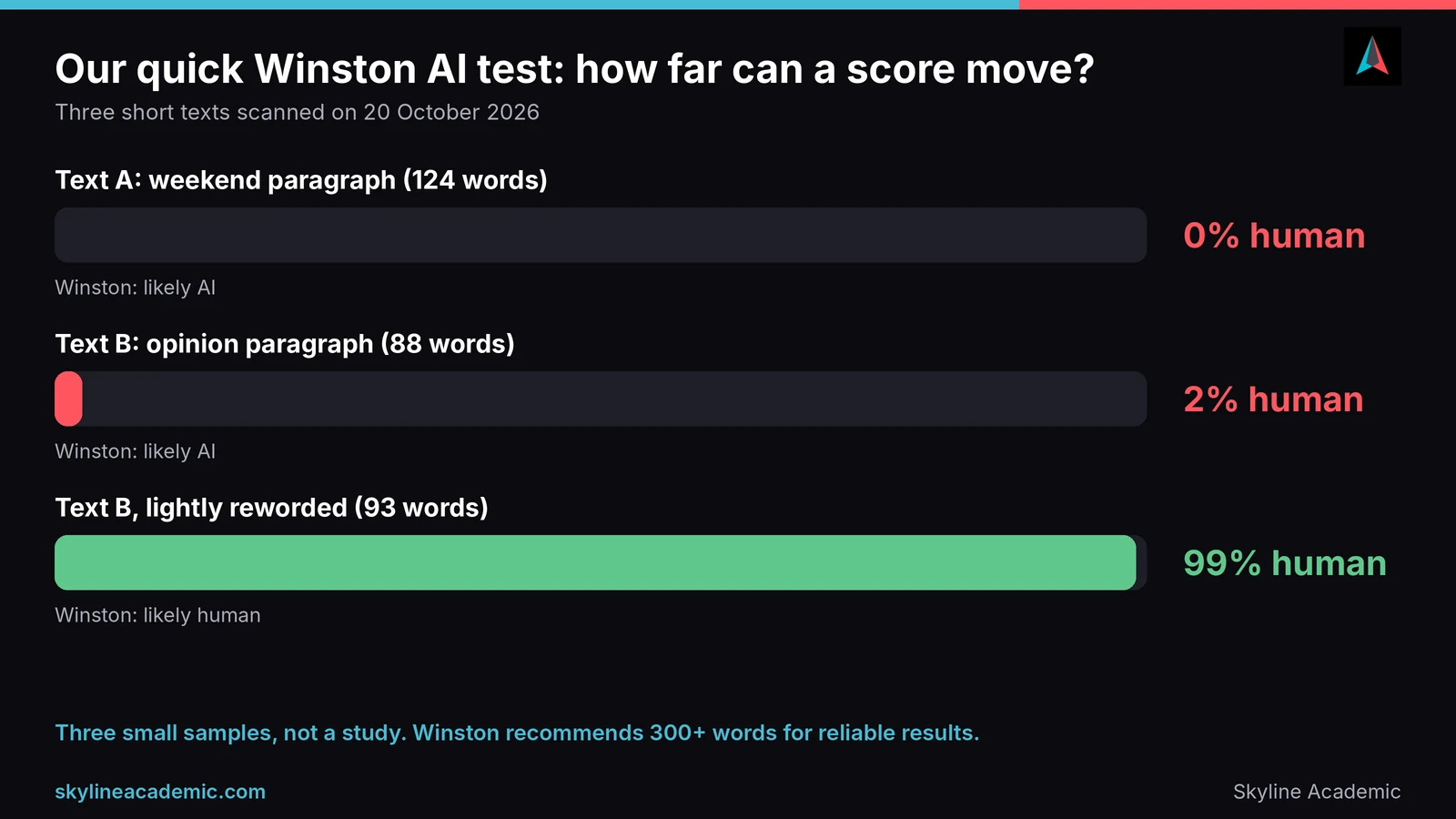
We ran three short texts through Winston AI on 20 October 2026. The first, a 124 word paragraph about spending weekends relaxing, scored 0% human. The second, an 88 word opinion paragraph about technology, scored 2% human. Then we lightly reworded that same opinion paragraph and scanned it again. The new version scored 99% human.
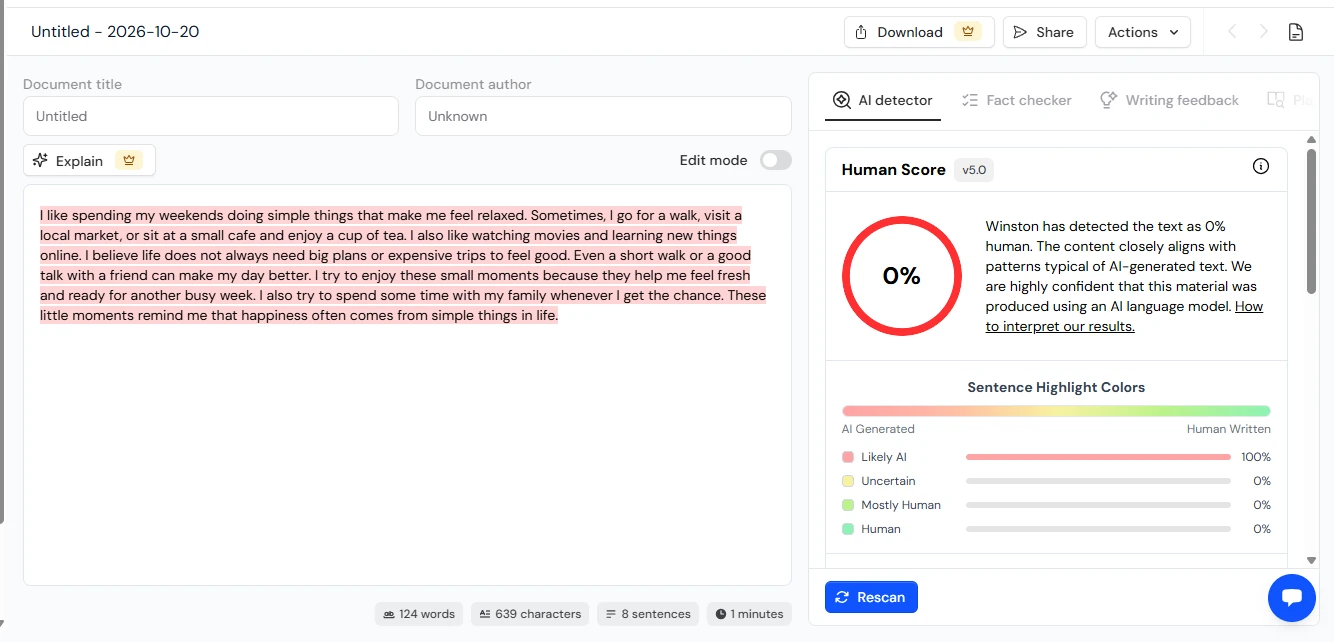
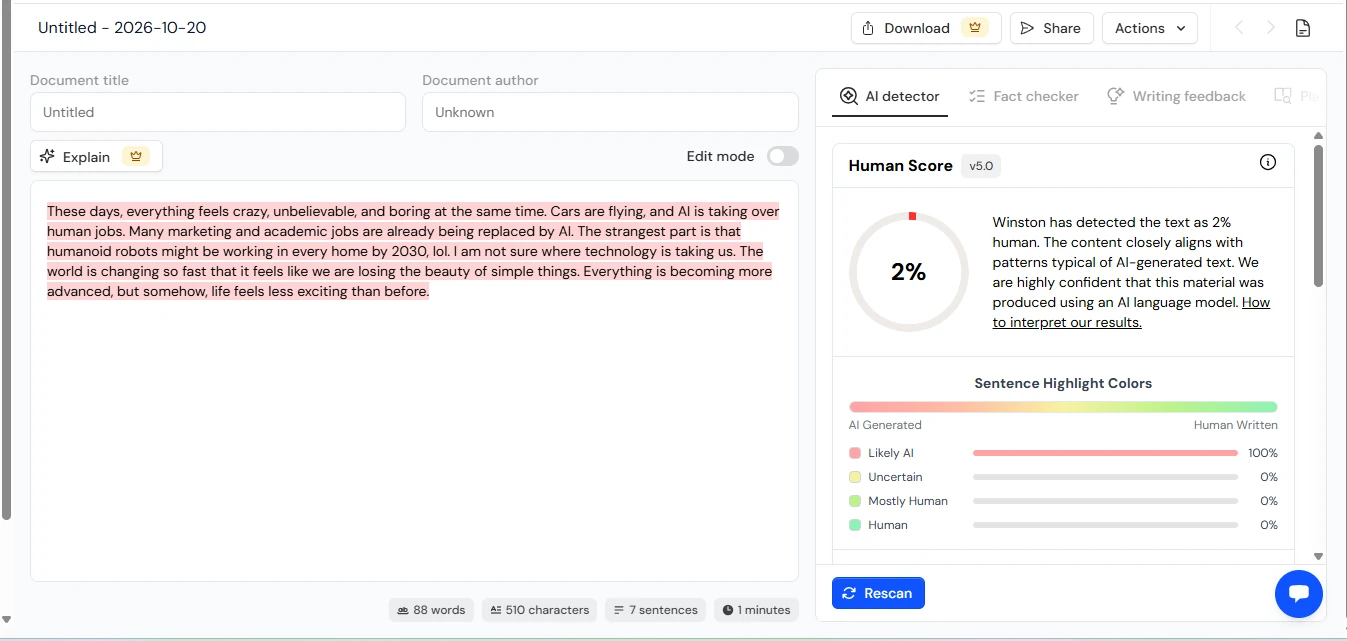
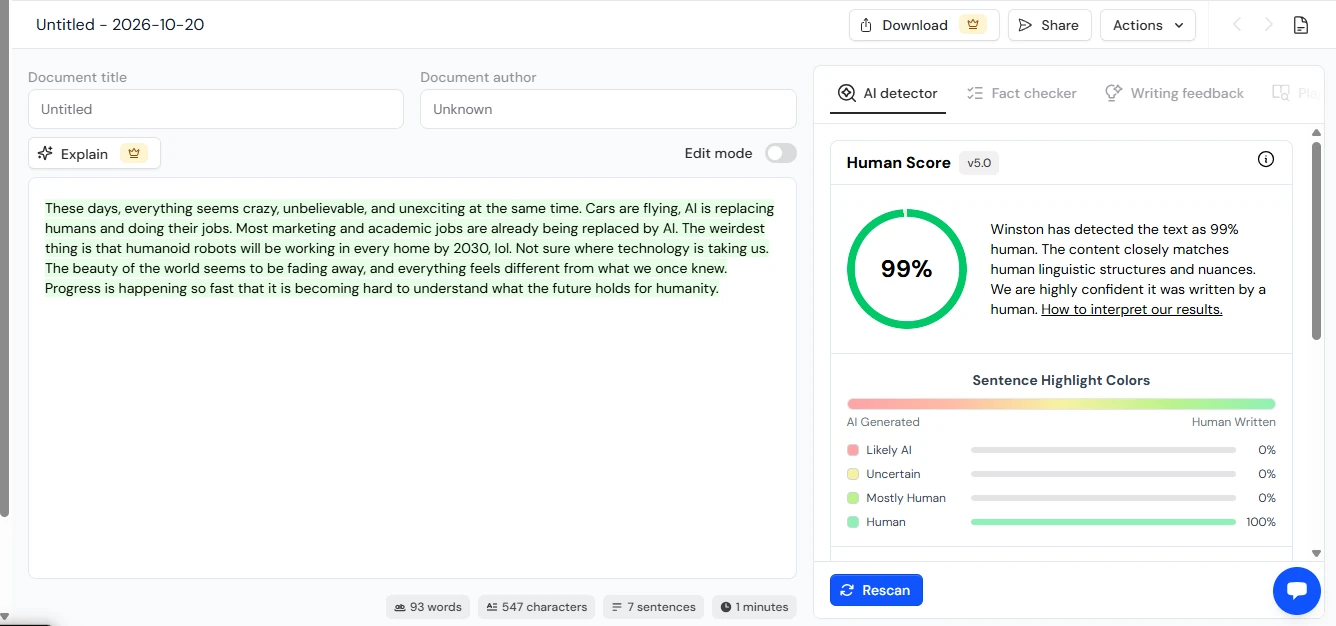
Please read this the right way. Three samples is not a study, and we are not claiming which result was correct. All three texts were also far shorter than the 300 words Winston itself recommends for a reliable reading. What the test does show is how sensitive the score is. The same idea, expressed with slightly different wording, went from 2% to 99%. If a few edited words can flip a verdict that completely, no student should be judged on a single number.
What students say on Reddit
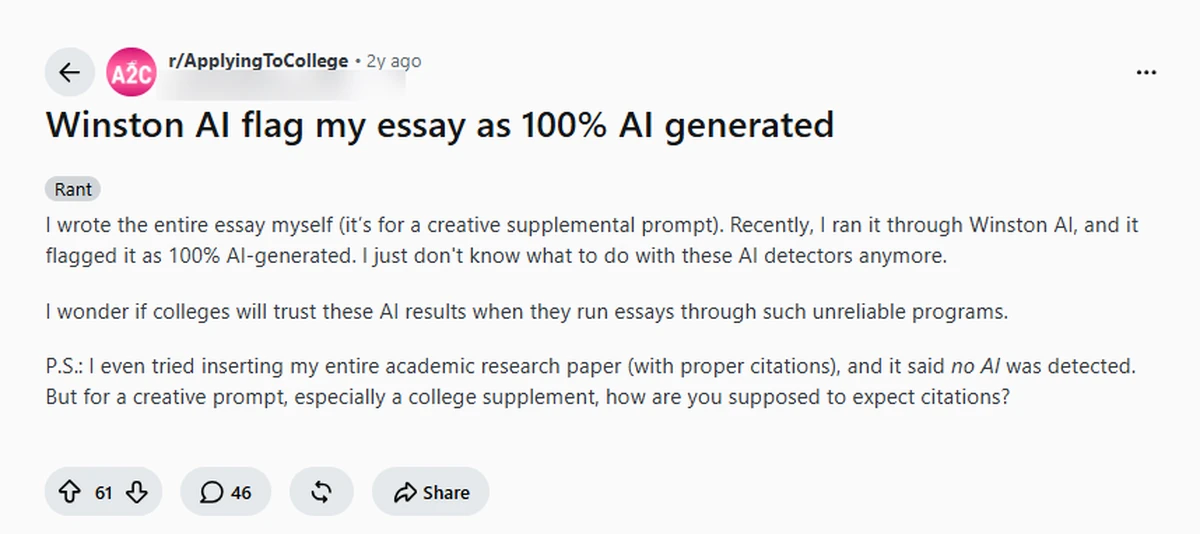
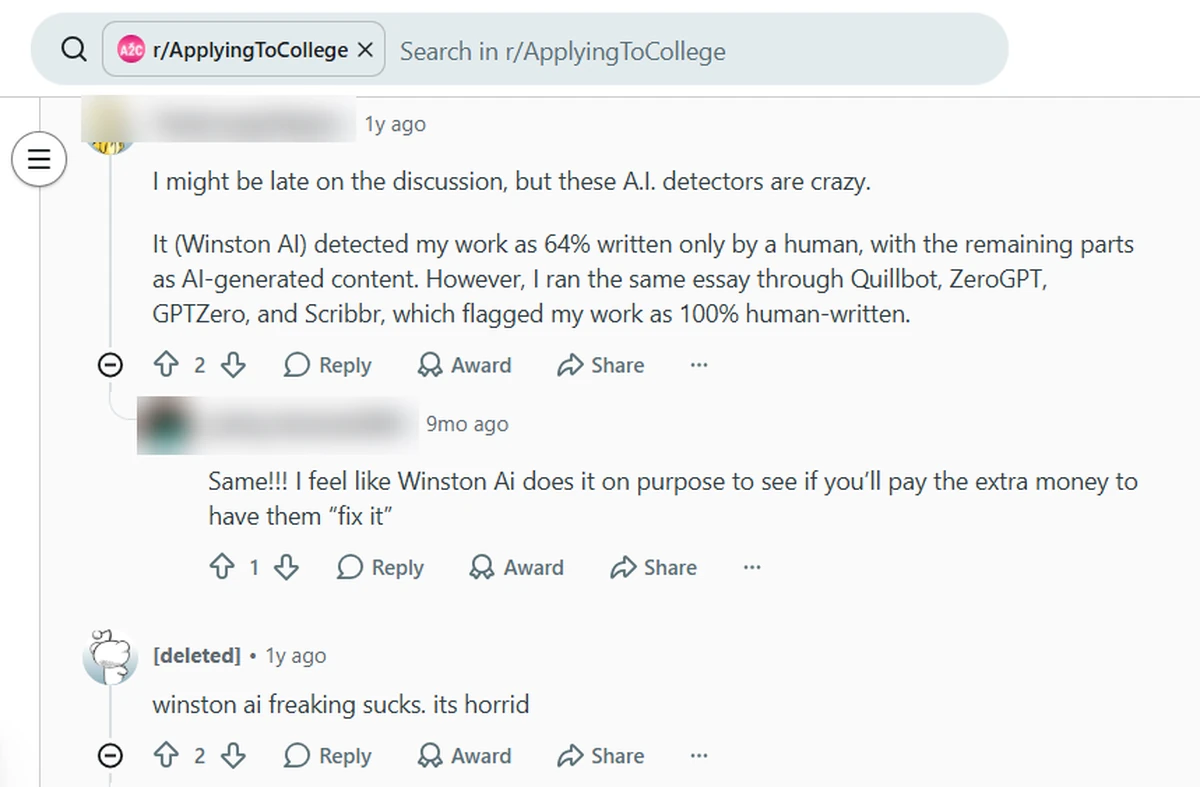
On Reddit, students describe the same worry. In a thread on r/ApplyingToCollege, a student said they wrote a creative supplement essay themselves and Winston flagged it as 100% AI generated, then asked whether colleges will trust such scores. Another commenter said Winston rated their essay 64% human, while Quillbot, ZeroGPT, GPTZero and Scribbr all called it fully human. Others replied with strong complaints. These are anecdotes from individual students, not test results, but they match the pattern in the research: different detectors often disagree about the same text.
What Trustpilot reviewers say
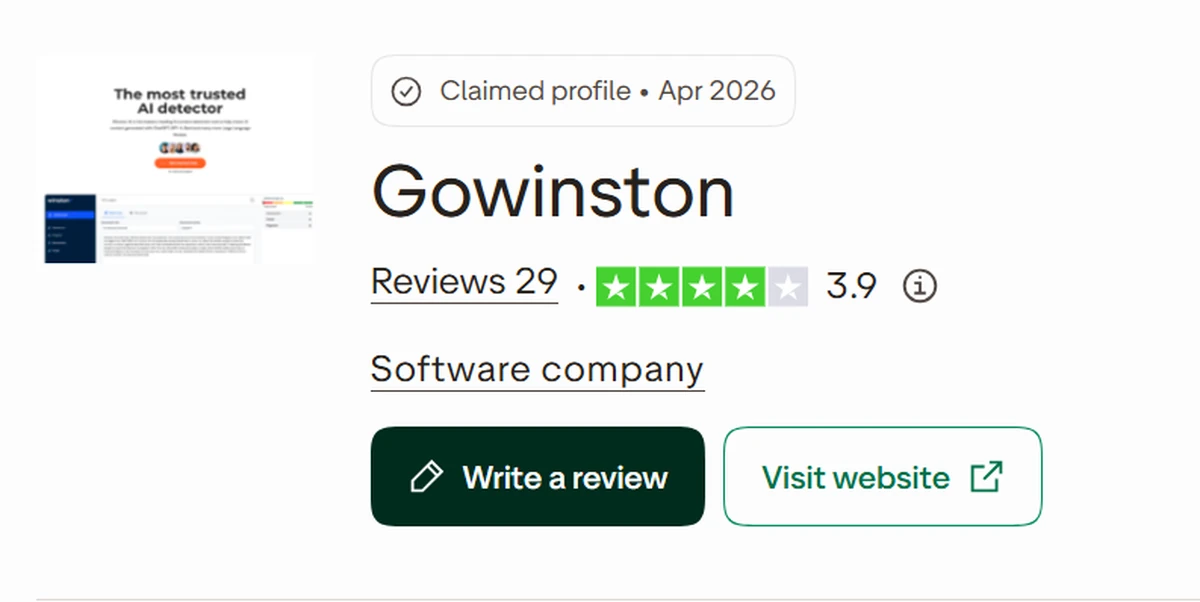
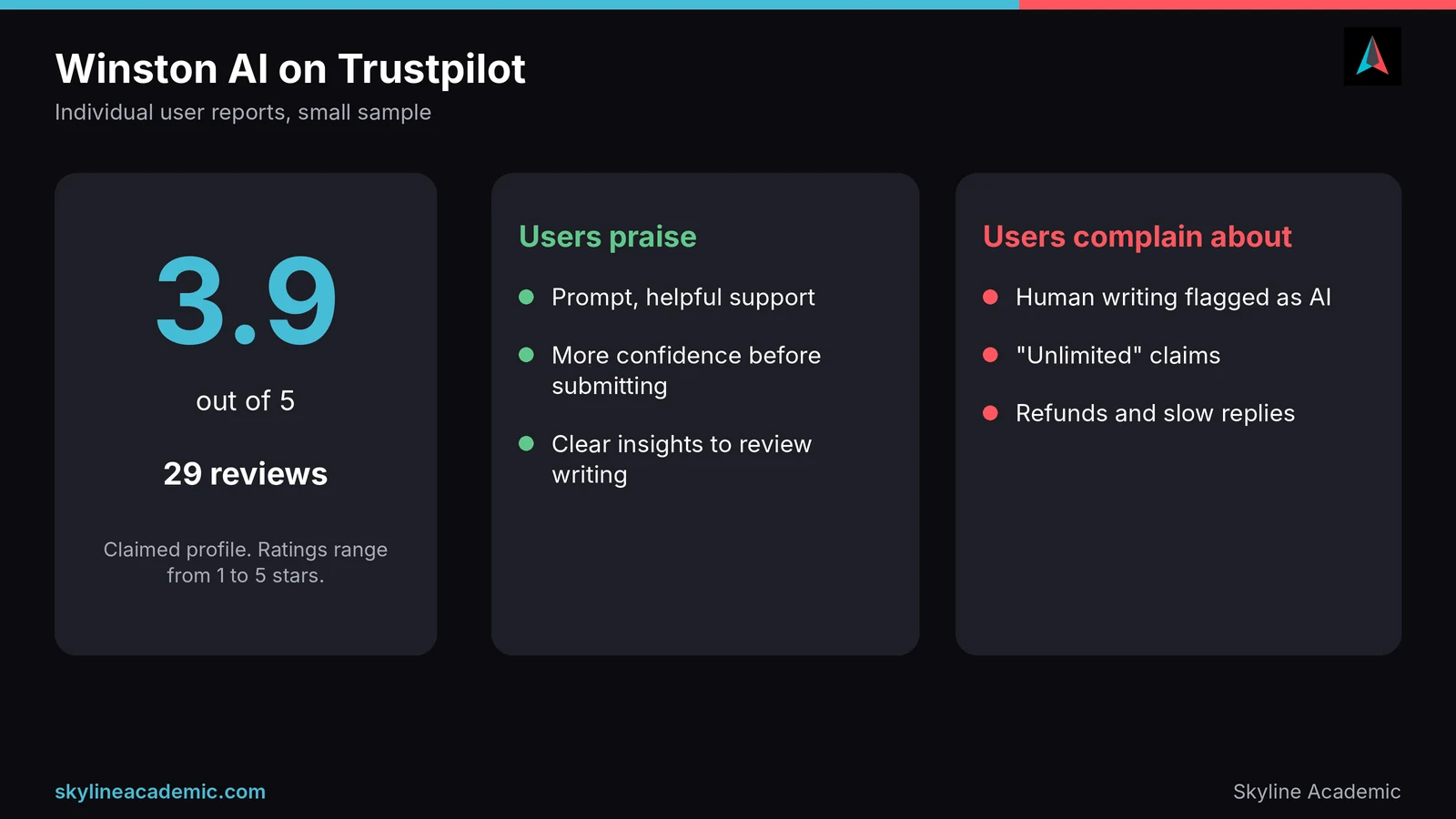
Winston AI holds a 3.9 rating from 29 reviews on Trustpilot, which is a small sample. Reading through them, the praise and the complaints fall into clear groups.
| What users praise | What users complain about |
|---|---|
| Helpful, prompt customer support | Human writing flagged as AI |
| Feeling more confident before submitting work | Old speeches and well-written text flagged as AI |
| Clear insights to review and adjust writing | “Unlimited” claims that did not feel unlimited |
| Easy cancellation, according to one reviewer | Refund requests and slow or missing replies |
Some reviewers said Winston ranked well in their own small tests. Others called it highly inaccurate. Both groups are describing real experiences, which is exactly why one tool’s verdict should not decide anything important.
Why detectors like Winston can misjudge honest writing
Clear, formal writing can look like AI
Detectors reward unpredictability. If you write in short, tidy, well-organized sentences, which is exactly what most teachers ask for, you can look more machine-like than a messy writer. One Trustpilot reviewer described this problem, saying well-written text was flagged while text with spelling errors passed as human.
Non-native English writers face extra risk
If English is your second language, you may use simpler vocabulary and more standard sentence patterns. The Stanford study found detectors flagged non-native writing far more often. If this sounds like you, our guide on AI detection for non-native English students explains the risk in detail and what to do about it.
Short texts give shaky scores
A paragraph has very little to analyze. Winston recommends at least 300 words for a more reliable assessment, and our own test used texts well below that. If you only scan a short section of your essay, treat the result as a rough hint at best.
Light edits can change the score
As our test showed, rewording can move the number a lot. That also means a score from one scan, on one day, is a snapshot, not a fact. For a closer look at why this happens, read our explainer on AI detection false positives.
How to read your Winston AI score
Winston gives a likelihood, not a fact. A score near 100% human means the tool saw patterns it associates with people. A score near 0% means it saw patterns it associates with AI. A middle score, like the 64% human result one Reddit user described, usually means some sentences looked human to the tool and some did not.
The most useful part is often the sentence highlighting. If a few sentences are flagged, read them and ask whether they sound generic, repetitive or overly polished. Adding a specific example, a personal detail or a clearer opinion often makes writing stronger, whatever the detector says. Do not treat a single scan as the final answer, and always scan the full piece, not a short extract.
Common student situations and what the score means
You wrote everything yourself but got a low human score
This happens, and it is the situation that worries students most. It does not prove you did anything wrong. Check the length of the text you scanned, keep your drafts, and read the guidance in the section below on what to do next.
You used AI to brainstorm but wrote the essay yourself
A detector cannot see your process, only your final words. A good score does not make your use of AI allowed, and a bad score does not make it forbidden. What matters is your course policy, so read it and disclose AI use if your course asks you to.
You are a non-native English writer
Plan for extra caution. Your writing may be simple and correct, which detectors can misread. Keep your drafts, scan the whole piece, and do not rely on one tool.
Your university uses a different detector
Then a Winston score tells you very little about what your lecturer will see. Ask your course team which tool they use and what they do with the result. Many universities say a detector score alone should not decide a misconduct case.
Winston AI vs Turnitin and other detectors
Students often ask whether Winston is as accurate as Turnitin. There is no fair, public, head-to-head test we can point to, so we will not invent a ranking. What we can say is that your university usually decides which detector it uses, and many do not use Winston at all. A good Winston score does not guarantee a good result elsewhere, and a bad one does not mean your lecturer sees the same thing.
The tools also disagree with each other, as the Reddit example shows. If you are comparing tools, our review of GPTZero accuracy shows the same pattern, strong marketing claims alongside mixed real-world reports. The sensible approach is to use any detector as a smoke alarm, not a judge.
Winston AI plagiarism checker and humanizer
The plagiarism checker
Winston offers a plagiarism checker that looks for copied content and helps with citations. On its pricing page, advanced plagiarism detection appears on the Advanced and Elite plans, not the free plan. Remember that plagiarism checking and AI detection are different jobs. One looks for matching text from other sources, and the other guesses how a text was produced.
The humanizer
Many students search for “Winston AI humanizer”. We could not find a humanizer tool on Winston’s main page, so check what the company actually offers before you pay for anything with that name. More importantly, tools that rewrite text to beat detectors can break your university’s rules and still fail to work, as our test suggests. If you used AI for a draft, the safer path is to follow your course policy and rewrite in your own words.
Who should and should not use Winston AI
Winston can be a reasonable choice if you want a quick, rough self check on a long piece of writing, if you like sentence-level highlights to spot flat or repetitive passages, or if you are a freelance writer whose client asks for a score.
It is a poor choice if you plan to use a score as proof in a dispute, if you are checking very short texts, or if you hope to find the one tool that gives the same answer as your university. No detector can promise that.
What to do if Winston flags your own writing
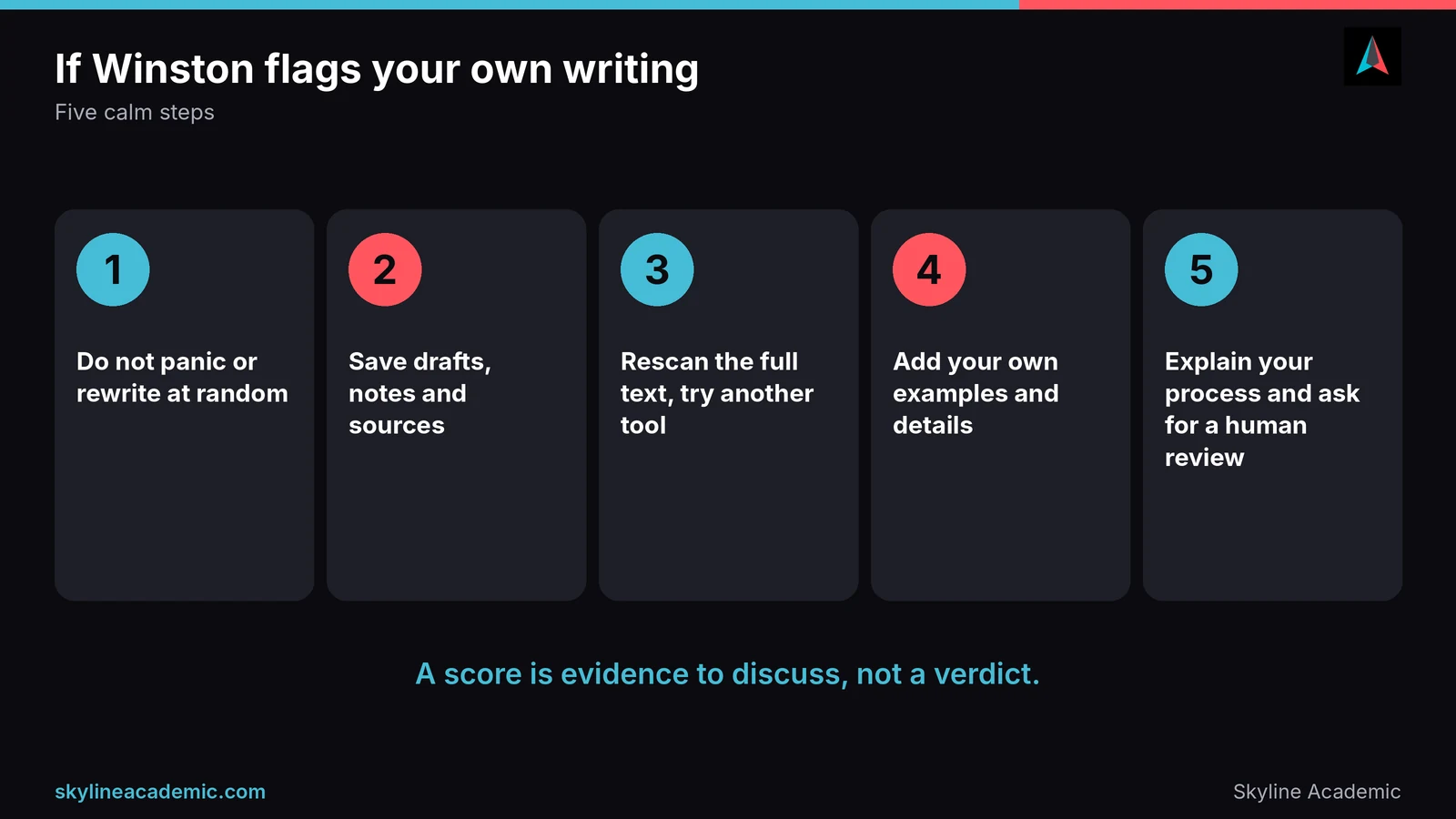
A bad score can feel like an accusation. Here is a calm way to handle it.
- Do not panic and do not start rewriting at random to chase a higher score. That can make your writing worse.
- Save your evidence: drafts, version history, notes, outlines and the sources you used.
- Rescan the full text, not just a short section, and try another tool to see whether they agree.
- Read the flagged sentences out loud and make sure they sound like you. Add your own examples and specific details where they feel generic.
- If your lecturer raises concerns, explain your writing process calmly and ask for a human review. Our guide on being falsely accused of using AI shows you step by step how to respond.
Still confused and need help?
If you are unsure whether your work will pass, you do not have to guess. Skyline Academic is one of the leading 1:1 live tutoring platforms, with a dedicated learning management system that includes progress tracking, assignment quizzes, workshops and bootcamps. Alongside tutoring, we offer a plagiarism checker and an AI content detector so you can check your draft before you submit it, and a live tutor can help you strengthen your own voice and show you how to document your writing process. Book a session when you are ready.
Frequently asked questions
Is Winston AI accurate?
Winston claims 99.87% accuracy, but that is the company’s own figure. Independent research shows AI detectors in general can be fooled and can wrongly flag honest writers. Treat the score as a hint, not proof.
How accurate is Winston AI on human writing?
Winston’s help center reports a 0.03% false positive rate on English human writing in its own testing. It publishes no separate rate for non-native English writers, and real users report false flags.
Is Winston AI accurate like Turnitin?
There is no fair public head-to-head test, so no one can say for sure. Your university chooses its own tool, and the two can give different results on the same text.
Is Winston AI free?
Partly. The free plan gives 2,000 credits for a 14 day trial. After that you need a paid plan, which starts at $60 a year on annual billing at the time of writing.
Can Winston AI detect ChatGPT?
Winston says it detects text from ChatGPT, Claude, Gemini and other models. Independent tests suggest detectors do better on well-known models and struggle when text is reworded or edited.
Can Winston AI be wrong about human writing?
Yes. Users report human essays and even old speeches flagged as AI, and our own test showed the score jumping from 2% to 99% after light rewording.
How many words does Winston AI need?
Winston recommends at least 300 words for a more reliable reading. Short paragraphs can give scores that swing a lot.
Is the Winston AI plagiarism checker good?
It offers plagiarism detection on its Advanced and Elite plans. We could not verify independent test results, so compare it with other checkers before you rely on it.
Is there a Winston AI humanizer?
We could not find a humanizer on Winston’s main page. Tools that rewrite text to beat detectors can also break academic rules, so use them with great care.
What should I do if Winston says my essay is AI?
Keep your drafts and notes, rescan the full text, try another detector, and ask for a human review if needed. Do not rewrite blindly to chase a score.
Conclusion
Winston AI is a decent tool for a rough check, but it is not a judge. Its 99.87% claim comes from the company itself, independent research shows detectors can misjudge honest and non-native writers, and our own quick test showed how far a score can move after a light rewrite. Use it to spot passages worth improving, keep your drafts as proof of your work, and never let one number decide your grade. If you want a tutor to help you write with confidence and prove your process, Skyline Academic is here to help.
Sources
- Winston AI homepage and accuracy claims
- Winston AI pricing
- Winston AI help center: false positive rates and human writing accuracy
- RAID: A Shared Benchmark for Robust Evaluation of Machine-Generated Text Detectors (arXiv)
- AI-Detectors Biased Against Non-Native English Writers, Stanford HAI
- Guidance on AI Detection and Why We Are Disabling Turnitin’s AI Detector, Vanderbilt University
- Winston AI reviews on Trustpilot