
Last updated:
It is the night before your deadline. Your essay is nearly done, but you are scared. Maybe you used an AI tool for part of it and you are not sure if that was allowed. Maybe you wrote every word yourself, but a friend’s honest essay got flagged last term and now you are worried yours will be too. So you search “how to bypass Turnitin” and hope for a quick fix.
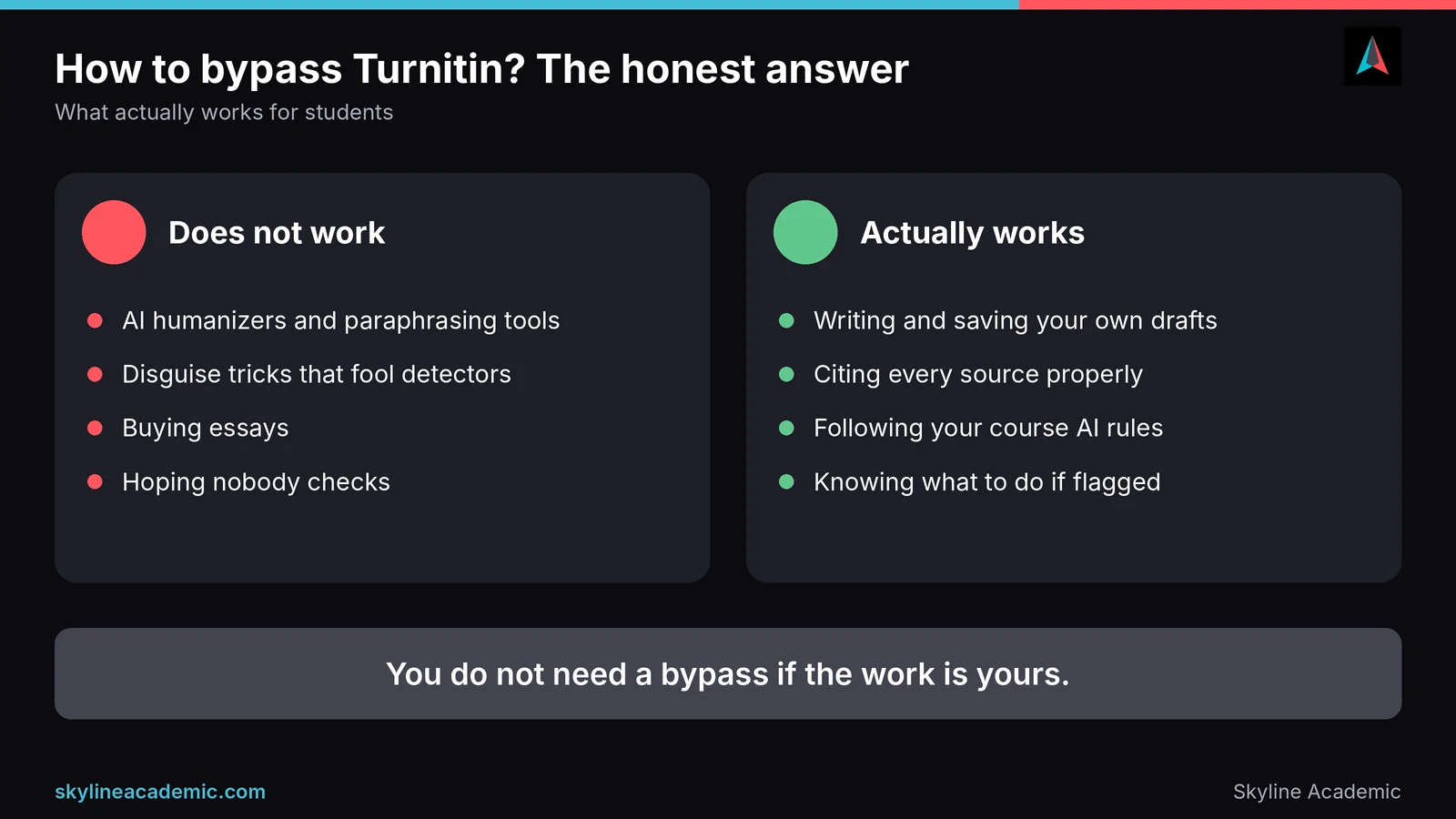
Here is the honest answer. There is no reliable or safe way to bypass Turnitin with AI-written or copied work, and trying can turn a stressful night into a misconduct case. Turnitin says it now flags text that was rewritten by AI paraphrasing and “humanizer” tools. But if your work is your own, you do not need to bypass anything. You need to understand how Turnitin works, avoid false flags, fix a high similarity score the right way and know what to do if you are flagged. This guide shows you how. We look at one of these tools in detail in our Phrasly AI review.
How Turnitin actually works
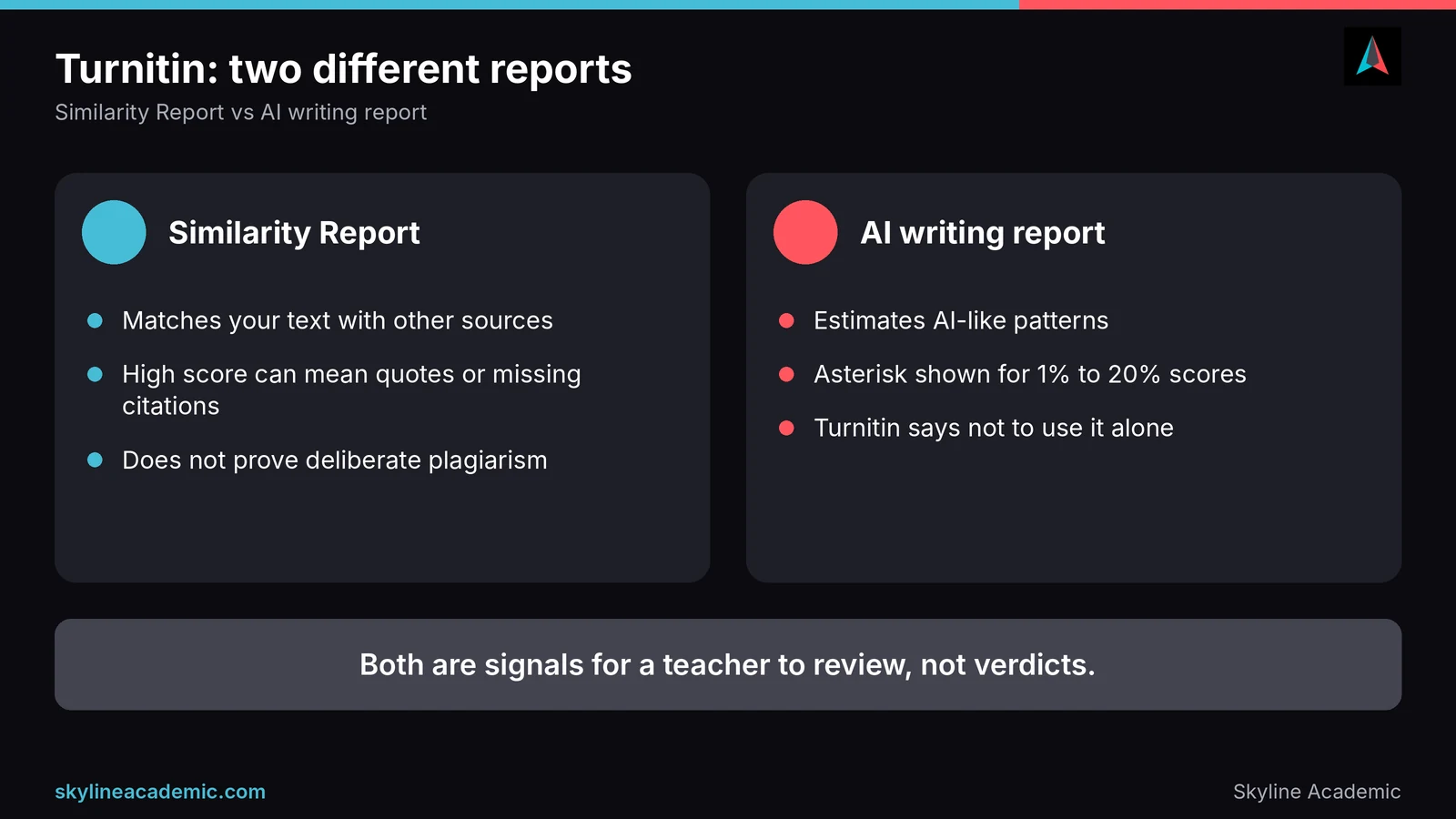
Turnitin is not one check but two. The Similarity Report compares your writing with web pages, published work and other student papers, then shows which parts match. The AI writing report estimates how much of your text looks like it was written by a large language model such as ChatGPT. Your teacher may see one or both, depending on how your school has set it up.
| Feature | Similarity Report | AI writing report |
|---|---|---|
| What it checks | Matches between your text and other sources | Patterns that look like AI-written text |
| What a high score can mean | Lots of quotes, common phrases, missing citations or copying | Some text may be AI-generated or AI-paraphrased |
| What it cannot prove | That you plagiarised on purpose | That you used AI, or who wrote the text |
What your AI score means
Turnitin’s own guide says it shows an asterisk instead of a number when the AI score is between 1% and 20%, because its testing found “a higher incidence of false positives” in that range. Text it thinks is AI-generated is highlighted in cyan, and text it thinks was AI-generated and then changed by a paraphrasing tool or word spinner is highlighted in purple. Turnitin also says the tool “should not be used as the sole basis for adverse actions against a student.” In 2023, it said it raised the minimum length it checks from 150 to 300 words, because accuracy improves with more text.
In other words, Turnitin itself says its AI score is a signal for a human to look at, not a final verdict.
What your similarity score means
The similarity score is the share of your text that matches other sources. It is not a plagiarism score. A 25% match made up of properly quoted and cited material can be completely fine, while a 10% match from one copied paragraph with no citation is a real problem. Teachers look at where the matches come from, not just the number. Many schools also let teachers exclude quotes or the reference list from the score, so ask your teacher how they read it if you are unsure.
Why students search “how to bypass Turnitin”
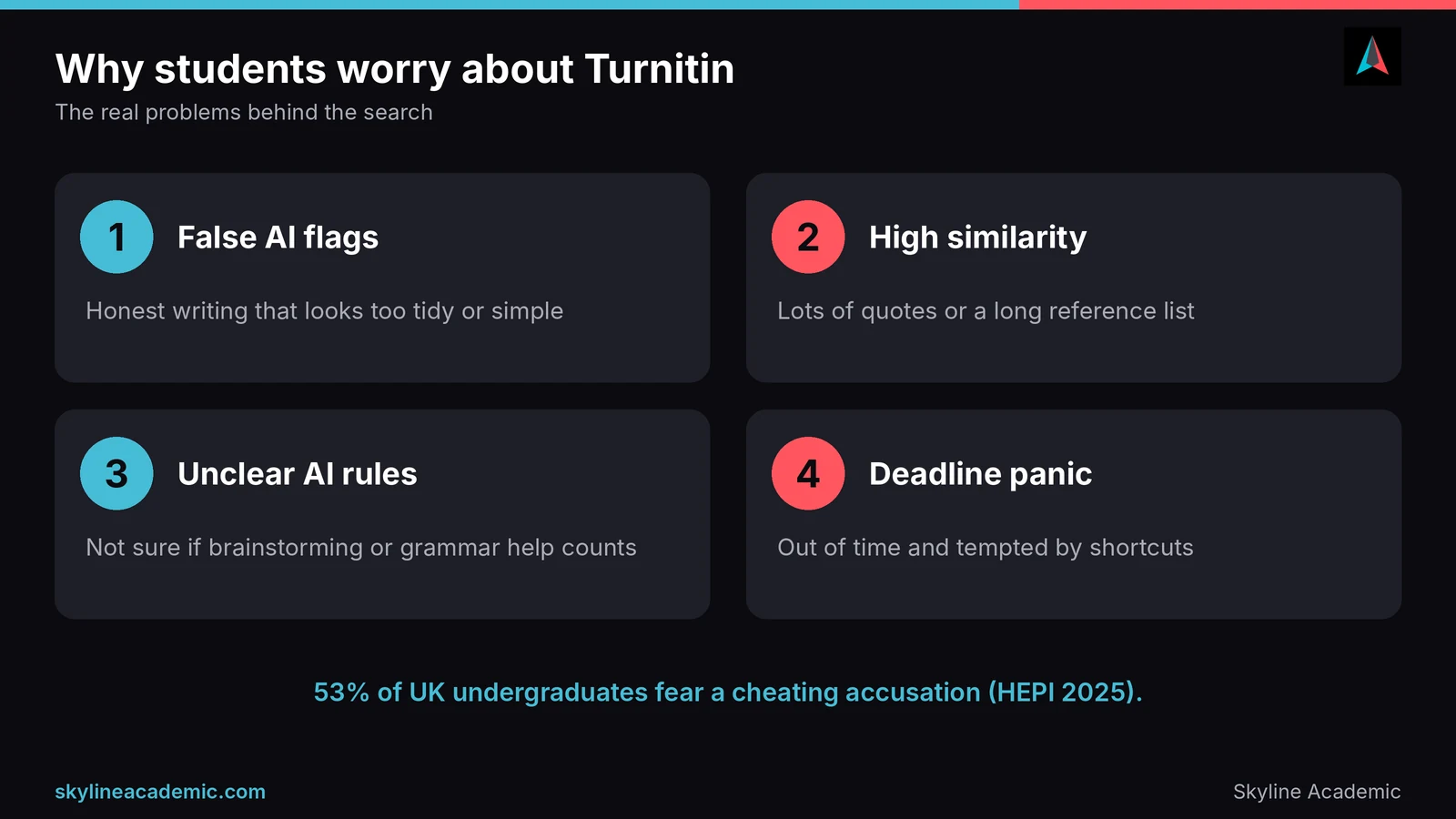
Most students who type this are not trying to cheat. They are scared. In the HEPI Student Generative AI Survey 2025, 53% of UK undergraduates said they worry about being accused of cheating. That fear is understandable, because the rules around AI are often unclear and change from course to course.
Here are the real problems we hear from students. Some wrote every word themselves and still worry an AI detector will flag their style. Some have a high similarity score because they used lots of quotes or a long reference list. Some are non-native English writers who use simple, careful sentences and fear that looks “robotic”. Some used AI for brainstorming or grammar and do not know if that counts. And many are simply out of time, which is when panic decisions happen. If deadlines are the real problem, our guide to the best study techniques can help you plan earlier next time.
It also helps to know that teachers are not out to trap you. Most want to see that you learned something and did the work in a fair way. When students talk to their teacher early about worries, unclear rules or deadline problems, things usually go much better than when they try to hide a problem.
Every one of these problems has an honest fix, and none of them need a “bypass”.
Why “bypass” tricks backfire
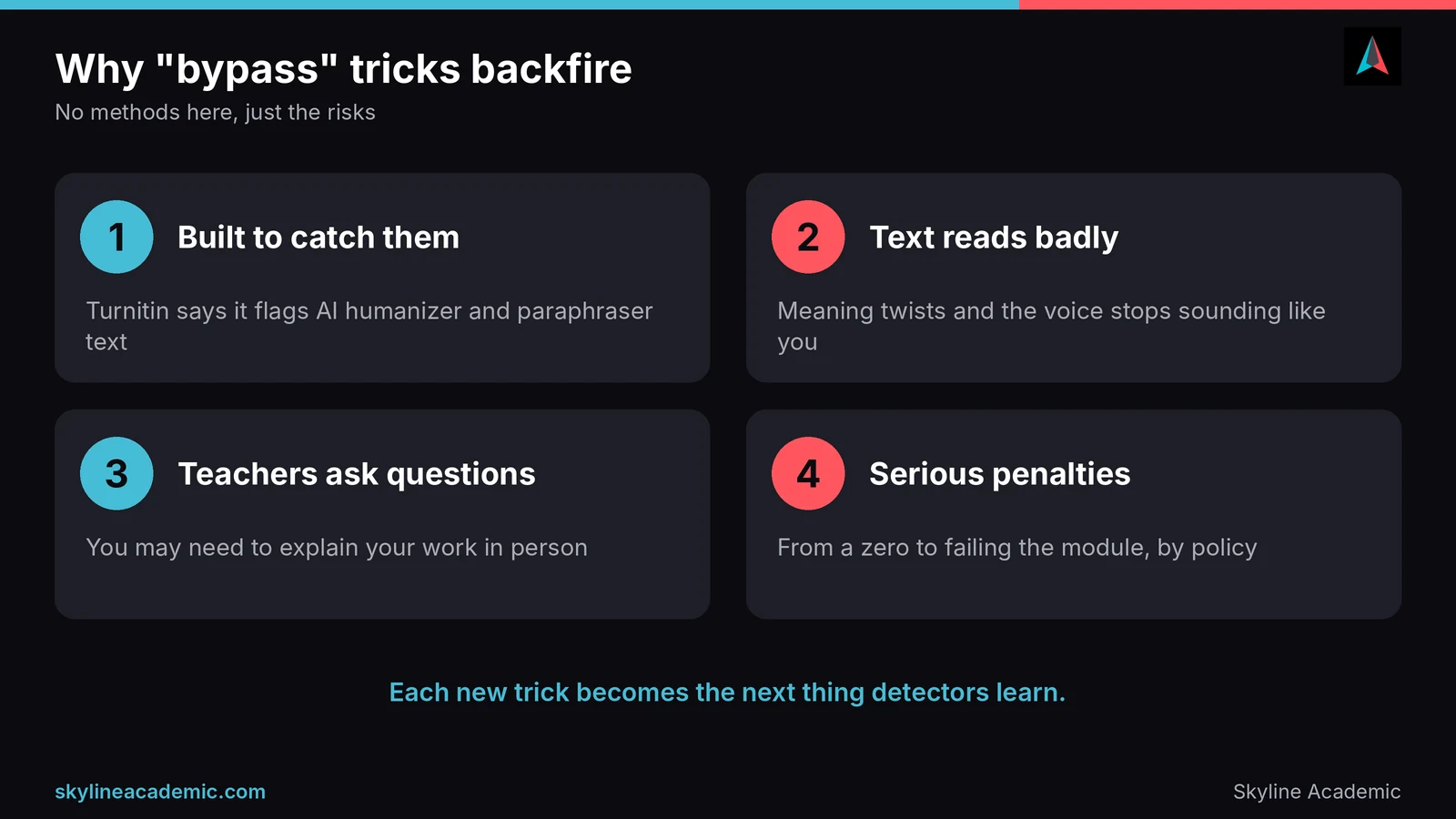
The internet is full of tools and tips that promise to make AI text “undetectable”. We will not list them, because they put students at real risk. Here is why.
Turnitin is built to catch them
In August 2025, Turnitin announced “AI bypasser detection”, which it says can flag text changed by AI humanizer tools. Its chief product officer said humanizers “leave a statistical trace that can be learned and detected.” Turnitin’s guide also has a separate highlight for AI text that was run through a paraphrasing tool or word spinner. These are company claims and still need independent testing, but they show the direction clearly: each new trick becomes the next thing detectors are trained on.
Disguised text often reads badly
Tools that scramble wording to fool detectors often twist the meaning, add odd word choices and break the flow. Teachers notice writing that suddenly sounds nothing like you, especially if they know your earlier work. And when a teacher has doubts, they can ask you to explain your essay in person, which no tool can do for you.
The consequences are serious and rising
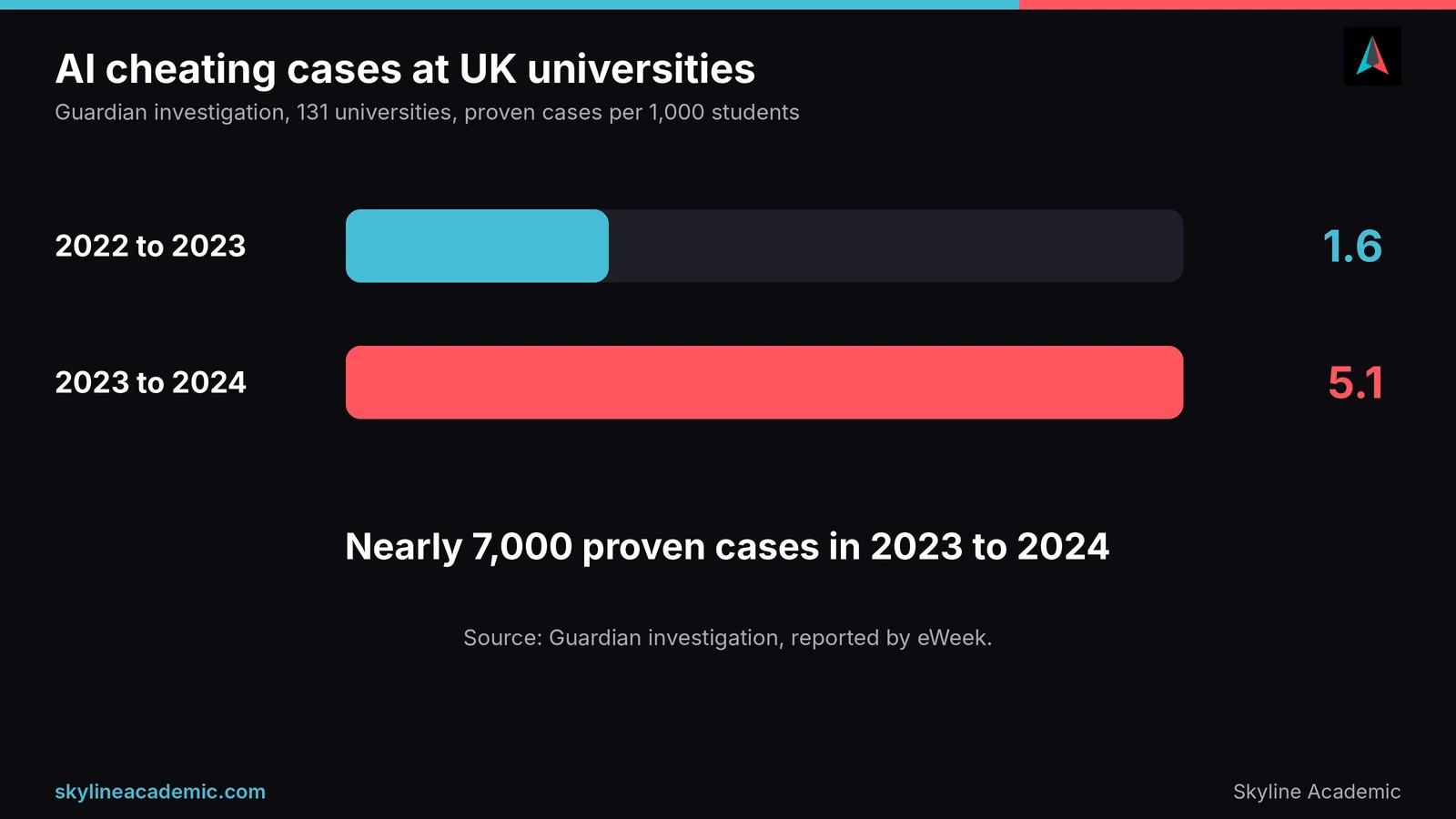
Universities are catching more AI misuse. A Guardian investigation, reported by eWeek, found nearly 7,000 proven cases of AI-assisted cheating across 131 UK universities in 2023 to 2024. That is 5.1 cases per 1,000 students, up from 1.6 the year before. Penalties can range from a zero on the assignment to failing the module or worse, depending on your university’s policy.
Paying someone else is not a safe shortcut either
Some students think about buying an essay instead of using AI. That is contract cheating, and most universities treat it as one of the most serious forms of misconduct. Bought essays can also be reused or resold, and they rarely match your voice or your course. If you are this stuck, it is a sign to ask for an extension or real support, not to take a bigger risk.
How to avoid a false Turnitin AI flag on your own writing
If you wrote your work yourself, the goal is not to hide anything. It is to make your process easy to see and your writing clearly yours.
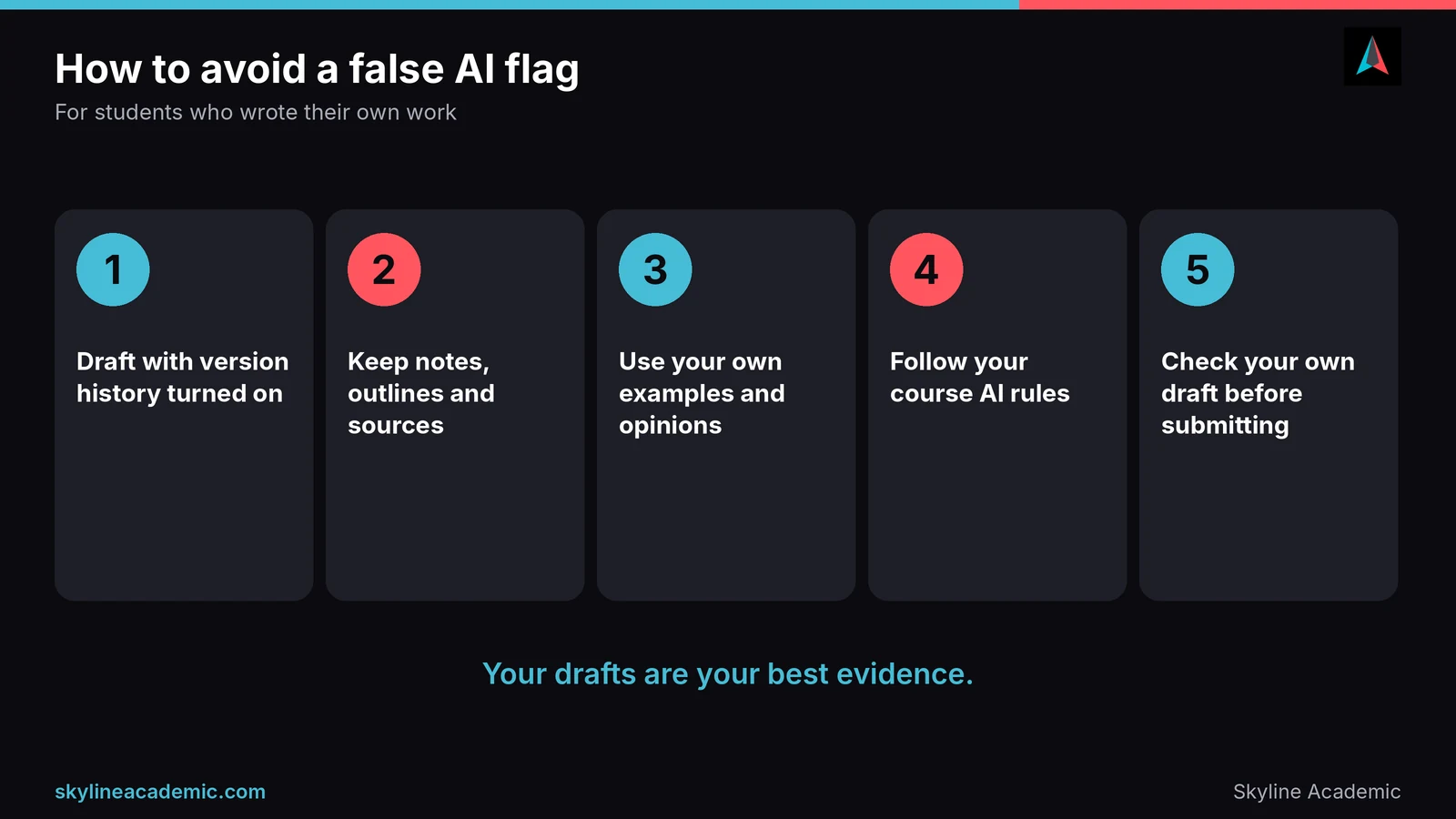
- Write your drafts in a tool with version history, such as Google Docs or Word with autosave, so you can show how your work grew over time.
- Keep your notes, outlines and source list. They are strong evidence of your own thinking.
- Use your own examples, opinions and details from your course, lectures or experience. Generic writing is more likely to look machine-like.
- Follow your course’s AI rules, and disclose any AI help if your school asks you to.
- Check your own draft before you submit, then fix anything that reads flat or generic.
Remember that detectors can get it wrong. Our guide on AI detection false positives explains why honest writing sometimes gets flagged. The risk is higher if English is your second language. A well-known Stanford study found seven detectors labeled 61.22% of essays by non-native English writers as AI generated. Turnitin was not part of that study and says its own research shows no significant bias, but it is still a reason to keep your drafts. Our guide on AI detection for non-native English students has more practical advice.
How to lower a high similarity score the right way
A high similarity score does not always mean plagiarism. Matches in quotes, references, technical terms and common phrases are normal, and your teacher knows that. What matters is whether you have used sources properly.
| Common problem | Honest fix |
|---|---|
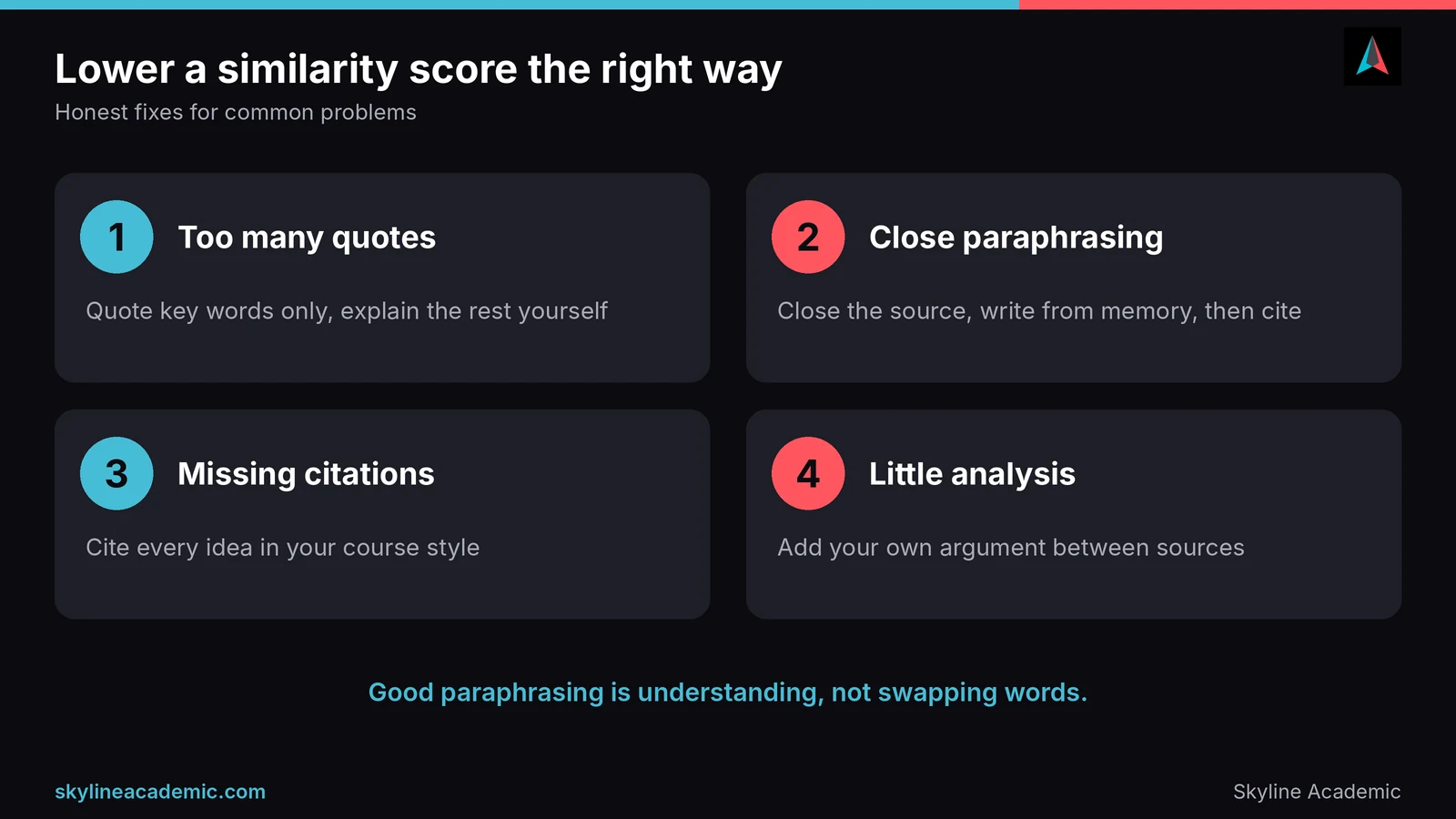
| Too many long quotes | Quote only the key words and explain the idea in your own words, with a citation |
| Paraphrasing that stays too close to the source | Close the source, write from memory, then check and cite it |
| Missing or wrong citations | Cite every idea you took from a source, in the style your course uses |
| Very little of your own analysis | Add your own argument, comparisons and examples between sources |
| Reusing your own old work | Ask your teacher first, as self-plagiarism rules vary |
Good paraphrasing is not swapping words. It means understanding an idea well enough to explain it in a new way, and still giving credit. Before you submit, you can check your draft with our free plagiarism checker to spot passages that need a citation or more of your own words.
Using AI tools without breaking the rules
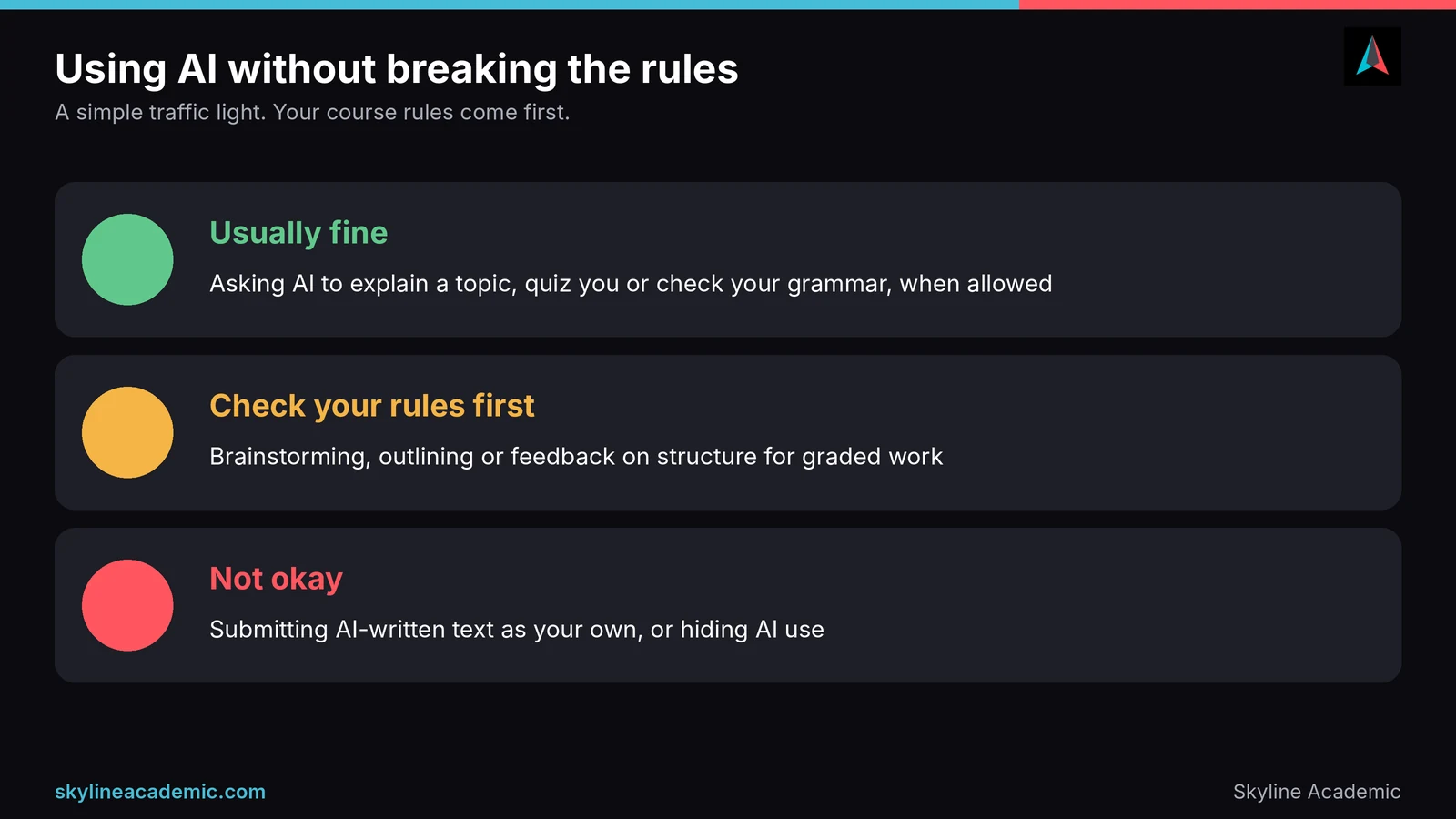
AI is not automatically cheating. Many courses allow AI for some tasks, such as brainstorming, explaining a hard topic or checking grammar, and ban it for others, such as writing graded text. The key is to know your rules and stay the author of your work.
A simple rule of thumb helps. Using AI to learn is usually fine. Using AI to plan or give feedback depends on your course, so check first. Using AI to write text you submit as your own is almost always not allowed. Our guide is using AI cheating walks through the grey areas, and our guide on using Claude AI ethically as a student shows safe ways to study with AI.
If you do use AI in an allowed way, a short note can protect you. Something like “I used an AI tool to quiz me on this topic and to check grammar. All writing and sources are my own” is often enough, unless your school has its own form.
If you already used more AI than your rules allow
Maybe you are reading this with a draft that leans on AI more than you are comfortable with. The safest step is to fix it before you submit, not to disguise it. Go back to your notes and sources, rewrite the sections in your own words and with your own thinking, and check them against your course rules. If time is too short, email your teacher and ask for a short extension. Many teachers would much rather give a few extra days than open a misconduct case. If you are unsure whether what you did is allowed, ask before you submit, because asking is never a breach.
A simple checklist before you submit
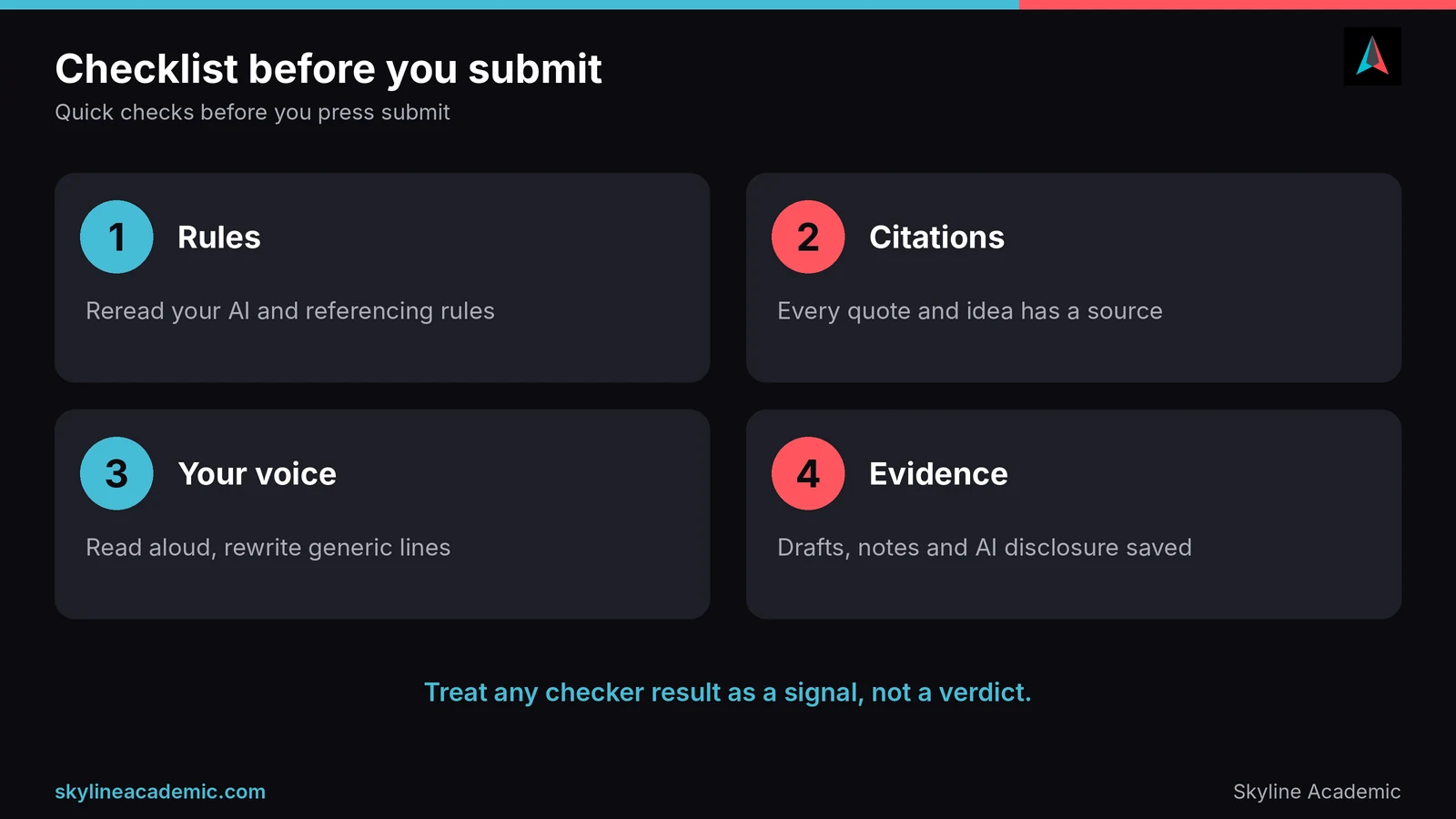
A few minutes of checking can save you a lot of stress. Before you press submit, go through this list.
- Read your course’s AI and referencing rules one more time.
- Make sure every quote, statistic and idea from a source has a citation.
- Read your essay out loud and rewrite anything that sounds generic or not like you.
- Check that your drafts, notes and version history are saved somewhere safe.
- Add an AI disclosure note if your course asks for one.
- Run your draft through a plagiarism checker and an AI checker if you want extra peace of mind, and treat the results as signals, not verdicts.
If you do all of this, you are not just “safe from Turnitin”. You are submitting work you can stand behind, which is what matters most.
What to do if Turnitin flags your work
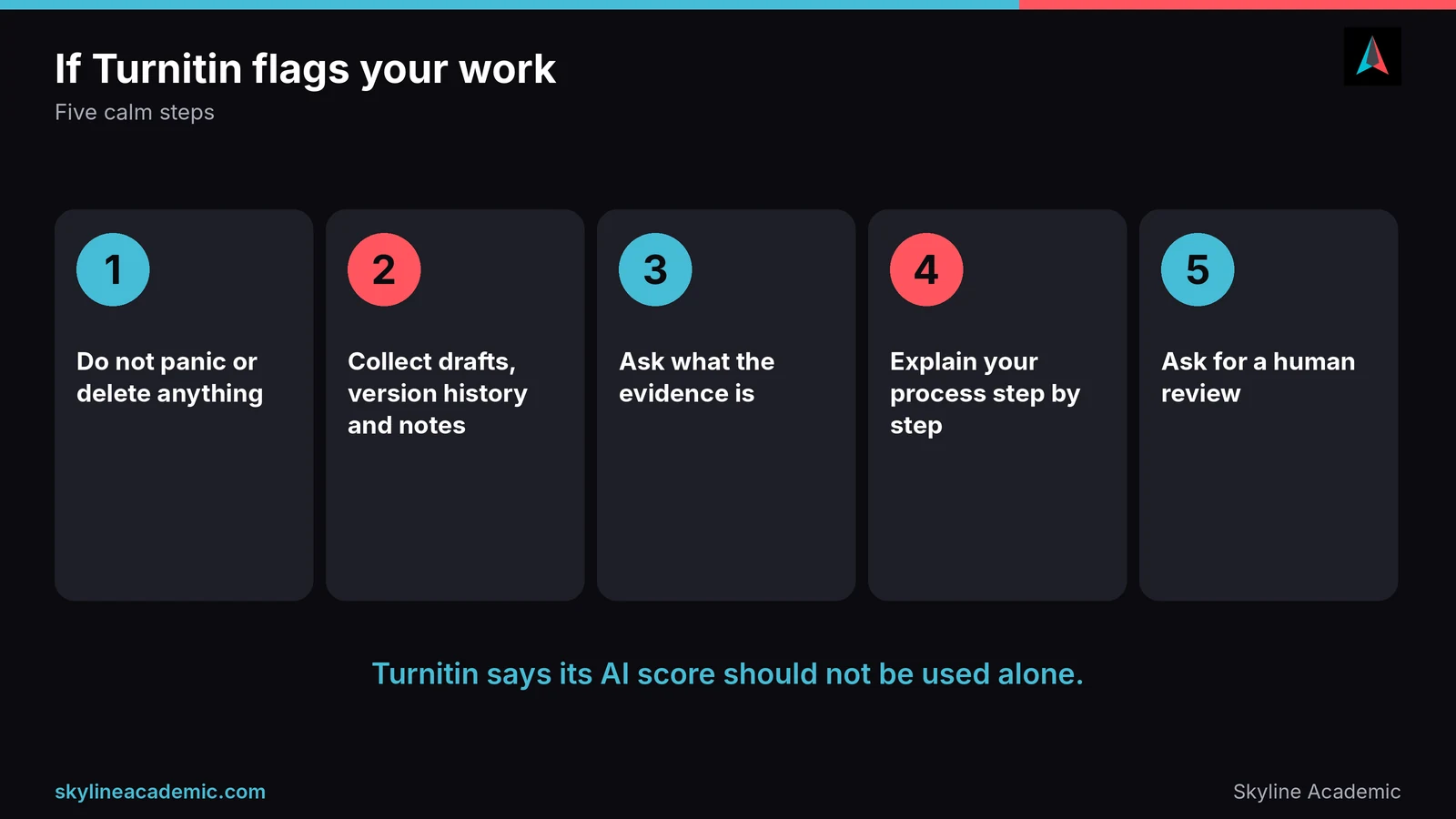
A flag is not a verdict. Turnitin itself says its AI score should not be the only basis for action. Here is a calm way to respond.
First, do not panic and do not delete anything. Collect your drafts, version history, notes and sources. Ask your teacher what the concern is, and whether it is based only on a detector score. Explain your writing process step by step, and offer to talk through your ideas in person. If needed, ask for a human review under your university’s policy. Our full guide on being falsely accused of using AI walks you through each stage. If you want help preparing, a Skyline tutor can help you organise your evidence and explain your work with confidence.
What your teacher is likely to look at
Teachers rarely decide on a score alone. They usually compare the flagged work with your earlier assignments, look at whether the writing style and level suddenly changed, and check whether the sources and citations are real and used correctly. Many will ask you to talk through your argument, explain a key paragraph or show your drafts. That is good news if you wrote the work yourself, because you can answer those questions easily. It is also why disguise tricks fail so often: they change the text, but they cannot give you the understanding a teacher is checking for.
Still worried about your next submission?
You do not have to face Turnitin alone or guess what is allowed. Skyline Academic is one of the leading 1:1 live tutoring platforms, with a dedicated LMS, progress tracking, assignment quizzes, workshops and bootcamps. We also offer an AI detector and a plagiarism checker. Use our AI content detector to check your own honest draft before you submit, knowing that any detector gives a signal, not proof. And if you want to build the skills to write strong, original work under pressure, our 1:1 live tutoring can help you get there.
Frequently asked questions
Can you bypass Turnitin AI detection?
There is no reliable or safe way to do it. Turnitin says it flags AI-paraphrased and humanized text, and getting caught can lead to a misconduct case.
Can Turnitin detect humanized or paraphrased AI text?
Turnitin says yes. It announced AI bypasser detection in 2025 and highlights AI text changed by paraphrasing tools in purple. Independent testing of this is still limited.
Can Turnitin detect ChatGPT or Claude?
Turnitin’s AI writing report is designed to flag text from large language models in general. It gives an estimate, not proof of which tool was used.
What AI percentage is acceptable on Turnitin?
There is no universal safe number. Turnitin shows an asterisk for scores between 1% and 20% because they are less reliable, and each school decides how to treat scores.
Why does Turnitin say my essay is AI when I wrote it myself?
Detectors can make mistakes, especially with formal, simple or very structured writing. Keep your drafts and version history so you can show how you wrote it.
How do I lower my Turnitin similarity score without cheating?
Quote less, cite every source, paraphrase with real understanding and add your own analysis. Check your draft with a plagiarism checker before you submit.
Can Turnitin detect paraphrasing?
It can match closely paraphrased text to sources, and it says it can flag AI paraphrasing tools. Proper paraphrasing with a citation is not plagiarism.
Does using Grammarly trigger Turnitin AI detection?
Basic spelling and grammar fixes are unlikely to be the issue, but heavy AI rewriting can change how your text reads. Check what your course allows and keep your drafts.
What happens if Turnitin flags my essay?
Usually your teacher reviews the report and may ask you about your work. Stay calm, share your drafts and notes, and ask for a human review if needed.
Is it worth trying to bypass Turnitin?
No. The risk of a misconduct penalty is far bigger than the time saved. Asking for an extension or getting help with the work is a much safer choice.
Conclusion
Searching “how to bypass Turnitin” usually comes from fear, not bad intent. The honest truth is that bypass tricks are risky and increasingly detected, while the real fixes are simple. Write your own work, keep your drafts, cite properly, follow your AI rules and know how to respond if you are flagged. If you want support to write with confidence and meet your deadlines without panic, Skyline Academic is here to help.