
Last updated:
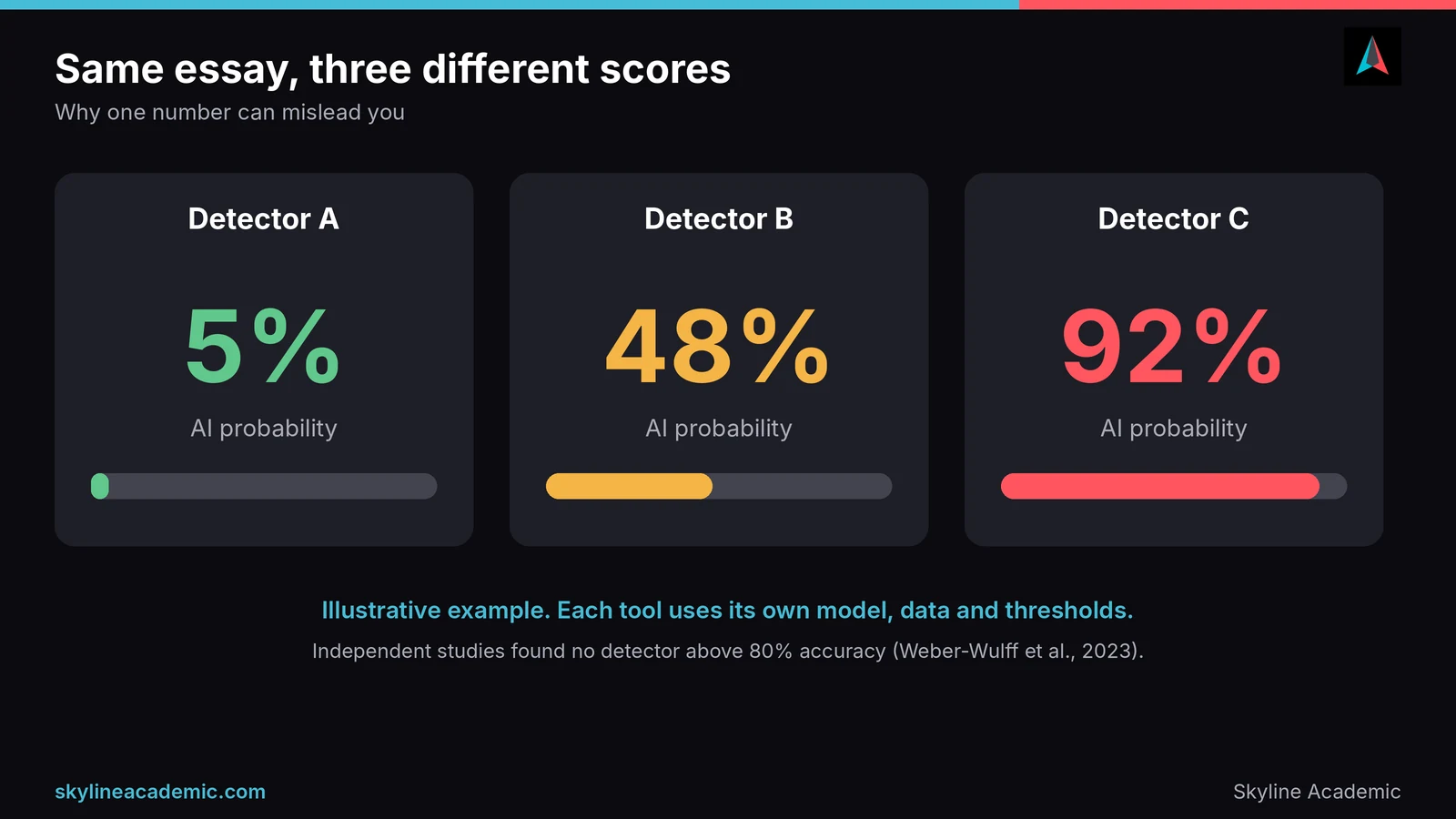
You wrote your essay yourself, line by line, over three late nights. Before you submit it, you paste it into three free AI detectors just to be safe. The first says 5% AI. The second says 48%. The third says 92%. Now you are panicking, because you have no idea which one is telling the truth, and you cannot see what Turnitin will say until it is too late.
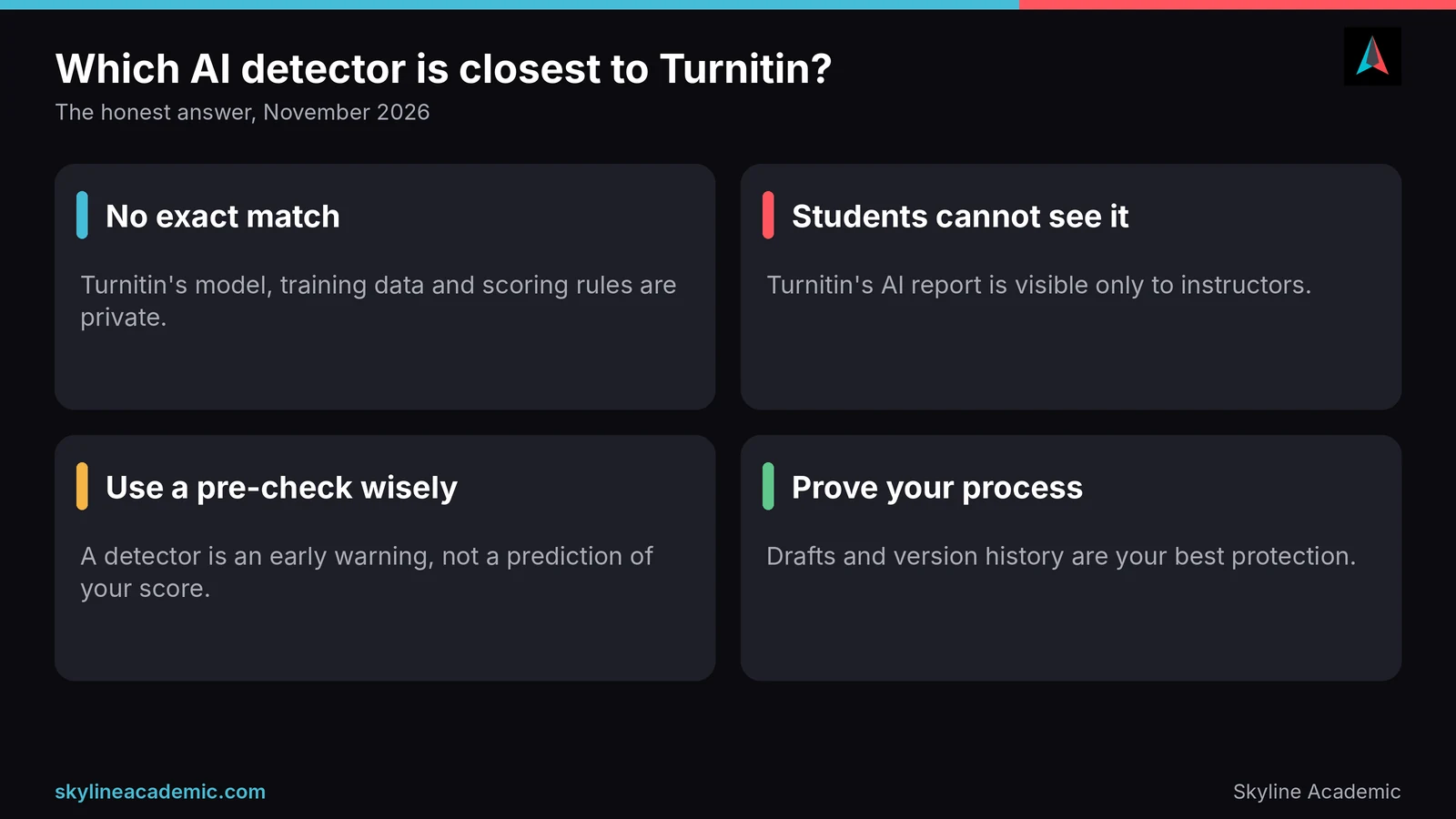
Here is the short answer. No public AI detector is a true copy of Turnitin. Turnitin’s AI model, training data and scoring rules are private, and its AI report is visible only to instructors, so no other tool can promise to give you the same score. The best you can do is use a reliable detector as an early warning sign, not as a prediction of your Turnitin result, and focus on proving that the work is yours.
Why no AI detector can perfectly match Turnitin
No other tool can match Turnitin because nobody outside Turnitin can see how its detector works, and students cannot see its AI report at all. Every other detector uses a different model, different training data and different rules.
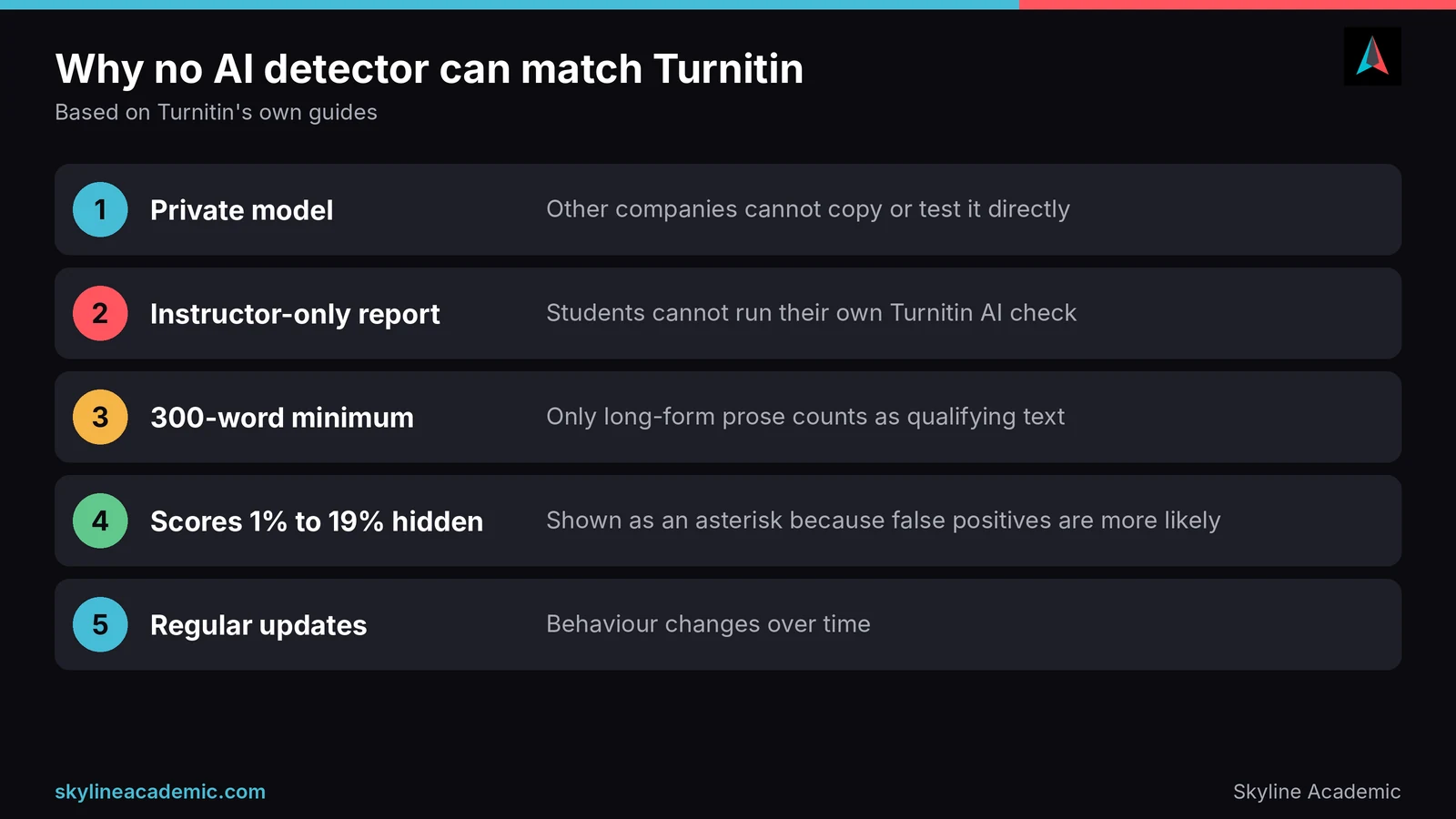
Here are the main reasons, based on Turnitin’s own guides.
- A private model. Turnitin builds and trains its own AI writing detector. Other companies cannot copy it, so they can only guess how it behaves.
- Instructor-only reports. Turnitin’s help centre says plainly that AI writing detection reports are not visible to students. Your instructor can download and share it, but you cannot run your own check.
- Its own rules about what counts. According to Turnitin’s report guide, a submission needs at least 300 words of prose. Only “qualifying text” (sentences in long-form writing) is scored, and bullet points, tables and code are not reliably detected.
- Low scores are hidden. Turnitin shows scores between 1% and 19% as an asterisk instead of a number, because false positives are more common in that range.
- Regular updates. Turnitin updates its model over time, so even a tool that behaved similarly last year may not today.
If you want a deeper look at how Turnitin’s score is calculated, our guide to how Turnitin’s AI detector works explains what your percentage actually means.
Which AI detector is closest to Turnitin? What the research says
Independent research does not name any public tool as a close match to Turnitin. The studies that tested many detectors side by side found that most tools disagree with each other and none is accurate enough to be treated as proof.
The largest academic test of detectors
In 2023, a team of researchers led by Debora Weber-Wulff tested 14 AI detection tools, including Turnitin, GPTZero, Compilatio and others. They found that all of them scored below 80% accuracy and only five scored above 70%. Interestingly, Turnitin itself ranked first in that study, with no false positives on human writing, followed by Compilatio and the GPT-2 Output Detector. The authors noted that Turnitin knew it was being tested and that Turnitin and Compilatio sponsor a conference the authors help organise, so the results should be read with that in mind.
The bigger finding was the warning. The authors concluded that detectors are “neither accurate nor reliable” enough to be used as evidence of misconduct, and that edited or paraphrased AI text was often missed.
Newer studies show the same pattern
A 2024 study by Mike Perkins and colleagues, published in the International Journal of Educational Technology in Higher Education, tested six major detectors. They found average accuracy of only about 39.5% on unedited AI text, falling to about 17.4% when the text was modified. The RAID benchmark, presented at a leading computer science conference in 2024, tested 12 detectors on over 6 million pieces of text and found they were easily fooled by small changes.
What about GPTZero, Copyleaks, Originality and Pangram?
These are the names students mention most when they ask which detector is closest to Turnitin. Each publishes its own accuracy figures, and many of them sound impressive. The catch is that most of those numbers come from the company’s own tests, on its own choice of text, and they measure how well the tool spots AI writing, not how closely it matches Turnitin. No independent study we found compares these tools directly against Turnitin’s results on the same student essays.
That does not make them useless. It just means you should read vendor claims carefully. Look for three things: whether the test was run by someone independent, whether it included human writing by non-native speakers, and whether it reports false positives, not just how much AI it caught. A tool that rarely flags honest writing is far more useful to a student than one that catches every AI sentence but also flags your own.
So which tool should you pick?
Because the research does not crown a “Turnitin twin”, the honest answer is to choose a detector based on features, not marketing claims. A tool that highlights sentences, has a low false positive rate, treats ESL writing fairly and protects your privacy will give you a more useful warning than one that just shows a big percentage. For the full list of tools we have tested, see our Turnitin checker alternatives for students, and our roundup of the best free AI detectors for students.
Here is a quick summary of the research.
| Study | What was tested | Key finding |
|---|---|---|
| Weber-Wulff et al. (2023) | 14 detectors, including Turnitin | None reached 80% accuracy. Turnitin ranked first, with sponsorship and awareness caveats |
| Perkins et al. (2024) | 6 major detectors | About 39.5% accuracy on unedited AI text, about 17.4% on edited text |
| RAID benchmark (2024) | 12 detectors, over 6 million texts | Detectors are easily fooled by small changes |
| Liang et al., Stanford (2023) | 7 detectors | 61% of essays by non-native English writers wrongly flagged as AI |
What makes an AI detector a useful Turnitin pre-check?
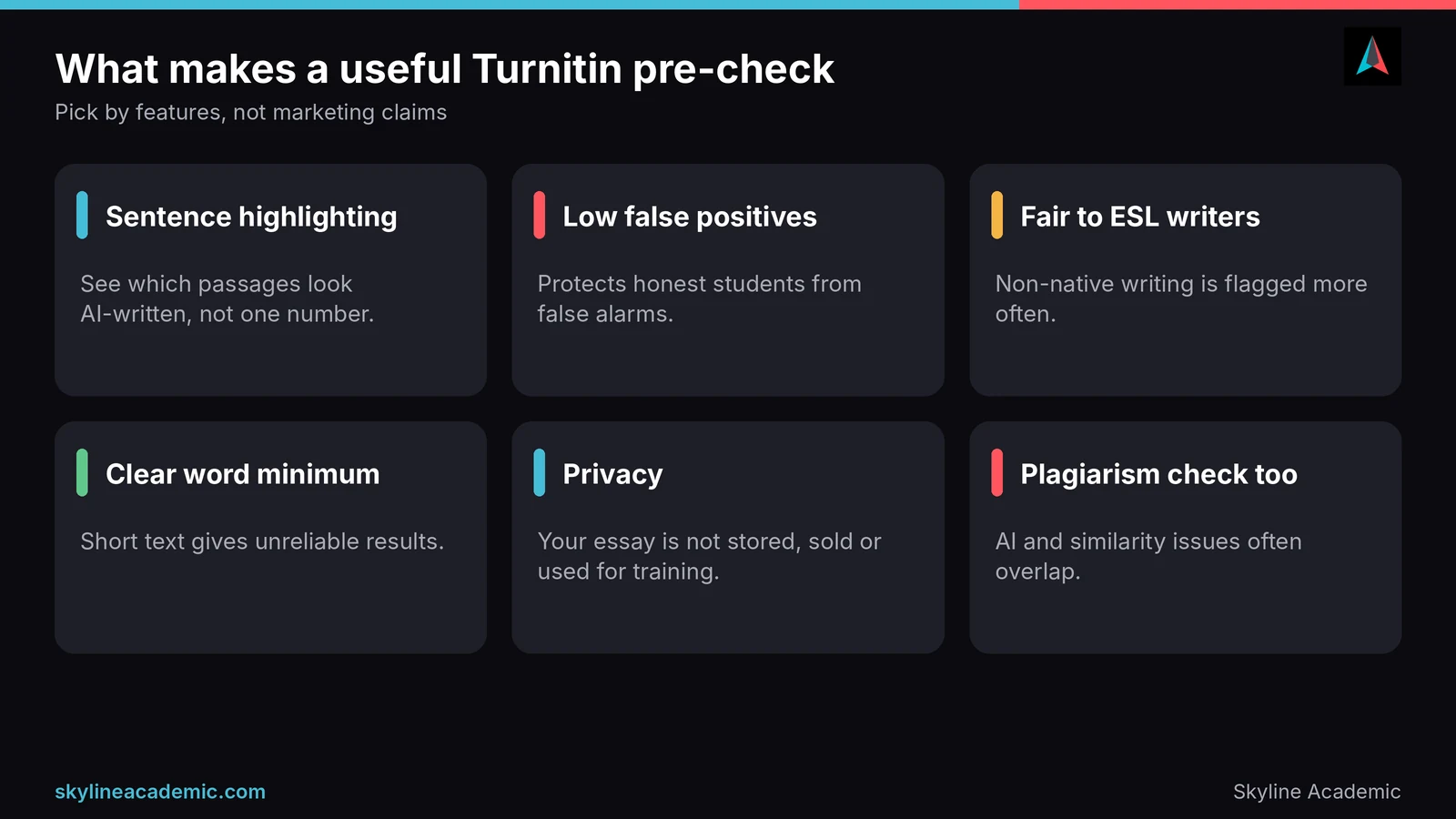
A good pre-check tool shows you which sentences look AI-written, has a low false positive rate and treats non-native writers fairly. It helps you spot risky passages before you submit, without pretending to predict your exact Turnitin score.
| Feature | Why it matters | What to look for |
|---|---|---|
| Sentence-level highlighting | Shows exactly which passages raise concern | Highlights, not just one overall number |
| Low false positive rate | Protects honest students from false alarms | Published, independently tested results |
| Fair to ESL writing | Non-native writers are flagged more often | Clear statements on ESL and language support |
| Clear minimum word count | Short texts give unreliable results | A stated minimum, similar to Turnitin’s 300 words |
| Privacy | Your essay should not be stored or reused | A policy that says your text is not sold or used for training |
| Plagiarism check included | Similarity and AI issues often overlap | AI and plagiarism results in one report |
Why AI detectors give different scores for the same text
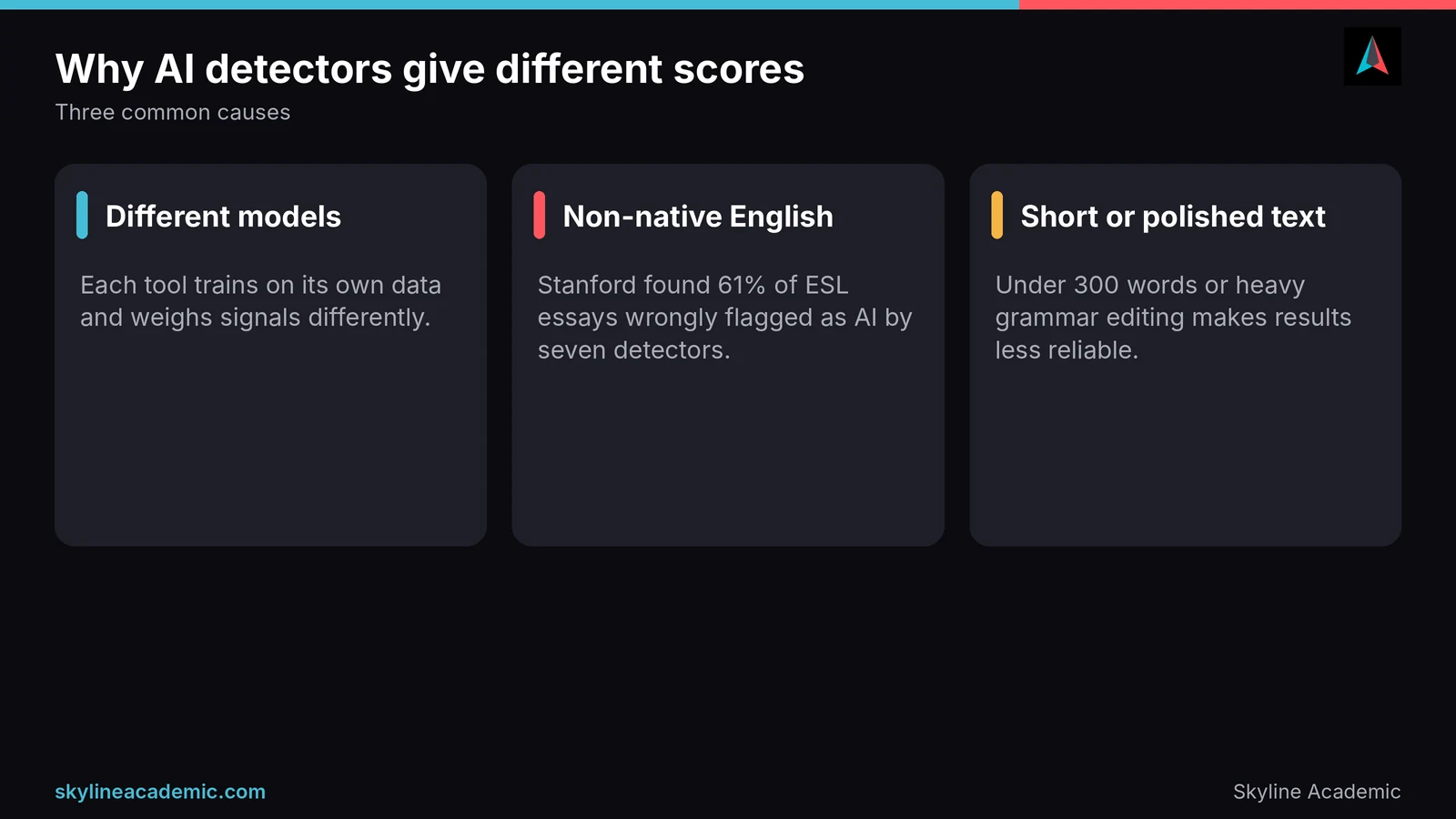
Detectors disagree because each one is trained on different data and uses different rules to decide what “sounds like AI”. Your score can change a lot depending on the tool, the length of your text and how polished your writing is.
Different models and training data
Each company trains its detector on its own collection of human and AI writing. Most look at signals such as how predictable your word choices are and how much your sentence length varies, which our explainer on perplexity and burstiness breaks down in simple terms. Small differences in how each tool weighs those signals can lead to very different scores. Our side-by-side test of Turnitin vs GPTZero vs Skyline Academic shows this in practice.
Non-native English writing
This is one of the biggest pain points for international students. A Stanford study led by Weixin Liang found that seven popular detectors classified 61% of essays by non-native English writers as AI-generated, while they were nearly perfect on essays by US-born students. Simpler vocabulary and more predictable sentence patterns can look “AI-like” to a detector, even when every word is your own.
Short, edited or heavily polished text
Short answers give detectors very little to work with, which is why Turnitin needs at least 300 words. Writing that has been heavily polished by grammar tools can also look more uniform. If you use Grammarly, our guide on whether Grammarly counts as AI explains where the line is.
How to use an AI detector before you submit, the honest way
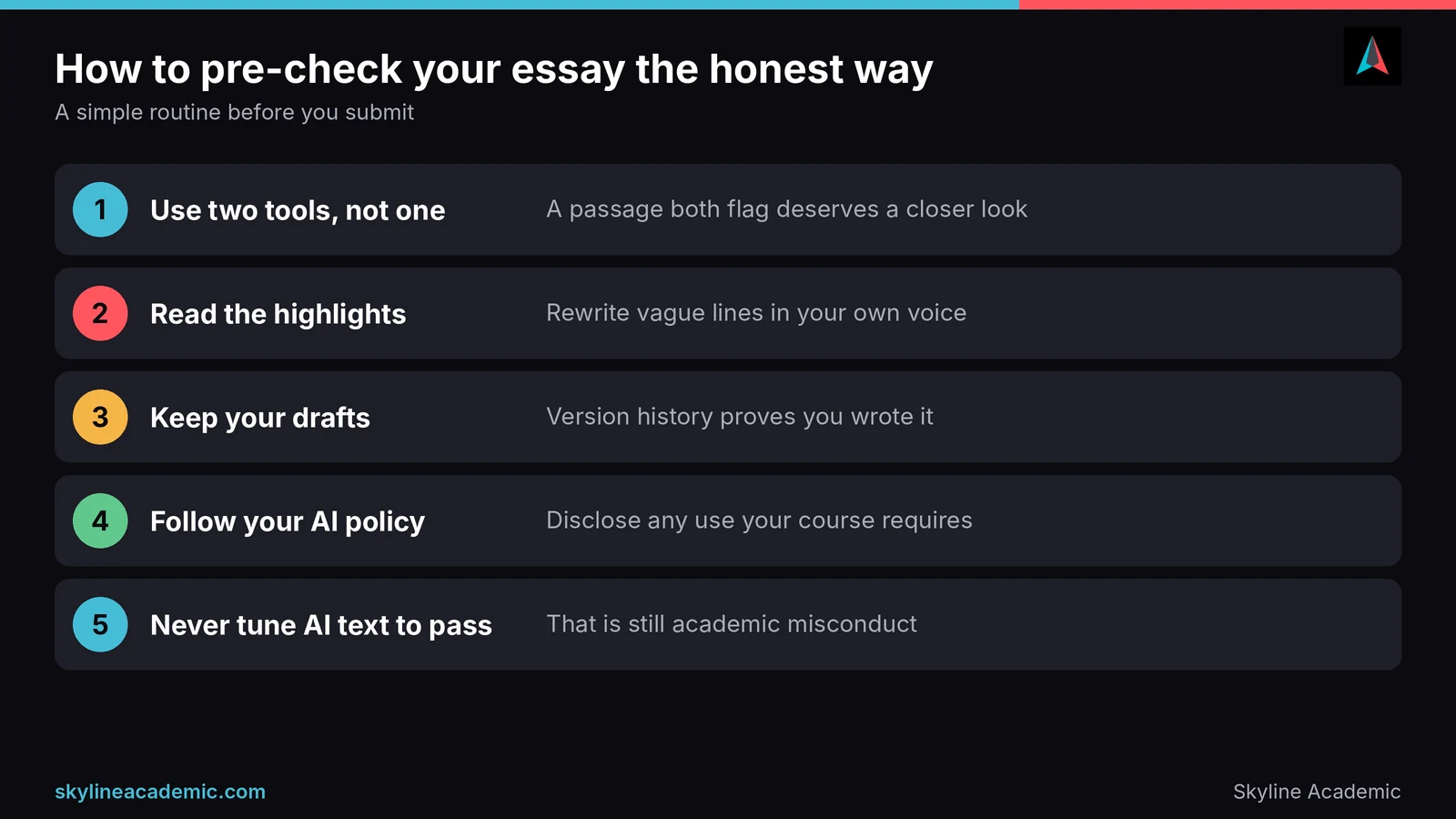
The right way to use a detector is as a self-check for your own work, not as a tool to make AI writing slip past Turnitin. Here is a simple routine.
- Check with two tools, not one. If two reliable detectors both flag the same passage, take a closer look. If only one does, it may be a false alarm.
- Read the highlighted sentences, not just the score. Ask whether those sentences are vague, generic or not in your voice, and rewrite them so they say what you actually think.
- Keep your drafts and version history. Google Docs or Word version history, notes and outlines are your best proof that you wrote the work.
- Follow your course’s AI policy. Some courses allow AI for brainstorming or grammar, others ban it. Disclose any use your course requires.
- Never “tune” AI text until it passes. Rewriting AI-generated work until a detector says it is human is still academic misconduct. Our honest guide on how to bypass Turnitin explains why it is risky and what to do instead.
What to do if Turnitin flags your own work
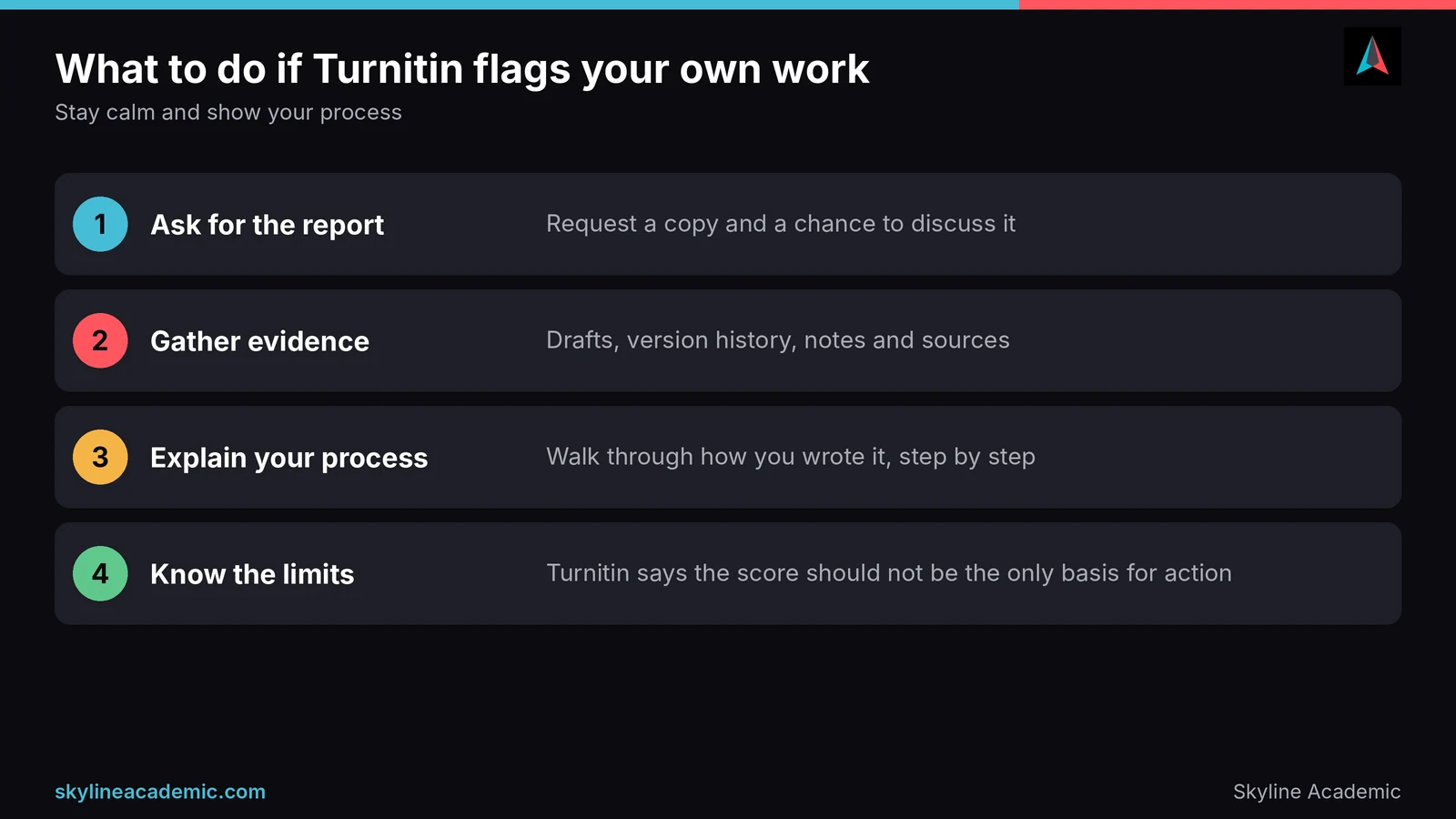
If Turnitin flags work you wrote yourself, stay calm and gather evidence of your writing process. Turnitin itself says its score should not be the only basis for action against a student.
Start by asking your instructor for a copy of the AI report and a chance to discuss it. Bring your drafts, version history, notes and any sources you used. Explain how you wrote the piece, step by step. Many universities treat a calm, well-documented explanation very differently from silence or panic. Our guide on whether AI detectors can be wrong covers the most common causes of false flags and how to respond to each one.
Where Skyline Academic fits
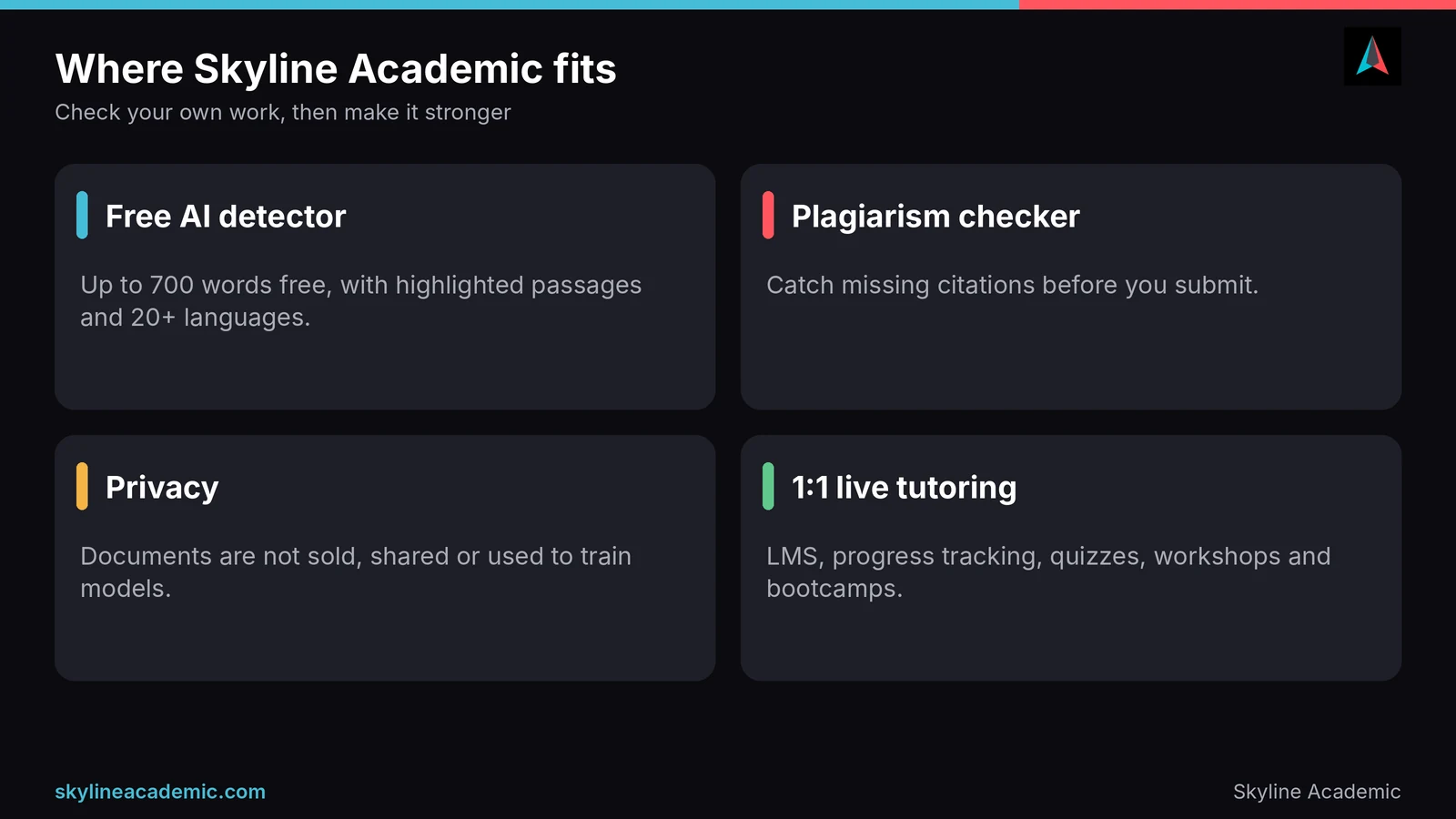
Skyline Academic gives you a free way to pre-check your own writing and real support to make it stronger. We run Skyline Academic, so weigh this with that in mind.
Our AI detector lets you check up to 700 words free, highlights the passages that look AI-written instead of giving you a single number, supports more than 20 languages, and says your documents are never sold, shared or used to train its models. Like every detector, it is a warning sign, not a prediction of your Turnitin score. You can also run a free plagiarism check to catch missing citations before you submit.
The best protection against a false flag, though, is writing that clearly sounds like you. Skyline Academic is one of the leading 1:1 live tutoring platforms, with a dedicated LMS, progress tracking, assignment quizzes, workshops and bootcamps. A tutor can help you plan, draft and revise your own work, so you can submit with confidence.
Ready to submit with confidence?
If you are worried about AI detection, the answer is not to chase a perfect score on a tool that cannot see Turnitin’s model. It is to write your own work, check it sensibly and keep proof of your process. Skyline Academic gives you the tools and the people to do exactly that. Run a free check, then book a session if you want help making your writing stronger and more clearly yours.
Frequently asked questions
Is there a free AI detector that works exactly like Turnitin?
No. Turnitin’s model is private, so no free tool can copy it or guarantee the same score. A free detector can still be a useful early warning sign for your own work.
Can I check my essay on Turnitin before I submit it?
Usually not. Turnitin’s AI writing report is visible only to instructors, although some courses let you submit a draft to see your similarity report.
Why does GPTZero say AI when Turnitin does not?
Each detector uses its own model, training data and thresholds, so they often disagree. Turnitin also hides scores between 1% and 19%, which other tools may show as a number.
What AI score is safe on Turnitin?
There is no official “safe” score. Turnitin shows scores below 20% only as an asterisk because false positives are more common there, and it says the score should not be the only basis for action.
Can Turnitin’s AI detector be wrong?
Yes. Turnitin admits false positives are possible, and independent studies have found that no detector is fully reliable. Keep your drafts and notes in case you need to explain your work.
Why do AI detectors flag non-native English writers?
Detectors often treat simple, predictable wording as a sign of AI. A Stanford study found seven detectors flagged 61% of essays by non-native English writers as AI-generated.
Is Grammarly’s AI detector the same as Turnitin’s?
No. They are separate tools built by different companies, so their scores often differ. Heavy grammar editing can also make writing look more uniform to some detectors.
How many words does Turnitin need to detect AI writing?
Turnitin needs at least 300 words of prose in a long-form format. Shorter texts are not scored for AI writing.
Should I use more than one AI detector?
Yes. Checking with two reliable tools and reading the highlighted sentences gives you a much better picture than trusting one number.
Is it cheating to use an AI detector on my own essay?
No. Checking your own work is a sensible step. It only becomes a problem if you use detectors to disguise AI-written text you plan to submit as your own.
Conclusion
No AI detector is a perfect copy of Turnitin, and none can promise you the same score. Turnitin’s model is private, its AI report is for instructors only, and independent research shows every detector makes mistakes. The smart approach is to use a reliable tool as an early warning, read the highlighted sentences, keep proof of your writing process and follow your course’s AI rules. If you want a free pre-check and real support to strengthen your own writing, Skyline Academic is ready to help.
Sources
- Turnitin Help Center: Why can’t I see the AI writing detection report?
- Turnitin: AI writing detection in the enhanced Similarity Report
- Weber-Wulff et al. (2023): Testing of detection tools for AI-generated text
- Perkins et al. (2024): GenAI detection tools, adversarial techniques and implications for inclusivity
- Dugan et al. (2024): RAID, a shared benchmark for machine-generated text detectors
- Stanford HAI (2023): AI detectors biased against non-native English writers