
I ran the exact same paragraph through GPTZero and ZeroGPT to see how two of the internet’s most recommended AI detectors actually hold up, not just what their landing pages promise. Both tools returned a 100 percent AI score on a paragraph that included natural, first person storytelling, small imperfections, and the kind of casual tone most people actually write in.
If you only want the short answer, here it is. Neither tool is reliable enough to lean on by itself before you submit an assignment. GPTZero and ZeroGPT differ in pricing, review scores, and how deep their feature sets go, but on the one test that matters most to a student, telling human writing apart from AI writing, they landed in the exact same place.
In this guide I’ll walk through the real test and both results, what each tool actually costs, what real users say about them on Trustpilot, how they tend to behave across different subjects from lab reports to literature essays, and which one is worth your money if you still want to use one.
This matters more than it might seem. A wrong AI score isn’t just an annoying pop up, it can turn into an academic integrity meeting, a delayed grade, or a stressful conversation with a professor over a paper you wrote yourself. Picking the right tool, and knowing exactly how much to trust its output, is worth ten minutes of reading before you’re stuck defending your own writing.
| GPTZero | ZeroGPT | |
| Score on our test paragraph | 100% AI, highly confident | 100% AI GPT |
| Trustpilot rating | 2.2 / 5 (138 reviews) | 1.2 / 5 (110 reviews) |
| Starting price | Free tier, paid plans vary by region | $9.99/month (Pro, billed annually) |
| Built for | Institutions, teachers, publishers | Individual, quick checks |
| Sells a “humanizer” tool | No | Yes |
What GPTZero and ZeroGPT Actually Are
GPTZero was originally built by a Princeton student, Edward Tian, in January 2023 as a fast response to ChatGPT showing up in classrooms. Since then it has grown into a company that markets mostly to teachers, schools, and publishers, with an Advanced Scan mode, a built in plagiarism checker, and even a hallucination checker layered on top of its core detection model. When I tested it, the tool displayed its engine as GPTZero AI Detection, Model 4.9b, which tells you the company is actively iterating on its detection model the way you’d expect from a business that primarily sells to institutions.
ZeroGPT takes a different approach. It’s a lighter, consumer facing tool built around a simple paste and scan box, bundled inside a wider suite that includes an AI summarizer, paraphraser, translator, and its own chatbot called ZeroCHAT. If you want the full breakdown of what it gets right and wrong on its own, read a detailed review on ZeroGPT before comparing it side by side with GPTZero here. One thing worth knowing upfront: ZeroGPT’s own results page pushes a “Humanize Text” upsell directly beneath your AI score, meaning the same company selling you the detector also sells you the tool built to beat it. That’s a real conflict of interest to keep in mind before you trust the number it gives you.
If neither of these sounds like what you actually need, Skyline’s free ai detector for students runs a comparable scan without an upsell attached to your result.
The Real Test: One Paragraph, Two Verdicts
To see how these tools actually behave, I ran one piece of writing, a 101 word, 538 character paragraph, through both detectors using their standard scan settings. Here’s the exact text:
“I’ve been trying to get better at cooking lately, and honestly, it’s harder than it looks. Every recipe online makes it seem so easy. You just add this, mix that, and boom, dinner is ready. But in real life, I burn the garlic or forget to salt the water for pasta. Last week I tried making soup from scratch. It took way longer than I expected, and it still tasted kind of bland. My friend told me I should stop rushing and just slow down a bit. Maybe she’s right. Cooking seems less about following steps and more about paying attention.”
This is exactly the kind of writing a student produces every week: personal, a little repetitive, built around real, specific details like burning garlic and under salting pasta water.
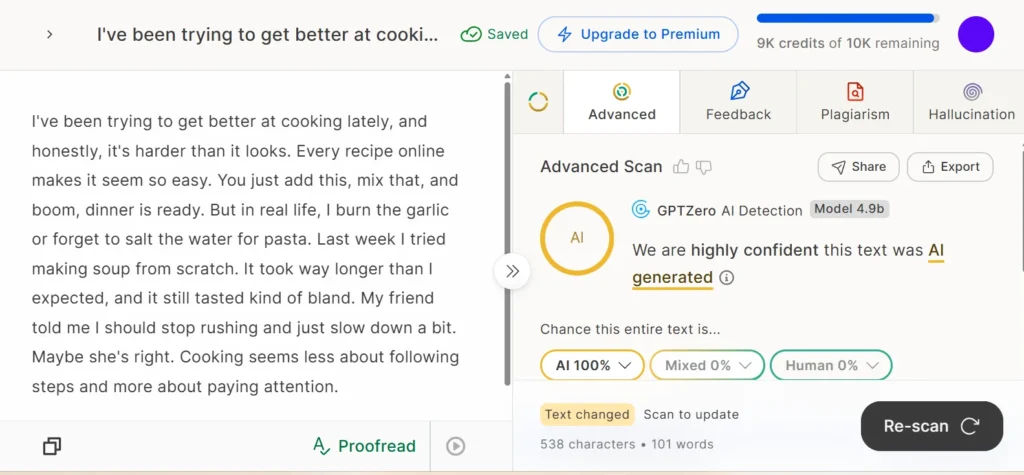
GPTZero’s Advanced Scan came back with a clear verdict: “We are highly confident this text was AI generated.” The breakdown underneath gave it AI 100 percent, Mixed 0 percent, Human 0 percent. No hedge, no partial call, just a flat 100 to 0 split.
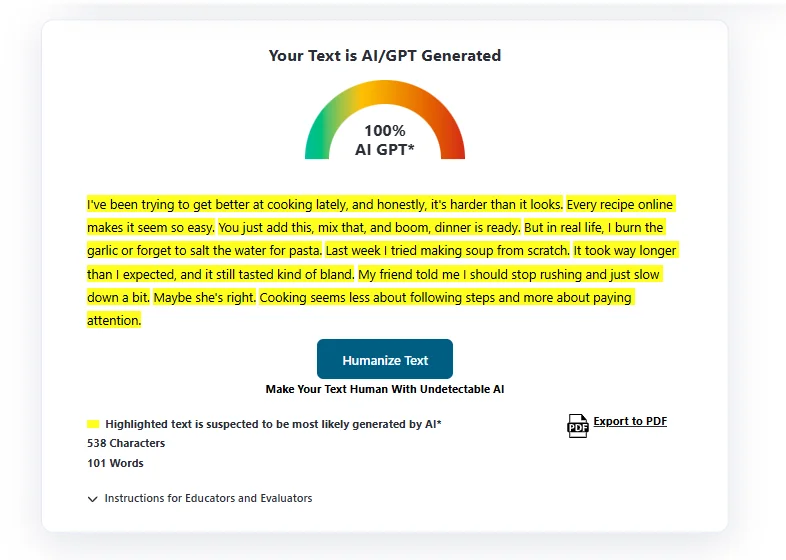
ZeroGPT returned the same shape of result on the identical text. Its verdict read “Your Text is AI/GPT Generated,” with a score of 100 percent AI GPT, and the entire paragraph was highlighted in yellow as “suspected to be most likely generated by AI.” Right below the score sat a call to action: “Humanize Text, Make Your Text Human With Undetectable AI.”
What stands out isn’t just that both tools got it wrong. It’s that both tools were completely confident about being wrong. Two separate companies, two separate detection models, and the exact same all or nothing verdict on a paragraph a real person actually wrote.
How AI Detectors Like These Actually Work
Neither GPTZero nor ZeroGPT is reading your essay for meaning. Both are scoring statistical patterns in how predictable your word choices and sentence lengths are compared to what large language models typically produce. Two ideas do most of the work behind the score: perplexity and burstiness.
Perplexity measures how surprising your word choices are to the model doing the scoring. AI generated text tends to pick the statistically likely next word most of the time, which makes it low perplexity, smooth and a little predictable. A student who writes clearly and correctly, without much stylistic variation, can accidentally produce the same low perplexity pattern, especially in a formal academic context where informal quirks are trained out of you.
Burstiness looks at variation between sentences, humans tend to mix short, punchy sentences with longer, more complex ones, while AI output is often more evenly paced. A student who writes in a consistent rhythm, or who has had a paper heavily edited for grammar and flow, can flatten that natural variation and end up looking more machine like to the detector, even though every word is their own.
This is the mechanism behind almost every false positive story in this guide. It’s not that the detectors are randomly broken, it’s that “writing that sounds a little too clean” and “writing an AI produced” can look statistically similar, even when only one of them is actually AI generated.
Accuracy and False Positives: What a 100 Percent Score Actually Costs You
A false AI flag isn’t just an inconvenience. It’s usually a meeting with a professor, an academic integrity form, and days of stress while you try to prove you wrote your own paragraph, sometimes right before a deadline for your next assignment. The stakes go up if English isn’t your first language, since a formal or academic style already reads as more “predictable” to these detectors.
This isn’t just my own test result either. Researchers at Stanford evaluated seven widely used GPT detectors against real TOEFL essays written by non native English speakers and found the detectors misclassified more than half of the TOEFL essays as AI generated, an average false positive rate of 61.22 percent, while the same detectors were nearly perfect on essays written by native English speaking eighth graders. The researchers concluded that many of these tools inherently penalize writers with a more limited or formal vocabulary, which is closer to how a lot of students, native English speakers included, actually write under exam or deadline conditions.
If you’ve already been flagged and you’re not sure what your options are, ai detection false positives breaks down what a false flag actually means and how to respond to it before it turns into a bigger academic integrity issue.
A partial score confuses people just as much as a 100 percent one does. If your content flagged by 50% ai, that isn’t proof you used AI. It usually means your writing style is simply more uniform or predictable than the detector expects, which is exactly the pattern researchers found penalizes non native English writers and anyone who writes in a clean, structured way.
There’s also a timing problem that rarely gets talked about. Most students don’t discover a false flag until an instructor brings it up, sometimes weeks after the paper was submitted, which means the draft history, browser tabs, and notes that would prove authorship may already be gone. If you know a paper is going through AI screening, it’s worth keeping your version history, outline, and research notes until the grade is finalized, not just until you hit submit.
What To Do If You’re Flagged
If a detector flags your own writing, don’t panic and don’t immediately rewrite the whole paper to chase a lower score. Start with these steps instead:
- Save your draft history, outline, and research notes as proof the work developed over time.
- Ask your instructor which tool and threshold they’re using, since a 20 percent flag and a 90 percent flag are not the same conversation.
- Point to specific sections that were flagged rather than defending the whole paper at once, it’s usually a handful of clean, formulaic sentences driving the score.
- Check your school’s academic integrity policy for its appeals process before you agree to any penalty.
Pricing: What You’re Actually Paying For
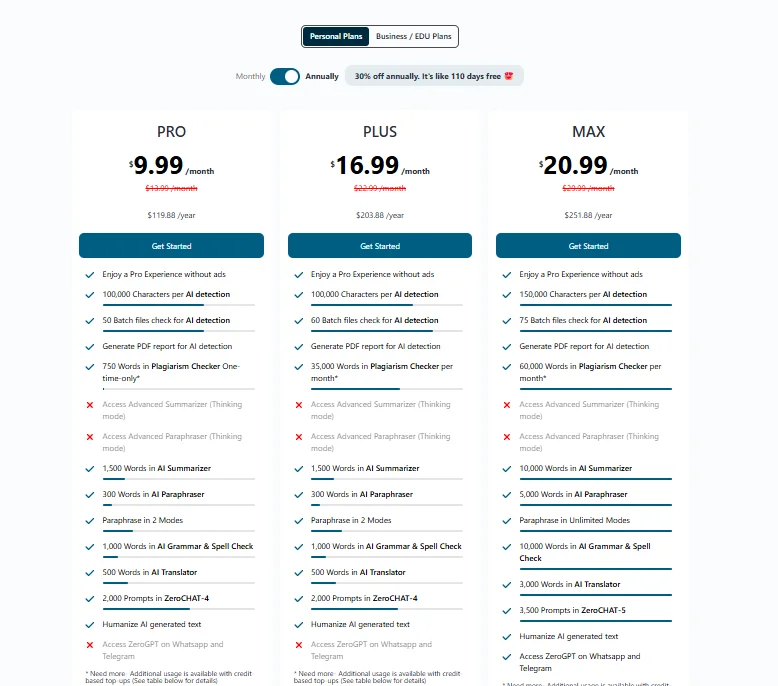
Price is often the deciding factor for a student, so here’s what each tool actually charges as of testing. ZeroGPT publishes clear personal plan tiers billed annually. GPTZero’s pricing page showed me localized pricing in Pakistani rupees when I checked from Pakistan, which won’t match what you see browsing from the US or UK, so treat any dollar figure you find as approximate and always check the live pricing page before you subscribe.
| Plan | Price/mo | AI detection limit | Plagiarism check | Notes |
| Pro | $9.99 | 100,000 characters | 750 words, one time only | No WhatsApp/Telegram access |
| Plus | $16.99 | 100,000 characters | 35,000 words/month | No WhatsApp/Telegram access |
| Max | $20.99 | 150,000 characters | 60,000 words/month | Includes WhatsApp/Telegram access |
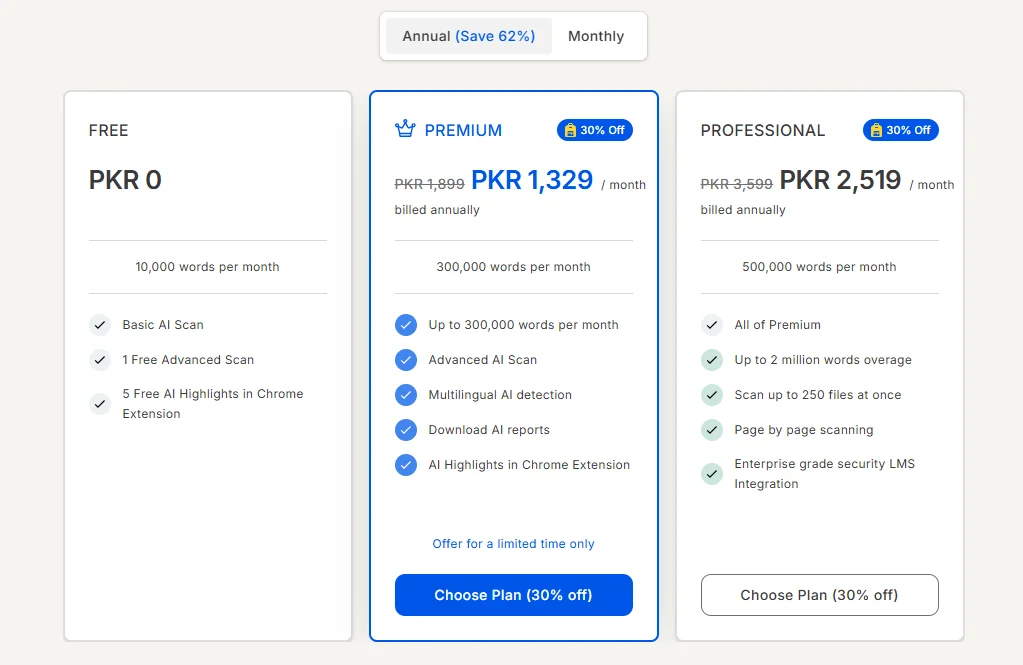
GPTZero uses a similar three tier structure: a limited Free plan, a Premium tier aimed at individual students that unlocks a much higher monthly word allowance along with advanced scanning and multilingual detection, and a Professional tier built for tutors or small teams that adds batch scanning across dozens of files at once and LMS integration. Word allowances scale from roughly ten thousand words a month on the free tier up into the hundreds of thousands on the paid tiers.
If ZeroGPT’s paid tiers feel like more than a student budget can justify, zerogpt alternatives covers several tools that offer a comparable scan for less.
It’s worth pausing on what you’re actually buying at each tier. The jump from a free plan to a paid one is rarely about accuracy, the underlying detection model is usually the same across tiers, it’s about volume: more characters per scan, more files checked in a batch, and a downloadable report you can save as a record. If you only need to check a paper or two before a deadline, the free tier or a single scan is often enough. A monthly subscription makes more sense if you’re checking drafts regularly across a full semester.
What Real Users Say: Trustpilot Reviews
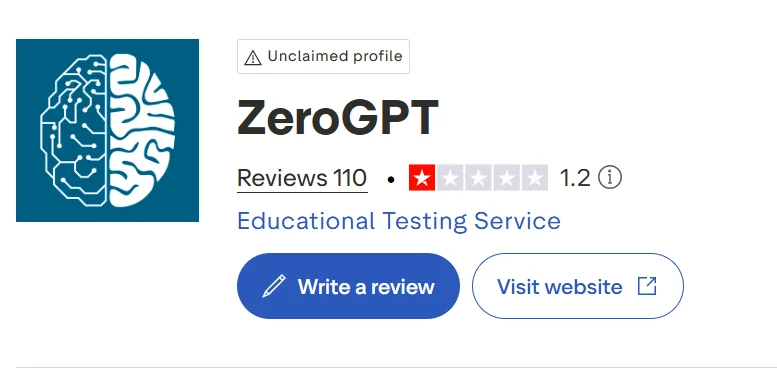
Marketing pages will always say a tool is highly accurate. Review platforms tend to tell a more honest story. On Trustpilot, ZeroGPT carries a rating of 1.2 out of 5 from 110 reviews, listed under Educational Testing Service, and its profile is unclaimed, meaning the company hasn’t stepped in to respond to complaints. GPTZero fares a little better at 2.2 out of 5 from 138 reviews, listed as a Software Company, with a profile claimed as of November 2024.
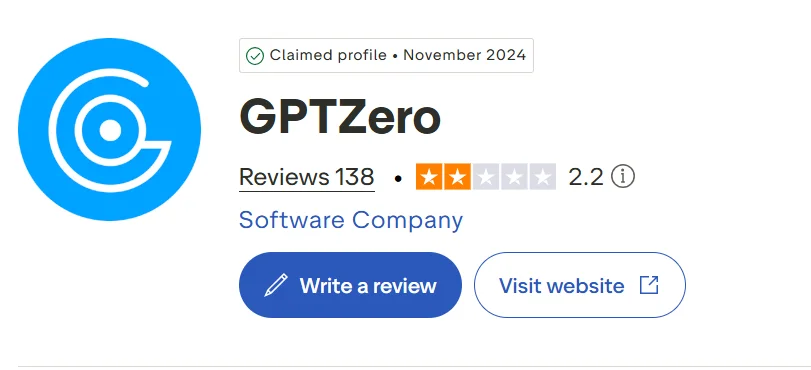
Neither score is good. A rating under 2.5 out of 5 on a platform where companies can respond to and resolve complaints usually means the frustration is coming from somewhere real, and the most common complaint across both tools is the same one my own test surfaced: human writing getting flagged as AI with total confidence.
This lines up with what’s already played out at the university level. Several US universities, including Vanderbilt, Michigan State, Northwestern, and the University of Texas at Austin, stopped using Turnitin’s AI detector after concluding its claimed accuracy didn’t hold up once it was actually used at scale. Vanderbilt pointed out that even a 1 percent false positive rate, the figure Turnitin itself claimed, would have mislabeled around 750 student papers a year at their volume alone.
If you’re wondering what your instructor actually sees when a score like this comes back, how do teachers know you use ai walks through what a flagged report looks like from the other side, and why a single AI score is rarely the only thing a professor is weighing.
Reading through both review pages, a few complaints show up again and again: the same document scoring differently on a second scan of the exact same text, subscriptions that are hard to cancel once billing starts, and writers describing the accuracy claims on each tool’s marketing page as misleading given what they actually experienced. None of that proves either tool is useless, but it’s a consistent enough pattern across more than two hundred combined reviews that it shouldn’t be ignored.
How GPTZero and ZeroGPT Perform Across Different Subjects
Detection tools don’t behave the same way across every kind of writing. The subject you’re writing in changes both how likely you are to get flagged and how much it costs you if you are. A false flag on a first year general education essay is annoying. The same false flag on a nursing clinical or a senior capstone project can threaten a grade you’ve spent months working toward, so it’s worth understanding where your own field sits on that risk scale before you submit anything.
STEM and Lab Reports
Lab reports and technical write ups already follow a rigid structure: hypothesis, method, results, discussion. That formulaic structure is exactly the kind of predictable pattern these detectors associate with AI writing, so a perfectly ordinary methods section can score higher on an AI scale than a rambling personal essay would.
Nursing and Health Sciences
Clinical documentation and care plans are taught with a specific, standardized format for good reason: patient safety depends on consistency. That same consistency is a red flag to an AI detector. Nursing programs also tend to have some of the strictest academic integrity policies tied directly to licensure, so a false flag here carries more weight than it would in a general education elective.
Humanities and Literature Essays
Analytical essays with a genuine personal argument tend to score more mixed, since voice and interpretation are harder to pattern match. But the five paragraph essay format taught in most high schools is its own trap: the structure itself is so predictable that a well organized, textbook correct essay can trigger a high AI score for the same reason a lab report does.
Business and Case Study Writing
Business writing is trained to be concise, jargon heavy, and low on personal voice by design. That professional tone reads as “flat” to a detector looking for the kind of low variation language associated with AI output, which makes case study responses and executive summaries surprisingly prone to false flags.
Computer Science and Coding Assignments
Code comments, README files, and technical documentation follow conventions just as rigid as a lab report, boilerplate phrasing, standardized function descriptions, and repeated formatting across every file. Detectors built primarily around natural language don’t always handle this well, and CS students report the same pattern as nursing and business students: the more correctly formatted the write up, the more likely it is to get flagged.
If a discipline specific assignment, like a capstone project, is where you’re most worried about getting this wrong, EssaysHelper offers expert academic support for capstone projects across every discipline, from nursing care plans to business case studies, which is a more direct fix than second guessing a detector score on your own.
Since detection risk changes by subject, the kind of help that actually reduces your risk changes too. how to choose an online tutor covers what to look for if you’d rather have a subject specific expert review your draft instead of relying on a detector’s opinion of it.
Which One Should You Actually Use
If you have to pick one, GPTZero is the safer default. It scores slightly better on Trustpilot, it’s the tool more schools already use on the other end so knowing how it scores your work tells you something closer to what your professor will actually see, and it doesn’t sell you a humanizer next to your own results. ZeroGPT is cheaper at the entry tier and fine for a quick gut check, but the built in upsell to “humanize” flagged text is a conflict of interest that GPTZero doesn’t have.
Neither one should be the final word on your own writing, though. Is 30% ai detection bad and a 100 percent score sit on the same broken scale if the underlying detector is prone to false positives in the first place. Treat any single score as a prompt to look closer at your draft, not as a verdict.
A practical middle ground a lot of students use is running a paper through one detector, not both, before submission, mainly to catch anything that reads unusually uniform or repetitive, and then rewriting flagged sections in their own natural voice rather than chasing a specific percentage. The goal isn’t a 0 percent score, since that number is just as unreliable as a 100 percent one. The goal is writing you can actually defend if anyone asks.
Before you run your own paper through either tool, it helps to understand what the score is actually measuring. The reality behind ai detection score explains the mechanics behind how these percentages get calculated, which makes it a lot easier to know when a flagged result is worth worrying about and when it isn’t.
And if you’ve read all of this and still want a second, human opinion on a specific paper before you submit it, you can book 1:1 live tutoring support and talk it through with someone directly instead of guessing based on a percentage.
For a broader look at how AI detection is evolving across tools beyond just these two, read more insights on ai detections covers the wider landscape.
Frequently Asked Questions
Is GPTZero or ZeroGPT more accurate for checking my essay?
Neither tool has proven reliably accurate in independent testing. In my own test, both flagged the exact same human written paragraph as 100 percent AI, and both carry Trustpilot ratings under 2.5 out of 5, so treat either score as a starting point, not a final answer.
Why did GPTZero say my essay is 100 percent AI when I wrote it myself?
GPTZero and similar detectors look for predictable sentence structure and word choice rather than proof of authorship. Clean, well organized writing, especially from students with a more formal or non native English style, often triggers a false positive.
Can ZeroGPT and GPTZero detect Grammarly or paraphrased text?
Both tools can flag heavily edited or grammar checked writing as AI generated, since editing tools often smooth out the natural inconsistencies detectors use to judge human writing. This is one of the more common false positive triggers students report.
Is a 100 percent AI score from ZeroGPT proof that I used AI?
No. A 100 percent score means the detector’s pattern matching found your text statistically similar to AI writing, not that it has evidence you used a tool. My own test showed a human written paragraph scoring 100 percent AI on both GPTZero and ZeroGPT.
Which is cheaper, GPTZero or ZeroGPT, for a student on a budget?
ZeroGPT’s entry level Pro plan starts at 9.99 dollars a month. GPTZero’s pricing varies by region and tier, so check both tools’ live pricing pages directly, since regional pricing can differ significantly from what shows up in search results.
Do professors actually trust GPTZero or ZeroGPT results?
It depends on the institution. Several US universities have already stopped relying on AI detector scores like Turnitin’s after finding high false positive rates, so many professors now treat a flagged score as one signal among several rather than proof on its own.
Why do AI detectors flag non native English writing more often?
Independent research has found that AI detectors consistently misclassify non native English writing as AI generated far more often than native English writing, since non native writers tend to use more predictable vocabulary and sentence patterns that resemble what detectors associate with AI text.
Can I appeal an AI detection false accusation at my university?
Most universities have an academic integrity appeals process, and a single detector score is rarely accepted as sole proof of misconduct. Keep your drafts, revision history, and any notes as evidence your work was your own if you need to appeal.
Does ZeroGPT’s Humanize Text feature actually help avoid detection?
It’s designed to, but using a tool built to bypass AI detectors on your own writing carries its own risk, since many schools consider deliberately evading detection a violation on its own, even when the underlying content is genuinely yours.
Is there a free AI detector that’s actually reliable for students?
No AI detector, free or paid, has proven consistently reliable, which is why it’s worth using a detector as a first check rather than a final judgment, then following up with a human reviewer for anything you’re unsure about before you submit it.
The Bottom Line
Both GPTZero and ZeroGPT flagged the exact same human written paragraph as completely AI generated in my test, and both carry weak Trustpilot ratings from real users reporting the same problem. That doesn’t mean these tools are useless. It means neither one should be the only thing standing between you and a finished assignment. Run your check, read the result with a healthy amount of skepticism, and if something feels wrong, get a second opinion from an actual person before you assume the percentage is right.