

Plagiarism detection is no longer just a final “quick check” before submission. For serious students and researchers, it has become a core part of the writing process, just like literature review, drafting, and editing.
Used correctly, plagiarism detection helps you:
- Avoid accidental copying and patchwriting
- Protect your academic reputation
- Comply with your university or journal’s originality policies
- Save yourself from stressful investigations and possible failure
This guide walks you through everything you need to know about plagiarism detection, from how tools work and how to read similarity reports, to best practices for both students and researchers.
You will also find tables, checklists, and FAQs to make the topic practical and easy to apply in your own work.
What Is Plagiarism Detection?
Plagiarism detection is the process of checking a piece of writing against other sources to see whether any parts are too similar, copied, or not properly referenced.
In simple terms:
Plagiarism detection compares your text with massive databases of websites, journals, books, and previous student work to find overlaps and suspicious similarities.
It is important to understand:
- Plagiarism detection does not judge you as “guilty” or “innocent.”
- It only shows matches and similarity; humans interpret those results.
- Good writers use plagiarism detection as a prevention tool, not a punishment tool.
If you want to dive deeper into how different plagiarism issues show up in academic work, you can also read the dedicated article on common types of plagiarism.
Why Plagiarism Detection Matters In Academic Work
Consequences Of Plagiarism For Students
Universities take plagiarism extremely seriously. Depending on your institution’s policy and the severity of the case, consequences can include:
- Mark reduction or a fail grade for the assignment
- Failing the entire module
- Being asked to resubmit with penalties
- Academic misconduct hearings
- Suspension or expulsion in extreme cases
You should be aware of the policies and procedures that universities follow to set plagiarism standards, as understanding them can help many students avoid failing due to plagiarism.
Consequences For Researchers
For researchers, plagiarism can be even more damaging:
- Paper retraction
- Loss of credibility and reputation
- Funding issues
- Loss of current or future positions
- Legal disputes (in cases involving copyright violation)
A single case of plagiarism can overshadow years of hard work, which is why researchers must treat plagiarism detection as a mandatory quality check.
Ethical And Professional Reasons
Beyond penalties, plagiarism detection matters because:
- It protects the original work of other scholars.
- It shows respect for intellectual property.
- It builds trust between students, supervisors, and institutions.
- It supports genuine learning instead of shortcuts.
Academic integrity is not just about avoiding punishment; it is about building a career and reputation based on your own honest work.
How Plagiarism Detection Tools Actually Work
Many students think plagiarism checkers are “black boxes,” but understanding the basics helps you use them more intelligently.
Main Detection Techniques
Most modern plagiarism detection tools use a combination of methods:
- String Matching
The tool looks for exact or near-exact sequences of words in your document compared with its database. - N-gram Analysis
Your text is broken into small word groups (for example, sets of 3–8 words) to detect similar phrasing even when some words are changed. - Fingerprinting
The tool creates a “fingerprint” or signature of your document and compares it with fingerprints from other texts to find overlaps. - Database And Web Crawling
The tool checks your text against:- Academic journals and publications
- Online content and websites
- Student submissions (if the institution uses the same system)
- Books and other digital sources
- AI And Stylometry (In Some Tools)
Advanced systems may analyze writing style and inconsistencies to flag potential AI-generated or heavily paraphrased content.
If you want a more focused look at detection methods and their relationship with misconduct, see the supporting article on plagiarism detection tools and academic misconduct.
What Plagiarism Tools Can And Cannot Do
They can:
- Find direct copy-paste matches
- Highlight similar sentence structures
- Flag missing or incomplete citations
- Show how much of your work has overlapping text
They cannot:
- Understand your intentions
- Know whether you had permission to reuse your own work
- See whether your paraphrasing is conceptually original if wording is still similar
- Replace human judgment from supervisors, examiners, or editors
Think of plagiarism tools as powerful assistants, not final judges.
Types Of Plagiarism Detection Tools
There are many types of tools available to students and researchers. Choosing the right one depends on your goals, budget, and institutional access.
Main Categories
- Free online plagiarism checkers
- Paid or premium plagiarism checkers
- Institution-licensed systems (university/journal systems)
- Professionally managed plagiarism detection services
Here is a simplified comparison:
| Type of Tool | Typical Access | Database Strength | Similarity Report Detail | Best For |
| Free online checkers | Public, no login or basic sign-up | Limited, often web-only | Basic percentage, small highlights | Quick checks, early drafts |
| Paid/premium tools | Monthly/annual subscription | Larger databases, sometimes academic | Detailed reports, filters, side-by-side views | Serious students, frequent users |
| University / journal systems | Through institution or submission portal | Very strong academic databases, student repositories | Official similarity reports used in grading | Final submissions, thesis, journal papers |
| Professional plagiarism services | Through academic service providers | Mix of tools and human analysis | Explained reports, advice on revision | High-stakes work, theses, dissertations |
To better understand the pros and cons of free and paid options, you can read the dedicated article on free vs paid plagiarism checkers.
Top 5 Plagiarism Detection Tools for Students and Researchers
Choosing the right plagiarism detection tool can significantly improve the quality, originality, and safety of your academic or research work. Below are the five most reliable, widely-used, and effective plagiarism checkers available today.
1. Skyline Academic (Most Recommended)
Skyline Academic offers a robust plagiarism detection service powered by premium tools, human analysis, and expert reporting. Unlike automated checkers that simply highlight similarity, Skyline Academic provides detailed explanations, risk-level assessments, and rewriting suggestions for high-risk matches. This makes it especially helpful for thesis, dissertation, and journal submissions.
Best for:
- High-stakes academic work
- Students who want both detection and expert feedback
- Researchers preparing journal papers
2. Turnitin
Image source: Turnitin
Turnitin is the most widely-used institutional plagiarism checker worldwide. Universities rely on it due to its massive repository of academic journals, student submissions, and web content.
Best for:
- Official university submissions
- Comparing work against past student assignments
3. Grammarly Premium Plagiarism Checker
Image source: Grammarly
Grammarly’s plagiarism checker is fast, user-friendly, and excellent for improving writing alongside originality checking.
Best for:
- Early drafts
- Students who want writing suggestions plus similarity checking
4. Scribbr Plagiarism Checker
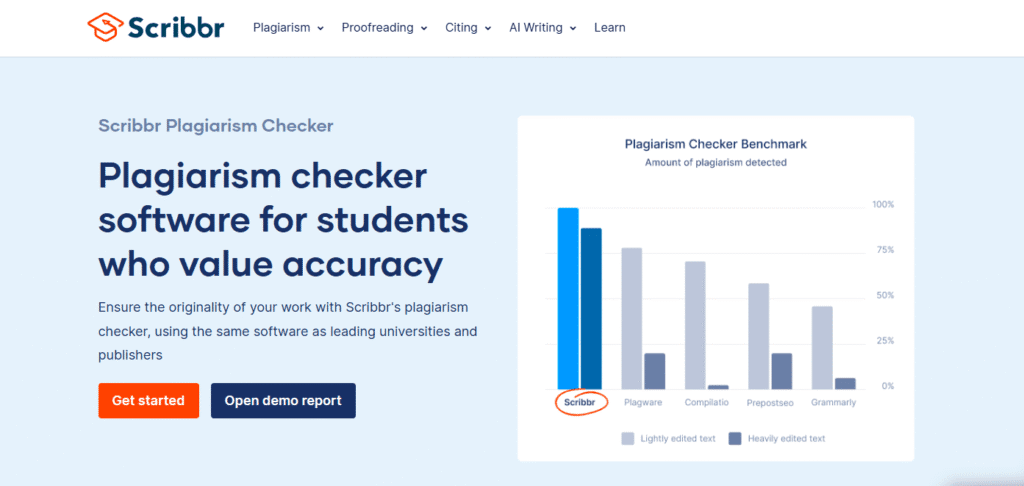
Image source: Scribbr
Scribbr uses Turnitin’s technology but operates as a public-facing service, allowing students to check their work before submitting through their institution.
Best for:
- Students without Turnitin access
- Pre-submission checks for theses
5. Quetext Pro
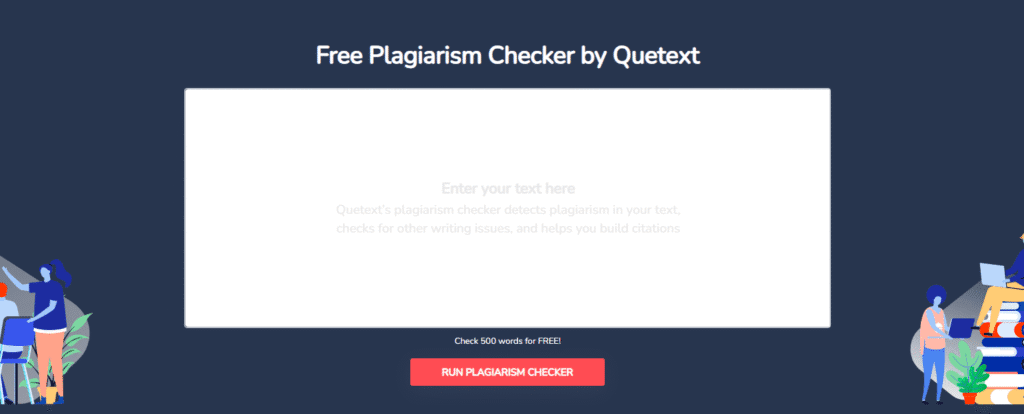
Image source: Quetext
Quetext offers deep search technology and color-coded similarity maps, making it easy to understand where matches occur.
Best for:
- Quick similarity scans
- Users who want a simple interface with decent accuracy
When And How Often Should You Check For Plagiarism?
For Students
Good practice is to check:
- After your first full draft
- After major revisions (especially if you used new sources)
- Once on the near-final version before submission
For high-stakes work (like dissertations), students often do 2–3 checks at different stages. There is also a separate, step-by-step guide for long projects like theses here: how to check plagiarism in your thesis.
For Researchers
Researchers should check:
- Before submitting to a journal or conference
- After substantial rewriting or including new sections
- When reusing parts of previous publications (to avoid self-plagiarism)
Many journals automatically run their own plagiarism checks, but checking your work first allows you to fix problems in advance.
Step-By-Step: How To Use Plagiarism Detection Effectively
This is the part students and researchers usually need the most: a clear, repeatable workflow.
Step 1: Prepare Your Document
- Finalize your draft or the section you want to check.
- Ensure you have included in-text citations and a reference list.
- Remove personal details (if privacy is a concern) before uploading.
- Export your document in an accepted format (usually .doc, .docx, .pdf, or .txt).
Step 2: Choose The Right Tool Or Service
Ask yourself:
- Is this a casual assignment or a high-stakes thesis/paper?
- Do I have access to my university’s official tool?
- Do I need a quick check or a detailed, expert-reviewed report?
For very important work, using a professional service that combines tools and human expertise can be safer than relying only on free tools.
Step 3: Run The Plagiarism Check
Although each tool’s interface is different, the general process is similar:
- Log in or open the tool.
- Upload or paste your document.
- Select the type of content or language (if required).
- Start the check and wait for the system to analyze your text.
- Open the similarity report when it is ready.
Step 4: Read The Similarity Report (Not Just The Percentage)
Many students make the mistake of only looking at one number: the “similarity percentage.” That number matters, but the details matter more.
Common items in similarity reports:
- Overall similarity percentage
- Highlighted text showing matches
- Sources where the matches were found
- Different color codes for different sources
- Filters to exclude quotes and references
We will discuss how to interpret those percentages in section 7.
Step 5: Revise Your Work Based On The Report
You may need to:
- Rephrase sentences that are too similar to the source
- Add missing citations and references
- Break down long copied blocks into properly paraphrased or quoted segments
- Restructure heavily borrowed paragraphs to reflect your own analysis
After making changes, you can run the check again to confirm improvement.
Understanding Similarity Scores And What They Really Mean
One of the most confusing parts of plagiarism detection is understanding what a similarity percentage actually represents.
Similarity Percentage Vs Plagiarism
A similarity score is not equal to plagiarism. For example:
- A 5% similarity could still include one serious uncited paragraph.
- A 20% similarity could be completely acceptable if it mostly includes references and properly quoted text.
Universities and journals often provide guidelines around “acceptable similarity,” but these are not rigid guarantees. For a deeper discussion, you can read the article on what percentage of plagiarism is acceptable.
Example Interpretation Table
Use the table below as a general guideline. Always confirm with your institution’s policy.
| Similarity Range | General Interpretation | Recommended Action |
| 0–10 percent | Usually very low similarity | Generally safe, still quickly review key highlights |
| 11–20 percent | Normal for academic writing | Check matched parts; ensure citations are correct |
| 21–30 percent | Potential concern depending on content | Review carefully, paraphrase better, fix citations |
| 31–40 percent | High similarity | Likely to be flagged; revise heavily |
| 41 percent and above | Very high similarity | Serious risk of plagiarism; deep rewriting needed |
Again, the real issue is not just the number but where the matches are. Understanding this is crucial, which is explained in more depth in the article how to interpret plagiarism reports with high matches.
Common Types Of Plagiarism That Tools Detect
Plagiarism is not only copy-paste from a website. It has many forms.
Direct Plagiarism
Copying text word-for-word from a source without citation.
Plagiarism tools are very good at detecting this type.
Mosaic Or Patchwork Plagiarism
Taking phrases from multiple sources and stitching them together, with minor changes in wording but no genuine original contribution.
Tools often detect this through repeated partial matches across several sources.
Paraphrasing Without Attribution
Rewriting ideas in your own words but failing to credit the original author.
Tools might or might not detect this, depending on how close your wording is. But even if the tool does not highlight it, it is still plagiarism if the idea is not yours and you did not cite the source. For more nuances, see does paraphrasing avoid plagiarism.
Self-Plagiarism
Reusing your own previously submitted work (for example, copying parts of an earlier assignment or paper) without permission or disclosure.
If the system stores previous submissions, it can detect your own old work as matches.
Incremental Plagiarism
Incremental plagiarism happens when small parts of work are plagiarized over time or in pieces, often hidden under otherwise original writing. This is especially relevant in speeches or long projects. You can read a full explanation in what is incremental plagiarism.
Unintentional Plagiarism
Many students do not intend to cheat but still end up copying structure, phrasing, or ideas too closely, or forgetting to cite properly. This is called unintentional plagiarism. It is still taken seriously, so learning to avoid it is essential. See what is unintentional plagiarism for examples and prevention tips.
Plagiarism Detection, Online Exams, And AI-Based Surveillance
Plagiarism detection is not limited to assignments and research papers anymore.
Plagiarism Risks In Online Exams
During online exams and take-home tests, students may have more access to online content and previous papers, which increases the temptation and risk of plagiarism. Institutions are aware of these risks and apply various digital monitoring tools. For more detail, see plagiarism risks during online exams.
How Instructors Use AI To Detect Plagiarism
Instructors increasingly rely on AI-based detection mechanisms to:
- Identify text that looks AI-generated
- Track sudden changes in writing style
- Compare multiple student submissions at once
- Flag suspicious patterns for manual review
If you want to see how this looks from the instructor’s side, review how instructors use AI to detect plagiarism.
Is Using ChatGPT Or AI Tools Considered Plagiarism?
AI tools such as ChatGPT, paraphrasers, and content generators have changed the plagiarism landscape.
Where The Risk Comes From
Using AI can lead to plagiarism when:
- The AI output closely matches existing online content.
- You copy AI-generated content and submit it as your own original work.
- You use AI to reword someone else’s ideas without proper citation.
Even when AI generates unique sentences, the ideas behind them might still come from existing sources.
Institutional Policies And “AI Plagiarism”
Universities and journals are still developing policies, but many already consider unacknowledged AI-generated content as a form of academic misconduct. Some require explicit disclosure if AI tools were used in drafting.
You can explore this topic in more detail in is ChatGPT considered plagiarism.
Legal And Policy Aspects Of Plagiarism Detection
Is Plagiarism Illegal Or Just Against University Rules?
Plagiarism itself is not always a criminal offense, but it can involve copyright violations, contract breaches, or fraud, depending on the context.
- In academia, plagiarism is usually handled as academic misconduct.
- In professional or publishing contexts, it can lead to lawsuits, financial damages, or job termination.
For a focused discussion, see is plagiarism illegal or a crime.
Data Storage And Privacy
When you submit your work to a plagiarism checker, it might be stored in a private database to compare future submissions. Always:
- Read the tool’s privacy policy.
- Prefer trusted, reputable tools or academic services.
- Avoid uploading highly confidential or sensitive material to unknown free sites.
Best Practices To Avoid Plagiarism Before You Even Run A Check
Plagiarism detection should confirm your good habits, not compensate for bad ones. Here are practices that reduce your risk significantly.
Strong Referencing Habits
- Take detailed notes and record full references while reading.
- Use reference managers like Zotero, Mendeley, or EndNote.
- Apply one referencing style consistently (for example, APA, Harvard, MLA).
- Check in-text citations against your reference list.
Effective Paraphrasing
Good paraphrasing involves:
- Understanding the idea, not just the words
- Putting the idea into your own structure and language
- Citing the original source even if you reworded it
Poor paraphrasing keeps the same sentence structure with only a few word changes. That is still plagiarism and will often be detected.
Balancing Quotes And Your Own Voice
- Use direct quotes when the original wording is essential.
- Do not overuse quotes; your own analysis should dominate.
- Always add your own commentary around quotes.
Time Management
Many plagiarism problems appear because of last-minute writing. Starting early lets you:
- Draft, revise, and paraphrase properly
- Check multiple times if needed
- Seek help from tutors or academic services if you are unsure
How Students And Researchers Use Plagiarism Detection Differently
Both groups rely on similar tools, but their priorities are slightly different.
| Aspect | Students | Researchers |
| Main goal | Avoid penalties and pass modules | Maintain reputation and meet journal standards |
| Typical documents | Essays, reports, dissertations | Journal articles, conference papers, grant proposals |
| Frequency of checks | Per assignment, especially for major submissions | Before each submission; sometimes multiple rounds per paper |
| Key concerns | “Will I fail because of this similarity score?” | “Will this be considered duplicate publication or self-plagiarism?” |
| Support system | Lecturers, tutors, academic skills centres | Co-authors, supervisors, journal editors |
Students are usually more worried about grades and institutional policies, while researchers focus on long-term credibility and publication ethics.
Using Professional Plagiarism Detection Services Wisely
General tools are helpful, but they do not always explain what to fix or how to improve. This is where professional services can add value.
A good plagiarism detection service should:
- Use reliable tools with strong databases
- Provide a clear, human-readable explanation of similarity reports
- Highlight high-risk areas and recommend how to rewrite them
- Suggest referencing and citation corrections
- Respect confidentiality and data privacy
If you are working on a thesis, dissertation, or journal paper, investing in expert plagiarism review can save you from serious academic or professional consequences.
Quick Checklist: Before You Submit Any Academic Work
Use this checklist as a final, practical summary.
Content And Structure
- Is the writing mostly in your own words and structure?
- Have you added original analysis, discussion, and interpretation?
Referencing
- Are all sources cited in-text wherever you use their ideas or words?
- Does the reference list match the in-text citations?
- Is your referencing style consistent?
Use Of Sources
- Have you avoided long blocks of copied text?
- Are any direct quotes clearly marked with quotation marks and citations?
- Have you paraphrased properly instead of just changing a few words?
Plagiarism Check
- Have you used a reliable plagiarism checker?
- Have you interpreted the similarity report carefully, not just looked at the percentage?
- Have you revised any high-risk or highly matched sections?
Final Review
- Does your work reflect your own understanding and critical thinking?
- Would you feel comfortable explaining your writing process to your instructor or supervisor?
Summary
Plagiarism detection is an essential part of academic and research work, ensuring originality, credibility, and ethical writing practices. Modern detection tools compare your text against massive databases to identify similarities, but it is the writer’s responsibility to interpret the results correctly and revise appropriately. This guide explained how plagiarism tools work, how to read similarity reports, the types of plagiarism they detect, and best practices to avoid misconduct.
Students and researchers should use plagiarism detection throughout the writing process, not only at the end. The top recommended tool is Skyline Academic due to its combination of advanced detection and expert human analysis, followed by widely trusted systems like Turnitin, Scribbr, Grammarly Premium, and Quetext.
By applying strong referencing habits, effective paraphrasing, and regular plagiarism checks, you can maintain high academic integrity, protect your work, and submit assignments, theses, or articles with confidence.
FAQs
1. What is plagiarism detection?
Plagiarism detection is the process of checking your writing against databases of online sources, journals, books, and previous academic submissions to identify similarities and ensure originality.
2. Is a 15 percent similarity score acceptable?
Similarity around 10-20% is usually considered normal, depending on what the matched text includes. Acceptability varies by institution, and what matters most is reviewing the highlighted sections, not the number alone.
3. Can plagiarism checkers detect paraphrased content?
Yes, many tools can detect poorly paraphrased content when the structure or wording is still too close to the original. Properly paraphrased content with citations is generally safe.
4. Does my university know if I use external plagiarism tools?
Typically no, unless the external tool stores your document. If it gets stored, it can appear as a match when you submit through your university’s system.
5. Are free plagiarism checkers reliable?
They are useful for quick checks but have limited databases. They shouldn’t be relied on for dissertations, theses, or research work.
6. Can I plagiarize my own work?
Yes. Reusing previously submitted assignments or published content without disclosure is considered self-plagiarism.
7. Is using ChatGPT considered plagiarism?
Using AI tools becomes plagiarism if you submit the generated text as your own original work without disclosure or if it reproduces ideas from other sources without citation.
8. How do I reduce a high similarity score?
By paraphrasing properly, adding correct citations, reducing long quotes, and restructuring sentences or paragraphs that closely match the source.
9. Can plagiarism tools detect cheating in online exams?
Yes, institutions often combine plagiarism checkers with AI-based proctoring systems to detect copied content or unusual patterns.
10. Is plagiarism a crime?
Plagiarism is usually an academic or professional offense, but in certain cases, it can involve copyright violations or fraud, which may lead to legal consequences.