
Plagiarism is not rare. According to the International Center for Academic Integrity, a majority of students report engaging in some form of academic dishonesty during their studies, which is why plagiarism detection has become a routine part of academic life. See the statistic from the International Center for Academic Integrity for context on prevalence. (ICAI statistics)
Key takeaways
- Free tools are fine for quick scans on short drafts, but they struggle with deep web coverage, institutional sources, and detailed reporting.
- Paid tools generally provide higher recall, fewer false alarms, stronger privacy protections, and reports your instructors actually trust.
- Reliability depends on four things: database coverage, matching algorithms, language handling, and how clearly the report explains risks.
- Use a layered workflow. Draft with integrity, run a quick free scan, then confirm with a paid checker before submission.
- Keep your data safe. Only upload to tools that disclose storage practices and let you opt out of permanent archiving.
Why reliability matters more than price
Accuracy is not just about catching copy paste. It is about identifying close paraphrases, detecting recycled submissions, and distinguishing proper citation from patchwork text. A reliable checker should:
- Catch both exact and near exact matches across journals, preprints, theses, and the open web.
- Explain why text is flagged and show the original source in context.
- Handle discipline specific terminology without marking it as copied prose.
- Respect your privacy and never reuse your file without permission.
If any of these are missing, you can end up with two costly problems. The first is false negatives where real overlap is missed. The second is false positives where common phrases or correctly quoted material get flagged, which can derail your submission and your time.
To understand the stakes, it helps to know the common types of plagiarism academics actually see, from verbatim copying to patchwriting and mosaic writing. Not all checkers are equally good at surfacing each pattern.
How free plagiarism checkers typically work
Most free checkers fund their service through advertising, data aggregation, or upsells. That does not make them bad. It does shape their design decisions.
What you usually get with free tools
- Smaller databases. Coverage focuses on public webpages and popular sites. Many lack sustained crawling of scholarly repositories, paywalled journals, and theses.
- Short document limits. Free scans often cap at a few thousand words or a limited number of pages.
- Basic string matching. Many use straightforward n-gram or shingle comparisons that miss well executed paraphrases.
- Simplified reports. You see a single percentage and a handful of top sources with limited controls to exclude quotations and references.
- Opaque privacy terms. Some services archive submissions by default. When they do, future scans can flag your own earlier draft as a match.
Where free tools are useful
- Early drafting on short assignments
- Blog posts and casual web content
- First pass identification of obvious copy paste
- As a quick gate before you invest in a deeper paid scan
If you are wondering whether rewriting alone prevents issues, it is worth reviewing the nuance around paraphrasing and citation in this explainer on does paraphrasing avoid plagiarism. Free tools often miss close paraphrase patterns that still breach academic norms.
What paid plagiarism checkers add
Paid platforms compete on depth, control, and trust. In practice that shows up in four areas.
- Broader and richer databases
Leading paid tools license content from publishers, index institutional repositories, and maintain large student submission archives with opt in or institutional agreements. This breadth increases recall for obscure sources, niche conference papers, and older course materials. It also helps with edge cases like incremental plagiarism, where bits are lifted across multiple sources over time. - Stronger algorithms
Commercial systems combine fingerprinting with semantic similarity and sequence alignment. That is how they detect patchwriting and recycled prose even when the wording shifts. They also allow finer exclusion rules for references, quotations, and small matches so your results emphasize meaningful overlap rather than noise. - Trustworthy reporting
Paid checkers usually produce instructor friendly reports that show side by side comparisons, stable source links, and audit friendly metadata. That matters during reviews, rechecks, and appeals. In settings like remote assessments, it pairs well with awareness of plagiarism risks during online exams. - Clearer privacy options
High quality services publish straightforward data handling policies, allow opt out from permanent archiving, and restrict human access to your files. Some offer region specific storage to align with local regulations.
Reliability criteria you should actually evaluate
Below is a practical checklist that goes beyond marketing claims. Use it to compare any two tools.
- Coverage
- Does it index journals, books, theses, conference papers, and courseware repositories
- Does it include preprints and grey literature where students often borrow text
- Match quality
- Can it detect near matches and paraphrases
- Does it ignore common phrases and terminology in your field
- Report clarity
- Can you exclude quotes, bibliography, and small matches with one click
- Does the report show matched passages in context with the original source
- Language support
- Does it handle multilingual sources and cross language similarity
- Workflow features
- Version comparison, institutional sharing, and recheck without reupload
- Security and privacy
- Opt in archiving, time bound storage, zero training on your private content
- Institutional acceptance
- Do your instructors or journal editors recognize and accept the report format
When a tool scores well across these criteria, you avoid the two big failure modes of free checkers: missing subtle borrowing and over flagging innocent text.
If you are unsure how to apply this checklist to your writing process, bookmark the step by step plagiarism detection guide for students. It shows how to structure a review without overreacting to a single similarity number.
Free vs paid: a side by side comparison
| Capability | Typical free checker | Typical paid checker |
| Document length | Limited | Unlimited or very high |
| Source coverage | Public web, limited repositories | Licensed journals, theses, courseware, preprints, web |
| Paraphrase detection | Basic patterns only | Advanced semantic matching |
| Report clarity | Single percentage, few sources | Detailed side by side report with controls |
| Privacy | Varies, sometimes archives by default | Clear policies, opt out archiving |
| Institution trust | Rarely accepted | Often required or preferred |
| Support | Community or none | Ticketed support and SLAs |
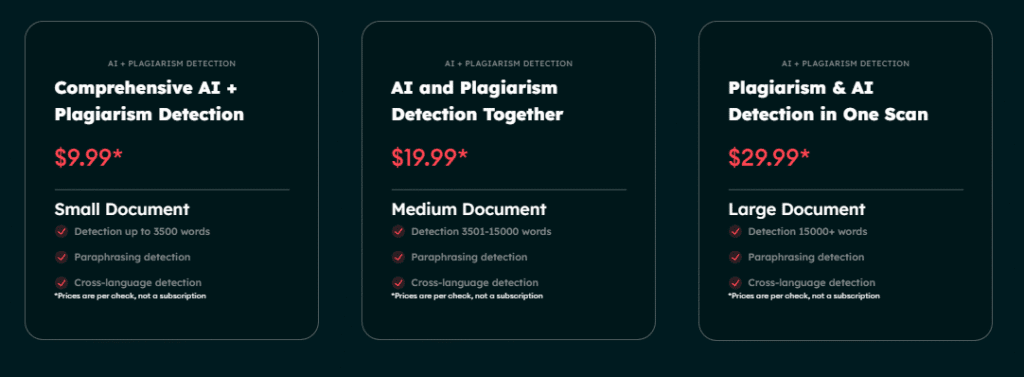
All plans include paraphrasing detection, cross-language scanning, and AI-content recognition, offering you a professional-grade report trusted by reviewers and institutions alike. With transparent one-time pricing and no subscriptions, you can focus on improving your work’s originality without worrying about recurring costs.
Edge cases where paid tools shine
Patchwriting and mosaic borrowing
Students often merge phrasing from several sources. Paid systems are better at aligning these fragments and surfacing the mosaic.
Self plagiarism and recycling
If you reuse parts of an earlier assignment, a paid checker that indexes institutional submissions is more likely to flag it. That is important because many schools treat reuse without citation as misconduct even if you are copying your own work. You can review the nuances around what is unintentional plagiarism to avoid accidental missteps.
AI assisted writing
AI can help with brainstorming and structure, but responsibility for originality remains with you. Editorial tools that advertise an AI score are not the same as a plagiarism check, and false certainty is common. If you are navigating policy boundaries, see this overview on is ChatGPT considered plagiarism.
Legal and ethical stakes
Plagiarism is both an ethical breach and, in certain contexts, a legal problem when it involves copyright infringement or contractual misrepresentation. For an overview of risks beyond a grade penalty, see the discussion of is plagiarism illegal.
A practical workflow you can copy
Use this sequence to reduce risk and cost while improving the reliability of your final check.
- Draft with citations from the start. Insert citations as placeholders even before you polish wording.
- Run a quick free scan on sections. Use free tools to catch obvious issues early on short excerpts rather than the whole document.
- Revise for paraphrase quality. Replace patchwriting with synthesis. If you are tempted to rely on paraphrase alone, read this on the limits of paraphrasing in academic writing and why attribution still matters in the article linked earlier on paraphrasing and plagiarism.
- Check the full draft with a paid tool. Do this before submission to catch edge cases in literature reviews and related work.
- Interpret the report carefully. Exclude references and short matches, then read the remaining highlights one by one.
- Document your due diligence. Save the report PDF. If a review occurs, you can show that you acted in good faith.
If you need expert help with a pre submission review or a second opinion on a tricky report, our team can assist through the dedicated plagiarism detection service. You will get a human read of the matches along with suggestions for revision that fit your discipline.
Buying considerations that matter more than price
Ask how the tool handles your data
Do your files get stored permanently Does the company use your text to train models Can you opt out Will deleting your file actually remove it from their archive
Confirm how instructors will read the report
Some departments specify which reports are acceptable. If you are submitting a thesis or a journal manuscript, check these rules in advance. It saves last minute stress.
Check multilingual and technical writing support
If your draft includes equations, code blocks, or non English passages, preview how the checker treats them. You want exclusion controls for references, formula heavy sections, and code snippets.
Watch for lock in
A good checker lets you recheck revised drafts without counting it as a new upload. This matters when you iterate based on feedback.
Mistakes to avoid with any checker
- Chasing a percentage rather than reading the actual matched passages
- Uploading the wrong draft or a version that still contains your notes and placeholders
- Ignoring self plagiarism in literature review sections and methods, where recycled phrasing is most tempting
- Treating paraphrase tools as a fix for poor citation discipline. Clean paraphrase still requires attribution
- Relying on a single tool for every stage of your process. Layer a quick free scan with a trusted paid one
For more background and resources on academic integrity, explore Skyline Academic. It is a hub for guidance on research writing, integrity, and graduate level support.
Summary
Free plagiarism checkers are helpful for early drafts and catching obvious overlap, but they are limited by smaller databases, simple matching, and basic reports. Paid tools bring wider coverage, stronger algorithms, clearer reporting, and better privacy controls, which translate into more reliable results for formal academic submissions. The most effective approach is layered. Draft ethically, use a free pass to catch low hanging issues, then confirm your final version with a paid checker whose report your department or journal will accept.
FAQs
- Are free plagiarism checkers accurate enough for a university submission
They can catch obvious copying from public websites, but they often miss paraphrased text and sources in journals or theses. For formal submissions, a paid checker is more reliable. - What is a good similarity score
There is no universal safe number. Exclude references and quotes first, then inspect what remains. A short but uncited paragraph is more serious than a larger percentage of properly quoted material. - Will a checker flag my references and quotations
Yes if you do not exclude them. Good tools let you filter out quotations and bibliographies, which improves the usefulness of the report. - Can a checker detect paraphrasing
Advanced paid systems detect close paraphrase and patchwriting. Basic free tools often struggle with this. - Is it safe to upload my thesis to an online checker
Read the privacy policy. Prefer tools that allow opt out from permanent archiving and confirm deletion. Do not upload confidential data. - Do instructors trust reports from all tools
Not equally. Many programs prefer or require specific paid platforms because the reports are standardized and easier to audit. - Will a checker catch recycled content from my previous assignments
Paid tools with institutional databases are more likely to detect self plagiarism. Save earlier submissions and cite them when reuse is necessary. - How often should I run a check
Run a quick scan after your first full draft, then a comprehensive paid check on your final version. Recheck after major revisions.