

When you are about to submit your thesis, one of the biggest risks is that something you wrote without realising it looks too similar to existing work. In a long running survey by the International Center for Academic Integrity, about 58 percent of students admitted to plagiarism at least once in their academic careers, which shows how easy it is to cross the line without noticing. You do not want your thesis to be part of that statistic, so learning how to check plagiarism properly is essential. survey by the International Center for Academic Integrity
Key takeaways
- Plagiarism checking is not only about the final percentage, it is about understanding where and why text matches appear.
- You must know the common types of plagiarism and how unintentional plagiarism happens before you can fix it effectively.
- A good plagiarism checker plus a clear reading of the similarity report helps you revise and protect your thesis.
- Aim to reduce risky matches by reworking structure, adding proper citations, and improving your own academic voice.
- When in doubt, getting expert help to review your thesis and similarity report can save you from serious consequences.
Why checking plagiarism in your thesis matters
Your thesis is usually the most important piece of academic writing you will produce. It is often used to judge whether you are ready to graduate or progress to a higher degree. If it contains plagiarism, the consequences can be severe. Depending on your university, these can include formal warnings, failing the thesis module, delay of graduation, or in extreme cases expulsion. Many institutions also treat plagiarism as a disciplinary issue, which can affect your academic record for years.
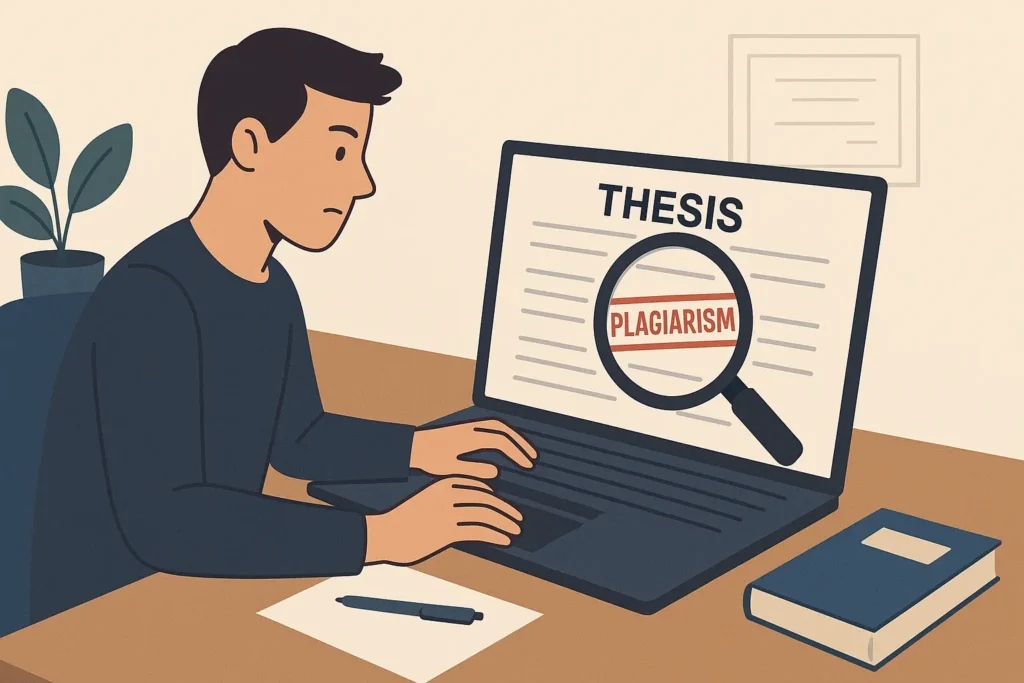
Plagiarism is not only an ethical issue, it is also a legal and professional risk. If you copy sections from books, articles, or online content without permission or proper citation, you can infringe copyright. If you want to understand how academic rules and laws interact, it is worth reading about whether is plagiarism illegal in different contexts.
For thesis students, there is a second layer of risk. A thesis is often archived in digital repositories and checked by future plagiarism detection tools. That means copied work can be discovered years later. Checking your thesis for plagiarism before submission protects your reputation now and in the future.
First, understand what actually counts as plagiarism
Before you run any software, you need a clear picture of what you are trying to avoid. Many students think plagiarism only means copying and pasting large chunks of text. In reality, there are several common types of plagiarism that show up in the thesis.
Some of the most frequent problems include:
- Copying text word for word from a source without quotation marks and citation
- Paraphrasing very closely, only changing a few words but keeping the same structure
- Reusing your own previous assignments without permission, which is a form of self plagiarism
- Poorly summarising sources so that your voice disappears and only the source’s ideas remain
A large share of plagiarism in theses is not deliberate. Students are rushing, have weak note taking habits, or are unsure how to combine reading and writing. This leads to what is unintentional plagiarism, where the student did not intend to cheat but still copied language or ideas in a way that breaks academic rules.
Another subtle pattern is incremental plagiarism. This happens when you build a chapter by copying small bits from different sources or from older assignments, thinking that each individual piece is minor. By the time the whole chapter is assembled, the combined amount of copied material is significant, even if you never pasted a full page from one place.
If you wrote parts of your thesis during remote assessments or mixed them with exam style answers, you should also be aware of plagiarism risks during online exams. Some of that content might have been rushed, poorly referenced, or influenced by quick online searches, which can later trigger plagiarism matches in your thesis.
The more clearly you understand these patterns, the more effectively you can use a plagiarism checker and interpret the results.
Step by step guide to checking plagiarism in your thesis
Now let us walk through a practical process you can follow from draft to submission.
Step 1: Prepare your thesis for checking
Before you upload anything, tidy your document:
- Combine all chapters into a single file, unless your university requires separate uploads.
- Remove pages that are not part of your own writing, for example ethics forms or blank title pages.
- Keep your references list and appendices. Most tools can exclude them automatically, but they still help the algorithm understand context.
- Save your file in a format that the checker accepts, usually Word or PDF.
It is best to run a plagiarism check when your thesis is fairly complete but still open to revision. If you check too early, you waste attempts on text that will change. If you leave it too late, you will not have time to revise properly.
Step 2: Choose the right plagiarism checker
Not all plagiarism tools are equal and not all are appropriate for theses.
In general, you have three main options:
- University provided tools
Many universities integrate a plagiarism checker into their learning environment. This is usually the safest option because it uses similar settings and databases to the one lecturers will use. If you have a practice area where you can upload a draft, take advantage of it. - Independent academic tools
There are also reputable third party tools built specifically for academic work. These usually scan against web content, student papers, and academic publications. When choosing one, look for transparency about how they store your thesis and whether your document will be added to their database. For a high stakes document like a thesis, you should prefer tools that allow you to opt out of permanent storage. - Professional support services
If you feel unsure about settings, interpretation, or risk, you can ask experts to help. Our team at Skyline Academic works daily with similarity reports and can advise how to lower risk while keeping your voice and argument.
For many students, the best strategy is to use the university checker if available and, if more reassurance is needed, a reputable external or expert option that mimics academic settings as closely as possible. If you want a guided option where experts run checks and explain the report to you, you can also use our professional plagiarism detection service.
Step 3: Upload and run the plagiarism check
When you are ready:
- Log in to the chosen plagiarism checker.
- Upload your thesis file.
- Check any available settings, for example:
- Exclude references and bibliography
- Exclude quoted material
- Exclude small matches, for instance phrases shorter than a certain number of words
These settings prevent the report from being filled with harmless matches, which makes it easier to focus on real risks.
After you submit, the tool will process your document and produce a similarity report. The processing time can vary, but for a thesis length document it is normal for it to take longer than a standard essay.
Step 4: Read the similarity report properly
The most common mistake students make is to focus only on the final percentage. A similarity score is a signal, not a verdict. It tells you how much of your thesis text could be found elsewhere, not whether you plagiarised.
To interpret the report, look at:
- Location of matches
If most matches are in your literature review, references, and standard methodology text, this is usually less serious than matches in your original analysis or discussion chapters. - Type of matched content
Short common phrases like “the results of this study indicate” are not a problem. Longer sentences or paragraphs copied from a single source are high risk. - Pattern of similarity
One or two short matches can be acceptable when properly cited. Long continuous blocks of colour in the report usually indicate poor paraphrasing or direct copying.
If you want a more structured explanation of similarity reports, thresholds and best practice, it is useful to read a dedicated plagiarism detection guide for students.
Step 5: Revise high risk sections
Once you know where the problems are, work through them in a focused way.
For each highlighted section, ask yourself:
- Did I copy this wording too closely from a source?
- Did I forget to include a citation or quotation marks?
- Is this a standard definition that is better quoted than paraphrased?
- Could I express this idea in my own words and structure?
Then, apply one of these fixes:
- Add missing citations where you used ideas or data from a source.
- Switch to direct quotation for important definitions or characteristic phrases, using proper quotation marks and a reference.
- Rewrite in your own words, changing both vocabulary and sentence structure while still acknowledging the original author.
- Summarise several related sources in one integrated paragraph instead of repeating each one separately.
Be careful not to over use paraphrasing tools or AI for rewriting. These can sometimes introduce new plagiarism risks, distort meaning, or create a style that does not match the rest of your thesis.
Step 6: Recheck if necessary
If your first report revealed large blocks of similarity and you have substantially rewritten those sections, it is wise to run another check. Many tools allow multiple submissions, but some have limits, so plan carefully.
You do not need to chase a similarity score of zero. That is neither realistic nor required. What you want is:
- No long uncited blocks of text from one source
- All key ideas properly referenced
- Similarity mainly in low risk areas such as references, titles of works, standard phrases, and correctly quoted material
At this stage, you can be confident that your thesis is your own work, supported by clear attribution.
Dealing with specific plagiarism patterns in a thesis
Theses often show a few recurring problems. Being aware of them makes it easier to fix your draft.
Self plagiarism
If you reused parts of your previous coursework or conference papers, your thesis may match your own earlier submissions. Universities differ in how they treat this. Some allow limited reuse with permission, others treat it as self plagiarism.
If your report shows many matches to your old assignments:
- Check your university policy on reusing your own work.
- Rephrase and restructure sections heavily influenced by earlier writing.
- Emphasise new data, updated analysis, and fresh interpretation.
Patchwriting and over paraphrasing
Patchwriting is when you combine fragments of source material with light editing rather than writing from your own understanding. It is common among students who have read a lot but still feel unsure in their academic voice.
Signs of patchwriting include:
- Paragraphs that closely follow a source’s structure
- Repeated use of the same technical phrases without explanation
- Many small matches to a single article or chapter
To fix this, step away from the original text. Close the article or book, make brief notes in your own words, then write from those notes instead of from the source.
Incremental copying across chapters
Because theses are long, students sometimes think that a few copied sentences in each chapter are harmless. Together, they create incremental plagiarism, which can still be viewed as misconduct.
When you see recurring matches to the same source scattered across the document, consider merging and rewriting those sections, or quoting more clearly with proper attribution.
For a more permanent reference you can revisit, you might like to bookmark this check plagiarism in thesis guide so that you can come back to the steps whenever you are revising.
When you should get expert help
There are situations where checking plagiarism on your own does not feel sufficient:
- Your similarity percentage is higher than your department recommends, even after revision.
- The report shows complex overlap with many sources and you are unsure what is acceptable.
- You are working on a high stakes thesis, such as a masters or doctoral dissertation, and want independent reassurance.
- You suspect that some similarities are due to templates or supervisor provided wording and need help judging the risk.
In these cases, speaking with your supervisor is usually the first step. They can advise what is normal for your discipline and how examiners are likely to view your report.
In addition, professional support teams who specialise in academic integrity can walk through the report with you in detail, explain which sections are high risk, and suggest specific revision strategies. This guidance can make the difference between a borderline case and a clearly acceptable thesis.
Summary
Checking your thesis for plagiarism is not a box to tick at the end, it is part of doing serious academic work. A good process starts with understanding what counts as plagiarism, including unintentional and incremental forms. Then you choose a suitable plagiarism checker, run a similarity report, and interpret the results carefully rather than obsessing over a single percentage.
From there, you revise high risk matches by improving citations, rewriting in your own words, and strengthening your own academic voice. If needed, you repeat the check for reassurance.Throughout, you keep in mind that the goal is originality in thought and expression, supported by honest acknowledgement of others’ work.
By approaching plagiarism checking as a structured, reflective process, you do more than protect yourself from penalties. You also become a stronger, more confident researcher, able to explain exactly how your thesis contributes something new.
Frequently Asked Questions
1. What is a safe plagiarism percentage for a thesis?
There is no single safe percentage that applies everywhere. Some universities are comfortable with similarity around ten to twenty percent when most matches are in references and common phrases. Others focus less on the number and more on whether there are any long uncited matches. Always follow your own institution’s guidelines and look at where the matches are, not only the final score.
2. Does a higher similarity score always mean I plagiarised?
No, a high similarity score means that a lot of your text appears in other sources, but it does not automatically prove misconduct. For example, long reference lists, standard methods sections, and correctly quoted material can all push the score up without being plagiarism. What matters is whether you have used other people’s words or ideas without proper acknowledgement.
3. Will paraphrasing tools or AI make my thesis plagiarism free?
Paraphrasing tools and AI cannot guarantee that your work is free from plagiarism. They often keep the same structure and ideas while only changing surface language, which can still be considered plagiarism. They may also introduce errors or unnatural style that raises suspicion. True originality comes from understanding your sources and expressing the ideas in your own way with clear citations.
4. Should I exclude references and quotes when checking for plagiarism?
Many plagiarism checkers allow you to exclude references and quoted material from the similarity score. This is helpful because it stops the report being dominated by harmless matches. However, you should still make sure that all quotations are properly formatted and all references are accurate and complete before submission.
5. Can I be penalised for self plagiarism in my thesis?
Yes, in many institutions reusing significant parts of your own previous work without permission is treated as self plagiarism. This can include copying sections from earlier essays, reports, or published articles. It is usually acceptable to build on your previous research, but you should acknowledge it and avoid copying large sections word for word. When in doubt, ask your supervisor how your department handles this.
6. How many times should I run a plagiarism check on my thesis?
Most students run one or two checks. The first check helps you identify and fix problems, the second confirms that your revisions have reduced risky overlaps. Too many checks are rarely necessary and may be limited by your institution or chosen software. Plan your writing schedule so that you have time for at least one revision after seeing the first report.
7. What should I do if my university’s checker is not available for drafts?
If your institution only allows one final submission, focus strongly on good referencing and careful writing throughout the process. You may choose to use an independent academic plagiarism tool to get an idea of your similarity level before that final upload, but make sure you understand the differences in databases and settings. In any case, your best protection is accurate citation and genuine engagement with your sources.
8. Is it possible for a thesis to have zero similarity?
A similarity score of zero is extremely rare for serious academic work. Any thesis that includes quotations, technical phrases, standard methods, or references will naturally share some text with other documents. Rather than aiming for zero, aim for a report where similarities are limited to low risk areas and there are no long sections of unacknowledged copying.
9. Will a plagiarism checker detect copied tables, figures, or formulas?
Many plagiarism tools focus mainly on text. Some can recognise text within tables or figure captions, but they may not detect copied images or complex formulas. You are still responsible for citing the sources of any tables, figures, or equations that you adapt or reproduce. When using such material, always include a clear reference and, if required, permission from the original publisher.
10. What if my thesis matches other theses from my university?
This can happen when your department uses standard templates or when many students use similar wording to describe common methods. Examiners are usually familiar with this and focus on whether your unique analysis and discussion chapters are original. If you see matches with other theses, check that you have not copied their specific phrases or structure and that your own contribution is clearly distinct.