If you are trying to decide between Chegg and Course Hero, I get why you are stuck. Both show up in basically every “best homework help” search, both promise expert answers and study materials, and both cost money, so picking wrong feels like a real risk to your wallet and your grade. I have spent a good amount of time comparing the two directly, pricing, content quality, and the academic integrity side that nobody likes to talk about, and there is genuinely a clearer answer here than most comparison posts want to admit. Let me walk you through it.
Quick Answer: Chegg vs Course Hero
If you only have thirty seconds, here is the short version. Chegg is the better pick if you need fast, specific answers to well defined homework problems and want one flat monthly price with no tier decisions. Course Hero is the better pick if you want broader study materials, more pricing flexibility across tiers, and are willing to commit annually for the lowest rate. Chegg costs $19.95 a month flat, while Course Hero ranges from $9.95 to $29.95 a month depending on tier and billing cycle. Neither is safer than the other when it comes to academic integrity, since the risk depends on how you use the platform, not which one you pick.
What Each Platform Actually Is
Chegg built its reputation on a massive Q and A archive, homework help submitted and answered across nearly every subject, alongside textbook solutions and study tools bundled into one subscription. If you have a specific problem and want a worked answer, Chegg’s whole model is built around getting you there fast.
Course Hero takes a slightly different shape. It leans more on a shared document library, class notes, study guides, and past assignments uploaded by other students, combined with an expert tutor feature and an AI assistant depending on which tier you pick. If you want a detailed analysis on course hero specifically, I have covered it in more depth elsewhere, but the short version is that it works best when you want to see how other students approached similar material rather than getting a single definitive answer.
Both platforms solve a similar underlying problem, feeling stuck on an assignment, but they get you there in noticeably different ways, which matters more than it sounds once you get into pricing and how each is actually used.
Feature Comparison at a Glance
Before getting into pricing specifics, it helps to see how the two platforms stack up feature by feature, since the differences go beyond just Q and A versus documents.
| Feature | Chegg | Course Hero |
| Q and A Archive | Yes, over 90 million answered questions | Limited, focused more on documents than a direct Q and A archive |
| Document and Notes Library | Not a core focus | Yes, this is the platform’s main strength |
| Expert Tutor Access | Yes, included in subscription | Yes, included on both Premier tiers |
| AI Assistant | Not a core feature | Yes, Ask AI included on both tiers |
| Writing Help | Expert proofreading included | Only on Premier Plus, through QuillBot |
| Math Solver Tool | Included as part of math help | Only on Premier Plus, through Symbolab |
| Plagiarism Detection | Included in subscription | Not included by default |
| Tier Options | Single flat plan | Two tiers, Premier and Premier Plus |
Looking at it this way, Chegg bundles more into a single flat price, while Course Hero spreads similar tools across two tiers, which means you need to actually think about which specific tools you will use before picking a plan.
Chegg vs Course Hero Pricing Comparison
This is where the numbers actually matter, so let me lay them out clearly rather than making you dig through pricing pages yourself.
Chegg runs a single Study Pack subscription at $19.95 per month plus applicable tax, billed monthly. That one price gets you unlimited access to the expert Q and A archive, which covers more than 90 million answered homework questions, plus quiz and exam help, expert proofreading, plagiarism detection, and math help all bundled together.
[Insert image: Chegg Study Pack pricing page. Alt text: “Chegg Study Pack monthly subscription pricing page”]
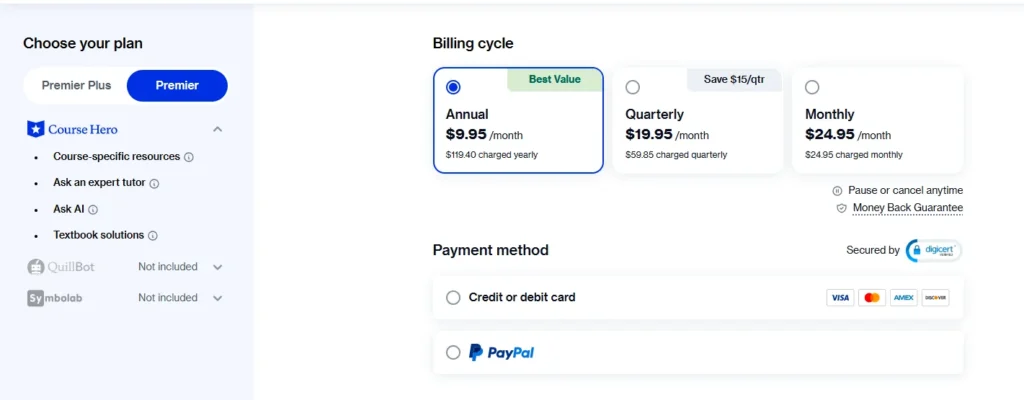
Course Hero splits things into two tiers, Premier and Premier Plus, and pricing shifts quite a bit depending on billing cycle. Premier runs $24.95 per month billed monthly, $19.95 per month billed quarterly at $59.85, or $9.95 per month billed annually at $119.40, which is the best value option if you commit for the full year. Premier includes course specific resources, the ask an expert tutor feature, Ask AI, and textbook solutions, but it does not include QuillBot AI writing or the Symbolab math solver.
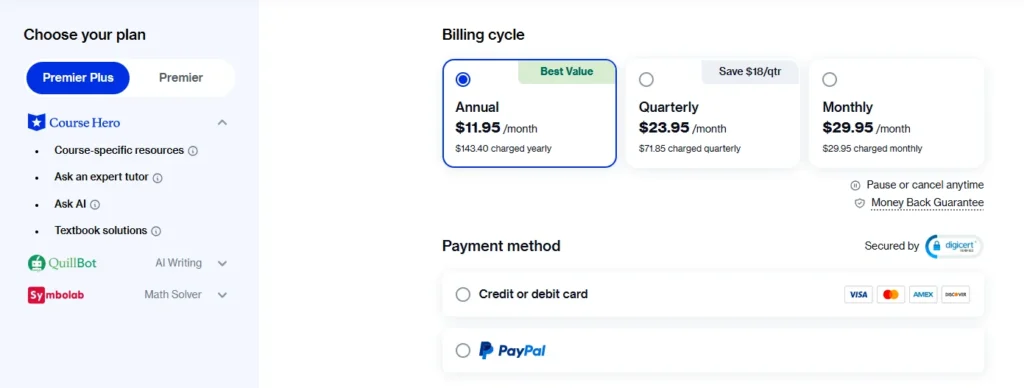
Premier Plus adds those two tools on top of everything Premier offers, and it runs $29.95 per month billed monthly, $23.95 per month billed quarterly at $71.85, or $11.95 per month billed annually at $143.40.
Here is the side by side breakdown so you can compare at a glance.
| Platform | Monthly | Quarterly | Annual | What’s Included |
| Chegg Study Pack | $19.95/month | Not offered | Not offered | Q and A archive, quiz and exam help, proofreading, plagiarism detection, math help |
| Course Hero Premier | $24.95/month | $19.95/month | $9.95/month | Course resources, expert tutor, Ask AI, textbook solutions |
| Course Hero Premier Plus | $29.95/month | $23.95/month | $11.95/month | Everything in Premier, plus QuillBot AI writing and Symbolab math solver |
If you are only comparing sticker price without committing annually, Chegg is actually cheaper than Course Hero Premier Plus and roughly comparable to Premier billed monthly. But if you are willing to commit to a full year, Course Hero’s annual pricing undercuts Chegg noticeably, which changes the calculation depending on how long you actually plan to use the platform.
Cancellation and Billing Basics
One thing worth checking before you subscribe to either platform is how cancellation actually works, since subscription based homework help services tend to auto renew until you cancel yourself. Chegg bills monthly and continues charging automatically until you cancel through your account settings, so it is worth marking a reminder if you only need it for a single semester. Course Hero works similarly, and because it offers quarterly and annual billing on top of monthly, canceling partway through a longer commitment does not always refund the remaining period, so it is worth reading the current terms on their billing page before choosing quarterly or annual over monthly if you are not fully sure you will stick with it. Both platforms are generally straightforward to cancel, but neither is the type of subscription you want to forget about.
Content Quality Comparison
Price only tells half the story, so let me get into how each platform actually performs once you are using it.
Chegg’s strength is depth on specific, well defined questions. Because the Q and A archive is so large, you have a decent shot at finding your exact textbook problem already answered, especially for common courses like intro statistics or general chemistry. The tradeoff is that answer quality depends on who originally submitted it, so you will occasionally run into explanations that are technically correct but not particularly well explained.
Course Hero’s document library works differently. Instead of a single answer to a single question, you are often looking at a full set of notes or a study guide, which can be genuinely useful for understanding a broader topic rather than just one problem. The downside is consistency, since document quality swings a lot depending on the original uploader, and it is not always obvious how closely a document matches your specific assignment until you are already reading through it.
Neither platform replaces actually working through material yourself, and if what you really want is someone explaining a concept live rather than reading a static answer or document, it is worth knowing that different online tutoring platforms solve that problem in a fundamentally different way than either Chegg or Course Hero can.
Academic Integrity Considerations
This is the part most comparison posts gloss over, and I do not think that is fair to students who are genuinely trying to stay on the right side of their school’s policies.
Both platforms have been the subject of academic integrity scrutiny at various schools, and both have cooperated with institutions during investigations in the past. Using either one to double check your own reasoning or understand a concept is generally low risk. Using either one to submit answers or content as your own original work is a very different situation, and it is the kind of thing that can genuinely put your academic standing at risk if flagged.
This is exactly why originality checks matter so much before you submit anything, regardless of which platform you used along the way. Skyline Academic offers free AI detection for students, which means you can check your work before submission rather than after a professor flags it, and that single step closes a gap that neither Chegg nor Course Hero really addresses on their own.
Where Each Platform Falls Short
Being direct here matters more than being diplomatic, so let me lay out the specific limitations of each.
Chegg’s biggest limitation is that it is fundamentally reactive. You submit a question and wait for or search for an answer, which works fine for well defined problems but falls apart for open ended, conceptual, or essay based work where there is no single correct answer to look up.
Course Hero’s biggest limitation is consistency and specificity. The document library is genuinely large, but finding something that actually matches your exact assignment, course, and professor’s expectations is hit or miss, and the expert tutor feature does not offer the same depth as a dedicated live tutoring relationship.
Neither platform is built for niche, highly specialized subject support. If you are dealing with something like Vensim PLE for a systems dynamics course, you are not going to find meaningful help on either platform, since that kind of specialized software tutoring requires an actual subject matter expert rather than a crowdsourced answer or document. Skyline Academic offers reliable 1:1 personalized live tutoring support for Vensim PLE specifically, which fills a gap that neither Chegg nor Course Hero even attempts to cover.
Who Should Actually Use Chegg
Chegg tends to work best for students who deal with a steady stream of well defined problem sets, particularly in subjects like math, statistics, chemistry, or intro level courses where textbook problems repeat semester to semester. If you know exactly what you are stuck on and just need a clear, worked explanation, Chegg’s Q and A archive is built for that specific moment. It also makes sense if you would rather pay one flat price and not think about tiers or add ons at all.
Who Should Actually Use Course Hero
Course Hero fits better for students who want broader context rather than a single answer, particularly for courses involving essays, discussion based material, or subjects where seeing a full set of notes helps more than one isolated answer would. It also makes more sense if you are comfortable committing for a semester or a full year, since that is where its pricing actually beats Chegg. If you specifically want built in AI writing help or a math solver on top of the core features, Premier Plus covers that, though it does cost more than Chegg’s flat rate.
The Verdict
Bringing this all together, here is how I would summarize the decision.
| Category | Chegg | Course Hero |
| Best For | Specific, well defined problems with a clear answer | Broader topic understanding through notes and study guides |
| Pricing | $19.95/month flat, no annual discount | $9.95 to $29.95/month depending on tier and billing cycle |
| Content Depth | Strong for direct Q and A, inconsistent explanation quality | Strong for context and notes, inconsistent document quality |
| Academic Integrity Risk | Moderate, higher if used to submit answers directly | Moderate, higher if used to submit documents directly |
| Overall Recommendation | Better if you need quick answers to specific problems | Better if you want broader study materials and flexible pricing |
If I had to give you one clear answer, it comes down to this. Choose Chegg if your main struggle is getting stuck on specific, well defined homework problems and you want a straightforward monthly cost. Choose Course Hero if you want broader study materials, some flexibility in tier and pricing, and are willing to commit annually for the best rate. Neither is inherently the safer or smarter choice across the board, it genuinely depends on what kind of help you need most often.
A Few Real Student Scenarios
Sometimes it helps to see the decision mapped onto an actual situation rather than an abstract comparison, so here are a few common ones.
A student taking intro statistics and stuck on a specific homework set with clear right answers is usually better served by Chegg, since the goal is a fast, accurate worked solution rather than broader context.
A student writing a research paper who wants to see how other students structured similar assignments in the same course is usually better served by Course Hero’s document library, since the goal is context and structure rather than a single answer.
A student juggling several subjects who wants writing help, a math solver, and tutoring all under one subscription might lean toward Course Hero Premier Plus, accepting the higher price for the bundled tools.
A student on a tight budget who just wants one predictable monthly charge without comparing tiers is often better off with Chegg’s flat pricing, even if it means missing out on some of Course Hero’s extras.
When a Written Answer or Document Just Is Not Enough
Sometimes none of this actually solves the real problem. If you have read through a Chegg answer or a Course Hero document three times and you are still lost, that usually means what you actually need is someone walking through the material with you, not another static explanation to decode on your own. This is especially true for harder or more technical courses where one wrong assumption early on throws off everything that follows.
If that sounds familiar, it might be worth trying 1:1 live tutoring instead, where you can ask follow up questions in real time and actually work through your specific assignment rather than hoping a generic answer happens to match your situation closely enough.
A Quick Word on Alternatives
Neither Chegg nor Course Hero is the only option out there, and honestly, depending on what you need, there might be a better fit entirely outside this comparison. If Course Hero’s document based approach is not clicking for you, it is worth browsing course hero alternatives to see platforms built around a different model, like live tutoring or self paced learning.
Similarly, if Chegg’s pricing or academic integrity concerns are giving you pause, there is a solid rundown of chegg alternatives covering platforms that solve the same underlying problem without some of the same tradeoffs.
Frequently Asked Questions
Is Chegg or Course Hero cheaper?
Chegg costs a flat $19.95 per month with no annual discount, while Course Hero ranges from $9.95 to $29.95 per month depending on tier and billing cycle, so Course Hero can be cheaper if you commit annually.
Which is safer, Chegg or Course Hero, for academic integrity?
Both carry similar risk levels since the danger comes from how you use the platform rather than the platform itself, so using either to submit answers or documents as your own original work is risky regardless of which you choose.
Does Chegg or Course Hero have better answer quality?
Chegg tends to be stronger for specific, well defined problems with a direct answer, while Course Hero tends to be stronger for broader context through notes and study guides, so it depends on what kind of help you need.
Can I use both Chegg and Course Hero at the same time?
Yes, there is no restriction against using both, and some students do subscribe to each for different purposes, though it does mean paying for two separate subscriptions.
Which platform is better for essay writing help?
Neither platform is built specifically for essay writing support, so if that is your main need, a dedicated writing or tutoring service is usually a better fit than either Chegg or Course Hero.
Is Course Hero’s annual plan worth it?
If you plan to use it consistently across a full academic year, the annual rate is noticeably cheaper per month than the monthly or quarterly options, so it can be worth it for regular users.
Do professors know if you use Chegg or Course Hero?
Many schools do monitor for both, and both companies have cooperated with academic integrity investigations in the past, so relying on either for graded work carries real risk.
What is included in Chegg’s Study Pack subscription?
It includes unlimited access to the expert Q and A archive, quiz and exam help, expert proofreading, plagiarism detection, and math help, all under one flat monthly price.
What is the difference between Course Hero Premier and Premier Plus?
Premier Plus includes everything Premier offers, plus QuillBot AI writing and the Symbolab math solver, which are not included in the standard Premier tier.
Which platform is better for STEM subjects specifically?
Chegg’s large Q and A archive tends to perform well for well defined STEM problems with clear right answers, while Course Hero’s tutor and Ask AI features can help with STEM concepts too, so it often comes down to whether you need a direct answer or broader explanation.
Final Verdict
Here is my honest take after weighing all of this out. If you need fast, specific answers to well defined problems and want a simple flat monthly price, go with Chegg. If you want broader study materials, more pricing flexibility, and are willing to commit annually for the best rate, Course Hero is the stronger pick. Either way, treat both as tools to help you understand material, not shortcuts to submit as your own work, since that is where the real risk lives regardless of which platform you choose.