Is Originality AI accurate? Based on my four practical tests, it was very good at identifying obvious AI-generated writing, but I would not trust it as standalone proof that someone used AI.
It correctly classified two fully AI-generated samples with 100% AI confidence. However, it also marked a mixed human and AI sample as 100% AI. More concerningly, my fully human-written sample received an 88% AI score.
That final result changed the direction of this Originality AI review. Instead of simply asking whether the detector can recognize ChatGPT-style writing, I wanted to know whether it can avoid falsely accusing human writers.
The answer is complicated.
Originality AI appears highly sensitive to conventional AI writing patterns, but sensitivity is only half of the accuracy story. A reliable detector must also recognize genuine human work. My small test suggests that this is where users, particularly students and academic writers, need to be careful.
I also reviewed the supplied Trustpilot and Reddit screenshots, examined current Originality.ai features and pricing, and compared my findings with broader research into the accuracy of AI detectors.
For students who want to check their work before submission, Skyline Academic also provides free AI detection alongside personalized academic support. However, the same rule applies to every detector: a score is a warning signal, not a magical truth machine wearing a digital judge’s wig.
Is Originality AI Accurate? My Quick Answer
Originality AI was accurate when I gave it two fully AI-generated samples. It identified both with 100% AI confidence.
The detector became much less reliable when I tested mixed and fully human writing. It classified the mixed sample as completely AI-generated and gave an 88% AI score to content that I knew was written entirely by a human.
That does not prove Originality AI is generally inaccurate. Four samples are far too few to calculate a scientifically meaningful accuracy rate. However, the results demonstrate why users should separate two questions:
- Can Originality AI detect obvious AI-generated writing?
- Can Originality AI avoid falsely flagging human writing?
In my test, the answer to the first question was yes. The answer to the second was not always.
My Verdict at a Glance
| Category | My finding | What it means |
| Fully AI-generated content | Both samples received 100% AI scores | Strong detection of conventional AI writing |
| Mixed human and AI content | Received a 100% AI score | The score did not reflect the apparent mixture |
| Fully human writing | Received an 88% AI score | Serious false-positive concern |
| Ease of use | Fast and straightforward | Suitable for quick preliminary screening |
| Score clarity | Visually clear but easy to overinterpret | A confident score may appear more conclusive than it is |
| Trustpilot sentiment | Overall rating is positive, but complaints are significant | Experiences vary by use case and content type |
| Academic suitability | Useful as an indicator | Should not be used alone to prove misconduct |
| Overall verdict | Capable but not conclusive | Best used with human review and authorship evidence |
My practical conclusion is that Originality AI can be useful for screening large amounts of writing, particularly for publishers and editors. It is much riskier when the result may be used to accuse a student, writer, employee, or applicant of dishonesty.
What Is Originality AI?
Originality AI is a content-verification platform built primarily for publishers, content agencies, website owners, editors, writers, educators, and organizations managing large amounts of written material.
Its best-known feature is the Originality AI detector, which predicts whether a passage is likely to have been produced by an AI writing system. The platform also includes plagiarism checking, readability analysis, grammar and spelling tools, fact-checking assistance, file uploads, URL scanning, website scanning, scan history, team management, report sharing and API access on eligible plans. currently promotes several detection options:
- Lite Model: Intended for situations where light AI-assisted grammar or spelling edits may be acceptable
- Turbo Model: Intended for strict, zero-tolerance AI policies
- Academic Model: Designed for educational content and academic use
- Multilingual Model: Supports detection across 30 languages
- AI Allowance: Allows users to choose an acceptable AI threshold, such as 0%, 5%, 15%, 25% or 40%
Originality.ai officially reports 99% accuracy and a 0.5% false-positive rate for its Lite model. It reports more than 99% accuracy and a 1.5% false-positive rate for Turbo, and more than 99% accuracy with a false-positive rate below 1% for its Academic model. These are company-published figures and should be understood as official claims rather than results produced by my four-sample test. the company also introduced AI Allowance, acknowledging that much modern writing combines human authorship with some form of AI assistance. Instead of treating every document as purely human or purely AI, users can select how much AI involvement their policy permits. sible development because mixed authorship is becoming increasingly common. A student may use a grammar checker. A writer may use AI for brainstorming but write the final article manually. An editor may revise a human draft with automated suggestions. These cases are more complicated than simply asking, “Was this written by ChatGPT?”
Originality AI is not the same as a plagiarism checker. AI detection estimates whether writing resembles machine-generated text, while plagiarism detection compares content with existing sources. Students who want to check copied or closely matching material can therefore use a separate free plagiarism check rather than treating an AI score as a similarity score.
How Does the Originality AI Detector Work?
Originality AI does not have access to a secret record showing who typed every sentence. It analyzes linguistic patterns and estimates whether the submitted writing resembles text generated by large language models.
AI-generated writing often contains patterns involving:
- Predictable word selection
- Consistent sentence length
- Smooth transitions
- Balanced paragraph structure
- Repeated grammatical patterns
- Uniform tone
- Low variation in rhythm
- Common explanatory phrases
- Highly organized progression
- Limited unexpected wording
Human writing can contain the same characteristics.
A careful student may write in a formal, organized and grammatically consistent way. A professional editor may remove awkward wording and create smoother transitions. A non-native English speaker may rely on familiar sentence patterns to communicate clearly. None of these things proves that AI was used.
The detector compares patterns in submitted text with patterns learned from human-written and AI-generated examples. It then produces a probability or confidence-based classification.
This is why understanding the truth behind AI detection scores matters.
An 88% AI score does not necessarily mean that 88% of the words were written by AI. It generally means that the detector is highly confident that the overall text resembles content in its AI-generated classification.
Originality.ai itself states that an AI detection score is a prediction about whether text is AI-generated or human-written. The company also says its scores represent probability rather than guilt and advises users not to apply a rigid rule to a single result. ion becomes especially important when mixed writing is tested.
Imagine that a document contains five paragraphs. Four were written manually and one was created using AI. A detector may not necessarily return a neat 20% AI result. It could classify the whole document as likely AI because it recognizes a strong AI pattern. Alternatively, it may miss the AI paragraph because the human writing surrounding it changes the overall pattern.
The score is therefore not always a precise measurement of authorship proportions.
Originality.ai’s newer AI Allowance system attempts to address this problem by letting users choose how much AI involvement is acceptable. The company recommends a 15% allowance for many general workflows, although the appropriate threshold depends on the institution, employer, publisher or assignment policy. ed Originality AI
I designed a small practical test using four different writing conditions:
- Fully AI-generated business content
- A second fully AI-generated passage about employee motivation
- A passage containing a mixture of human and AI writing
- Fully human-written content
The screenshots show that I used Originality.ai Model Lite 1.0.2.
I chose these categories because testing only obvious ChatGPT output would not tell me enough. A detector may be excellent at catching unedited AI text but still create problems when it reviews mixed or polished human writing.
The purpose was not to establish a universal accuracy percentage. A formal accuracy study would require a much larger and more diverse dataset, controlled sample preparation, multiple genres, different text lengths, repeated scans and clearly defined thresholds.
My four tests are better understood as practical examples of how Originality AI behaved under different conditions.
The test also cannot prove that every human-written passage will be flagged or that all AI-generated content will be caught. It simply shows that, in this case, the detector produced two expected results and two results that require much more caution.
My Originality AI Accuracy Test Results
Test 1: Originality AI Correctly Flagged Fully AI-Generated Business Content
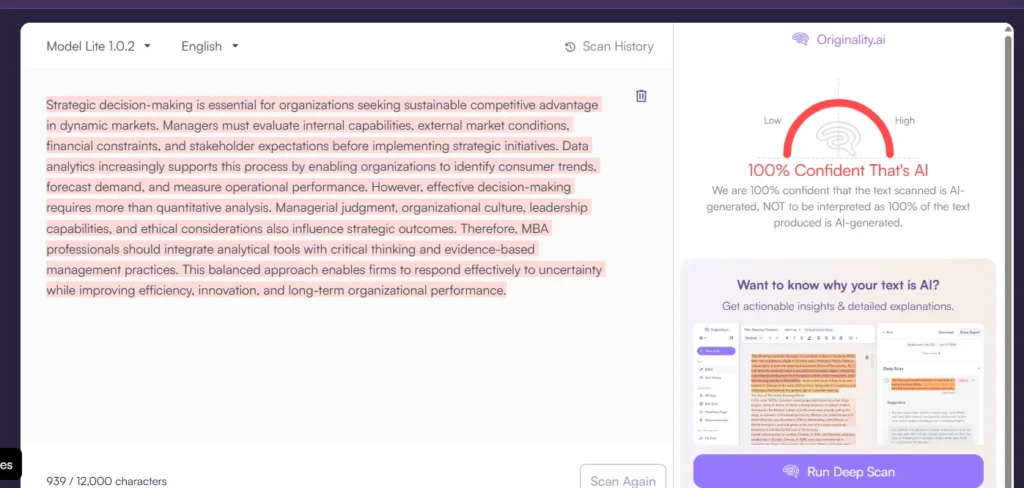
For my first test, I submitted a fully AI-generated passage discussing strategic business decision-making. Originality AI classified it with 100% confidence as AI-generated, which was the result I expected. The writing was structured, polished and consistently explanatory, so it contained several features commonly associated with unedited AI prose. This result suggests that the detector can recognize straightforward AI-generated business content. However, one correct classification cannot prove that the detector will perform equally well across academic writing, creative work, edited AI text or writing produced by different language models.
Test 2: A Second Fully AI Sample Also Received a 100% AI Result
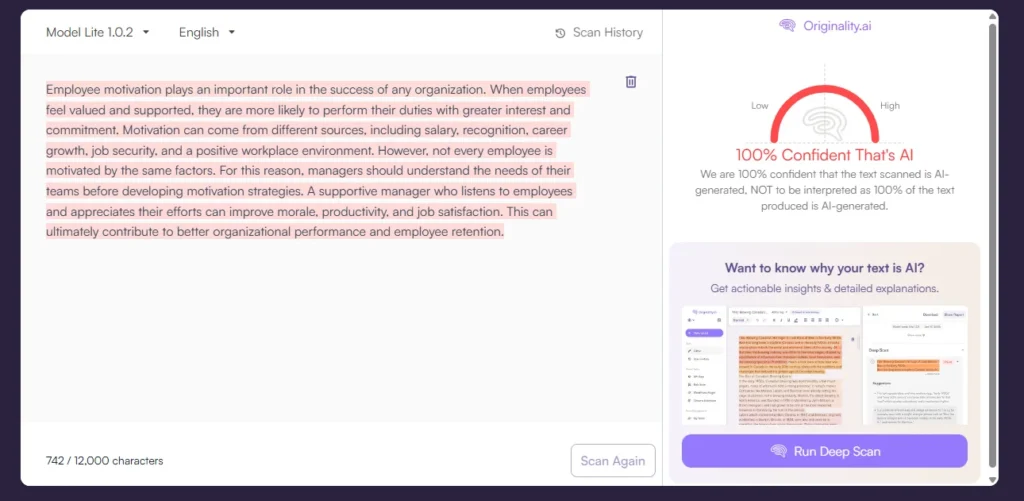
The second sample was also generated entirely by AI, but it focused on employee motivation rather than strategic decision-making. Once again, Originality AI returned a 100% AI confidence result. Receiving the same classification across two different topics strengthened my impression that the detector is highly sensitive to conventional, unedited AI prose. That is useful for editors who need to screen obvious machine-generated drafts. Still, two successful detections are not enough to establish universal accuracy, especially when AI writing can vary considerably depending on the model, prompt, editing process and length of the submitted content.
Test 3: Mixed Human and AI Writing Was Still Flagged as 100% AI
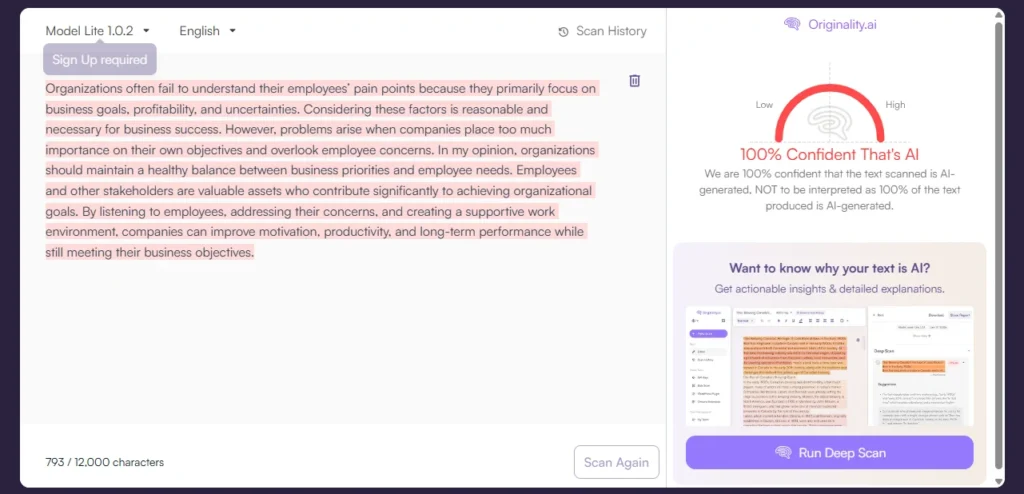
The third test was more realistic because the passage contained both human and AI-written material. Despite that mixture, Originality AI classified the complete passage with 100% confidence as AI-generated. This result shows why users should not automatically interpret the score as the exact percentage of words produced by AI. The detector recognized enough machine-like patterns to classify the entire sample as AI, but it did not visibly communicate that human writing was also present. For students, editors and content managers, this could make partially assisted documents appear completely machine-written when the actual authorship process was more complicated.
Test 4: Fully Human-Written Content Received an 88% AI Score
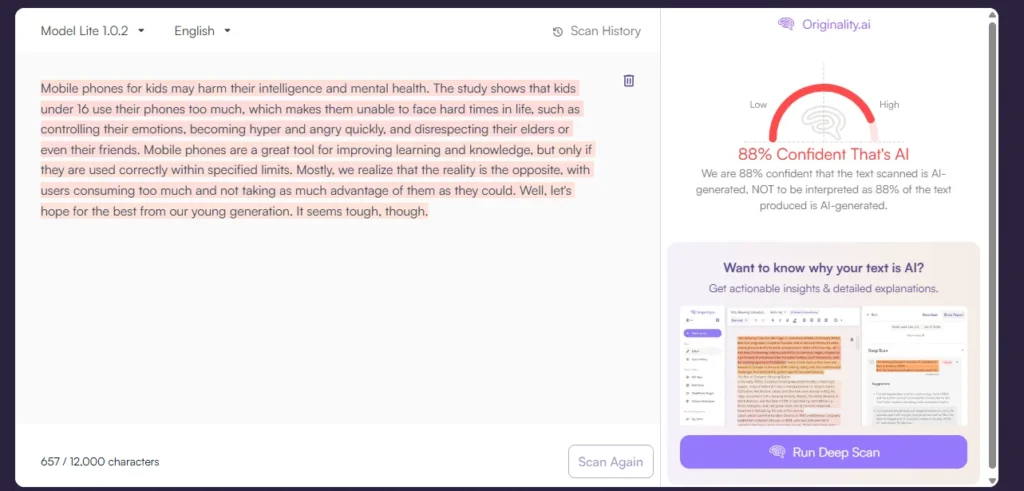
My fourth test produced the most concerning result. I submitted a passage that had been written entirely by a human, but Originality AI reported 88% confidence that it was AI-generated. In other words, the detector was not slightly uncertain. It appeared strongly convinced of the wrong classification. This is a clear false positive within my test and the main reason I would never recommend treating one Originality AI score as proof of misconduct. The result was so confident that, had I not known the writing history, it would have been easy to assume the detector had discovered something that simply was not there.
Originality AI Test Results Compared
| Test | Content type | Expected classification | Originality AI result | Did it make sense? | Main concern |
| Test 1 | Fully AI-generated | AI | 100% AI | Yes | Small sample |
| Test 2 | Fully AI-generated | AI | 100% AI | Yes | Similar polished AI style |
| Test 3 | Mixed human and AI | Mixed or uncertain | 100% AI | Partially | Human contribution was not reflected |
| Test 4 | Fully human-written | Human | 88% AI | No | Serious false positive |
Two terms help explain what happened:
Sensitivity refers to a detector’s ability to correctly identify AI-generated content. Originality AI showed strong sensitivity in my first two tests.
Specificity refers to its ability to correctly recognize human-written content. My fourth test exposed a specificity problem because the human passage was incorrectly classified as AI.
A detector can be very sensitive while still creating false accusations. For example, an airport security system could flag every suitcase as dangerous and successfully catch every prohibited item. It would technically miss very little, but it would also create chaos by treating harmless luggage as suspicious.
The best AI detector must balance both sides.
My mixed-content result also reflects a wider challenge identified in recent academic research. A 2026 study comparing Originality and Turnitin across 192 human, AI and hybrid texts found that Originality performed better overall than Turnitin in that dataset. However, both tools performed poorly on hybrid writing, and performance varied by text length and genre. The researchers concluded that detectors should be used as indicators that prompt further investigation, not as the sole basis for academic-misconduct decisions. iginality AI Flag My Human Writing as AI?
I cannot know the exact internal reason because Originality.ai’s full detection system is proprietary. However, several characteristics may help explain why a human-written passage can resemble AI-generated text.
Predictable Sentence Structure
AI models are often associated with evenly constructed sentences and clear subject-verb patterns. Human writers can naturally write in the same way, particularly when explaining a straightforward topic.
A passage does not become machine-generated merely because it is easy to read.
Formal and Polished Language
Academic and professional writing is expected to be organized, grammatically controlled and relatively objective. Unfortunately, these are also qualities AI tools are trained to reproduce.
A polished human paragraph may therefore look more “AI-like” than a messy first draft.
Repetitive Phrasing
If a writer repeats similar transitions, sentence openings or explanatory patterns, the detector may recognize statistical regularity. AI models also tend to produce repeated structures unless prompted to vary them.
This does not mean every repetitive paragraph was generated by AI. Sometimes a writer simply has a favourite phrase and refuses to let it retire.
Limited Sentence-Rhythm Variation
Human writing often moves between short, medium and long sentences. AI-generated prose can be more uniform.
However, a human writer working under academic constraints may intentionally maintain a steady rhythm. Editing tools may also smooth out irregular sentences, making the final draft more consistent.
Short Sample Length
Short passages provide less evidence than complete essays or long articles. Originality.ai’s support guidance states that website scans have a 100-word minimum and that accuracy generally improves when more text is supplied. ked to classify a short passage must make its decision using fewer linguistic signals. This may increase uncertainty even when the displayed percentage looks highly confident.
Common Academic Vocabulary
Terms such as “furthermore,” “significant,” “effective,” “therefore” and “in conclusion” appear frequently in academic writing. They also appear frequently in AI-generated responses because language models learned from large collections of formal text.
The overlap is one reason that understanding the difference between human and AI writing is more complicated than searching for a few suspicious words.
Detector Model Limitations
Every detector operates using a particular model, dataset, threshold and decision process. Performance can change when the subject, language, genre, length or writing style differs from the material used during training and evaluation.
My human passage may have fallen into a pattern that Model Lite 1.0.2 associated with AI, even though that association was incorrect.
These are plausible explanations, not confirmed causes. The only confirmed fact from my test is that the human-written sample received an 88% AI result.
Can Originality AI Produce False Positives?
Yes. Originality AI can produce false positives, and the company itself acknowledges that false positives occur.
A false positive happens when human-written content is incorrectly classified as AI-generated. My fourth test is a direct example because fully human writing received an 88% AI score.
Originality.ai says its Academic model has a false-positive rate below 1% and specifically warns that an AI score should not be used as the only measure for identifying academic cheating. is important.
A false-positive rate that sounds small can still matter when thousands of assignments, applications or articles are scanned. Even a relatively uncommon error becomes serious when the person affected must prove that they did not do something.
This is the central issue behind AI false positives. The practical harm is not evenly distributed. The detector produces a number in seconds, but the accused person may spend days or weeks gathering drafts, attending meetings and defending their work.
Recent research also suggests that performance may differ between professional human writing and writing produced by English-as-a-foreign-language students. The 2026 study mentioned earlier found that Originality’s performance showed a borderline trend toward greater accuracy on professionally authored texts than on EFL student writing, raising possible fairness concerns. es are particularly important for the following groups.
Students
A high AI score can trigger academic-integrity concerns, even when a student wrote the assignment independently. The consequences may involve delayed grading, stressful investigations or requests to demonstrate authorship.
Non-Native English Writers
Writers using English as an additional language may rely on consistent grammar, familiar expressions and simpler sentence structures. These patterns can overlap with the predictable structures associated with AI writing.
Academic Researchers
Researchers may use highly standardized language because scientific and technical writing prioritizes clarity and repeatability. A detector could mistake conventional scholarly phrasing for machine generation.
Professional Writers
A freelancer may be asked to rewrite work, lose a client or provide unpaid evidence of authorship because a detector produced a high score.
Job Applicants
Cover letters and personal statements are often concise, polished and formulaic. These characteristics may increase suspicion even when an applicant wrote the material manually.
Employees
Organizations may use detectors to review reports, marketing copy or internal documents. A false result could create unfair questions about an employee’s honesty or productivity.
Authors
Creative writers and nonfiction authors may run manuscripts through detectors because publishers are increasingly concerned about undisclosed AI use. This creates an unusual situation where human writers feel pressured to prove their humanity to a machine.
Another 2026 analysis of AI detection in academic publishing argued that detector findings can produce more false accusations than correct identifications under certain real-world conditions, particularly when undisclosed AI use is relatively uncommon and AI-generated text has been edited. mean detectors are useless. It means their output must be interpreted in context.
What Originality AI Trustpilot Reviews Reveal
At the time the supplied screenshot was captured, Originality.ai showed a Trustpilot rating of 4.6 based on 1,256 reviews. The live Trustpilot listing I checked showed the same 4.6 rating with approximately 1,253 reviews, indicating that review totals can change as reviews are added, removed or processed. ore of 4.6 is clearly positive. However, average ratings cannot explain why different people were satisfied or disappointed.
The positive reviews frequently praise speed, usability and customer support. The negative reviews focus more heavily on false positives, inconsistent results, subscription cancellation and the potential consequences of incorrect detection.
Originality AI Has a Strong Trustpilot Rating, but the Individual Reviews Tell a More Complicated Story
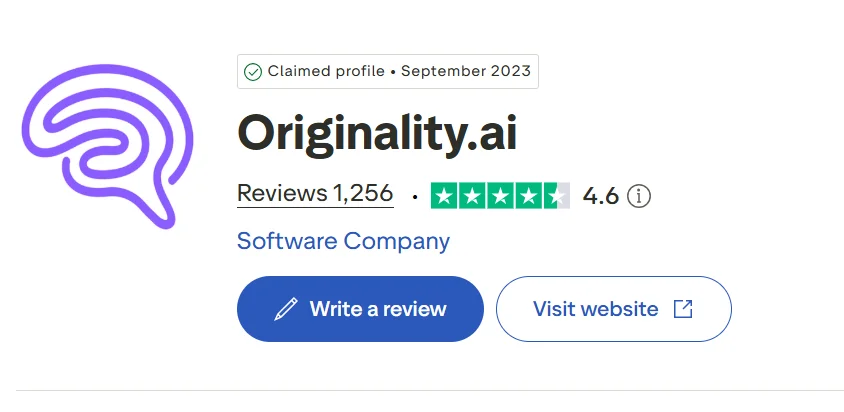
The supplied overview shows a strong public rating, which suggests that many customers have had a positive experience with Originality.ai. However, the rating alone does not tell me whether those users were publishers, teachers, students, website owners or occasional writers. A tool can work well for high-volume content screening while remaining unsuitable for proving academic misconduct. Looking at individual reviews reveals that satisfaction often depends on the user’s purpose. People who value speed and support tend to rate it highly, while users whose human work was flagged describe a far more serious experience.
What Positive Originality AI Reviews Commonly Praise
A Reviewer Praises Originality AI for Fast Scans, Clear Results and Helpful Support
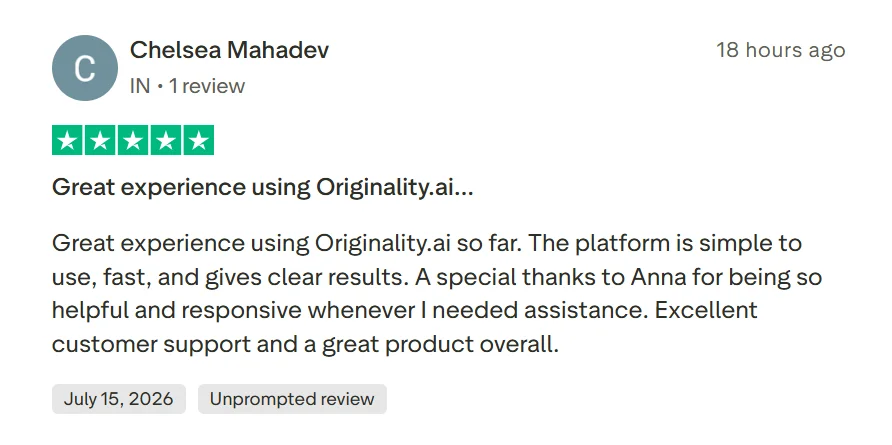
This five-star reviewer described Originality AI as simple to use, quick and easy to understand. The review also praised the support team for responding helpfully. These are meaningful strengths because a detector becomes frustrating very quickly if users cannot interpret the interface or resolve account problems. The positive experience matches what I observed about the scan presentation, which is visually clear and does not require technical knowledge. However, usability and customer support are separate from detection accuracy. A tool can present a result beautifully while still producing a classification that deserves further investigation.
One User Describes Originality AI as Strict but Believes That Improves Safety
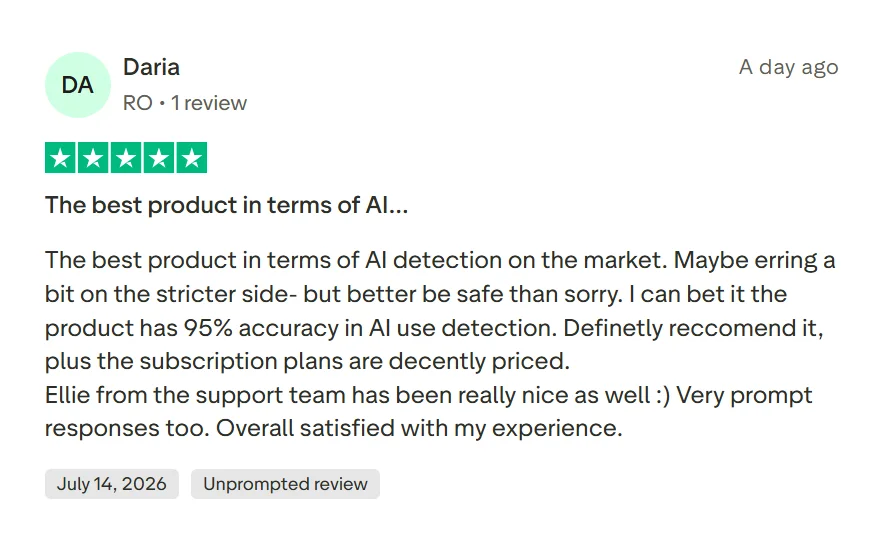
Another reviewer described the detector as stricter than alternative tools and viewed that strictness as a benefit. The reviewer personally estimated that the detector was approximately 95% accurate and considered the subscription reasonably priced. That percentage represents the customer’s own impression rather than a controlled accuracy study, so it should not be presented as verified performance. Still, the review highlights an important difference between users. Publishers with a zero-AI policy may prefer an aggressive detector, even if it produces more false warnings. Students and educators may place greater importance on minimizing false accusations.
A Book Writer Chose Originality AI to Reduce the Risk of Future AI Accusations
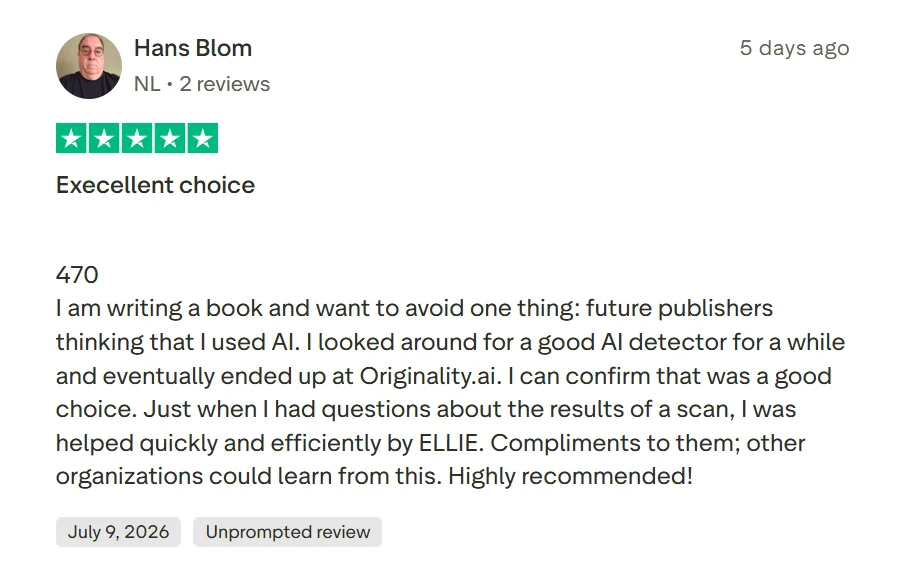
This reviewer was writing a book and wanted reassurance that publishers would not suspect undisclosed AI use. The customer also reported receiving quick and useful assistance when asking about the scan results. What interests me most is why the writer used the detector. It was not simply to catch someone else using AI. It was a defensive measure intended to protect genuine authorship. That says a lot about the current writing environment. Human writers are increasingly checking their own work because they fear being incorrectly flagged, although the possibility of false positives means a detector cannot provide complete peace of mind.
An Educator Finds the Interface Useful for Reviewing Student Work
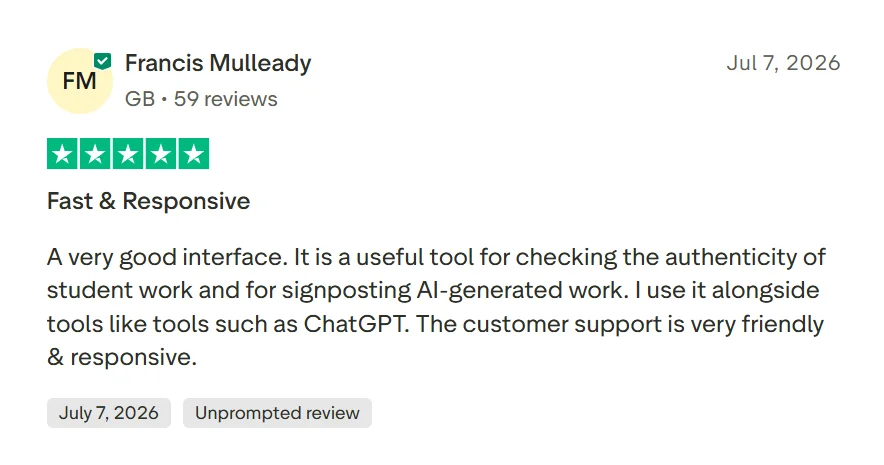
An educator reported using Originality AI to examine student submissions and praised the platform’s interface, speed and responsiveness. The review demonstrates why teachers may find the tool attractive. It can scan content quickly and identify passages that might deserve a closer look. That can be useful when one instructor is responsible for reviewing many assignments. The danger begins when convenience becomes certainty. Even educators who find the tool helpful should examine drafts, references, writing history and the student’s understanding before reaching a misconduct decision based on a probability score.
Fast Customer Support Is Another Common Positive Theme
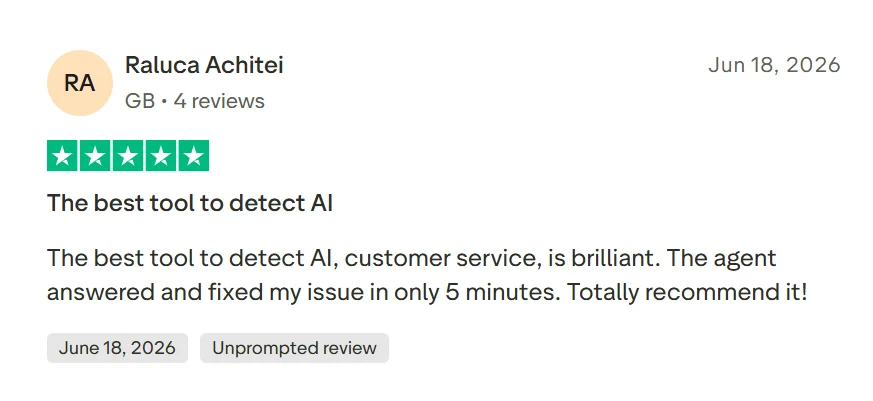
This reviewer called Originality AI a strong detection tool and said that a support representative resolved an issue in approximately five minutes. Fast support is especially valuable for paid platforms because users may be dealing with missing credits, scan questions or subscription concerns. Several of the supplied positive reviews mention support, making it one of the clearest strengths in the positive feedback. At the same time, customer service satisfaction does not validate every AI score. I would evaluate support quality and detection reliability as two separate parts of the product rather than allowing one to stand in for the other.
What Negative Originality AI Reviews Commonly Complain About
A Writer Reports Repeated 100% AI Scores on Human-Written Work
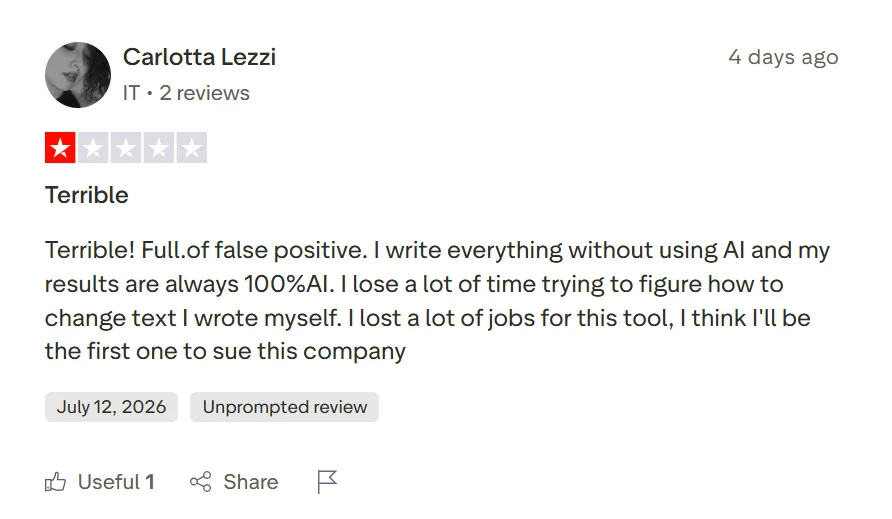
This one-star reviewer claimed that Originality AI repeatedly classified completely human-written work as 100% AI-generated. The reviewer also described professional consequences connected with those classifications. I cannot independently verify the person’s writing process or the events that followed, so the account must be treated as an individual allegation. However, the complaint is relevant because it resembles the pattern I observed when my own fully human sample received an 88% AI score. When separate users report confident AI classifications on human writing, the possibility of false positives deserves serious attention.
Original Content Was Allegedly Flagged as 91% AI
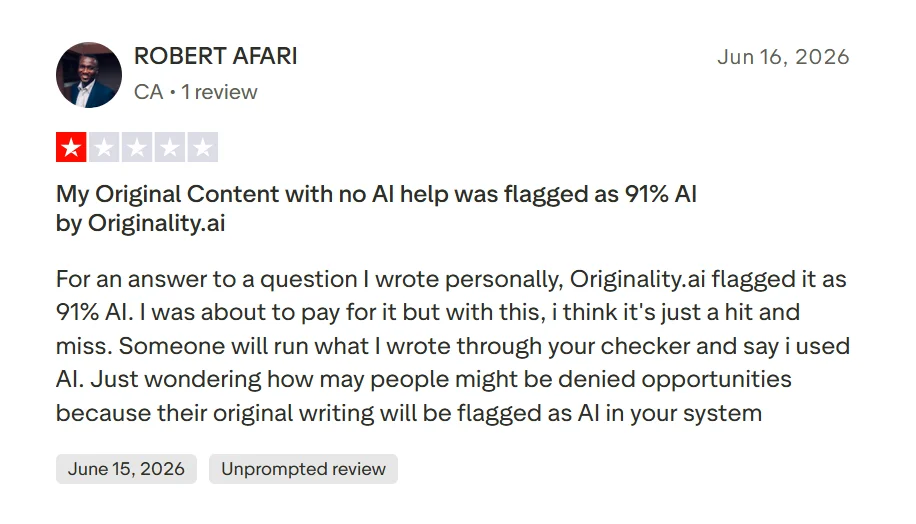
Another reviewer stated that a personally written response received a 91% AI score. The customer was concerned that inaccurate classifications could prevent people from accessing academic or professional opportunities. The screenshot does not establish that such consequences occurred, but it illustrates why false positives are not harmless technical mistakes. A 91% score looks highly confident and may influence someone who does not understand the limits of AI detection. In high-stakes situations, the stronger the displayed confidence appears, the more important it becomes to require supporting evidence before making a decision.
One Reviewer Claims Human and AI Content Were Classified in the Opposite Way
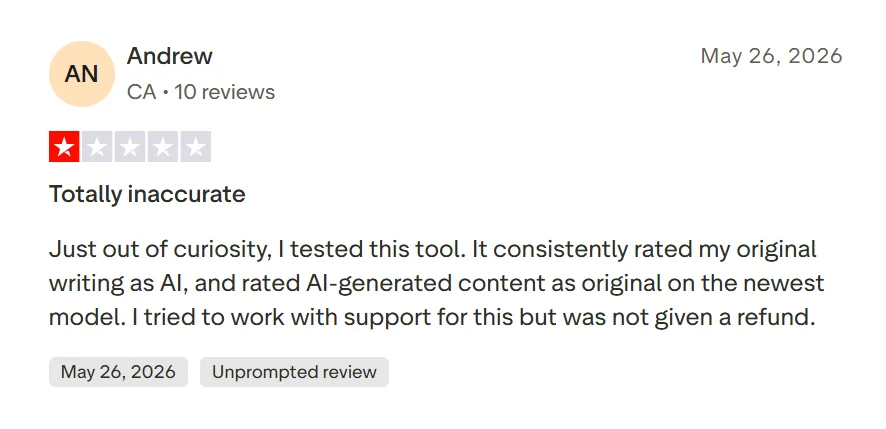
This reviewer reported a particularly confusing experience. According to the review, human writing was classified as AI while AI-generated content was considered original. The customer also described an unsuccessful attempt to obtain a refund. This is anecdotal evidence and does not demonstrate that the detector behaves this way for most users. However, it shows how quickly trust can collapse when a user tests material with known authorship and receives the opposite result. A detector is most persuasive when it agrees with ground truth. When it reverses known categories, users naturally question the value of the remaining scores.
Changing the Tense Allegedly Shifted the Result from Human to 50% AI
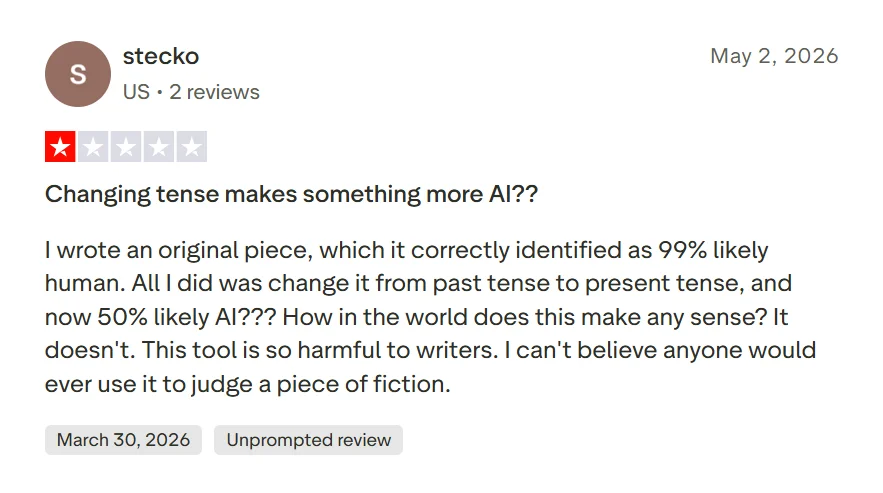
One reviewer claimed that changing writing from past tense to present tense caused the detector’s classification to shift significantly. If accurate, this would suggest that relatively modest grammatical changes can influence the result. Some variation is expected because detectors analyze language patterns, and changing tense may affect sentence construction throughout a passage. Still, a dramatic score shift can make the system feel unstable to a user who sees both versions as equally human-written. It also demonstrates why a single scan should not be treated as a permanent or objective measurement of authorship.
A Reviewer Reports Difficulty Cancelling an Originality AI Subscription
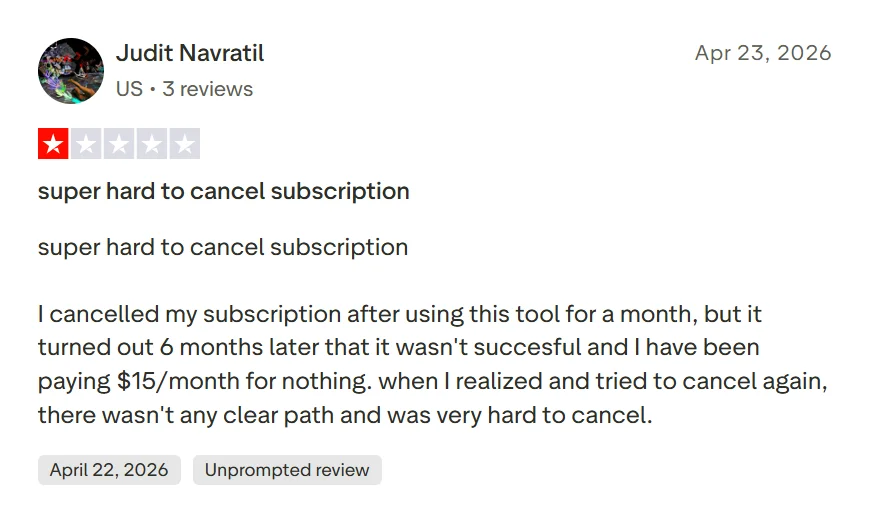
This complaint focuses on billing rather than AI detection. The reviewer claimed that the cancellation process was unclear and that monthly charges continued for several months. One account cannot establish that subscription problems are widespread, but it does provide a useful reminder for prospective customers. Anyone purchasing a recurring plan should check the renewal terms, cancel through the correct account settings and retain confirmation. Originality.ai’s current pricing page states that subscriptions can be cancelled at any time, but customers should still verify that the cancellation has been processed before assuming future billing has stopped.
A Reviewer Says Originality AI Struggled with Romanian Academic Writing
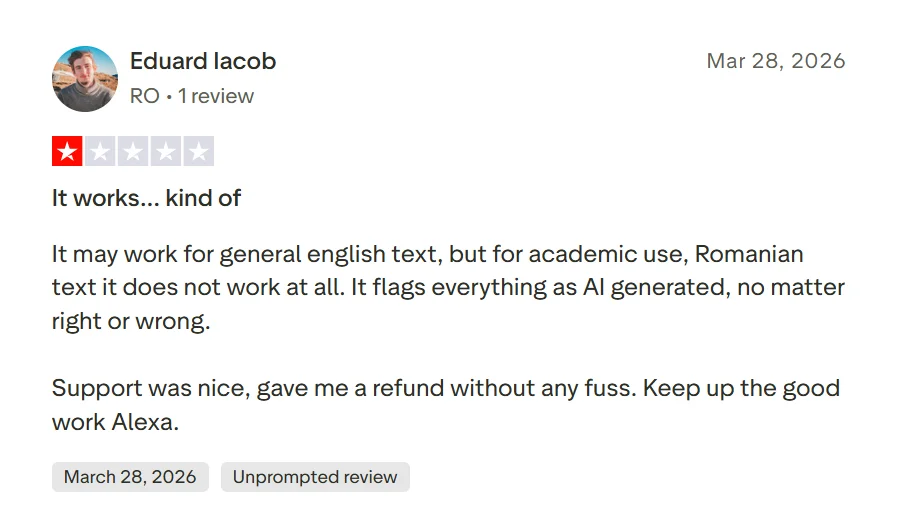
This reviewer said the detector may work better with general English content but repeatedly flagged Romanian academic writing. Interestingly, the same person praised customer support for issuing a refund. The review therefore separates two parts of the service: the detection result was disappointing, while the support response was positive. Originality.ai currently promotes a multilingual model supporting 30 languages, but performance can still vary by language, genre and dataset. ian may present different patterns from the general material used in broad multilingual testing.
Minor Punctuation Changes Allegedly Produced Different AI Scores
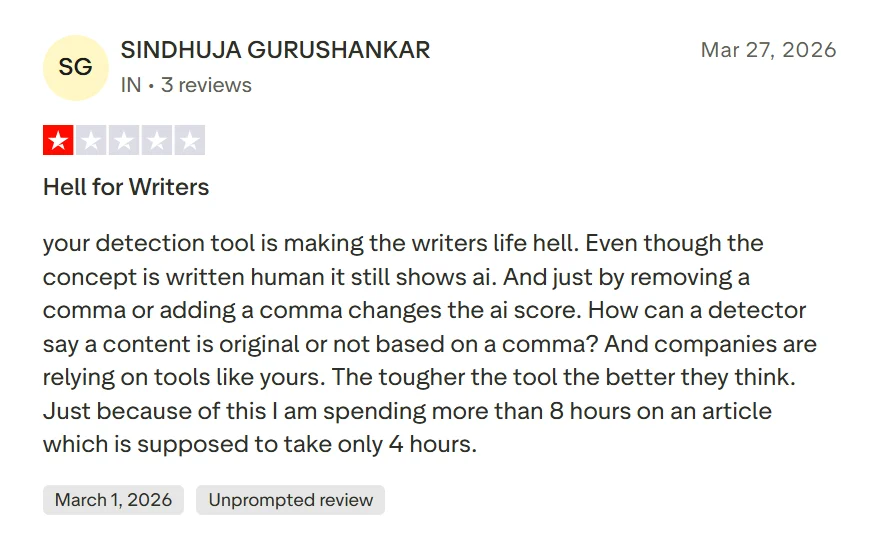
One reviewer claimed that adding or removing a comma changed the AI score and made completing assignments more time-consuming. Punctuation can influence sentence boundaries and statistical patterns, so some movement in a probability score is possible. The more troubling issue is what users do in response. A student may start changing punctuation, vocabulary and sentence structure solely to satisfy a detector rather than to improve the assignment. This reverses the purpose of writing support. Instead of developing clarity and argument quality, the writer begins negotiating with an unpredictable percentage displayed on a screen.
A Handwritten Essay Was Reportedly Rated as 81% AI
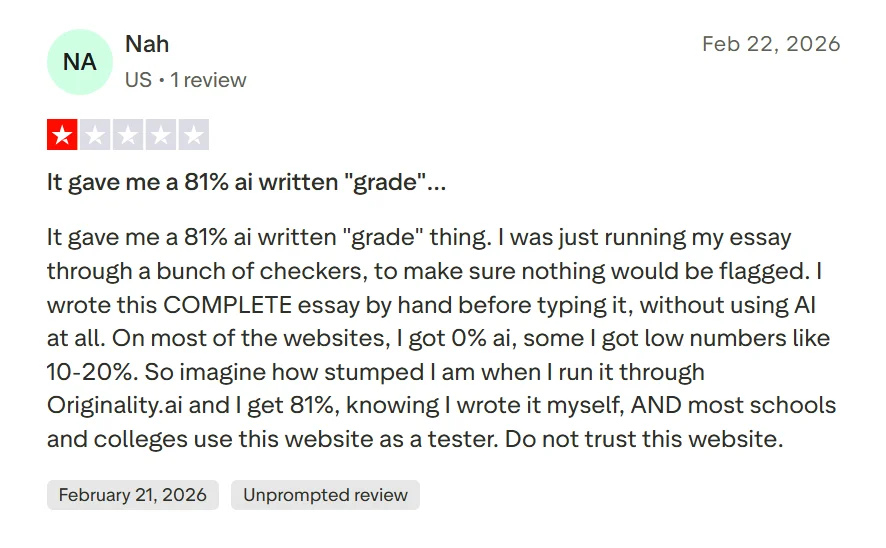
This reviewer stated that an essay was originally written by hand and later typed, yet Originality AI classified it as 81% AI-generated. The reviewer also reported that other detection tools produced lower scores. Differences between detectors are common because each tool uses different training data, thresholds and classification methods. Disagreement does not automatically prove which detector is correct. In this situation, the handwritten draft would be much stronger authorship evidence than any isolated percentage. Physical notes, early drafts and document history can provide a direct record of the writing process that a statistical detector cannot see.
Another Reviewer Combines Accuracy, Cancellation and Support Complaints
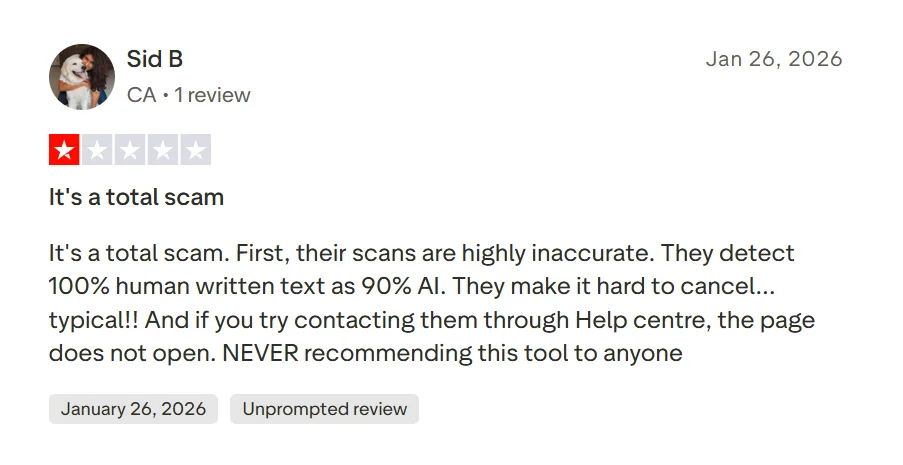
The final negative Trustpilot screenshot combines several complaints. The reviewer alleged that fully human writing received an AI score of approximately 90%, that cancelling the subscription was difficult and that support was not easily accessible. These claims should be separated rather than treated as one verified conclusion. Detection accuracy, account cancellation and customer service are different product areas. The emotional language shows how frustrated the reviewer felt, but it does not independently prove every allegation. Still, the reported 90% classification is relevant because it closely resembles the 88% result from my own human-writing test.
Main Themes Across the Supplied Trustpilot Reviews
| Review theme | What positive reviewers reported | What negative reviewers reported |
| Interface | Clear, fast and easy to use | Clear presentation can make wrong scores appear authoritative |
| AI detection | Useful and appropriately strict | Human content allegedly receives high AI scores |
| Customer support | Fast and responsive help | Some users report difficulty obtaining support or refunds |
| Education | Helpful for reviewing student submissions | Risk of unfair academic accusations |
| Languages | Useful general detection | Possible limitations with Romanian academic content |
| Pricing | Reasonable for frequent users | Subscription and cancellation concerns |
| Consistency | Useful screening results | Scores allegedly change after small edits |
The supplied reviews do not prove that every positive or negative claim is accurate. They do show that Originality AI experiences vary considerably depending on the type of content, user expectations and consequences attached to the result.
What Reddit Users Say About Originality AI
Reddit can be useful for identifying recurring concerns, unusual test cases and questions that polished product reviews may ignore. However, Reddit posts are anecdotal. I usually cannot confirm who wrote the content, which detector settings were selected or whether the testing conditions remained identical.
The comments below should therefore be treated as user-reported experiences rather than controlled evidence.
Reddit Users Report Major Disagreement Between Different AI Detectors
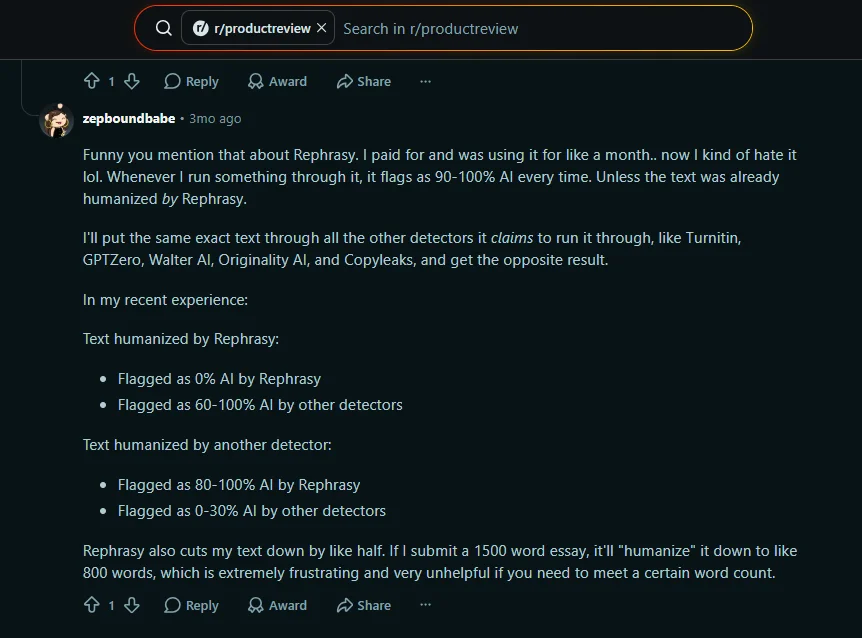
This Reddit comment primarily discusses Rephrasy rather than Originality AI alone. The user compared outputs across several detection systems, including Turnitin, GPTZero, Walter AI, Originality AI and Copyleaks, and reported conflicting results. The value of this screenshot is not that it proves one named detector is wrong. It demonstrates that different tools can reach opposite conclusions about the same or similar writing. When detectors disagree, selecting whichever percentage supports a preferred accusation is not a fair method. The disagreement should instead reduce confidence and trigger a closer review of authorship evidence.
One Reddit User Claims Originality AI Scores Changed When Logged In
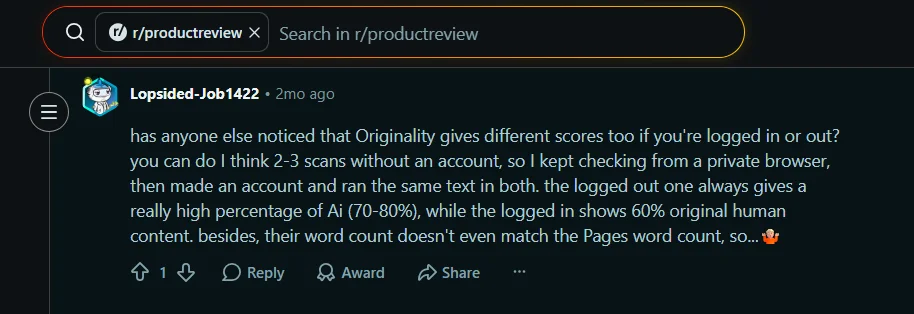
This user alleged that identical text received different results depending on whether the scan was performed while logged in or logged out. The post also mentioned a mismatch involving the word count. I cannot verify the test, settings or platform state, so I would not present the claim as an established product defect. However, it raises a reasonable question about consistency. A proper follow-up test would need to use the same text, model, threshold, account state and scan options repeatedly. Without that controlled replication, the screenshot is best treated as a concern that deserves investigation.
A Professor Warns Against Treating AI Detector Scores as Proof
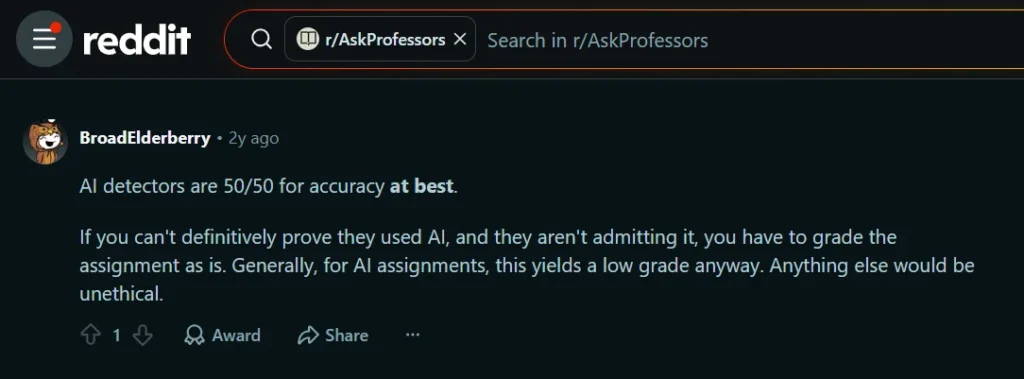
In this academic discussion, a Reddit user identifying as a professor argued that AI detectors are unreliable and that students should not be penalized without stronger evidence. This represents one academic’s perspective rather than a universal institutional policy. Nevertheless, the underlying principle is sensible. Detection may justify asking questions, reviewing document history or discussing the student’s argument, but it should not automatically establish guilt. Originality.ai’s own education guidance similarly states that a detection score should not be used as the only measure for identifying academic cheating.
Originality AI Features
Originality AI has expanded beyond a basic checker and now functions as a broader content-quality platform.
| Feature | What it does | Who may find it useful | Important limitation |
| AI detection | Predicts whether text is likely AI-generated | Publishers, editors, teachers and writers | A prediction is not proof |
| Lite model | Allows some light AI-assisted editing | General content teams | May still flag polished human writing |
| Turbo model | Uses stricter detection sensitivity | Zero-AI publishers | Greater sensitivity may increase false positives |
| Academic model | Focuses on educational writing | Teachers, institutions and students | Should not replace academic investigation |
| Multilingual detection | Scans content in 30 languages | International teams | Performance can vary by language and genre |
| AI Allowance | Lets users permit selected levels of AI involvement | Hybrid writing workflows | The selected threshold must match the actual policy |
| Plagiarism checker | Identifies matching or copied online content | Students, editors and publishers | Plagiarism and AI generation are different issues |
| Readability checker | Evaluates reading difficulty | Content writers and marketers | Readability scores do not measure factual quality |
| Grammar and spelling | Identifies writing errors | Writers and editors | Automated edits may change writing patterns |
| Fact-checking aid | Highlights claims that may need verification | Publishers and researchers | It is an aid, not a substitute for source verification |
| File uploads | Accepts DOC, DOCX and PDF files | Users checking longer documents | Formatting or extraction may affect text |
| URL and site scans | Reviews individual pages or full websites | Agencies and website owners | More relevant to publishing than occasional students |
| Chrome extension | Supports scanning and writing-process replay | Google Docs users | Requires use during the writing process |
| Scan history | Stores previous reports | Teams and frequent users | Retention length depends on the plan |
| Team management | Organizes roles, scans and shared reports | Agencies and publishers | Less useful for individual students |
| API access | Integrates scans into external workflows | Enterprise teams | Available through higher-level workflows or plans |
Originality.ai’s pricing page lists AI checking, plagiarism checking, readability, grammar, fact-checking, URL scanning, file uploads, team management, shared reports and scan history among its current capabilities. ho want broader explanations rather than only tool reviews, Skyline Academic also publishes practical guides about AI covering detection scores, false positives and responsible academic use.
Originality AI Pricing
Originality AI is not primarily positioned as an unlimited free detector. Limited versions of some tools may be available through its public pages, but full scans and platform features require credits or a subscription. ublic pricing information lists the following main options.
| Plan | Current price | Included credits | Credit expiry | Best suited for |
| Pay As You Go | $30 one-time purchase | 3,000 credits | Two years | Occasional users |
| Pro monthly | $14.95 per month | 2,000 credits monthly | End of each billing month | Individuals and small teams |
| Pro annual | Equivalent to $12.95 per month, billed annually | 2,000 credits monthly | End of each billing month | Regular users seeking a lower monthly equivalent |
| Enterprise monthly | $179 per month | 15,000 credits monthly | End of each billing month | Agencies and publishers |
| Enterprise annual | Equivalent to $136.58 per month, billed annually | 15,000 credits monthly | End of each billing month | High-volume organizations |
One credit covers up to 100 words when running an AI-only check. Checking 100 words for both AI and plagiarism uses two credits. Separately purchased credits expire after two years, while monthly subscription credits expire at the end of the month if they are unused. currently includes 2,000 monthly credits, file uploads, full-site scans, URL scanning, team management, tagging, a Chrome extension and standard support. Enterprise adds 15,000 credits, priority support, longer scan history, API access and additional team features. dual publisher checking hundreds of articles, the pricing may be reasonable. For a student who only wants to check one essay, paying $30 for 3,000 credits may feel excessive.
Students can use Skyline Academic’s free AI detector when they want a quick preliminary check without beginning with a large credit purchase.
Before subscribing to Originality AI, I would check:
- Whether monthly credits roll over
- Whether the plan renews automatically
- How cancellation is completed
- Whether AI and plagiarism scans are both selected
- How many credits each scan will consume
- How long reports will remain available
- Whether the selected detector model matches the intended use
The supplied negative reviews include individual complaints about cancellation and recurring billing. These reports are not proof of a universal problem, but they make it sensible to retain cancellation confirmation and monitor the next billing date.
Is Originality AI Easy to Use?
Yes, Originality AI is relatively easy to use.
The general process involves pasting text, uploading a supported document or entering a URL, selecting the required checks and starting the scan. The results are visually prominent, with probability scores and highlighted sections that guide the user toward passages considered suspicious.
The platform can also store previous scans and generate shareable reports. Pro and Pay As You Go customers currently receive 30 days of scan history, while Enterprise accounts receive 365 days. s a strength, but it also creates a psychological problem. When a platform displays “100% AI” or “88% AI” in a polished dashboard, the result feels definitive.
A user may forget that the number is generated by a prediction model.
That is why the interface should ideally encourage users to ask:
- Was the sample long enough?
- Which model was selected?
- Was the text translated?
- Was it edited using grammar software?
- Does the writer have drafts?
- Did another scan produce the same result?
- What does the institution or publisher actually permit?
Students searching for how to avoid AI detection should not attempt to disguise machine-written assignments. The ethical approach is to write original work, document the writing process, cite sources properly and revise for clarity rather than manipulating sentences solely to satisfy a detector.
Originality AI Pros and Cons
| Pros | Cons |
| Correctly detected both fully AI samples in my test | Flagged fully human writing as 88% AI |
| Fast, clear and accessible interface | Classified mixed writing as 100% AI |
| Offers multiple models for different use cases | Scores can be misinterpreted as proof |
| Includes plagiarism and content-quality tools | Full platform access is paid |
| Supports file, URL and website scanning | May be excessive for an occasional student |
| Offers team features and shareable reports | Reviewers report inconsistent results after edits |
| Positive support feedback appears frequently | Some reviewers report cancellation concerns |
| Provides an Academic model | False positives remain possible |
| Supports 30 languages | Performance may vary by language and genre |
| AI Allowance recognizes hybrid workflows | Threshold settings may complicate interpretation |
Is Originality AI Reliable for Students and Academic Work?
Originality AI may be useful for identifying assignments that deserve closer review, but it is not reliable enough to serve as the only evidence that a student used AI.
Even the company advises educators not to treat an AI detection score as the sole measure of academic cheating. specially clear from my test. If the fully human-written passage had belonged to a student, an 88% AI result could easily have triggered suspicion. The score would have been wrong, but the student might still have been expected to prove innocence.
A fair academic process should examine more than one detector output.
Evidence Students Should Keep
Students can protect themselves by retaining:
- Early outlines
- Research notes
- Reading summaries
- Downloaded articles
- Reference-manager records
- Handwritten plans
- Draft files
- Google Docs or Microsoft Word version history
- Tutor feedback
- Email discussions
- Data-analysis files
- Presentation notes
- Records of source selection
These materials show how an assignment developed over time.
A student who can explain the argument, justify the selected evidence and show multiple drafts has stronger authorship evidence than someone relying on a screenshot from another detector.
The same distinction applies to plagiarism. A Turnitin similarity score identifies matching text, but the number alone does not determine whether plagiarism occurred. Quotations, reference lists, standard terminology and correctly cited material may all contribute to similarity.
AI detection requires equally careful interpretation.
What Should Happen After a High AI Score?
A responsible process may include:
- Checking the document’s version history
- Comparing the writing with earlier work
- Asking the student to explain key arguments
- Reviewing notes and research materials
- Checking whether grammar or translation tools were permitted
- Running additional analysis without selecting only the most suspicious result
- Applying the institution’s published academic-integrity policy
- Giving the student a fair opportunity to respond
An AI score can begin a conversation. It should not end one.
Students worried about false flags may also benefit from 1:1 Personalized Live Tutoring, where the focus is on understanding the subject, planning the assignment and developing original work rather than chasing a detector percentage.
Skyline Academic combines live tutoring with a dedicated LMS, progress tracking, coursework guidance, learning materials, video lectures, workshops and bootcamps. This type of documented learning process can help students develop stronger work while creating a clearer record of how that work was produced.
Who Should Consider Using Originality AI?
Originality AI is best suited to users who need a screening and content-quality platform rather than a final authorship judge.
Publishers
Publishers reviewing large numbers of submissions may use Originality AI to identify articles requiring closer editorial attention. Its plagiarism checking, readability analysis and report-sharing features make more sense in a publishing workflow than they do for someone checking one short paragraph.
Content Agencies
Agencies can use team management, tags, scan history and shared reports to review content submitted by multiple writers. The AI Allowance feature may also help agencies apply different policies for different clients.
Website Owners
URL scanning and full-site scanning can help website owners review existing pages. This is useful when acquiring a website, auditing outsourced content or assessing a large archive.
Editors
Editors may use the platform as one part of quality assurance. A high score can prompt the editor to ask for drafts or discuss the writing process with a contributor.
Organizations with Clear AI Policies
Originality AI is most useful when an organization has already defined what is permitted. The AI Allowance feature is difficult to interpret when nobody has decided whether grammar assistance, brainstorming or partial rewriting is acceptable.
Teachers Using It Cautiously
Educators may use the Academic model to identify submissions that deserve further discussion. It becomes problematic when the score is treated as automatic evidence.
Who Should Be Cautious About Using It?
Universities Making Misconduct Decisions
Universities should not rely on a single detector score when penalties, progression or a student’s academic record are at stake.
Employers Investigating Staff
An employer should require supporting evidence before accusing an employee of misrepresenting authorship.
Clients Reviewing Freelancers
A client can ask for drafts, revision history and research records. Rejecting paid work solely because one detector produced a high number may unfairly punish a genuine writer.
Occasional Student Users
The paid credit system may not be worthwhile for someone who only needs a small number of scans. Students may also become unnecessarily anxious if they repeatedly rescan and rewrite authentic work to reduce an uncertain score.
Users Expecting Exact AI Percentages
A 70% AI score does not necessarily mean exactly 70% of the words came from a language model. My mixed sample’s 100% result demonstrates why that interpretation can be misleading.
Anyone Seeking Absolute Proof
No detector can observe the complete writing process from the final text alone. Direct evidence such as drafts, editing history, notes and author explanation remains essential.
Originality AI Alternatives
Originality AI is not the only available detector, and the best alternative depends on what the user actually needs.
Some tools are designed for quick student checks. Others focus on enterprise integrations, educational institutions or content publishing. No detector should be selected solely because it produced the lowest or highest score in one test.
| Tool | Best suited for | Free option | Main strength | Main limitation |
| Originality AI | Publishers, agencies and content teams | Limited public tools | Broad content-verification suite | Paid access and false-positive risk |
| Skyline Academic | Students seeking detection and academic guidance | Yes | Free student-focused checking with tutoring support | No detector can guarantee zero false positives |
| QuillBot AI Detector | Quick individual scans | Yes | Familiar and accessible interface | Results may vary with edited or mixed writing |
| Copyleaks | Institutions and enterprise workflows | Limited access | Integrations and multilingual tools | Can be expensive or complex for occasional users |
| ZeroGPT | Casual, fast checks | Yes | Easy to access | Free results should not be treated as conclusive |
| JustDone | Writers seeking multiple AI-related tools | Limited or trial-based | Combines checking and writing features | Subscription terms and detection claims require review |
| StealthWriter | Users studying rewriting and detection interactions | Limited access | Demonstrates how rewriting changes detector results | “Humanizing” content does not establish genuine authorship |
Skyline Academic
Skyline Academic is a practical alternative for students because its support is not limited to displaying an AI percentage. It offers free AI detection alongside tutoring, progress monitoring, coursework guidance, learning materials and a dedicated LMS.
This is useful when the underlying problem is not simply “What percentage did my essay receive?” but “How can I improve my argument, show my working process and submit genuinely original academic work?”
Skyline Academic does not need to claim that any detector is perfect. Its value comes from combining preliminary checks with educational support.
QuillBot AI Detector
The Quillbot AI detector is easier to access for quick checks and is associated with a writing platform many students already recognize.
It may be convenient for comparing how a passage is interpreted, but disagreement between QuillBot and Originality AI does not automatically establish which one is correct. The original writing process remains more reliable than selecting the preferred score.
Copyleaks
The copyleaks AI detector is widely considered by organizations looking for integrations, multilingual checking and institutional workflows.
Like Originality AI, it should be used as part of a broader review process rather than standalone evidence against a student or writer.
ZeroGPT
Zerogpt is popular because users can access it quickly and run basic checks without beginning with a large paid plan.
Its accessibility makes it useful for preliminary comparison, but free availability should not be confused with verified accuracy.
JustDone
The justdone AI review covers another platform combining detection with broader writing tools.
Users should examine what is included in the plan, how the detector explains its score and whether the service is intended for academic, professional or general writing.
StealthWriter AI
Stealthwriter AI is associated with rewriting or “humanizing” AI-generated content.
I do not recommend using rewriting tools to disguise AI-generated assignments. Passing a detector after automated rewriting does not transform outsourced machine authorship into original student work.
These tools are more useful for demonstrating a weakness in detection: the result can change when wording is altered, even though the underlying source of the ideas remains the same.
My Final Originality AI Review and Verdict
Originality AI performed extremely well on the easiest part of my test. Both fully AI-generated passages received 100% AI scores.
If I had stopped there, this review would have been very positive.
The mixed-content test revealed the first limitation. Originality AI classified the entire passage as 100% AI, even though human writing was present. That showed me that the percentage should not be read as a precise measurement of how many words were generated by AI.
The fully human test was the deciding result.
A passage written entirely by a human received an 88% AI score. That is not a small warning or borderline result. It is a highly confident false positive.
For publishers and agencies, Originality AI may still be valuable as a first-stage screening platform. It is fast, visually clear and supported by plagiarism, readability, fact-checking, team and website-scanning features.
For students, teachers, employers and clients, I would be much more cautious.
My final verdict is that Originality AI is a capable AI detector, but it is not reliable enough to function as standalone proof of authorship or misconduct. Use it to identify content that deserves a closer look. Do not use it to skip the closer look.
Frequently Asked Questions About Originality AI
1. Is Originality AI accurate for detecting ChatGPT content?
Originality AI correctly detected both fully AI-generated passages in my test with 100% AI confidence. However, four samples cannot establish a universal accuracy rate, and performance may change with editing, text length, subject and the AI model used.
2. Can Originality AI falsely flag human writing as AI?
Yes. My fully human-written sample received an 88% AI score, making it a clear false positive within this test. Originality.ai also acknowledges that false positives can occur and advises against using a score as the only evidence of academic cheating.
3. Why does Originality AI say my writing is AI-generated?
Formal structure, predictable wording, consistent sentence rhythm, common academic phrases and short sample length may make human writing resemble AI-generated text. A high score does not automatically prove that you used an AI writing tool.
4. Is Originality AI reliable enough for university assignments?
It may be useful as a preliminary screening tool, but it should not determine academic misconduct by itself. Universities should also review drafts, notes, version history, previous writing and the student’s explanation.
5. Can a professor use an Originality AI score as proof?
A professor can use the score as one reason to examine an assignment more closely, but the percentage alone is not conclusive proof. Fair academic procedures should include supporting evidence and allow the student to respond.
6. Is Originality AI better than Turnitin for AI detection?
A 2026 study found that Originality performed better overall than Turnitin on its 192-text dataset, although both struggled with hybrid writing. Performance depends on the text type, language, length and threshold, so neither should be used alone to determine guilt.
7. Does Originality AI offer a free AI detector?
Originality.ai offers limited public tools, but full platform access operates through credits or subscriptions. Students seeking occasional checks may prefer a genuinely free detector before purchasing a larger credit package.
8. What does an 80% or 90% AI score on Originality AI mean?
It generally means the model is highly confident that the overall writing resembles AI-generated text. It does not necessarily mean that exactly 80% or 90% of the words were produced by AI.
9. Is Originality AI worth paying for?
It may be worth paying for if you manage high volumes of content and need plagiarism checking, website scans, team tools and shared reports. It is less attractive for someone who only wants to check one or two student essays.
10. What is the best Originality AI alternative for students?
A useful student alternative should provide accessible detection while also helping with genuine writing, research and academic development. Skyline Academic combines a free AI detector with personalized tutoring, an LMS, progress tracking, learning materials and coursework guidance.