
Yes, Turnitin can detect some ChatGPT-style writing, but it is not a mind reader and it is not a guaranteed “caught you” button. Turnitin’s AI writing indicator estimates the likelihood that qualifying text was generated by AI based on patterns in writing, not by finding a copied source the way plagiarism checking works. That difference matters, because it explains why results can be both useful and wrong.
If you’re a student trying to figure out how risky it is to submit AI-assisted work, the smartest move is to check your draft before you submit using a tool designed for students. You can use this free ai detector for students to sanity-check what an AI report might flag, then revise responsibly.
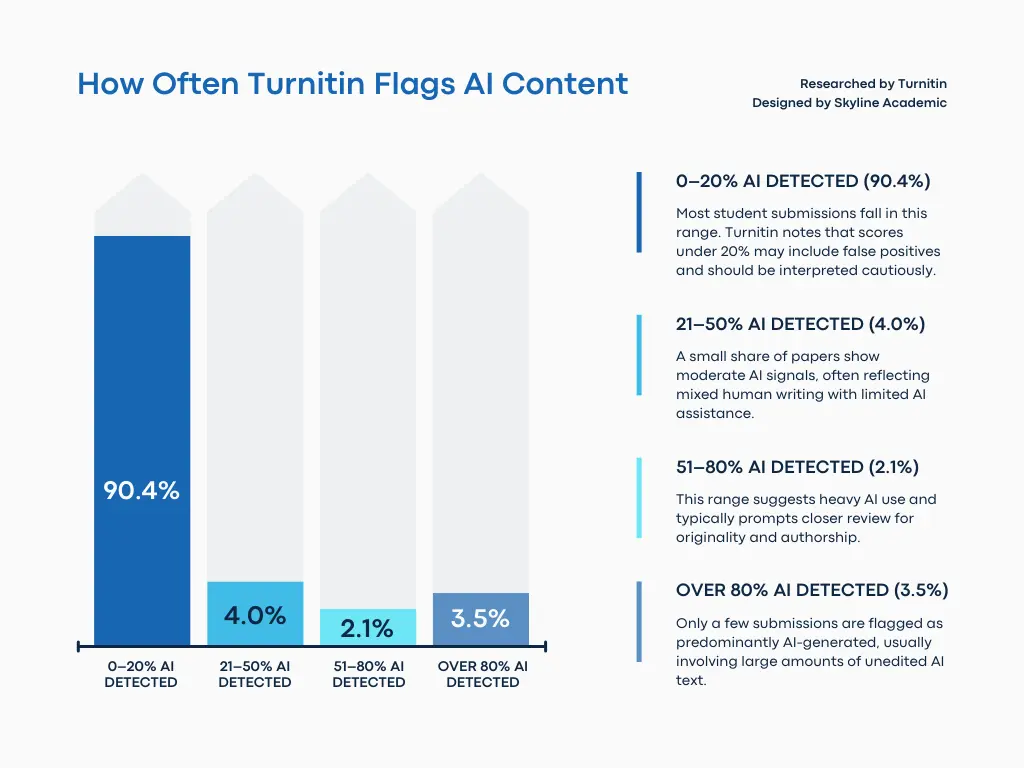
Turnitin itself has shared data showing its AI detection has been used at huge scale: 130+ million papers processed for AI detection since launch (April 2023), with 12.5 million showing over 20% AI-written content and 3.5 million flagged with 80% or more AI-written content (data as of Oct 27, 2023).That kind of volume doesn’t mean the tool is perfect, but it does show it’s widely deployed and actively used in real classrooms.
Let’s unpack the “hidden truth”: what Turnitin actually detects, where it struggles, how accurate it can be, and what you should do if your work is flagged.
How Turnitin “Detects ChatGPT” (And What It’s Really Measuring)
Turnitin’s AI writing detection isn’t a plagiarism match. It doesn’t search the internet for “the ChatGPT version” of your paragraph.
Instead, it uses a detection model that looks for patterns often associated with AI-generated language, then produces an AI writing percentage in the report. Importantly:
- The AI writing percentage is separate from the similarity score.
- The AI indicator is meant to be a signal, not a verdict.
Turnitin explicitly warns that its AI model may not always be accurate and should not be used as the sole basis for adverse actions against a student. (Turnitin Guides) That line is a big deal, because it’s the company acknowledging what students already experience: a report can be wrong.
If you want a simple mental model, think of Turnitin’s AI indicator like a “likelihood meter.” It estimates probability based on writing features, not proof of tool usage.
Does Turnitin Detect ChatGPT Specifically, or “AI-Like Writing” in General?
Turnitin positions its tool as able to identify when AI tools such as ChatGPT may have been used. (turnitin.co.uk) But technically, detectors don’t identify “ChatGPT” like a fingerprint. They identify patterns that are common in LLM output.
That’s why two things can be true at the same time:
- Some ChatGPT content gets flagged very clearly, especially if it’s pasted with minimal editing.
- Some human writing also gets flagged, especially if it’s formulaic, highly polished, or resembles academic template language.
So when people ask, “Can Turnitin detect ChatGPT?” the more accurate question is:
Can Turnitin detect writing that looks statistically similar to AI-generated text?
Often, yes. Always, no.
Turnitin AI Detection Accuracy: What the Data Says (And What It Doesn’t)
Students usually want a clean number like “Turnitin is 95% accurate.” Real life is messier.
What Turnitin and reporting around Turnitin has said
After release, Turnitin promoted a very low false positive rate, but later acknowledged higher false positives in certain ranges. Reporting on Turnitin’s statements noted that:
- The sentence-level false positive rate is around 4% (meaning some human-written sentences can be incorrectly flagged). (insidehighered.com)
- False positives are more likely when the AI score is under 20%, which is why Turnitin introduced a caution indicator in that range. (Turnitin Guides)
- In real-world use, false positives often appear near AI-written sentences: 54% of false positive sentences are next to AI-written sentences, and 26% are two sentences away. (insidehighered.com)
Another report citing Turnitin’s leadership said that as of May 14, 2023, 38.5 million submissions had been processed, with 9.6% reporting over 20% AI writing and 3.5% over 80% AI writing.
What this means in plain English
- Turnitin can be strong at catching heavy AI use (big chunks of AI-written text).
- It can be less reliable for small percentages, light AI assistance, or mixed writing.
- Sentence-level “highlights” are not the same as proof, because even a small error rate becomes meaningful at scale.
This is why many universities treat AI detection reports as one piece of evidence, not the whole case.
The 1% to 20% Range: Why Turnitin Itself Treats It as Less Reliable
Here’s a detail most students miss: Turnitin’s own guidance says it found a higher incidence of false positives when the AI score falls between 1% and 20%. (Turnitin Guides)
To reduce misinterpretation, Turnitin now displays an asterisk for results under 20% on newer reports, signaling that these lower-range outputs are less dependable. (Turnitin Guides)
So if you’re panicking over a low AI percentage, the “hidden truth” is: Turnitin is literally telling instructors to treat that range cautiously.
AI Detection Score vs Similarity Score: Don’t Confuse Them
One of the biggest student mistakes is thinking a Turnitin similarity percentage equals “AI percent.”
They measure different things:
- Similarity score: how much text matches existing sources (published papers, web pages, databases).
- AI writing percentage: how much qualifying text resembles AI-generated patterns.
Turnitin’s own guide states these are different and independent. (Turnitin Guides) If you want to understand similarity reports properly, read this breakdown of the Turnitin similarity score and how universities interpret it.
If you’re confused by what an AI percentage means in general, this guide on AI detection score will make the numbers feel a lot less mysterious.
Why Turnitin Flags Human Writing as AI (False Positives Explained)
False positives happen because AI detectors are probabilistic. They make an educated guess based on signals, and those signals can show up in genuine human work.
Common reasons human writing gets flagged:
1) Your writing is too “template perfect”
Academic writing often follows predictable patterns: definition, explanation, citation, conclusion. That structure can look AI-like when it’s extremely consistent.
2) You used heavy paraphrasing tools
Paraphrasers and “humanizers” can introduce unusual smoothness, uniform sentence rhythm, or simplified vocabulary that triggers detectors.
3) You wrote in a highly neutral, generic voice
AI tends to sound confident, balanced, and non-committal. Humans can sound like that too, especially when trying to be formal.
4) Your text mixes AI and human sentences
This is a big one. Reports around Turnitin’s own statements found false positives often appear near AI-generated sentences. (insidehighered.com)
If you want the deeper “why,” here’s a full explainer on AI detection false positives and how to respond if you’re wrongly flagged.
What Exactly Can Turnitin Detect (And What It Often Misses)
Turnitin is most effective when:
- Large sections are directly pasted from ChatGPT
- The writing has a uniform, predictable rhythm
- The topic is general and the writing reads like a clean summary
Turnitin is more likely to miss or under-detect when:
- The student writes a messy first draft and refines it manually
- The text contains personal examples, unique reasoning, and specific course references
- AI was used only for brainstorming, outlining, or light editing
- The student mixes AI and human writing in a way that breaks typical AI patterns
This is also why “beating Turnitin” is not a smart goal. Tools change, models update, and universities look beyond the percentage.
If you want to understand what makes writing “feel human,” this article on AI vs human writing differences breaks down the signals in a practical way.
What Students Should Know Before Submitting (The Practical Truth)
Here’s the reality: many students use AI in some form. What gets students in trouble is usually not “AI existed,” but how it was used, how policies define it, and whether the final submission shows real learning.
A safer approach looks like this:
- Use AI for brainstorming or clarity, then write in your own words.
- Keep your drafts and edit history (Google Docs version history can help).
- Add course-specific references, lecture material, and original analysis.
- Cite sources properly and follow your university policy.
If you want to check your draft with a tool built for student use, you can try turnitin alternate with 80% more accuracy than turnitin and review what might be triggering AI-style signals before you submit.
You can also explore the Turnitin checker alternative for students if your institution doesn’t give you access to full reporting.
What AI Detection Percentage Is “Acceptable” in Universities?
There isn’t one universal acceptable percentage, because universities set policies differently and many don’t use a hard cutoff.
Some instructors treat AI indicators as:
- A conversation starter
- A prompt to review drafts or oral defenses
- A reason to ask for process evidence (notes, outlines, references)
Others may treat higher percentages as more serious, especially if the work is meant to be original writing.
If you want a student-friendly breakdown of how universities tend to think about thresholds, this guide on the acceptable AI detection percentage universities explains what’s commonly seen and how to interpret it without guessing.
What to Do If Turnitin Flags You (Without Panicking)
If you get flagged, don’t self-incriminate or spiral. Do this instead:
- Review the report carefully
Check whether the AI indicator is low-range (under 20%) and whether the report itself signals uncertainty. (Turnitin Guides) - Gather proof of authorship
Drafts, outlines, notes, version history, and sources. - Be ready to explain your process
How you researched, planned, and wrote the paper. - Fix genuine problems
If you used AI too heavily, rewrite sections with your own reasoning and evidence.
If you want support with structured editing, outlining, or proofreading so your writing reflects your own voice clearly, you can start from Skyline Academic and pick the service that matches your situation.
FAQs: Turnitin and ChatGPT Detection
1) Can Turnitin detect ChatGPT in every assignment?
No. Turnitin’s AI writing indicator estimates likelihood based on patterns and qualifying text, so it can miss AI use or flag human writing incorrectly.
2) What does “qualifying text” mean in Turnitin AI detection?
It usually refers to long-form prose in a format the model can analyze. Text outside that scope may not be included in the AI percentage.
3) Is Turnitin AI detection the same as the similarity score?
No. Turnitin states the AI writing percentage is separate from and independent of the similarity score.
4) Why does Turnitin sometimes flag human writing as AI?
Because AI detection models can produce false positives, especially when writing is very formulaic or when AI and human writing are mixed.
5) Is a low AI score on Turnitin reliable?
Lower scores can be less reliable. Turnitin notes a higher incidence of false positives in the 1% to 20% range and treats it with caution indicators.
6) What is Turnitin’s false positive rate for AI detection?
Reporting on Turnitin’s statements has cited a sentence-level false positive rate of about 4%, meaning some human-written sentences can be misclassified.
7) Can paraphrasing tools reduce Turnitin AI detection?
Sometimes they change patterns, but they can also create odd language signals and still trigger detectors. They also don’t solve policy issues about misuse.
8) Can universities punish students based only on Turnitin AI reports?
Many institutions treat AI reports as one input, not sole proof. Turnitin itself advises it should not be the only basis for adverse action.