

AI detection scores are scary when you do not know what they mean. Maybe your Turnitin, GPTZero, or other report says your essay is 5 percent AI. Or 30 percent. Or a terrifying 80 percent. Is that proof of cheating? Are you in trouble? Or is the detector just guessing?
This guide breaks down AI detection score meaning in plain language, so you know how to read the numbers and what to do next. Before we dive in, a quick note. At Skyline Academic we work with students, tutors, and content creators every day who are confused by these scores. You are not alone in this.
What is an AI detection score?
An AI detection score is a percentage that shows how likely a piece of text is to be written by artificial intelligence according to a specific detector.
Different tools use different labels, for example:
- “Probability this text is AI generated”
- “Portion of document that is AI written”
- “AI content score”
Even though they look similar, each tool has its own model, training data, and thresholds. That means an 80 percent score in one detector does not always equal 80 percent in another.
Most tools do something like this behind the scenes:
- They scan your text and compare it with patterns seen in AI outputs.
- They look at how predictable the next word is, sentence length, and variation in style.
- They then assign a probability that each part of the text is AI written.
- Finally they combine those probabilities into an overall score for the document.
If you want a gentle walkthrough of the mechanics under the hood, this explainer on how AI detectors actually work is a good next step.
| AI score | Worried status | Quick understanding |
| 5% | ✅ Not worried | Extremely low score. |
| 8% | ✅ Not worried | Minor phrasing may have triggered it. |
| 10% | 🟢 Very low concern | Overwhelmingly human-written with slight pattern similarity. |
| 30% | 🟡 Moderate caution | Not serious, but may raise questions. |
| 50% | 🟠 Concerning | Significant portion flagged. Likely to trigger review. |
| 80% | 🔴 High risk | Majority of text strongly matches AI patterns. |
The important takeaway is this. AI detection scores are probabilistic guesses. They can be useful signals, but they are not perfect truth.
How the Same Score Reads Differently Depending on the Tool
| Tool | How It Labels the Score | Scores It Treats as Low-Confidence | What Makes It Flag Text |
| Turnitin | Percent AI-generated | Turnitin’s own guidance notes higher false-positive rates under about 20 percent, and newer reports mark these with an asterisk | Sentence-level prediction patterns across the whole submission |
| GPTZero | Probability AI-generated, plus perplexity and burstiness scores | Short passages under about 250 words are flagged as lower-confidence | Predictability of word choice and variation in sentence length |
| Copyleaks | AI Content percent with a source-model breakdown | Mixed human and AI text in the same document | Pattern-matching against known LLM output fingerprints |
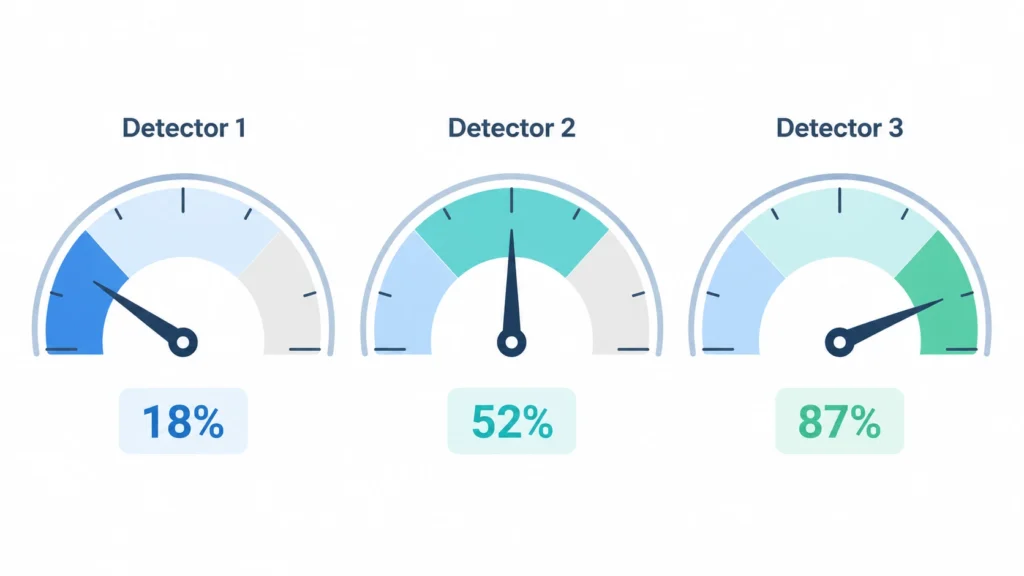
Same Essay, Three Different Scores
The exact same piece of writing can return a low score on one detector and a much higher score on another — this is why no single percentage should be treated as a final verdict.
What is 5 percent, 10 percent, 30 percent, and 80 percent usually mean
Every institution and every tool can set its own thresholds, so there is no universal rule. Still, you can think of typical scores in ranges.
What does a 5 percent AI detection score mean?
A score around 5 percent usually indicates:
- The detector sees your text as mostly human.
- A small portion might match AI like patterns, or the tool simply never returns zero.
Reasons you might see a low but non zero score even for fully human work:
- Your writing style is very clear and formulaic, similar to AI.
- The essay uses common phrases or standard academic structures.
- The text is short, and the model has limited data to judge.
Most teachers or editors will not worry about a score this low, especially if everything else looks normal. Still, if you repeatedly get flagged even at low levels, using a free ai detector for academics can help you understand what the tool is sensitive to and how to adjust your writing to better reflect your natural voice.
What does a 10 percent AI Detection score mean?
What does a 10 percent AI detection score mean?
A score around 10 percent is generally considered very low.
It may mean:
The tool detected only minor patterns that slightly resemble AI-generated text.
Certain phrases or sentence structures are common and triggered the system.
Your writing is clear and structured, which sometimes overlaps with AI-style patterns.
In this range, people usually:
Consider the work to be mostly human-written.
Do not raise serious concerns about AI assistance.
Focus more on the quality of content rather than the detection score.
Ten percent does not suggest misconduct in most cases. It is typically seen as a normal margin of error in AI detection tools.
What does a 30 percent AI detection score mean?
A score around 30 percent sits in the uncomfortable middle.
It may mean:
- The tool thinks significant parts of your text look AI assisted.
- You heavily edited AI output rather than writing from scratch.
- Your writing style is unusually consistent, simple, or repetitive.
In this range, people tend to:
- Double check the work manually.
- Compare the style with your past writing.
- Ask you to explain your process or provide drafts.
Thirty percent does not automatically prove misconduct, but it raises enough questions that you should be ready to show how you created the work.
What does an 80 percent AI detection score mean?
A score around 80 percent usually signals that the detector believes most of your text matches AI patterns.
This can happen when:
- You pasted a full answer from a chatbot with only light edits.
- You paraphrased AI output using another tool.
- You used AI for nearly the entire draft and only added minor details.
However, it is still not absolute proof. Research shows that some detectors can produce high false positive rates, especially on certain types of human writing, for example essays by non native English speakers or texts that follow very formal templates. One recent study from the University of Chicago found that some open source detectors had false positive rates between 30 and 78 percent and struggled to distinguish humanized AI content from real human writing.
So 80 percent is a serious warning sign, not a final guilty verdict.
How are AI detection scores calculated?
While every vendor has its own secret sauce, most detectors rely on similar ideas.
- They measure the predictability of each word. AI text tends to follow patterns more consistently than human writing.
- They look at burstiness, which is how much sentence length and structure vary. Human writers jump between short and long sentences naturally. AI often stays smooth and even.
- Some tools compare your text with known AI outputs or large language model fingerprints.
Because of these methods, detectors also tend to lock onto the typical features that separate human and machine generated writing. If you want more detail on these signals, this breakdown of differences between AI and human writing explains what detectors usually look for.
A key point. Different tools handle these signals differently. That is why it is normal for the same essay to get 10 percent in one detector and 70 percent in another.
For an overview that connects calculation methods, accuracy, and common score ranges, you can also read this complete guide to AI writing detection.
How reliable are AI detection scores?
Short answer. Useful, but far from perfect.
Studies and independent tests show mixed results. Many detectors can perform well on long, clearly AI generated text, but they are weaker on:
- Heavily edited AI writing
- Human writing from non native English speakers
- Short answers like discussion posts or reflections
The University of Chicago research mentioned earlier compared multiple tools and found that while some commercial detectors performed strongly, others showed very high false positive rates and large differences in performance when AI “humanizers” were used. (Tech & Learning)
The same research warned that relying only on AI scores for decisions like grades or discipline is risky, especially when the tool is not transparent about how it works.
If you are curious about real world accuracy checks, this breakdown of how accurate AI detection tools really are goes deeper into tests and examples.
All of this leads to a simple rule. Treat the score as one piece of evidence, not the whole case.
Why Your Human-Written Content Still Shows an AI Detection Score
It feels deeply unfair when you know you wrote something yourself and it still gets flagged. Unfortunately, false positives are a real problem.
Common reasons include:
- Very polished grammar and vocabulary
If you spent a lot of time editing, used a grammar checker, or are just an excellent writer, the smoothness can look AI like. - Non native writing patterns
Some detectors seem biased against writers who learned English as a second language. Their sentence patterns can accidentally trigger the model. - Template heavy content
Lab reports, legal documents, technical manuals, or standardised essays follow strict structures, which detectors may misread as machine generated. - Short word count
With only a few sentences, the model does not have enough data. It guesses, and the guess can be wrong.
If you want to understand this problem more deeply, including case studies where students were wrongly flagged, this article on AI detection false positives is worth reading.
What to do if your AI detection score is high
Whether your score is 30 percent or 80 percent, do not panic. Focus on being transparent and calm.
Here is a practical step by step approach.
Step 1: Gather your evidence
Collect anything that shows you created the work yourself:
- Rough notes and outlines
- Earlier drafts with tracked changes
- Saved versions in Google Docs or Word with timestamps
- Research sources, screenshots, or handwritten notes
This helps demonstrate your real writing process.
Step 2: Ask what the score actually means
If a teacher or manager contacts you:
- Ask which detector was used.
- Ask whether they are looking at the whole document or sections.
- Ask what threshold they consider suspicious.
Showing that you understand AI detection score meaning and asking thoughtful questions signals that you are acting in good faith.
Step 3: Explain your process clearly
Describe how you wrote the assignment, step by step. Mention if you used:
- Spellcheck or grammar tools
- Reference managers
- Formatting templates
Be honest if you used AI for brainstorming or outlining but wrote the final text yourself. Many institutions allow limited assistance if you disclose it.
Step 4: Request a human review
Encourage your teacher, supervisor, or editor to:
- Compare the work with your previous writing
- Look at your drafts and notes
- Consider other signs of your understanding, for example oral explanations
Remind them that even researchers have warned against treating AI scores as final proof because of high false positive risks in some tools.
Not sure your score is even a problem? Check what counts as an acceptable AI detection percentage in universities, many schools tolerate a range you might not expect. And if you’re getting flagged repeatedly despite writing everything yourself, our deeper breakdown of AI detection false positives walks through why that happens and what evidence carries the most weight.
If you need a more detailed, human checked report to support your case, you can also use specialised AI detector for students that combine automated scanning with expert review instead of relying only on a single free detector.
How to reduce AI detection scores ethically
There are many shady “AI humanizer” tools that promise to beat detectors. Most of them either do not work or simply produce low quality, robotic text that still gets flagged.
A better approach is to make your writing more genuinely human.
Practical tips:
- Write from your own experience
Add personal examples, reflections, and specific details that only you would know. - Vary your sentence structure
Mix long, complex sentences with short, punchy ones. Read your work aloud and listen for rhythm. - Edit in multiple passes
First fix ideas and structure, then clarity, then style. Resist the temptation to rewrite everything using a bot. - Use AI carefully and transparently
If you use AI, use it for brainstorming or idea generation, then close the chat and write your own version in your own words.
For a bigger picture on detection, writing style, and score interpretation across different tools, exploring the question “is using AI cheating” can help you understand how AI use connects with academic writing and integrity.
When should you be worried about your AI detection score?
Here are some general signals:
You probably do not need to worry much when:
- Your score is under about 10 percent.
- The work clearly matches your usual style and understanding.
- You have drafts and notes to back it up.
You should take it seriously and prepare your evidence when:
- Your score is in the 20 to 50 percent range, especially for important submissions.
- The institution has strict AI rules.
- You relied a lot on AI in early drafts and are not sure how much of that remains.
You should be very careful when:
- Your score is above 70 percent.
- You pasted AI content and only lightly edited it.
- You are in a high stakes context, such as a thesis, professional exam, or job application.
In all cases, the safest long term strategy is to become a stronger writer yourself rather than trying to “game” detectors.
How Skyline Academic can help
If you are unsure about your AI detection score or worried about a specific assignment, you do not have to face it alone.
At Skyline Academic we work with:
- Students who want to check their essays before submission.
- Tutors and educators who need a second opinion on AI flags.
- Content creators who must keep their writing authentic for clients and search engines.
We combine automated checks with human review, proofreading, and guidance on how to keep your writing both original and natural. If you are confused by scores from multiple tools, our team can help you interpret them and decide on your next steps.
Conclusion
AI detection scores can look intimidating, especially when you see numbers like 30 percent or 80 percent and fear the worst. The truth is more nuanced. Scores are estimates based on patterns, not perfect detectors of cheating.
Understanding AI detection score meaning helps you respond with confidence. Low scores usually mean you are safe, middle scores call for explanation, and high scores need careful review and honesty about how you used AI. Above all, detectors should be one tool among many, never the only judge of your integrity.
If you focus on developing your own voice, documenting your process, and using technology ethically, you can navigate AI detection reports without panic and with much more control.
Frequently asked questions about AI detection scores
What is an AI detection score in simple terms?
An AI detection score is a percentage that shows how confident a tool is that some part of your text was written by artificial intelligence. It is a probability estimate, not a final proof.
Is a 5 percent AI detection score safe?
In most cases, yes. A score around 5 percent usually means the detector sees your work as mostly human and may simply be accounting for uncertainty or small AI like patterns. Teachers rarely act on scores that low unless there are other strong concerns.
Is an 8 percent AI detection score safe?
In most cases, yes. A score around 8 percent is still considered very low and usually falls within the normal margin of error for AI detection tools. It often reflects minor sentence patterns or common phrasing rather than real AI use. Most instructors would not consider this score concerning on its own.
Is a 10 percent AI detection score safe?
Generally, yes. A 10 percent score suggests the work is overwhelmingly human-written, with only slight similarities to AI-style text. Detection systems are not perfect, and small percentages like this are common even in fully human writing. It typically does not trigger academic action unless combined with other red flags.
Is a 30 percent AI score proof that I used AI?
No. A 30 percent score is a warning, not proof. It suggests that the tool sees suspicious patterns in a noticeable portion of your text, but human review is still needed. You can and should explain your writing process and provide drafts if asked.
What does a 40 percent AI detection score mean?
A 40 percent score sits closer to the concerning end of the moderate range. It usually means the detector found AI-like patterns across a meaningful chunk of the text, not just a stray sentence. It’s not proof of misconduct, but at this level you should be ready to walk through your drafts and writing process if asked.
Is a 50 percent AI detection score safe?
A 50 percent score is more concerning. It indicates that a large portion of the text is flagged as potentially AI-generated. While it is not automatic proof of misconduct, it may prompt closer review. In this situation, you may be asked to explain your writing process, provide drafts, or demonstrate how you developed the work.
Is a 60 percent AI detection score bad?
A 60 percent score is high enough that most reviewers will want an explanation. It suggests the majority of the text shares patterns the tool associates with AI writing. It still isn’t definitive, heavily edited human writing and non-native English patterns can push scores this high, but this is the range where documenting your process really matters.
What does an 80 percent AI score usually mean?
An 80 percent score usually indicates the detector believes most of your text matches AI patterns. This often happens when people paste chatbot outputs with only light edits. However, even high scores can be wrong, so a human review and evidence of your process are still important.
Is a 90 percent AI detection score almost always AI-generated?
Usually, yes. A 90 percent score means the detector sees very few human-pattern signals left in the text. It’s the strongest kind of automated flag a detector produces. Even so, treat it as a serious red flag to investigate, not a verdict, since edge cases like heavy templating or certain non-native writing styles can still push a score this high without AI involvement.
Why did my human written essay get flagged as AI?
Human writing can be flagged for several reasons. Your style might be very polished and consistent, your essay might follow a strict template, or the detector may struggle with non native writing patterns or short responses. These factors can cause false positives even for genuine work.
Do different AI detectors give different scores for the same text?
Yes. Different tools use different models, training data, and thresholds. It is common for the same essay to receive a low score in one detector and a high score in another. That is why it is important to understand how each tool frames its score and not rely on a single number.
Can I lower my AI detection score by using paraphrasing or “humanizer” tools?
Paraphrasing or “humanizer” tools sometimes change the score, but they often create awkward, low quality text and can still be detected. Some detectors are specifically trained to spot paraphrased AI writing. The safest way to reduce your score is to write authentically, add personal insight, and revise in your own voice.
Should teachers or managers rely only on AI detection scores?
No. Most experts recommend using AI detection scores as one piece of evidence rather than the sole basis for serious decisions. Because of known false positives and differences between tools, human judgment, comparison with past work, and clear communication are all essential alongside any automated report.
Can human-written text score 100 percent AI?
Rarely, but it has happened in independent testing, some detectors have flagged fully human, formally structured writing at or near 100 percent. A perfect score is the clearest sign something needs a closer human look, but on its own it still isn’t absolute proof, especially for short, templated, or non-native English text.