

Master Your Essay Outline in 30 Minutes: A Step-by-Step Tutorial
A remarkable 98.7% of students who create well-laid-out essay outlines earn positive ratings on their academic papers . Many students struggle to organize their thoughts when writing essays, but this challenge has a solution.
Essay outlines don’t work like mystery novels that gradually reveal arguments to readers . They serve as blueprints for your entire paper and help you arrange arguments logically while maintaining clarity. Strong outline examples can guide you to create a powerful essay format that enhances your writing process. Your outline helps arrange your arguments and ideas while mapping out your paragraphs .
You’ll find how to create a complete essay outline in just 30 minutes in this piece. Many students produce a “lyrical flood of words,” but we’ll show you how to build a paper that “resembles a mathematical proof” – logical, clear, and persuasive. Your choice to write the introduction first or last doesn’t matter because this outline technique will improve your academic writing significantly. Let’s begin!
Understand the Purpose of an Essay Outline
An essay outline works like a blueprint for your academic writing. Making this framework before you start writing isn’t just a formality—it’s a crucial step that substantially affects your final paper’s quality.
Why outlines matter in academic writing
Your essay’s outline works as a roadmap [1]. It connects your ideas to back up your thesis statement and claims. You get space to work with concepts without writing full paragraphs [2]. On top of that, it gives you a great chance to try different styles and tones to see what works best for your assignment [1].
Outlines do more than just organize your thoughts. Studies show that an outline’s effectiveness depends on your writing style—some writers do better with detailed plans, while others need minimal structure [3]. Whatever your style, outlines help you create a working thesis statement and develop ideas for body paragraphs before drafting [1].
How outlines improve clarity and structure
A well-laid-out outline boosts your essay’s organization and coherence with ideas flowing in a logical way [4]. This approach helps you:
- Spot gaps in your reasoning
- Make sure each paragraph has a clear purpose
- Build smooth transitions between sections
- Keep your ideas flowing naturally
Your outline acts as a mental buffer to help you break down complex assignments into smaller pieces [5]. This keeps your mind from getting overwhelmed and lets you focus on building strong arguments without hitting writer’s block [4].
Common mistakes students make without an outline
Papers without proper outlines often turn messy and disconnected [6]. Here are the usual problems:
Students create essays with poor structure where paragraphs drift away from their main points. They make claims without backing them up with research or evidence [6]. The writing strays from the original prompt by covering general topics instead of answering the specific question [7].
The biggest problem shows up when students skip outlines—their writing jumps between different ideas and confuses readers [4]. Without an outline, writers end up with multiple drafts that need lots of fixes—something they could avoid with proper planning.
Start with a Strong Foundation
A solid foundation starts your essay outline. The first 30 minutes you spend preparing will shape how well your final paper turns out.
Break down the essay question
Your assignment’s understanding is the first and most significant step when creating an effective outline. You should analyze the question by:
- Identifying the main subject of the question
- Determining specific aspects to think about
- Noting any limitations (time periods, geographical regions)
- Paying attention to the instruction verb (analyze, compare, discuss)
- Checking specific knowledge requirements
Let’s look at this example: When asked to “get into the role of women in Parliament since 1918, with reference to key Equality legislation,” you should spot that Parliament is the subject. Women’s roles become the specific aspect, since 1918 marks the time limitation, and “get into” serves as the instruction verb.
Define your thesis early
Your thesis statement becomes the backbone of your entire outline. A strong thesis:
- Makes an arguable claim that thoughtful readers might challenge
- Covers what you’ll discuss in your paper
- Shows up at your introduction’s end
- Emerges from evidence analysis and organized thoughts
Don’t just state facts everyone agrees with. Create a thesis that needs support through careful analysis. It’s worth mentioning that different assignments need different types of claims. Analytical claims interpret facts, while normative claims build cases for importance or action.
Limit the scope of your argument
Students often try to cover too much ground in their essays. Your outline becomes manageable when you:
- Focus on specific aspects that interest you
- Add filters like geographic region, time period, or demographics
- Use research questions to guide your investigation
- Refine your topic if it seems too broad
A narrower focus leads to deeper analysis and stronger arguments. When your topic search yields “a gazillion hits,” you need to narrow it down to something more researchable.
Build the Outline Step-by-Step
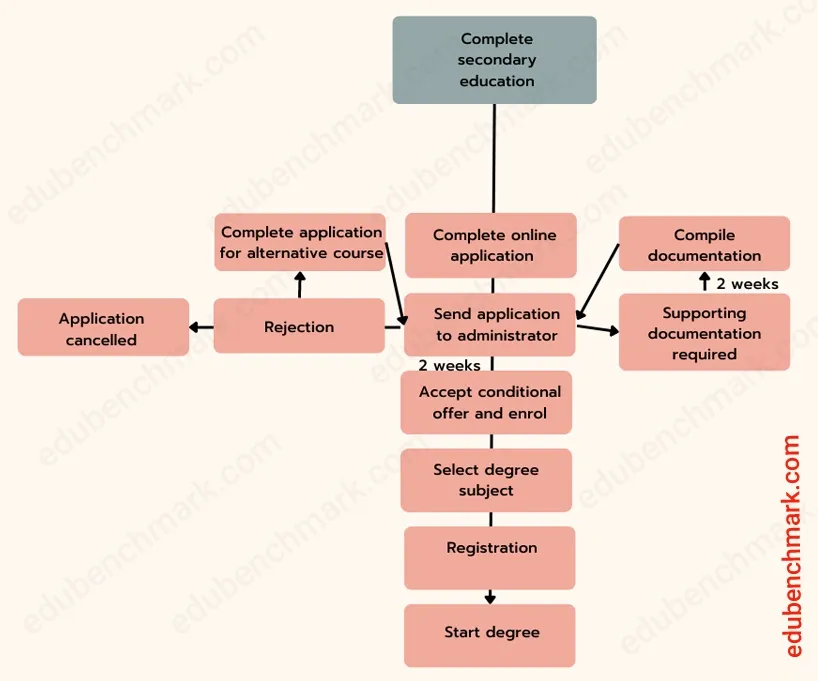
Image Source: Benchmark Education
You have a solid foundation. Let’s build your essay outline. These steps will give you a well-laid-out framework that guides your writing process.
Create a logical structure: intro, body, conclusion
The classic three-part essay structure works best. Your framework has an introduction that presents your thesis, body paragraphs that develop your supporting points, and a conclusion that brings your ideas together. Think of your essay outline as your paper’s skeleton. It shows your thesis and key supporting points in text form.
Your introduction should hook the reader quickly. The body paragraphs support your thesis with evidence. The number of paragraphs depends on your assignment requirements. The conclusion wraps up and summarizes your main points.
Use topic sentences to guide each paragraph
Topic sentences work like signposts that guide you and your reader through your argument. Each topic sentence should be more specific than your thesis statement but stay connected to it. These sentences appear at the paragraph start and show what you’ll discuss.
Your topic sentences should connect to the previous paragraph’s ideas. This helps you stay focused and ensures each paragraph supports your main argument.
Add supporting evidence under each point
Each topic sentence needs evidence that validates your claims. You can use facts, anecdotes, statistics, or quotes from credible sources. Good evidence follows a simple pattern: make your claim, show the evidence, and explain how it supports your point.
Note that different essays need different types of evidence. Academic essays rely on research citations and expert quotes. Creative writing uses plot points or character development instead.
Include transitions for flow
Good transitions create connections between your paragraphs and ideas. They work as glue that holds your argument together. A transition can be a word, phrase, sentence, or even a paragraph that summarizes previous content and leads into new information.
Use key phrases from earlier paragraphs in later ones. This creates a clear path for readers to follow. Skip generic transitions. Create specific links between your paragraphs and ideas that fit naturally in your writing.
Refine and Finalize Your Outline
The refinement stage shapes your essay’s final quality once you complete your original outline. This crucial step turns your rough draft into a polished blueprint.
Check for balance across sections
Your outline’s structure needs proper balance. Body paragraphs should carry similar weight based on their role in your argument. You’ll want to review these balance indicators:
- Length distribution across sections
- Equal development of main points
- Appropriate evidence allocation
- Logical progression between ideas
Ensure each point supports your thesis
Your outline’s elements should directly connect to your thesis statement. You need to review how each paragraph builds your central argument. A well-arranged essay makes every point count toward your position. Misaligned paragraphs can weaken your overall argument, even when written well.
Use an outline example to compare your structure
Your work becomes stronger when compared against proven templates. Point-by-point or subject-by-subject formats prove especially helpful depending on your essay type. Check out Skyline Academic Resources for outline examples and templates that can help you compare and improve your essay structure. Our resources include guides for different essay formats to help you adapt your outline effectively.
Adapt your outline to different essay formats
Each essay type needs its own organizational approach. A simple outline works for most essays, but specialized formats need structural adjustments. Your assignment might work better with chronological, problem-solution, or compare-contrast structures. Of course, stay flexible—your outline should evolve as you learn more about the topic.
Conclusion
Becoming skilled at essay outlining reshapes your writing from chaos to clarity. A well-laid-out outline acts as your paper’s foundation and gives you a clear path for your arguments and ideas. The 30-minute framework helps you analyze questions, define your thesis, create logical structure and refine your outline. This approach will substantially boost your chances of producing quality academic work.
Note that outlines help you avoid common issues like scattered arguments, weak claims, and irrelevant discussions. They let you spot gaps in your reasoning before writing and save time during revisions. Your sections need proper balance, strong topic sentences, and solid evidence to create work that will impress your instructors.
Your outline should be simple yet structured enough to guide your writing. It needs flexibility to add new ideas as you progress. Skyline Academic Resources offers more outline templates, writing guides, and expert advice to enhance your academic writing skills.
These outlining techniques will help you complete in 30 minutes what used to take hours of preparation. Time spent planning improves your final paper’s quality. When you utilize outlining effectively, you’ll see better grades and grow more confident as a writer.
FAQs
Q1. How long should I spend on creating an essay outline?
Aim to spend about 10 minutes on your outline when given 30 minutes for the entire essay. This allows 15 minutes for writing and 5 minutes for revision. Generally, dedicate about one-fifth of your total time to structuring your essay.
Q2. What are the key components of an effective essay outline?
An effective outline includes your thesis statement, main points organized in a logical order, potential transitions between paragraphs, and supporting evidence for each point. This structure helps ensure your essay flows coherently and supports your main argument.
Q3. How can I ensure my outline leads to a well-structured essay?
Check for balance across sections, ensure each point directly supports your thesis, and compare your outline to established templates or examples. Also, adapt your outline to suit different essay formats as needed, such as chronological or compare-contrast structures.
Q4. Is it possible to write a good essay without an outline?
While it’s possible, writing without an outline often leads to disorganized arguments, unsupported claims, and off-topic discussions. An outline helps prevent these common pitfalls and saves time during the writing and revision process.
Q5. How detailed should my essay outline be?
Your outline should provide enough structure to guide your writing without being overly complex. Include your thesis, main points, and key supporting evidence. It should be flexible enough to accommodate new insights as you write, while still offering a clear roadmap for your essay.
References
[1] – https://www.sjsu.edu/writingcenter/docs/handouts/Essay Planning – Outlining.pdf
[2] – https://writingcenter.gmu.edu/writing-resources/writing-as-process/outlining
[3] – https://www.apa.org/monitor/julaug06/outline
[4] – https://www.academiawriting.com/blog/the-importance-of-structuring-your-essay-creating-a-solid-outline/
[5] – https://www.papergen.ai/blog/essay-outline-matter
[6] – https://www.bibguru.com/blog/common-essay-mistakes/
[7] – https://www.quora.com/What-are-common-mistakes-found-in-essay-writing-Do-you-have-any-tips-for-a-flawless-essay